
The pursuit of efficiency, compactness, and reliability in power transmission systems is a perpetual engineering challenge. Among various solutions, the harmonic drive gear stands out as a unique and highly effective technology, particularly in applications demanding high reduction ratios, precision positioning, and minimal backlash within a confined space. This transmission system, often referred to as a strain wave gear, operates on a fundamentally different principle compared to conventional gears, offering distinct advantages that have cemented its role in fields such as aerospace robotics, precision instrumentation, and industrial automation.
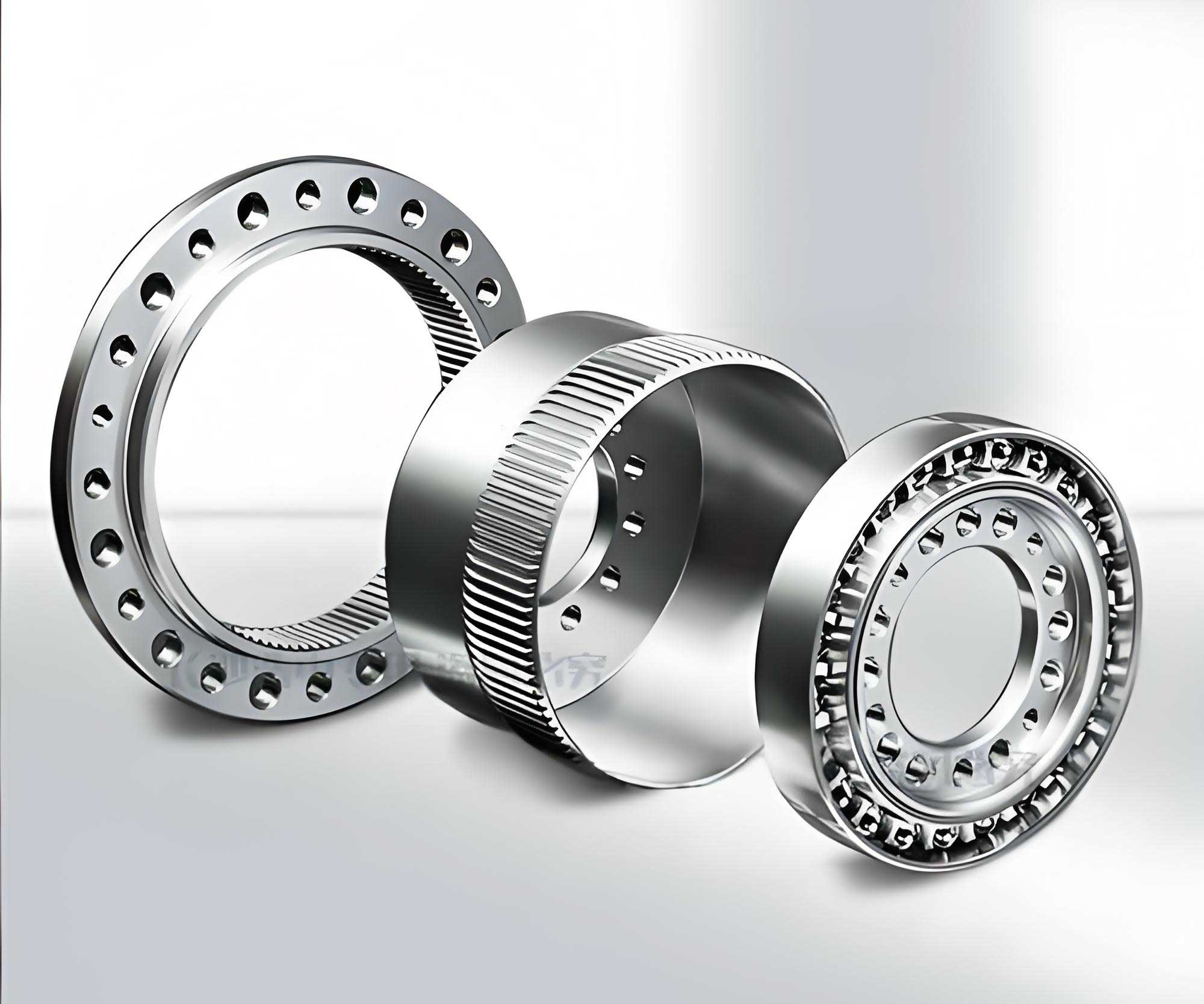
The core of a harmonic drive gear system comprises three primary components: a rigid circular spline (often called the “circular spline” or “rigid spline”), a flexible spline (or “flexspline”), and a wave generator. The wave generator, typically an elliptical bearing assembly, is inserted into the flexible spline, causing it to deform into an elliptical shape. This deformation engages the teeth of the flexible spline with those of the rigid circular spline at two diametrically opposite regions. As the wave generator rotates, the engagement points move, and because the flexible spline has fewer teeth (usually two fewer) than the rigid circular spline, a large speed reduction is achieved between the input (wave generator) and the output (flexible spline). The kinematic relationship is elegantly simple: for each full revolution of the wave generator, the flexible spline rotates backward by a number of teeth equal to the difference between the tooth counts of the two splines. This mechanism provides the harmonic drive gear with its characteristic high single-stage reduction ratios, often ranging from 50:1 to over 300:1.
The optimization of a harmonic drive gear presents a complex, multi-faceted engineering problem. The design objectives are often conflicting: minimizing volume and weight while maximizing torque capacity, efficiency, and lifespan. Furthermore, the design is governed by a set of stringent constraints, including stress limits in the critically loaded flexible spline, geometric conditions to prevent tooth interference, and precise kinematic relations to achieve the desired speed ratio. Traditional optimization approaches that treat design variables as continuous parameters often yield results that are theoretically sound but practically infeasible. For instance, an optimized gear module of 0.884 mm is meaningless in manufacturing, as cutting tools are only available for standard module sizes. Therefore, the problem is inherently one of mixed discrete variable optimization, involving integer variables (e.g., tooth counts) and non-uniformly spaced discrete variables (e.g., standard gear modules).
This article delves into the formulation and solution of this mixed-discrete optimization problem for harmonic drive gear systems. We will establish a comprehensive mathematical model that incorporates fuzzy logic to handle the inherent uncertainties in material properties and constraint boundaries. To solve this challenging problem, we turn to nature-inspired metaheuristics, specifically an enhanced Ant Colony Optimization (ACO) algorithm. The standard ACO is improved with specific strategies to prevent premature convergence and to efficiently handle discrete and integer variables directly during the search process. The effectiveness of this approach is demonstrated through a detailed case study, comparing its performance against other established optimization methods.
Mathematical Modeling of the Harmonic Drive Gear Optimization Problem
The foundation of any optimization process is a precise mathematical model. For a harmonic drive gear with a cup-type flexible spline and a dual-wave (four-contact) generator, the goal is to define the design variables, objective function, and constraints.
Design Variables
The primary geometric parameters defining the system are selected as the design variables. These parameters directly influence the size, weight, and performance of the harmonic drive gear. The design vector x is defined as follows:
$$ \mathbf{x} = [z_G, z_R, m, L, b, h_2]^T = [x_1, x_2, x_3, x_4, x_5, x_6]^T $$
Where:
- $z_G$: Number of teeth on the rigid circular spline (integer variable).
- $z_R$: Number of teeth on the flexible spline (integer variable).
- $m$: Gear module (discrete variable, from standard series: e.g., 0.5, 0.8, 1.0, 1.25 mm, etc.).
- $L$: Length of the flexible spline cup (integer variable, in mm).
- $b$: Face width of the gear teeth (integer variable, in mm).
- $h_2$: Nominal wall thickness of the flexible spline cup (continuous variable, but practically rounded to 0.1 mm).
This combination results in a classic mixed discrete-integer-continuous variable optimization problem.
Objective Function: Minimizing Volume
A common design goal for compact transmission systems like the harmonic drive gear is to minimize the overall volume, which correlates strongly with weight and material cost. The total volume is approximated as the sum of the volumes of the flexible spline cup body and the rigid circular spline ring.
The simplified volume of the flexible spline cup is modeled as a cylindrical shell. Its mean diameter is based on the tooth root diameter of the flexible spline ($d_{f2}$), and its wall thickness varies. A key simplification is relating the wall thickness at the tooth root ($h_1$) to the nominal wall thickness ($h_2$) as $h_1 = 2h_2$.
$$ V_{flex} = L \pi h_2 \left( \frac{d_{f2}}{2} – h_1 + \frac{h_2}{2} \right)^2 $$
Given that $d_{f2} = d_R – \frac{9}{8}d$, and the wave generator height $d = 2m$, and the pitch diameter of the flexible spline $d_R = m z_R$, we can substitute:
$$ d_{f2} = m z_R – \frac{9}{4}m $$
Therefore,
$$ V_{flex} = L \pi h_2 \left( \frac{m z_R}{2} – \frac{9}{8}m – 1.5 h_2 \right)^2 $$
The volume of the rigid circular spline is modeled as a ring with face width $b$, tooth height $h_{gf} = 2m$, and a rim thickness $S_G$ assumed to be $20m$ for robustness.
$$ V_{rigid} = \frac{1}{4} \pi b (h_{gf} + S_G) d_G^2 = \frac{1}{4} \pi b (22m) (m z_G)^2 = 5.5 \pi b m^3 z_G^2 $$
The final objective function to be minimized is:
$$ f(\mathbf{x}) = V_{flex} + V_{rigid} = \pi L h_2 \left( \frac{m z_R}{2} – \frac{9}{8}m – 1.5 h_2 \right)^2 + 5.5 \pi b m^3 z_G^2 $$
Constraint Formulation
The design must satisfy several mechanical and geometric constraints to ensure proper function, strength, and durability of the harmonic drive gear.
1. Flexible Spline Strength Constraint (Fuzzy):
The flexible spline undergoes cyclic elastic deformation, making fatigue strength the primary design concern. The stress state is complex, combining bending and shear. The safety factor $S$ against fatigue failure must exceed a minimum value with a degree of certainty. This is a classic application for fuzzy constraints. Using the von Mises criterion for alternating stresses:
$$ S = \frac{S_{-1}}{\sqrt{\sigma_a^2 + (K_\tau \tau_a)^2}} \gtrsim [S] $$
Where $S_{-1}$ is the fatigue endurance limit, $\sigma_a$ and $\tau_a$ are the alternating bending and shear stress amplitudes, $K_\tau$ is a sensitivity factor, and $[S]$ is the required safety factor (e.g., 1.5). The symbol $\gtrsim$ denotes “fuzzy greater than or equal to.” This constraint is transformed into a crisp equivalent using a fuzzy membership function and an optimal $\lambda$-cut level $\lambda^*$ determined via comprehensive fuzzy evaluation, resulting in a standard inequality: $g_1(\mathbf{x}) \leq 0$.
2. Tooth Interference Constraint:
To ensure smooth meshing without the tip of one gear digging into the flank of the other, the engagement angles must be checked. For the harmonic drive gear, the condition that the rigid spline tooth tip engagement angle $\Theta_{L1}$ is greater than the flexible spline tooth tip engagement angle $\Theta_{L2}$ must hold:
$$ \Theta_{L1} – \Theta_{L2} \geq 0 $$
This geometric condition, dependent on tooth profiles and deformation, forms a nonlinear inequality constraint $g_2(\mathbf{x}) \leq 0$.
3. Kinematic (Transmission Ratio) Constraint:
This is an equality constraint that must be satisfied exactly. For a standard harmonic drive gear (wave generator input, rigid spline fixed, flexible spline output), the reduction ratio $i$ is given by:
$$ i = \frac{z_R}{z_G – z_R} $$
Therefore, for a desired ratio $i_{req}$, the constraint is:
$$ h(\mathbf{x}) = i_{req}(z_G – z_R) – z_R = 0 $$
4. Boundary and Empirical Constraints:
Based on design handbooks and practical experience, the variables are bounded to reasonable ranges to ensure manufacturability and performance:
$$
\begin{aligned}
&0.8 d_R \leq L \leq 1.2 d_R \\
&0.2 d_R \leq b \leq 0.25 d_R \\
&0.01 d_R \leq h_2 \leq 0.015 d_R \\
&180 \leq z_G \leq 230 \\
&180 \leq z_R \leq 230 \\
&m \in \{0.25, 0.3, 0.4, 0.5, 0.6, 0.8, 1.0, \ldots\} \text{ (Standard Series)}
\end{aligned}
$$
These are formulated as inequality constraints $g_3(\mathbf{x}) \leq 0, …, g_8(\mathbf{x}) \leq 0$.
The complete optimization problem is therefore:
$$ \begin{aligned}
& \underset{\mathbf{x}}{\text{minimize}}
& & f(\mathbf{x}) = \pi L h_2 \left( \frac{m z_R}{2} – \frac{9}{8}m – 1.5 h_2 \right)^2 + 5.5 \pi b m^3 z_G^2 \\
& \text{subject to}
& & h(\mathbf{x}) = 0 \\
& & & g_j(\mathbf{x}) \leq 0, \quad j=1,2,\ldots,8 \\
& & & x_1, x_2, x_4, x_5 \in \mathbb{Z}^+; \quad x_3 \in \mathbb{D}; \quad x_6 \in \mathbb{R}
\end{aligned} $$
where $\mathbb{D}$ is the set of standard module values.
Enhanced Ant Colony Optimization for Mixed-Discrete Problems
Ant Colony Optimization (ACO) is a population-based metaheuristic inspired by the foraging behavior of real ants. Ants find the shortest path between their colony and a food source by communicating via pheromone trails. Shorter paths accumulate more pheromone due to higher ant traffic, creating a positive feedback loop that guides the colony to the optimum. This natural paradigm is adapted for solving complex optimization problems.
Core Algorithmic Metaphor and Adaptation
In the computational version, a population of $m$ artificial “ants” (candidate solutions) explores the design space. Each ant’s position corresponds to a specific design vector $\mathbf{x}^k$. The “path length” is analogous to the objective function value $f(\mathbf{x}^k)$; a lower value indicates a better (shorter) path. The algorithm proceeds through iterative cycles of solution construction and pheromone update.
1. Solution Construction with Discrete Handling:
Unlike standard ACO for combinatorial problems, we deal with continuous, integer, and discrete variables. Each variable $x_i$ has its permissible set of values $D_i$ (e.g., real interval, integer set, discrete standard values). An ant $k$ constructs its solution variable-by-variable. The probability of choosing value $v$ for variable $x_i$ is given by a discrete probability distribution influenced by pheromone $\tau_{i,v}$ and a heuristic desirability $\eta_{i,v}$:
$$ P_{i,v}^k = \frac{[\tau_{i,v}]^\alpha \cdot [\eta_{i,v}]^\beta}{\sum_{u \in D_i} [\tau_{i,u}]^\alpha \cdot [\eta_{i,u}]^\beta} $$
For continuous variables, the domain is discretized into a fine grid during the probabilistic selection, and the chosen value can be locally refined. The heuristic $\eta_{i,v}$ often relates to the improvement in objective function or constraint satisfaction if that value is chosen.
2. Local Search (Engineering Discretization):
After an ant constructs a solution, a local search is performed. For variables like module $m$ or integer dimensions $L, b$, the current value is snapped to the nearest valid discrete or integer value in its set $D_i$. This “engineering rounding” is applied after every major move, ensuring the ant always resides on a manufacturable design point. This step is crucial for the harmonic drive gear problem, as it bridges the gap between algorithmic exploration and practical feasibility.
3. Pheromone Update:
After all ants have constructed solutions in an iteration, the pheromone trails are updated. First, all trails evaporate to simulate the natural decay and avoid unlimited accumulation:
$$ \tau_{i,v} \leftarrow (1-\rho) \cdot \tau_{i,v} $$
where $\rho \in (0,1]$ is the evaporation rate. Then, pheromone is deposited by the ants, typically only by the best ants of the iteration (e.g., the global-best ant and the iteration-best ant):
$$ \tau_{i,v} \leftarrow \tau_{i,v} + \sum_{k \in S_{best}} \Delta \tau^k $$
where $\Delta \tau^k = Q / f(\mathbf{x}^k)$ if ant $k$ used value $v$ for variable $i$, and $0$ otherwise. $Q$ is a constant. This reinforces the variable values present in high-quality solutions.
Key Enhancements for Robust Optimization
Standard ACO can suffer from stagnation or premature convergence. The following enhancements were incorporated specifically for the harmonic drive gear optimization problem:
1. Adaptive Penalty Function for Constraints:
The constrained problem is transformed into an unconstrained one using a penalty function. A dynamic penalty factor is used to guide the search toward the feasible region:
$$ F(\mathbf{x}) = f(\mathbf{x}) + \mu(t) \cdot \left( [h(\mathbf{x})]^2 + \sum_{j} \max(0, g_j(\mathbf{x}))^2 \right) $$
where $\mu(t)$ is a penalty coefficient that increases over iterations $t$, applying greater pressure to satisfy constraints as the search progresses.
2. Population Monitoring and Rebirth Strategy:
A critical enhancement is monitoring the population’s diversity. If the algorithm shows signs of premature convergence—defined as no improvement in the best solution $(f_{min})$ for $p$ consecutive iterations AND the relative difference between the mean $(f_{mean})$ and best objective is below a threshold $\upsilon$:
$$ \left\{ (f_{min})^{(t-p)} – (f_{min})^{t} = 0 \right\} \cap \left\{ \left( \frac{f_{mean} – f_{min}}{f_{mean}} \right)^t \leq \upsilon \right\} $$
then a “rebirth” is triggered. The best ant is preserved (elitism), but the rest of the population is reinitialized randomly within the bounds. This injects fresh diversity into the search, helping to escape local optima.
3. Hybrid Local Search:
After the ACO phase converges or reaches an iteration limit, a final local exploitation phase is conducted. Starting from the best-found discrete/integer solution, a gradient-based or pattern search is applied only to the continuous variables (like $h_2$), with all other variables held fixed at their discrete values. This fine-tunes the solution.
Algorithm Implementation and Case Study
The enhanced ACO algorithm for mixed-discrete optimization, termed **Ls_Antalg**, was implemented in MATLAB. The program flow is summarized below:
Algorithm Pseudocode: Ls_Antalg
1. Initialize: Set parameters (number of ants $m$, evaporation rate $\rho$, $\alpha$, $\beta$, max iterations $t_{max}$, rebirth threshold $\upsilon$, penalty schedule).
2. Initialize Population: Randomly generate $m$ ants at valid discrete/integer points. Evaluate $F(\mathbf{x})$ using penalty function.
3. Initialize Pheromone: Set equal, small pheromone values for all variable-value pairs.
4. While $t < t_{max}$:
4.1. Construct Solutions: For each ant, build a new solution using discrete probability distribution $P_{i,v}$.
4.2. Apply Engineering Discretization: Snap variables to nearest valid discrete/integer values.
4.3. Local Search: Perform a restricted neighborhood search around the new position.
4.4. Evaluate Population: Calculate $F(\mathbf{x})$ for all ants.
4.5. Update Pheromones: Evaporate and deposit pheromone based on best ants.
4.6. Check for Rebirth: If premature convergence condition is met, reinitialize population (keep best ant).
4.7. $t \leftarrow t + 1$.
5. Hybrid Local Exploitation: Fix discrete/integer variables from the global best solution. Optimize continuous variables using a local method.
6. Output the optimized design vector $\mathbf{x}^*$ and $f(\mathbf{x}^*)$.
Optimization Example and Comparative Analysis
To validate the approach, a specific harmonic drive gear design problem was solved. The requirements were: transmission ratio $i = 100$, output torque $T_{out} = 500\ N\cdot m$, input speed $n_{in} = 3000\ rpm$, continuous daily operation. The flexible spline material was 40CrNiMoA with fatigue limits $\sigma_{-1}=500\ MPa$, $\tau_{-1}=250\ MPa$. The optimal fuzzy cut level was determined to be $\lambda^* = 0.91$.
The **Ls_Antalg** algorithm was run with $m=20$ ants for $t_{max}=300$ iterations. The results were compared with those from a Mixed-Discrete Genetic Algorithm (MD-GA) and a standard Continuous Variable Genetic Algorithm (CV-GA) whose results required subsequent rounding.
| Optimization Method | $z_G$ | $z_R$ | $m$ (mm) | $L$ (mm) | $b$ (mm) | $h_2$ (mm) | $f(\mathbf{x})$ (mm³) | Key Feature |
|---|---|---|---|---|---|---|---|---|
| Enhanced ACO (Ls_Antalg) | 202 | 200 | 0.5 | 120 | 20 | 1.0 | 2.6289e6 | Direct mixed-discrete search; feasible design. |
| Mixed-Discrete GA | 202 | 200 | 0.5 | 120 | 20 | 1.0 | 2.6289e6 | Direct mixed-discrete search; feasible design. |
| Continuous GA (Rounded) | 202* | 200* | 0.5* | 120* | 20* | 1.0* | ~2.6289e6 | Result requires post-hoc rounding. May violate constraints. |
| Continuous GA (Raw Output) | 187.42 | 185.56 | 0.539 | 120.07 | 20.04 | 1.002 | 2.7752e6 | Theoretically optimal but manufacturing-infeasible. |
* Values obtained after rounding the continuous GA result to nearest feasible discrete/integer values. This step is not guaranteed to preserve constraint satisfaction.
The analysis of Table 1 reveals critical insights. The continuous variable GA produced a solution with non-standard module and fractional tooth counts, which is impossible to manufacture directly. The reported volume is also larger than the discrete-optimized results, indicating that the true constrained optimum lies on the discrete grid, not in the continuous space. Both the Enhanced ACO and the specialized MD-GA found the same optimal discrete point: $z_G=202, z_R=200, m=0.5\ mm$, etc. This design perfectly satisfies the transmission ratio ($i = 200/(202-200) = 100$), uses a standard module, and meets all strength and geometric constraints. The key difference observed in multiple runs was that the **Enhanced ACO** consistently found this optimum in fewer iterations (often under 250) compared to the MD-GA, demonstrating improved convergence speed due to its rebirth strategy and efficient pheromone-guided discrete search.
This case study underscores a fundamental principle in engineering design optimization: for systems like the harmonic drive gear where parameters are intrinsically discrete, optimization algorithms must explicitly operate within the discrete space. Post-hoc rounding is an unreliable and potentially unsafe practice, as it can lead to constraint violation (e.g., insufficient safety factor, tooth interference). The enhanced ACO approach provides a robust, direct route to feasible, manufacturable optimal designs.
Discussion and Concluding Remarks
The successful application of the enhanced Ant Colony Optimization algorithm to the harmonic drive gear design problem highlights several important advancements in engineering optimization methodology.
First, it addresses the critical need for native mixed-discrete variable handling. By integrating “engineering discretization” directly into the solution construction and local search phases, the algorithm ensures that every evaluated point is a realistic candidate for manufacturing. This eliminates the disconnect often found between computational design and practical implementation, a common issue with gradient-based or purely continuous metaheuristics when applied to problems involving standard parts or sizes.
Second, the incorporation of fuzzy logic into the constraint formulation provides a more realistic model of engineering uncertainty. Material properties, load estimates, and required safety margins are not crisp values. The fuzzy optimization framework allows the designer to incorporate this experience-based knowledge, yielding a solution that is robust under real-world variations. The optimal $\lambda$-cut level effectively balances performance and reliability.
Third, the algorithmic enhancements—specifically the population rebirth mechanism and the adaptive penalty function—greatly improve the robustness and global search capability of the basic ACO. The rebirth strategy acts as a powerful diversity preservation tool, preventing the stagnation that can plague population-based methods on complex, constrained landscapes like that of the harmonic drive gear problem.
The comparison with other methods clearly demonstrates the practicality of this approach. While a continuous algorithm might find a marginally better mathematical point in the unconstrained real space, that point is irrelevant for producing a physical harmonic drive gear. The true engineering optimum is the best point on the feasible discrete grid, which algorithms like the enhanced ACO are specifically designed to find efficiently.
Future work could extend this methodology in several directions. Multi-objective optimization could simultaneously minimize volume, maximize efficiency, and minimize backlash, providing a Pareto front of optimal harmonic drive gear designs for different application priorities. The integration of more detailed physics-based models, such as finite element analysis for stress and thermal analysis, into the evaluation loop could increase accuracy at the cost of computational expense. Furthermore, exploring other recent metaheuristics or hybridizing ACO with machine learning models for surrogate-based optimization could tackle even more complex, high-fidelity design problems.
In conclusion, the design of a harmonic drive gear is a quintessential engineering optimization problem characterized by discrete variables, nonlinear constraints, and multiple competing objectives. The enhanced Ant Colony Optimization algorithm presented here, with its direct discrete search capability, fuzzy constraint handling, and built-in strategies to maintain search diversity, offers a powerful and practical tool for solving this problem. It moves beyond theoretical optimization to deliver directly implementable, optimal design parameters, thereby bridging the gap between computational design and the manufacturing of high-performance harmonic drive gear systems.