
In the field of mechanical transmission, the pursuit of high reduction ratios, compact design, and high power capacity has led to the development of various innovative gear systems. Among these, the end face harmonic drive gear with oscillating teeth represents a novel approach that combines the advantages of traditional harmonic drives and oscillating tooth mechanisms. This type of harmonic drive gear is particularly suited for applications requiring large speed ratios and high power transmission, such as in heavy machinery, mining, metallurgy, and construction equipment. In this article, I will delve into the meshing principles of this harmonic drive gear system, focusing on the theoretical foundations, coordinate system establishment, tooth surface equations, and the conditions for constant instantaneous transmission ratio. The analysis will be supported by mathematical derivations, formulas, and tables to provide a comprehensive understanding.
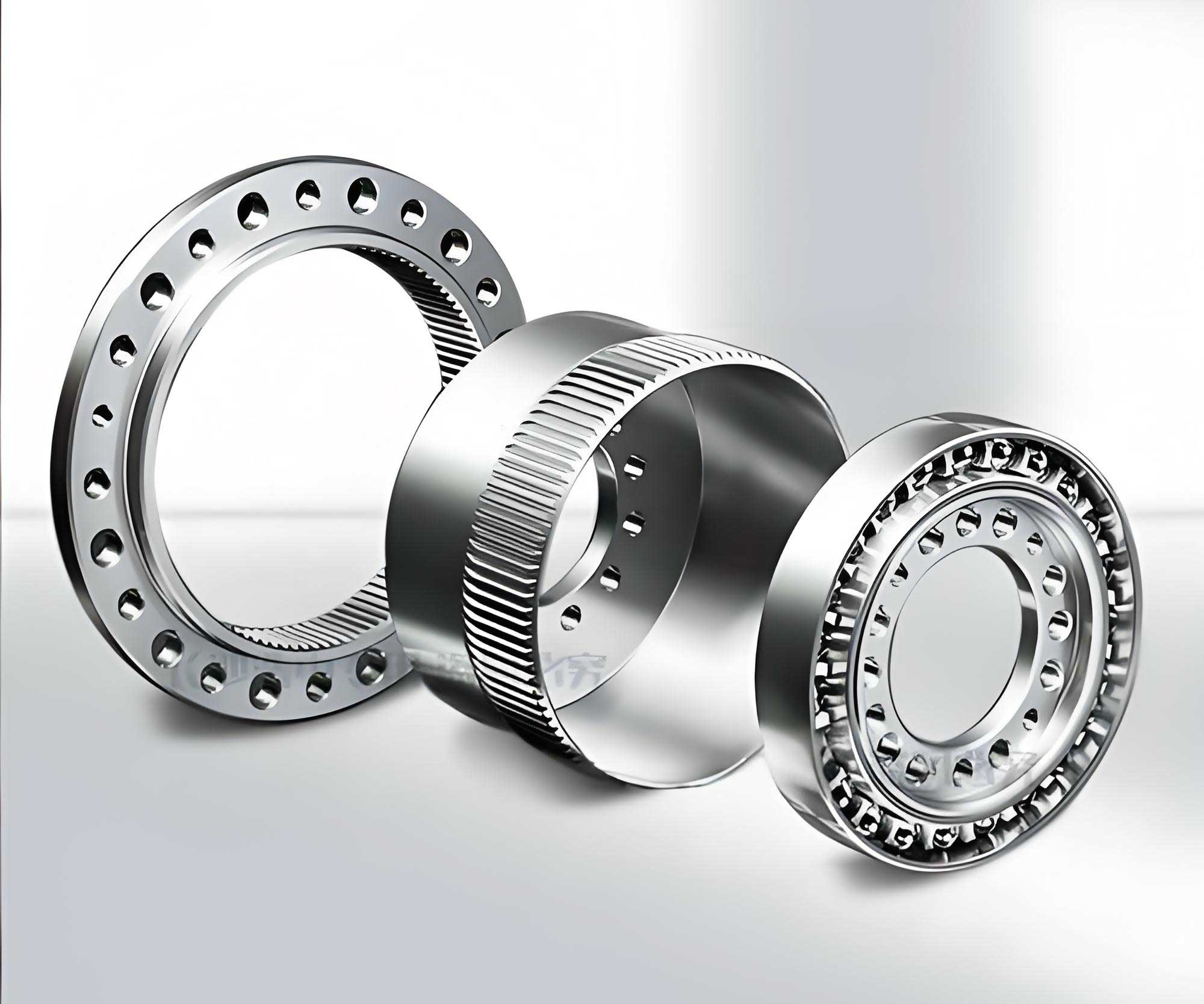
The end face harmonic drive gear with oscillating teeth operates on a unique principle that leverages non-steady lifting surface theory. It consists of four main components: an end face gear, a wave generator, oscillating teeth, and a slotted wheel. In a typical configuration, such as a single-sided transmission system, when the wave generator rotates, its end face cam action causes the oscillating teeth to move axially within the slotted wheel. This motion engages the oscillating teeth with the end face gear, resulting in relative rotation between the slotted wheel and the end face gear. The engagement process involves two key meshing pairs: Pair A between the wave generator and the rear end of the oscillating teeth, and Pair B between the front end of the oscillating teeth and the end face gear. This dual-pair interaction is fundamental to the harmonic drive gear’s functionality, allowing for smooth transmission and high torque capacity.
To analyze the meshing theory of this harmonic drive gear, it is essential to consider two fundamental types of tooth surface synthesis problems. The first is the direct tooth surface synthesis problem, where given the simple tooth surfaces of Pair A (the wave generator tooth surface and the rear tooth surface of the oscillating teeth) and one tooth surface of Pair B (either the front tooth surface of the oscillating teeth or the tooth surface of the end face gear), the goal is to determine the conjugate tooth surface of Pair B based on known motion laws. This essentially involves applying classical envelope theory from geometry to find the conjugate surfaces for Pair B. The second is the inverse tooth surface synthesis problem, where given the simple tooth surfaces of Pair B and one tooth surface of Pair A, the objective is to determine the conjugate tooth surface of Pair A according to specific requirements, such as manufacturability or performance criteria. This inverse problem is crucial for designing the wave generator tooth surface to meet practical constraints in harmonic drive gear applications.
In addressing these problems, I assume that all components—wave generator, end face gear, slotted wheel, and oscillating teeth—are rigid bodies, and manufacturing errors are negligible. This simplification allows for a focused theoretical analysis of the meshing behavior in the harmonic drive gear system. The core of the meshing principle lies in deriving the tooth surface equations for both pairs, ensuring that the instantaneous transmission ratio remains constant. This condition is vital for smooth operation and efficiency in harmonic drive gear transmissions.
To facilitate the derivation, I establish coordinate systems attached to the wave generator and the oscillating teeth. For the wave generator, a coordinate system \( O_1-x_1y_1z_1 \) is fixed to it, as illustrated in Figure 1. The \( z_1 \)-axis aligns with the centerline of the wave generator, pointing from the wave generator toward the end face gear. The \( x_1 \)-axis is defined along a straight line at the tooth bottom of the wave generator tooth surface, perpendicular to \( z_1 \), with the origin \( O_1 \) at their intersection. The positive direction of \( x_1 \) extends from the inner to the outer side of the wave generator. The \( y_1 \)-axis is established using the right-hand rule, also pointing outward. Similarly, a coordinate system \( O_2-x_2y_2z_2 \) is fixed to the oscillating teeth, initially coinciding with \( O_1-x_1y_1z_1 \). These coordinate systems are crucial for expressing tooth surface equations and analyzing meshing kinematics in the harmonic drive gear.
The wave generator tooth surface in this harmonic drive gear is designed as a special type of Archimedean spiral surface to ensure constant instantaneous transmission ratio. For a harmonic drive gear, the condition for constant instantaneous transmission ratio is given by \( \tan\theta \tan\alpha = C \), where \( \theta \) is the lead angle of the wave generator end face cam, \( \alpha \) is the tooth half-angle of the end face gear, and \( C \) is a constant. To simplify design and machining, the wave generator tooth surface can be constructed as an Archimedean spiral surface with a straight generatrix perpendicular to the axis of rotation. This results in a surface where the axial displacement is proportional to the circumferential rotation angle, leading to constant lead along each cylindrical radius. The number of waves on the wave generator is denoted by \( U \), and the tooth height is \( h \). The relationship between the lead angle \( \theta \) and the radius \( r \) is chosen as \( \tan\theta = \frac{hU}{\pi r} \), which ensures that the tooth surface forms a continuous spiral across different radii.
Based on this, the tooth surface equation for the right-handed spiral segment of the wave generator in the \( O_1-x_1y_1z_1 \) coordinate system can be derived. The general equation for an Archimedean spiral surface is:
$$ x = u \cos \delta \cos \phi, \quad y = u \cos \delta \sin \phi, \quad z = u \sin \delta + p \phi $$
where \( u \) is the distance from the rotation axis to a point, \( \phi \) is the rotation angle, \( \delta \) is the initial angle of the generatrix, and \( p \) is the lead parameter. For the wave generator in this harmonic drive gear, the generatrix is a straight line perpendicular to the axis, so \( \delta = 0 \). Thus, the equation simplifies to:
$$ x_1 = r \cos \phi_W, \quad y_1 = r \sin \phi_W, \quad z_1 = \frac{hU}{\pi} (\phi_W – 2n \psi_W) $$
where \( r \) is the radius of the wave generator cam (with \( R_1 \leq r \leq R_2 \), \( R_1 \) and \( R_2 \) being the inner and outer radii, respectively), \( \phi_W \) is the rotation angle of the wave generator, \( \psi_W = \frac{\pi}{U} \) is the meshing half-angle (half the angular width of a wave), and \( n = 0, 1, 2, \dots, U-1 \), with the constraint \( 0 \leq \phi_W – 2n \psi_W \leq \psi_W \). Similarly, for the left-handed spiral segment:
$$ x_1 = r \cos \phi_W, \quad y_1 = r \sin \phi_W, \quad z_1 = \frac{hU}{\pi} (2n \psi_W – \phi_W) $$
with \( n = 1, 2, \dots, U \) and \( 0 \leq 2n \psi_W – \phi_W \leq \psi_W \). These equations define the tooth surface of the wave generator in the harmonic drive gear, which is essential for meshing with the oscillating teeth.
Now, for the rear tooth surface of the oscillating teeth (Pair A), it must be conjugate to the wave generator tooth surface. According to the meshing principle of spiral surfaces, when two spiral surfaces engage, the relative velocity vector is perpendicular to the common normal vector at the contact point. This can be expressed as \( \vec{n} \cdot \vec{V}_{ow} = 0 \), where \( \vec{n} \) is the common normal and \( \vec{V}_{ow} \) is the relative velocity. Since the wave generator tooth surface is an Archimedean spiral, its envelope during rotation is itself, implying that the conjugate tooth surface of the oscillating teeth will have a similar form but limited to the tooth root portion. Therefore, in the coordinate system \( O_2-x_2y_2z_2 \) attached to the oscillating teeth, the tooth surface equations corresponding to the wave generator’s right-handed and left-handed segments are derived as follows.
For the right-handed segment conjugate:
$$ x_2 = r \cos \phi_0, \quad y_2 = r \sin \phi_0, \quad z_2 = \frac{hU}{\pi} \phi_0 $$
where \( \phi_0 \) is the rotation angle of the oscillating teeth, \( \psi_0 = \frac{\pi}{Z_0} \) is half the central angle corresponding to the oscillating teeth (with \( Z_0 \) being the number of oscillating teeth), and \( 0 \leq \phi_0 \leq \psi_0 \). For the left-handed segment conjugate:
$$ x_2 = r \cos \phi_0, \quad y_2 = r \sin \phi_0, \quad z_2 = \frac{hU}{\pi} (2\psi_0 – \phi_0) $$
with \( 0 \leq 2\psi_0 – \phi_0 \leq \psi_0 \). These equations describe the rear tooth surface of the oscillating teeth in the harmonic drive gear, ensuring proper meshing with the wave generator.
To further illustrate the parameters and relationships in this harmonic drive gear system, I summarize key aspects in the following tables. Table 1 provides the main components and their functions, while Table 2 lists the symbols and definitions used in the tooth surface equations.
| Component | Function |
|---|---|
| End Face Gear | Engages with the front ends of oscillating teeth to transmit motion. |
| Wave Generator | Rotates to drive oscillating teeth axially via its end face cam. |
| Oscillating Teeth | Move axially and rotate to transfer motion between wave generator and end face gear. |
| Slotted Wheel | Holds oscillating teeth and rotates relative to the end face gear. |
| Symbol | Definition | Unit |
|---|---|---|
| \( U \) | Number of waves on the wave generator | Dimensionless |
| \( h \) | Tooth height of the wave generator cam | mm |
| \( r \) | Radius from the wave generator axis | mm |
| \( R_1, R_2 \) | Inner and outer radii of the wave generator cam | mm |
| \( \phi_W \) | Rotation angle of the wave generator | rad |
| \( \psi_W \) | Meshing half-angle of the wave generator, \( \psi_W = \pi / U \) | rad |
| \( \phi_0 \) | Rotation angle of the oscillating teeth | rad |
| \( \psi_0 \) | Half central angle of oscillating teeth, \( \psi_0 = \pi / Z_0 \) | rad |
| \( Z_0 \) | Number of oscillating teeth | Dimensionless |
| \( \theta \) | Lead angle of the wave generator cam | rad |
| \( \alpha \) | Tooth half-angle of the end face gear | rad |
The meshing condition for constant instantaneous transmission ratio in this harmonic drive gear is derived from the geometry of engagement. For Pair A, the relative motion between the wave generator and oscillating teeth must satisfy the spiral surface meshing principle. The condition \( \tan\theta \tan\alpha = C \) ensures that the transmission ratio remains invariant. In practice, for the harmonic drive gear, this can be achieved by designing the wave generator tooth surface with the specific Archimedean spiral profile as described. The mathematical derivation involves analyzing the kinematics of the oscillating teeth motion and the contact geometry. For instance, the axial velocity of the oscillating teeth is related to the rotational speed of the wave generator, and from the tooth surface equations, we can compute the transmission ratio as a function of the design parameters.
To expand on the meshing analysis, consider the dynamics of the harmonic drive gear system. The oscillating teeth undergo both axial and rotational motions, which can be modeled using the derived tooth surface equations. Let \( \omega_W \) be the angular velocity of the wave generator and \( \omega_0 \) be the angular velocity of the oscillating teeth. From the tooth surface equations, the axial displacement \( z \) of the oscillating teeth is proportional to the rotation angle \( \phi_W \). For the right-handed segment, we have \( z_1 = \frac{hU}{\pi} (\phi_W – 2n \psi_W) \). Differentiating with respect to time, the axial velocity \( v_z \) is:
$$ v_z = \frac{dz_1}{dt} = \frac{hU}{\pi} \frac{d\phi_W}{dt} = \frac{hU}{\pi} \omega_W $$
This linear relationship simplifies the control and prediction of motion in the harmonic drive gear. Similarly, for the oscillating teeth, the rotational motion is coupled with the axial motion via the meshing with the end face gear. The transmission ratio between the wave generator and the end face gear can be derived by considering the geometry of Pair B. However, since Pair B involves the end face gear, which typically has a fixed tooth profile, the conjugate tooth surface of the oscillating teeth front end must be determined based on the motion laws. This leads to the direct tooth surface synthesis problem mentioned earlier.
In solving the direct synthesis problem for Pair B, we assume the tooth surface of the end face gear is known, such as a planar or conical surface. The goal is to find the front tooth surface of the oscillating teeth that ensures continuous meshing. Using envelope theory, the family of surfaces generated by the motion of the end face gear relative to the oscillating teeth is considered. The equation of the envelope surface is found by solving the meshing equation \( \vec{n} \cdot \vec{V} = 0 \), where \( \vec{V} \) is the relative velocity between the two surfaces. For the harmonic drive gear, this process involves complex coordinate transformations and differential geometry. As an example, if the end face gear has a planar tooth surface with equation \( z_E = 0 \) in its own coordinate system, the relative motion due to the rotation of the oscillating teeth and the axial displacement must be accounted for. The resulting front tooth surface of the oscillating teeth might be a curved surface that ensures no interference and smooth transmission.
Conversely, for the inverse synthesis problem, we might start with a simple front tooth surface of the oscillating teeth, such as a spherical or cylindrical surface, and determine the required wave generator tooth surface. This is particularly useful in designing harmonic drive gear systems for manufacturability, where the oscillating teeth can be made using standard machining processes. The inverse problem requires solving the meshing conditions backwards, often using numerical methods or optimization techniques to find the wave generator profile that yields the desired motion.
The advantages of this harmonic drive gear with oscillating teeth are numerous. Compared to traditional harmonic drives, it offers higher power capacity due to the distributed load across multiple oscillating teeth. The use of oscillating teeth reduces stress concentration and wear, extending the lifespan of the harmonic drive gear. Additionally, the end face configuration allows for compact axial dimensions, making it suitable for space-constrained applications. The constant instantaneous transmission ratio ensures smooth operation without jerk or vibration, which is critical in precision machinery. These benefits make the harmonic drive gear a promising solution for industries demanding reliable high-performance transmissions.
In terms of design considerations, several parameters influence the performance of the harmonic drive gear. The number of waves \( U \) affects the reduction ratio and smoothness of motion. A higher \( U \) typically increases the reduction ratio but may complicate manufacturing. The tooth height \( h \) determines the axial stroke of the oscillating teeth and thus the torque capacity. The radii \( R_1 \) and \( R_2 \) define the working range of the wave generator cam and must be chosen based on size constraints and load requirements. The number of oscillating teeth \( Z_0 \) influences the distribution of contact forces and should be optimized to minimize backlash and ensure even wear. These factors can be analyzed using the tooth surface equations and meshing conditions to optimize the harmonic drive gear design.
To further illustrate the mathematical model, I present additional formulas related to the transmission ratio. For the harmonic drive gear, the overall transmission ratio \( i \) between the input (wave generator) and output (end face gear or slotted wheel) depends on the kinematics of both meshing pairs. If the end face gear is fixed and the slotted wheel is the output, the transmission ratio can be derived from the geometry of the oscillating teeth motion. Let \( \theta \) be the lead angle of the wave generator and \( \alpha \) be the pressure angle of the end face gear. From the condition \( \tan\theta \tan\alpha = C \), and since \( \theta \) varies with radius \( r \) as \( \tan\theta = \frac{hU}{\pi r} \), we can express \( \alpha \) as:
$$ \alpha = \arctan\left( \frac{C \pi r}{hU} \right) $$
This shows that for constant \( C \), the tooth half-angle \( \alpha \) of the end face gear must vary with radius to maintain constant transmission ratio. In practice, the end face gear might have a modified profile to approximate this condition. Alternatively, if the end face gear has a fixed \( \alpha \), then \( \theta \) must be adjusted, leading to a non-Archimedean spiral for the wave generator. This highlights the flexibility in designing harmonic drive gear systems to meet specific requirements.
Another important aspect is the lubrication and wear in the harmonic drive gear. The oscillating teeth move axially and rotate, creating sliding contacts at both meshing pairs. Proper lubrication is essential to reduce friction and prevent seizing. The tooth surface equations can be used to analyze contact pressures and sliding velocities, aiding in the selection of materials and lubricants. For instance, the relative velocity at the contact point between the wave generator and oscillating teeth can be computed from the derivatives of the tooth surface equations with respect to time. This information is crucial for predicting wear rates and optimizing the service life of the harmonic drive gear.
In comparison to other gear systems, such as planetary gears or traditional harmonic drives, the end face harmonic drive gear with oscillating teeth offers unique advantages. Planetary gears often require multiple stages for high reduction ratios, increasing complexity and size. Traditional harmonic drives use a flexible spline and wave generator, which can have limitations in power transmission due to stress in the flexspline. In contrast, the oscillating teeth in this harmonic drive gear distribute loads more evenly, allowing for higher torque capacity. Additionally, the end face configuration reduces axial length, making it compact. However, challenges include precise manufacturing of the spiral surfaces and assembly of the oscillating teeth. Advances in CNC machining and additive manufacturing can address these issues, making the harmonic drive gear more accessible.
Future research directions for this harmonic drive gear could include dynamic modeling to account for elasticity and vibrations, experimental validation of the meshing principles, and optimization algorithms for tooth profile design. The use of composite materials or surface coatings could enhance durability and efficiency. Furthermore, integrating the harmonic drive gear into robotic joints or aerospace mechanisms could open new applications. The theoretical foundation provided here serves as a starting point for these advancements.
In conclusion, the end face harmonic drive gear with oscillating teeth is a sophisticated transmission system that leverages advanced meshing principles for high-performance applications. Through the derivation of tooth surface equations based on Archimedean spirals and the analysis of meshing conditions, I have outlined the theoretical framework for understanding and designing this harmonic drive gear. The use of coordinate systems, mathematical formulas, and tables helps clarify the complex interactions between components. By ensuring constant instantaneous transmission ratio, the harmonic drive gear achieves smooth and efficient motion transmission. This research contributes to the broader field of gear technology, offering insights that can drive innovation in mechanical systems. As industries continue to demand more compact and powerful transmissions, the harmonic drive gear with oscillating teeth stands out as a promising solution worthy of further exploration and development.