
As a researcher deeply engaged in the field of precision mechanical transmission, my work has consistently focused on the unique capabilities and inherent challenges of harmonic drive gear systems. These systems represent a fascinating and highly effective form of gearing, distinct from conventional cylindrical, planetary, or cycloidal gear trains. Their defining advantages—compact size, minimal weight, high reduction ratios, exceptional load capacity, high efficiency, low operational noise, and minimal backlash—have made them indispensable in advanced robotics, aerospace mechanisms, and precision instrumentation. A particularly unique capability is their ability to transmit motion into sealed or isolated spaces, a feature that grants them a dominant position in specialized applications. However, the pursuit of absolute precision reveals a persistent technical challenge: the inherent slippage or “skidding” within the conventional wave generator assembly, which ultimately limits the certainty and repeatability of the transmission ratio. This article documents my investigation into this problem, presenting a novel structural design for a harmonic drive gear reducer with a deterministic transmission ratio, followed by a detailed finite element analysis of the flexspline’s deformation and an experimental validation of the improved performance.
The fundamental operating principle of a harmonic drive gear involves the controlled elastic deformation of a component. The system comprises three primary elements: the rigid Circular Spline (CS), the flexible Flexspline (FS), and the Wave Generator (WG). The Wave Generator, typically an elliptical cam surrounded by a special thin-walled ball bearing, is inserted into the Flexspline, causing its initially circular rim to deform into an elliptical shape. This deformation engages the teeth of the Flexspline with those of the Circular Spline at two diametrically opposite regions along the major axis of the ellipse. A critical design feature is that the Flexspline has slightly fewer teeth (e.g., N_f) than the Circular Spline (e.g., N_c). When the Wave Generator rotates, the elliptical deformation pattern rotates with it. The meshing action forces a relative rotation between the Flexspline and the Circular Spline. For each full revolution of the Wave Generator, the Flexspline shifts relative to the Circular Spline by a number of teeth equal to the difference in tooth count (N_c – N_f). This yields a very high reduction ratio in a compact package, calculated as:
$$ i = -\frac{N_f}{N_c – N_f} $$
where a negative sign typically indicates that the input and output rotate in opposite directions.
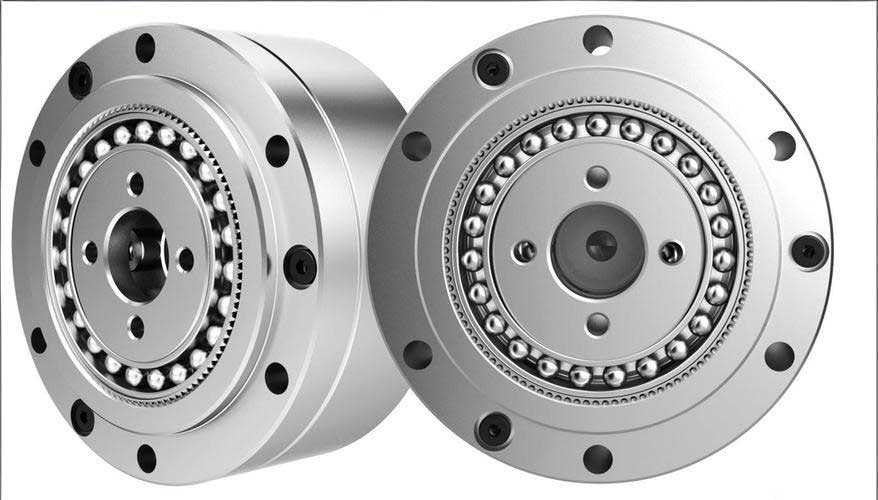
The conventional Wave Generator design, which employs a thin-walled (“flex”) ball bearing, is the source of the transmission ratio uncertainty. Two primary issues exist. First, microscopic sliding can occur between the outer race of the bearing and the inner wall of the Flexspline. Second, and more fundamentally, the rollers within the bearing itself are not in a state of pure rolling; manufacturing imperfections lead to a slight skidding component. While these effects are minute, they introduce non-deterministic errors that accumulate, affecting the absolute positional accuracy and repeatability of the harmonic drive gear system. Furthermore, the thin-walled bearing is often a life-limiting component due to its complex stress state. My proposed innovation addresses these shortcomings by fundamentally re-engineering the Wave Generator.
The core of the new design replaces the standard thin-walled bearing assembly with a compact planetary gear system. This planetary mechanism serves to generate the precise elliptical motion required to deform the Flexspline. The significant advantage is that the motion transfer within a planetary gear set is purely kinematic, based on gear meshing, eliminating the skidding inherent in a bearing-based system. Moreover, the planetary stage itself provides an additional, precisely defined speed reduction, which can be leveraged to either increase the overall reduction ratio of the harmonic drive gear unit without increasing its envelope size or to optimize the kinematics of the wave generation. To solve the potential sliding interface problem between the generator and the Flexspline, the outer ring gear of the planetary system is permanently bonded to the inner bore of the Flexspline using a high-strength structural adhesive (e.g., DG-3S epoxy). This creates a monolithic connection, ensuring no relative motion at this critical interface.
For a concrete design example, targeting specific performance metrics, the following parameters were selected using standard harmonic drive gear design formulas:
| Component | Parameter | Value |
|---|---|---|
| Flexspline | Number of Teeth (N_f) | 200 |
| Circular Spline | Number of Teeth (N_c) | 202 |
| Gear Set | Module (m) | 0.3 mm |
Based on these parameters, the theoretical reduction ratio of the harmonic stage is:
$$ i_{harmonic} = -\frac{200}{202 – 200} = -100 $$
The planetary wave generator stage adds its own ratio, leading to a novel, compound harmonic drive gear reducer with a deterministic overall ratio. The cross-sectional layout of this proposed reducer includes the Flexspline (1), front cover (2), supporting bearings (3, 7), Circular Spline (4), the innovative Planetary Wave Generator (5), and rear cover (6).
A critical aspect of optimizing any harmonic drive gear is understanding the stress and deformation behavior of the Flexspline. Traditional analytical models often simplify the Flexspline as a smooth, thin-walled cylinder of equivalent thickness, neglecting the local stiffness effects of the teeth. To gain a more accurate insight, I conducted a detailed Finite Element Analysis (FEA) using ANSYS software, explicitly modeling the teeth and the contact between the Flexspline and the Wave Generator.
Given the symmetry of the meshing process, a quarter-model of the Flexspline ring was analyzed to save computational resources. The model was constrained appropriately, and pressure was applied to the inner surface to simulate the elliptical deformation imposed by the Wave Generator. The key results focus on the displacement and strain of the neutral axis of the Flexspline wall.
The radial and tangential displacement of nodes along the neutral axis path (from 0° to 90°) reveals the deformation pattern. The maximum radial displacement aligns with the major axis of the ellipse (Y-direction). The tangential displacement is zero at the 0° and 90° symmetry lines, reaching its maximum magnitude at approximately θ = 45°. The total displacement curve shows a minimum around θ = 44°.
More revealing is the analysis of elastic strain. The strain contour plot shows that the gear teeth themselves experience negligible strain, while the maximum elastic strain is concentrated at the tooth root fillets. Crucially, the strain along the neutral axis of the Flexspline wall is very small but not uniformly zero as classic shell theory for a smooth ring would predict. When plotting the elastic strain of neutral axis nodes, the curve for the toothed Flexspline exhibits distinct oscillations superimposed on a general trend. The number of oscillations corresponds directly to the number of teeth in the quarter-model.
To isolate the effect of the teeth, a second FEA model was created: a smooth ring with an equivalent wall thickness (the “smoothed” model used in traditional theory). The results were strikingly different:
| Analysis Model | Neutral Axis Strain Trend (0° to 90°) | Notable Feature |
|---|---|---|
| Toothed Flexspline | Decreases, then increases with oscillatory perturbations. | Strain oscillations correlate with tooth spacing. |
| Equivalent Smooth Ring | Increases smoothly, then decreases smoothly. | Strain magnitude is significantly lower and uniform. |
This comparison conclusively demonstrates that the teeth significantly modulate the strain field in the Flexspline wall. The local stiffening effect of each tooth creates a periodic variation in compliance along the circumference. Therefore, for high-precision applications, especially those aiming for zero-backlash or ultra-precise motion control in a harmonic drive gear, it is essential to consider the influence of the tooth geometry on the overall Flexspline deformation. This insight is vital for refining tooth profile design and moving beyond the traditional “smoothed ring” approximation.
The theoretical improvement offered by the planetary Wave Generator design required empirical validation. A dedicated test apparatus was constructed to measure and compare the transmission ratio accuracy of the new design against a conventional harmonic drive gear reducer of comparable size and ratio. The core hypothesis was that the conventional reducer would show errors influenced by non-deterministic skidding, while the new design’s errors would stem primarily from manufacturing tolerances and kinematic motion error, which are systematic and potentially smaller.
The measurement setup consisted of a high-resolution optical encoder attached to the input shaft (Wave Generator), the test reducer, and a precision mechanical dividing head on the output shaft (Flexspline). Great care was taken to ensure precise alignment via couplings. After zeroing the system, the input was rotated in precise increments using the dividing head, and the actual input rotation was recorded by the encoder. The transmission error for a given output segment is defined as the deviation between the measured input rotation and the theoretically required input rotation for that output motion.
The test protocol involved rotating the output through a series of steps, with a reference segment of 100 degrees of output rotation chosen for detailed comparison. The transmission error was calculated for multiple consecutive 100-degree segments for both reducer types. The results are summarized below:
| Reducer Type | Maximum Error over 100° output segment | Minimum Error over 100° output segment | Error Reduction vs. Conventional Design |
|---|---|---|---|
| Conventional (Bearing-based WG) | +2.587 arc-min | -1.832 arc-min | Baseline |
| Novel (Planetary WG) | +1.923 arc-min | -1.102 arc-min | Max: -0.664 arc-min (25.7%) Min: -0.730 arc-min (39.8%) |
The data clearly shows a significant reduction in transmission error for the novel harmonic drive gear design. The maximum observed error was reduced by 0.664 arc-minutes (approximately 2’40”), and the minimum error was reduced by 0.730 arc-minutes. In relative terms, this represents an error reduction of over 25% for the maximum error and nearly 40% for the minimum error when considering the 100-degree output cycle. This experimental evidence strongly supports the theoretical premise: by replacing the skid-prone thin-walled bearing with a kinematically precise planetary gear mechanism and bonding it to the Flexspline, the non-deterministic components of the transmission error are substantially mitigated. The resulting system exhibits a more predictable and accurate transmission ratio, moving closer to the ideal of a truly deterministic harmonic drive gear.
In conclusion, this work has addressed a fundamental precision limitation in conventional harmonic drive gear systems. The innovative integration of a planetary gear set as the Wave Generator core presents a viable solution to the problem of transmission ratio uncertainty caused by interfacial sliding. The detailed FEA of the Flexspline further underscores the importance of accounting for tooth geometry in high-fidelity modeling, as the teeth induce a periodic modulation of the strain field that is absent in simplified models. Finally, the experimental validation confirms the practical efficacy of the new design, demonstrating a measurable and significant improvement in positional accuracy. This structural innovation, coupled with advanced analytical methods for understanding Flexspline deformation, provides a valuable pathway for the ongoing optimization and application of harmonic drive gear technology in the most demanding precision engineering fields.