
The harmonic drive gear, a unique precision motion control device, operates on a fascinating principle of elastic dynamics. At its core are three primary components: a rigid Circular Spline, a flexible Flexspline with external teeth, and an elliptical Wave Generator that is inserted into the flexspline. The wave generator, often in the form of a bearing assembly or specialized cams, forces the compliant flexspline into a controlled non-circular shape, meshing its teeth with those of the stationary circular spline at two diametrically opposite regions. This controlled elastic deformation enables high-ratio speed reduction, exceptional positional accuracy, and zero-backlash performance in a compact package, making harmonic drive gear systems indispensable in robotics, aerospace, and precision instrumentation.
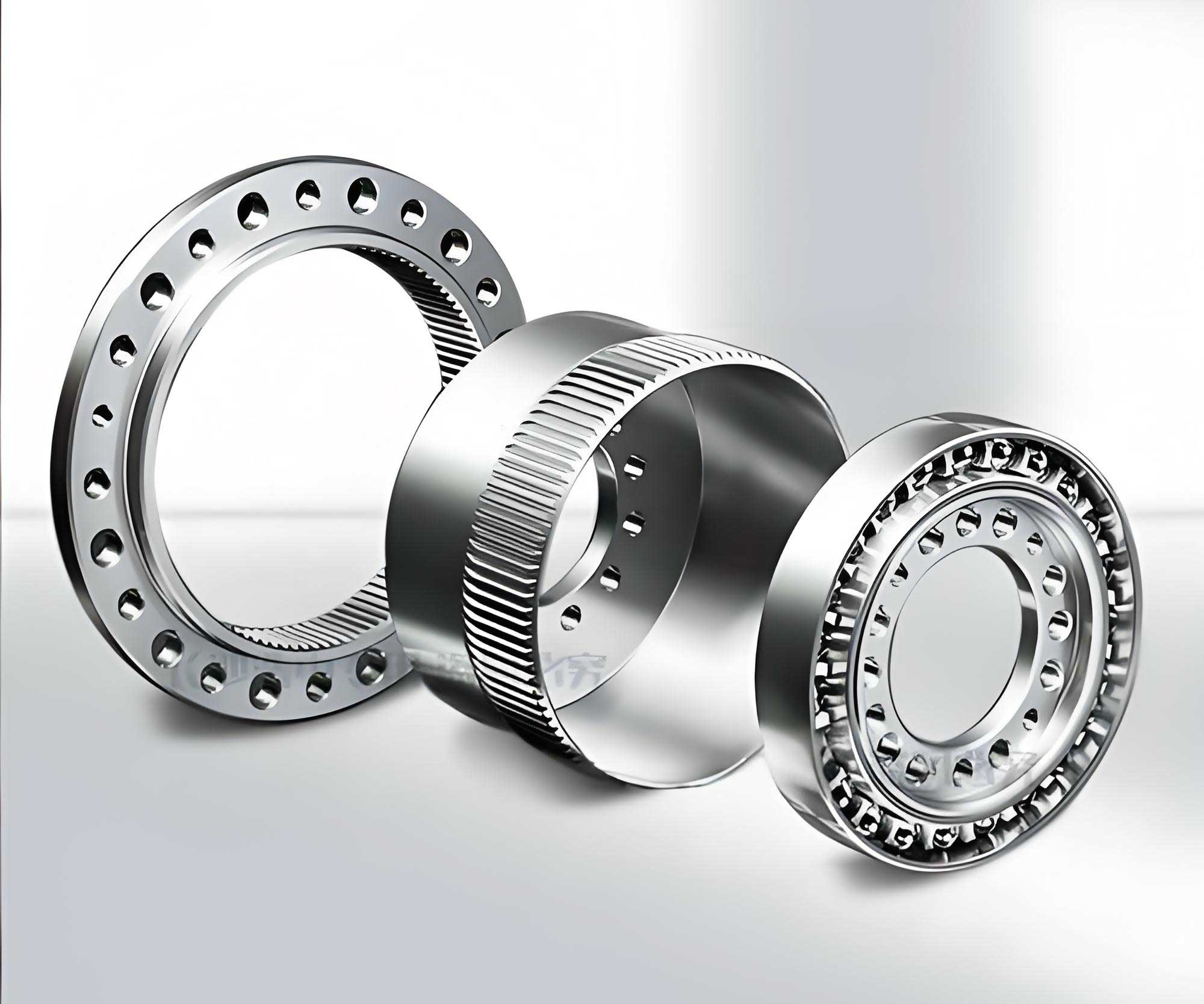
The accurate prediction of the flexspline’s deformation under load from the wave generator is the very foundation for designing conjugate tooth profiles, analyzing mesh conditions, calculating stress for fatigue life, and simulating overall transmission performance. For decades, the standard analytical approach has relied on the classical “inextensible neutral line” assumption for the flexspline’s tooth-bearing ring. This model simplifies the complex three-dimensional deformation into a purely bending problem of a planar ring, assuming the circumferential length of the mid-surface (neutral line) of the ring remains constant during deflection. While this assumption facilitates manageable closed-form solutions for radial displacement and rotation, emerging evidence from both geometric compatibility checks and advanced Finite Element Analysis (FEA) suggests a fundamental inconsistency: the neutral layer of the flexspline experiences measurable circumferential strain, leading to elongation or contraction. This paper presents a detailed mechanical analysis that explicitly accounts for this phenomenon in a harmonic drive gear with a two-disk wave generator, providing a more accurate theoretical basis for advanced design and simulation.
The Critical Gap in Classical Theory: Acknowledging Circumferential Strain
Traditional kinematic models for tooth engagement in a harmonic drive gear are built upon the deformed shape of the flexspline’s neutral curve. The standard solution provides radial deflection $$u(\phi)$$ and tangential deflection $$v(\phi)$$, from which tooth positions and orientations are derived. A direct consequence of the inextensibility assumption is the kinematic relation:
$$ \frac{dv}{d\phi} = -u $$
However, when the arc length of the deformed neutral curve, calculated from the geometric coordinates derived from $$u(\phi)$$ and $$v(\phi)$$, is integrated, it often exceeds the original circumference. This indicates a logical contradiction within the framework of the assumptions. The computed “apparent” circumferential strain from such geometric models shows a non-physical distribution, typically peaking in regions away from the wave generator’s major axis. This discrepancy is not merely academic; it translates directly into errors when simulating the meshing of advanced tooth profiles, such as double-arc profiles, where precise control over the relative position of teeth along the circumference is crucial for avoiding interference and ensuring proper conjugate action. Therefore, moving beyond the inextensible assumption is essential for high-fidelity modeling of modern harmonic drive gear systems.
Comprehensive Analytical Model for a Two-Disk Wave Generator
We develop a refined analytical model for the flexspline ring subjected to a two-disk wave generator. The model segments the ring into distinct zones based on its interaction with the generator.
1. System Geometry and Assumptions
The model considers the tooth-bearing portion of the flexspline as a thin, initially circular ring of mean radius $$r_m$$. A two-disk wave generator, with an effective rolling radius $$R$$ and an eccentricity $$e$$, imposes a maximum radial deflection $$w_0$$ at the major axis ($$\phi = 0$$). The flexspline conforms perfectly to the wave generator over a finite contact angle $$2\gamma$$. The key departure from classical theory is that we treat the ring as an elastic body with both bending stiffness $$EI$$ and axial (membrane) stiffness $$EA$$, allowing for the development of circumferential force $$F_N(\phi)$$ and the associated strain $$\epsilon(\phi)$$.
The relationship between geometric parameters is:
$$ R = r_m + w_0 – e $$
The contact angle $$\gamma$$ is a critical design parameter influencing stress and deformation.
2. Internal Force Determination
Using symmetry, we analyze one-quarter of the ring. The internal forces are expressed in terms of two unknown redundant forces: the bending moment $$X_1$$ and the circumferential force $$X_2$$ at the symmetry boundary ($$\phi = \pi/2$$).
Contact Region ($$0 \le \phi \le \gamma$$):
The ring is forced to a constant curvature $$1/R$$. The bending moment is constant:
$$ M_1(\phi) = EI \left( \frac{1}{R} – \frac{1}{r_m} \right) = \text{constant} $$
Consequently, the shear force in this region is zero, and the circumferential force is also constant:
$$ F_{N1}(\phi) = X_2 \sin \gamma = \text{constant} $$
Non-Contact Region ($$\gamma < \phi \le \pi/2$$):
The ring deforms freely under the action of the redundant forces. The internal forces are:
$$ M_2(\phi) = X_1 + X_2 r_m (1 – \sin \phi) $$
$$ F_{N2}(\phi) = X_2 \sin \phi $$
$$ F_{S2}(\phi) = X_2 \cos \phi \quad \text{(Shear Force)} $$
3. Solving for Deformation and Forces
The governing differential equation for the ring’s radial deflection $$u(\phi)$$ is:
$$ \frac{d^2 u}{d\phi^2} + u = -\frac{M(\phi) r_m^2}{EI} $$
We solve this equation separately for the two regions. The solutions involve constants of integration and the unknown forces $$X_1$$ and $$X_2$$. These are determined by enforcing boundary conditions (slope zero at $$\phi=0$$ and $$\phi=\pi/2$$) and continuity conditions (deflection, slope, and moment must be continuous at the contact boundary $$\phi=\gamma$$).
Solving this system yields explicit, though lengthy, expressions for $$X_1$$ and $$X_2$$, and subsequently for the radial deflection $$u(\phi)$$ and the rotation $$\theta(\phi)$$ of the neutral line. More importantly, we obtain the circumferential force distribution:
In the contact region:
$$ F_{N1} = \frac{EI}{r_m^3} \cdot \frac{ w_0 \left(1 – \frac{r_m}{R}\right) \sin \gamma }{ \frac{\pi}{2} – \gamma – \sin \gamma \cos \gamma } $$
In the non-contact region:
$$ F_{N2}(\phi) = \frac{EI}{r_m^3} \cdot \frac{ w_0 \left(1 – \frac{r_m}{R}\right) \sin \phi }{ \frac{\pi}{2} – \gamma – \sin \gamma \cos \gamma } $$
The bending moment distribution is:
$$ M_1 = \frac{EI}{r_m} \left( \frac{1}{R} – \frac{1}{r_m} \right) \quad \text{(Contact)} $$
$$ M_2(\phi) = \frac{EI w_0}{r_m^2} \cdot C_M(\phi, \gamma) \quad \text{(Non-Contact)} $$
where $$C_M$$ is a dimensionless bending moment coefficient dependent on the geometry.
| Symbol | Description | Formula / Note |
|---|---|---|
| $$r_m$$ | Mean radius of flexspline neutral line | Initial design parameter |
| $$w_0$$ | Maximum radial deflection (at major axis) | $$w_0 = \Delta r_{max}$$ |
| $$R$$ | Effective radius of wave generator disk | $$R = r_m + w_0 – e$$ |
| $$\gamma$$ | Half contact angle | Design parameter affecting stress |
| $$F_N(\phi)$$ | Circumferential (hoop) force | Derived from force equilibrium |
| $$M(\phi)$$ | Bending moment | Causes bending stress |
| $$\epsilon(\phi)$$ | Circumferential strain | $$\epsilon(\phi) = F_N(\phi) / (EA)$$ |
4. Circumferential Strain and Elongation
This is the core of the new formulation. Using Hooke’s Law, the circumferential strain is directly proportional to the hoop force:
$$ \epsilon(\phi) = \frac{F_N(\phi)}{EA} $$
where $$A$$ is the cross-sectional area of the ring model. Substituting the expressions for $$F_N$$:
Contact Region Strain:
$$ \epsilon_1 = \frac{h^2}{12 r_m^2} \cdot \frac{ w_0 \left(1 – \frac{r_m}{R}\right) \sin \gamma }{ \frac{\pi}{2} – \gamma – \sin \gamma \cos \gamma } $$
Non-Contact Region Strain:
$$ \epsilon_2(\phi) = \frac{h^2}{12 r_m^2} \cdot \frac{ w_0 \left(1 – \frac{r_m}{R}\right) \sin \phi }{ \frac{\pi}{2} – \gamma – \sin \gamma \cos \gamma } $$
Here, $$h$$ is the radial thickness of the ring, and we used the relation $$I/A = h^2/12$$ for a rectangular cross-section. The total elongation over one-quarter of the circumference is obtained by integration:
$$ \Delta s = r_m \int_0^{\pi/2} \epsilon(\phi) d\phi = r_m \left( \int_0^{\gamma} \epsilon_1 d\phi + \int_{\gamma}^{\pi/2} \epsilon_2(\phi) d\phi \right) $$
This results in:
$$ \Delta s = \frac{h^2 w_0}{12 r_m^2} \cdot \frac{ \left(1 – \frac{r_m}{R}\right) (\sin \gamma + \cos \gamma) }{ \frac{\pi}{2} – \gamma – \sin \gamma \cos \gamma } $$
Analysis of Results and Design Implications
The derived formulas reveal critical insights into the behavior of the harmonic drive gear flexspline.
1. Strain and Elongation Distribution
The circumferential strain is not constant and is not zero. Its distribution has distinct characteristics:
- Within the contact region ($$0 \le \phi \le \gamma$$), the strain is constant and at its minimum value for that quarter.
- Upon exiting the contact region, the strain begins to increase with the angle $$\phi$$.
- It reaches its maximum value at the minor axis ($$\phi = \pi/2$$).
This pattern is physically intuitive: the region forced onto the wave generator disk is constrained, limiting its ability to stretch. The free region between the generator disks accommodates the overall deformation partly through increased stretching. The magnitude of the strain is proportional to $$(h^2 w_0 / r_m^2)$$, indicating that thinner rings (smaller $$h$$) and smaller deflections relative to the radius produce less stretching, justifying why the inextensible assumption can be a reasonable approximation for some designs but not a fundamental truth.
2. Optimal Contact Angle
The contact angle $$\gamma$$ is a crucial design variable. It affects the bending stress distribution. The bending stress $$\sigma_b$$ is proportional to the bending moment $$M$$. By analyzing the stress coefficients at the major axis ($$\phi=0$$) and the minor axis ($$\phi=\pi/2$$), we can find an angle that minimizes the peak bending stress, potentially improving fatigue life. The condition for balanced bending stress is approximately given by solving:
$$ \frac{B_1 + \sin \gamma – 1}{A_1 – B_1} = 0 $$
where $$A_1$$ and $$B_1$$ are functions of $$\gamma$$. For a typical setup, this yields an optimal half-contact angle $$\gamma_{opt} \approx 20.7^\circ$$.
| Parameter | $$\gamma = 15^\circ$$ | $$\gamma = 20.7^\circ$$ (Optimal) | $$\gamma = 25^\circ$$ | Trend |
|---|---|---|---|---|
| Max Bending Stress (Major Axis) | Higher | Moderate | Lower | Decreases with increasing $$\gamma$$ |
| Max Bending Stress (Minor Axis) | Lower | Moderate | Higher | Increases with increasing $$\gamma$$ |
| Peak Circumferential Strain | Lower | Moderate | Higher | Increases with increasing $$\gamma$$ |
| Contact Region Strain ($$\epsilon_1$$) | Lower | Moderate | Higher | Increases with increasing $$\gamma$$ |
Finite Element Validation and Comparison
To verify the analytical model, a detailed Finite Element Analysis was conducted using a shell element model. Two models were created: a simplified narrow ring (to closely match the analytical plane-stress ring assumptions) and a full 3D cup-type flexspline model with teeth.
1. Narrow Ring FEA Model
This model isolates the tooth-ring behavior. The FEA results for circumferential strain showed excellent agreement with the new theoretical predictions:
- The strain was constant in the contact zone and matched the theoretical value $$\epsilon_1$$.
- The strain increased sinusoidally in the non-contact zone, closely following the $$\epsilon_2(\phi)$$ curve.
- The peak strain at the minor axis aligned with the theoretical maximum.
This correlation strongly validates the derived mechanical model for the neutral layer stretching in a harmonic drive gear.
2. Full 3D Flexspline FEA Model
The full model, incorporating the cup diaphragm and teeth, revealed more complex behavior. The strain distribution along the width of the tooth ring was no longer uniform due to 3D effects and Poisson’s ratio influences. The average strain across the ring width, however, still followed the general pattern predicted by theory: lower strain near the major axis and higher strain towards the minor axis. The magnitude of strain in the full model was larger (by a factor of ~2.5 in the studied example) than in the simple ring model because the overall stiffness of the cup structure requires higher forces to achieve the same radial deflection $$w_0$$. This highlights that while the analytical model captures the fundamental mechanics correctly, detailed design requires 3D FEA to account for complex structural interactions.
| Model / Method | Basis | Predicted Peak Strain Location | Total 1/4-Circumference Elongation | Comments |
|---|---|---|---|---|
| Classical Geometric (Inextensible) | Kinematic relation $$dv/d\phi = -u$$ | Erroneously peaks at ~40° from major axis | Overestimated by >16x | Internally inconsistent, leads to significant error in arc length. |
| New Mechanical Model (This work) | Force equilibrium & Hooke’s Law | Correctly at minor axis (90°) | $$\Delta s_{theory}$$ (e.g., 0.53 μm) | Physically consistent. Matches narrow-ring FEA. |
| 3D Shell FEA (Narrow Ring) | Numerical simulation | At minor axis | $$\approx \Delta s_{theory}$$ | Validates the analytical model. |
| 3D Shell FEA (Full Cup) | Numerical simulation | At minor axis (average) | $$\approx 2.5 \times \Delta s_{theory}$$ | Shows magnitude increase due to full 3D stiffness. Pattern is correct. |
Conclusions and Significance for Harmonic Drive Gear Design
This detailed analysis conclusively demonstrates that the neutral layer of a flexspline in a harmonic drive gear undergoes circumferential stretching when deformed by a wave generator. The inextensibility assumption, while useful for simplified first-order kinematic models, is a physical approximation that breaks down when high accuracy is required for stress analysis, precise tooth engagement simulation, or the design of non-standard tooth profiles.
The presented analytical model, based on solid mechanics principles of a segmented elastic ring under geometric constraint, successfully quantifies this stretching. It provides closed-form solutions for:
- The complete internal force state (bending moment and circumferential force).
- The accurate circumferential strain distribution $$\epsilon(\phi)$$.
- The total elongation of the neutral line.
The model reveals that strain is minimum and constant under the wave generator disk and increases to a maximum at the minor axis. Furthermore, it provides a framework for optimizing design parameters like the contact angle $$\gamma$$ to balance bending stresses.
The excellent agreement with FEA for a simplified ring confirms the model’s validity. The discrepancy in magnitude with a full 3D FEA underscores the importance of considering the complete flexspline structure in final design stages, but the analytical model provides the essential correct underlying pattern and scaling laws.
For the future development of high-performance harmonic drive gear systems, especially those employing advanced tooth geometries for increased load capacity or precision, incorporating this understanding of neutral layer stretching is crucial. It enables more accurate digital twins, reliable interference checks in CAD assembly simulations, and forms a superior foundation for dynamic and loaded tooth contact analysis, ultimately leading to more robust and predictable harmonic drive transmissions.