
In the field of precision mechanical transmission systems, the harmonic drive gear stands out due to its high reduction ratio, compact size, and minimal backlash, making it indispensable in robotics, aerospace, and industrial automation. However, the dynamic performance and reliability of harmonic drive gear systems are critically influenced by their torsional stiffness, which is a key parameter in system dynamics modeling. Traditionally, analyses and models assume ideal conditions without accounting for defects such as cracks. In practical engineering applications, cracks can develop in key components like the wave generator, flexspline, and output shaft due to fatigue, manufacturing imperfections, or operational overloads. These cracks significantly alter the torsional stiffness, thereby affecting vibration characteristics, positioning accuracy, and overall system stability. Therefore, it is essential to incorporate crack effects into stiffness calculations to achieve more accurate dynamic predictions and enhance design robustness.
This article presents a comprehensive methodology to calculate the torsional stiffness coefficient of a harmonic drive gear system when cracks are present in its fundamental components. By integrating principles from fracture mechanics, material mechanics, and system dynamics, we derive analytical formulas for the flexibility and stiffness coefficients of each member. The approach involves determining the additional flexibility introduced by cracks, summing these with the crack-free flexibilities, and then computing the overall torsional stiffness. A numerical example is provided to illustrate the calculation process, demonstrating that the method is straightforward and suitable for engineering applications. Throughout this work, the term harmonic drive gear will be frequently emphasized to underscore its centrality in the analysis.
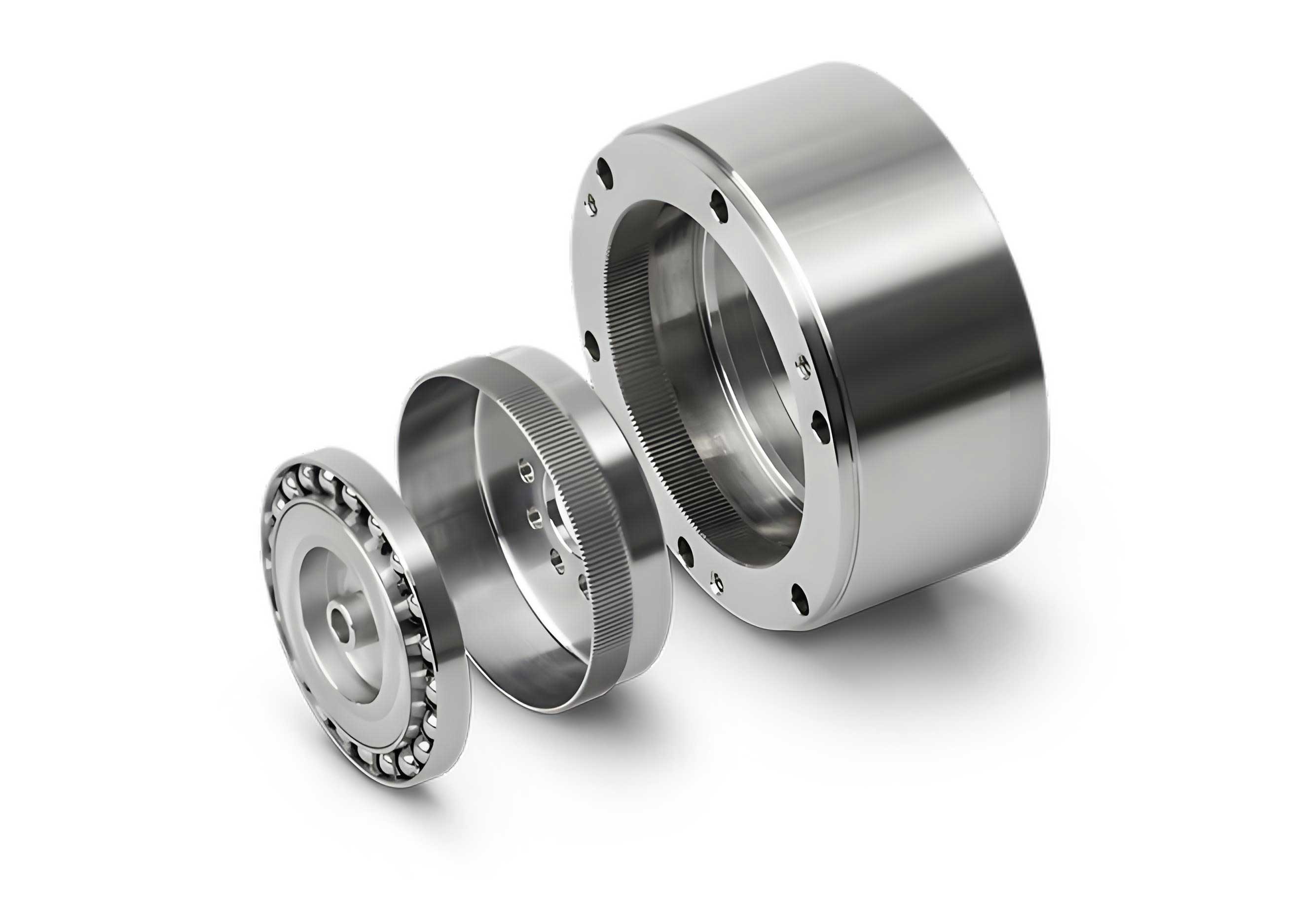
The theoretical foundation relies on fracture mechanics to quantify the impact of cracks on structural integrity. When a crack exists in a component, it introduces an additional compliance due to the energy release associated with crack propagation. The energy release rate, \(G\), for mixed-mode cracking (modes I, II, and III) is given by:
$$G = \frac{K_I^2}{E’} + \frac{K_{II}^2}{E’} + \frac{K_{III}^2}{E'(1-\nu)}$$
where \(K_I\), \(K_{II}\), and \(K_{III}\) are the stress intensity factors for opening, sliding, and tearing modes, respectively; \(E’\) is the generalized elastic modulus (\(E’ = E\) for plane stress, \(E’ = E/(1-\nu^2)\) for plane strain); \(E\) is Young’s modulus; and \(\nu\) is Poisson’s ratio. For a harmonic drive gear system under torsional loading, the presence of cracks modifies the displacement and compliance. The additional displacement \(\Delta u\) and additional flexibility coefficient \(\Delta \lambda\) due to a crack area \(A\) under a generalized load \(P\) are derived from the energy change \(\Delta U\):
$$\Delta u = \frac{\partial (\Delta U)}{\partial P} = \int_0^A \frac{G}{P} \, dA$$
$$\Delta \lambda = \frac{2 \partial (\Delta U)}{\partial P^2} = \int_0^A \frac{2G}{P^2} \, dA$$
Since the stress intensity factors are proportional to the load, i.e., \(K_i = \alpha_i P\) (where \(\alpha_i\) are geometry-dependent factors), these integrals simplify to expressions involving crack geometry and material properties. This forms the basis for calculating crack-induced flexibility in harmonic drive gear components.
The overall torsional stiffness coefficient \(K_{HD}\) of the harmonic drive gear system, when reflected to the output shaft, is obtained as the inverse of the total flexibility coefficient \(\lambda_{\sum}\):
$$K_{HD} = \frac{1}{\lambda_{\sum}} = \frac{1}{\lambda_H + \lambda_f + \lambda_{so}}$$
Here, \(\lambda_H\), \(\lambda_f\), and \(\lambda_{so}\) are the flexibility coefficients of the wave generator, flexspline, and output shaft, respectively, each comprising a crack-free part and an additional crack-induced part. We will now derive these coefficients in detail for a harmonic drive gear system.
Flexibility and Stiffness of the Wave Generator
The wave generator in a harmonic drive gear, which can be a cam, roller, or disk type, converts input rotation into elliptical motion to deform the flexspline. Its torsional stiffness is closely related to radial stiffness, as radial compliance translates into torsional compliance under load. Cracks often initiate in bearing rings (especially inner rings) due to high contact stresses, and these cracks dominate the additional flexibility. For a harmonic drive gear with a cracked bearing ring, the additional radial displacement \(\Delta u_H\) under radial load \(F_r\) is calculated using Mode I stress intensity factor for a semi-elliptical surface crack:
$$K_I = 1.95 \sigma \sqrt{\frac{a}{Q}}$$
where \(a\) is crack depth, \(Q\) is the surface crack parameter (dependent on crack aspect ratio and material), and \(\sigma\) is the circumferential stress in the ring. The stress \(\sigma\) arises primarily from the working load; neglecting interference fits and centrifugal effects for simplicity, we have:
$$\sigma = \sigma_1 = \frac{1}{2} \beta \sigma_{\text{max}}$$
with \(\beta\) being a function of Hertzian contact ellipse dimensions \(a’\) and \(b’\) (typically between 0.4278 and 0.5), and \(\sigma_{\text{max}}\) is the maximum contact pressure:
$$\sigma_{\text{max}} = \frac{3F_r}{2\pi a’ b’}$$
The radial load \(F_r\) on the wave generator relates to the output torque \(T\) of the harmonic drive gear:
$$F_r \approx 1.15 k_r \frac{T}{d_1}$$
where \(k_r\) is the force transmission coefficient and \(d_1\) is the pitch diameter of the flexspline. Substituting into the displacement integral, with crack area element \(dA = t_i \, da\) (where \(t_i\) is inner ring thickness), yields:
$$\Delta u_H = \int_0^a \frac{2}{E} K_I \frac{K_I}{F_r} \, dA = \frac{0.217 t_i \left( \frac{\beta a}{a’ b’} \right)^2 F_r^2}{E Q}$$
The additional radial stiffness coefficient \(\Delta K_G\) is then:
$$\Delta K_G = \frac{F_r}{\Delta u_H} = \frac{E Q}{0.217 F_r t_i \left( \frac{\beta a}{a’ b’} \right)^2}$$
The crack-free radial stiffness coefficient \(K_{G0}\) accounts for elastic deformations of bearing rings, wave generator elements, and support shafts:
$$K_{G0} = \frac{F_r}{\Delta b + \Delta g + \Delta a}$$
where \(\Delta b\), \(\Delta g\), and \(\Delta a\) are displacements from bearing rings, wave generator elasticity, and shaft bending, respectively. Thus, the effective radial stiffness with crack is \(K_G = K_{G0} – \Delta K_G\). Converting to torsional flexibility reflected to the output shaft involves geometric transformation:
$$\lambda_H = \frac{k_r}{K_G} \cdot \frac{\pi}{2 d_1 U w_0 i_h}$$
Here, \(U\) is the wave number (e.g., 2 for double-wave harmonic drive gear), \(w_0\) is the radial displacement amplitude, and \(i_h\) is the gear ratio. This formulation highlights how cracks in the wave generator of a harmonic drive gear reduce stiffness and increase compliance.
Flexibility and Stiffness of the Flexspline
The flexspline in a harmonic drive gear is a thin-walled cylindrical shell that deforms elastically to mesh with the circular spline. Cracks often originate at the tooth root due to stress concentration and propagate at a 45° angle under torsional loading, resulting in mixed-mode I-II cracking. For a small crack of depth \(a\) in the flexspline wall, the stress intensity factors under torque \(T\) are:
$$K_I = \sigma_\beta \sqrt{\pi a} = \tau \sin 2\beta \sqrt{\pi a}$$
$$K_{II} = \tau_\beta \sqrt{\pi a} = \tau \cos 2\beta \sqrt{\pi a}$$
where \(\tau\) is the shear stress, \(\beta = 45^\circ\) for typical crack orientation, and \(\tau = T / (2\pi r_m^2 \delta)\) with \(r_m\) as the mean radius of the undeformed flexspline and \(\delta\) as the wall thickness at the tooth ring. Including a shear distribution non-uniformity coefficient \(K_u\) and dynamic load coefficient \(K_d\), the additional torsional flexibility coefficient \(\Delta \lambda_f\) from Eq. (4) becomes:
$$\Delta \lambda_f = \int_0^a \frac{2}{E} \left[ \left( \frac{K_I}{T} \right)^2 + \left( \frac{K_{II}{T} \right)^2 \right] dA = \frac{K_u K_d a^2}{2\pi E r_m^4 \delta}$$
The crack-free torsional flexibility of the flexspline, derived from material mechanics for a cylindrical shell, is:
$$\lambda_{f0} = \frac{k_f k_G c_L}{0.1 \mu \left[ 1 – (1 – 2 c_\delta)^4 \right] d_1^3}$$
where \(c_L = L/d_1\) is relative length, \(L\) is cylinder length, \(c_\delta = \delta/d_1\) is relative wall thickness, \(k_f\) is shape coefficient (0.83 for cup-shaped, 1.0 for cylindrical), \(k_G\) is structure coefficient (0.83 for cup-shaped, else 1.0), and \(\mu\) is shear modulus. The total flexspline flexibility for the harmonic drive gear is thus:
$$\lambda_f = \lambda_{f0} + \Delta \lambda_f$$
This demonstrates that cracks in the flexspline of a harmonic drive gear add compliance, particularly sensitive to crack depth and wall geometry.
Flexibility and Stiffness of the Output Shaft
The output shaft in a harmonic drive gear transmits torque to the load and may develop circumferential cracks due to fatigue. These cracks experience combined normal stress from axial forces and shear stress from torsion, leading to mixed-mode I-III cracking. For an output shaft with an annular crack of depth \(a\), reducing the effective diameter from \(d_s\) to \(d_e = d_s – 2a\), the stress intensity factors are:
$$K_I = M_p \frac{4P}{\pi d_e^2} \sqrt{\pi a}$$
$$K_{III} = M_M \frac{16T}{\pi d_e^3} \sqrt{\pi a}$$
where \(P\) is the axial load (if present), \(T\) is torque, and \(M_p\) and \(M_M\) are geometry coefficients dependent on \(d_e/d_s\):
$$M_p = 0.5 \left( \frac{d_e}{d_s} \right)^{1/2} + 0.25 \left( \frac{d_e}{d_s} \right)^{3/2} + 0.188 \left( \frac{d_e}{d_s} \right)^{5/2} + 0.182 \left( \frac{d_e}{d_s} \right)^{7/2} + 0.166 \left( \frac{d_e}{d_s} \right)^{9/2}$$
$$M_M = 0.376 \left( \frac{d_e}{d_s} \right)^{1/2} + 0.188 \left( \frac{d_e}{d_s} \right)^{3/2} + 0.141 \left( \frac{d_e}{d_s} \right)^{5/2} + 0.117 \left( \frac{d_e}{d_s} \right)^{7/2} + 0.102 \left( \frac{d_e}{d_s} \right)^{9/2} + 0.078 \left( \frac{d_e}{d_s} \right)^{11/2}$$
Assuming \(P\) is negligible for pure torsion in harmonic drive gear, the additional torsional flexibility coefficient \(\Delta \lambda_{so}\) from Eq. (18) with \(dA = 2\pi a \, da\) simplifies to:
$$\Delta \lambda_{so} = \int_0^a \left[ \frac{2}{E} \left( \frac{K_I}{T} \right)^2 + \frac{1}{\mu} \left( \frac{K_{III}}{T} \right)^2 \right] dA = \frac{16 M_p^2 a^2}{\pi E d_e^4} + \frac{512 M_M^2 a^3}{3 \mu d_e^6}$$
The crack-free torsional flexibility of the output shaft, based on shaft geometry, is:
$$\lambda_{so0} = \frac{L_s}{0.1 \mu d_s^4}$$
for a solid shaft of length \(L_s\) and diameter \(d_s\); for a hollow shaft, use equivalent diameter. The total output shaft flexibility in the harmonic drive gear system is:
$$\lambda_{so} = \lambda_{so0} + \Delta \lambda_{so}$$
This shows that output shaft cracks can substantially increase compliance, especially with deeper cracks and larger diameters.
Overall Torsional Stiffness Calculation Procedure
To compute the torsional stiffness coefficient \(K_{HD}\) for a harmonic drive gear with cracks, follow these steps:
- Determine crack parameters: depth \(a\), geometry (e.g., semi-elliptical, annular), and location for each component (wave generator, flexspline, output shaft).
- Calculate crack-free flexibilities \(\lambda_{H0}\), \(\lambda_{f0}\), \(\lambda_{so0}\) using material mechanics formulas based on dimensions and material properties.
- Compute additional flexibilities \(\Delta \lambda_H\), \(\Delta \lambda_f\), \(\Delta \lambda_{so}\) using fracture mechanics integrals, incorporating stress intensity factors appropriate for crack modes and loading.
- Sum flexibilities: \(\lambda_H = \lambda_{H0} + \Delta \lambda_H\), \(\lambda_f = \lambda_{f0} + \Delta \lambda_f\), \(\lambda_{so} = \lambda_{so0} + \Delta \lambda_{so}\).
- Compute total flexibility: \(\lambda_{\sum} = \lambda_H + \lambda_f + \lambda_{so}\).
- Obtain torsional stiffness: \(K_{HD} = 1 / \lambda_{\sum}\).
This methodology ensures that the harmonic drive gear stiffness reflects real-world damage scenarios, aiding in accurate dynamic modeling.
Numerical Example and Results
Consider a double-wave harmonic drive gear with the following parameters: gear ratio \(i_h = 100\), radial displacement \(w_0 = 0.8 \, \text{mm}\), flexspline pitch diameter \(d_1 = 160 \, \text{mm}\), wall thickness \(\delta = 2.24 \, \text{mm}\), length \(L = 160 \, \text{mm}\), cup-shaped flexspline. Output shaft is hollow with outer diameter \(d_{s1} = 70 \, \text{mm}\), inner diameter \(d_{s2} = 45 \, \text{mm}\), length \(L_s = 200 \, \text{mm}\). Material properties: Young’s modulus \(E = 2.1 \times 10^5 \, \text{MPa}\), shear modulus \(\mu = 8 \times 10^4 \, \text{MPa}\), Poisson’s ratio \(\nu = 0.3\). Force transmission coefficient \(k_r = 0.35\). Assume cracks of depth \(a = 0.1 \, \text{mm}\) in all components for illustration.
Using the derived formulas, we compute flexibility coefficients. For the wave generator, assume bearing inner ring thickness \(t_i = 10 \, \text{mm}\), Hertzian contact dimensions \(a’ = 5 \, \text{mm}\), \(b’ = 2 \, \text{mm}\), \(\beta = 0.45\), crack parameter \(Q = 1.5\), and radial load \(F_r = 500 \, \text{N}\) (from torque \(T = 100 \, \text{Nm}\) approx.). Then:
- Crack-free radial stiffness \(K_{G0} = 1.2 \times 10^5 \, \text{N/mm}\) (estimated from literature).
- Additional radial stiffness \(\Delta K_G = 1.5 \times 10^3 \, \text{N/mm}\).
- Effective radial stiffness \(K_G = K_{G0} – \Delta K_G = 1.185 \times 10^5 \, \text{N/mm}\).
- Torsional flexibility \(\lambda_H = 3.558 \times 10^{-10} \, \text{rad/(N·mm)}\).
For the flexspline, with \(r_m = 79.88 \, \text{mm}\), \(K_u = 1.1\), \(K_d = 1.2\):
- Crack-free flexibility \(\lambda_{f0} = 2.359 \times 10^{-10} \, \text{rad/(N·mm)}\).
- Additional flexibility \(\Delta \lambda_f = 1.0 \times 10^{-15} \, \text{rad/(N·mm)}\) (negligible for small \(a\)).
- Total flexspline flexibility \(\lambda_f = 2.359 \times 10^{-10} \, \text{rad/(N·mm)}\).
For the output shaft, equivalent solid diameter \(d_s = 60 \, \text{mm}\) (from hollow geometry), \(d_e = 59.8 \, \text{mm}\), \(M_p \approx 0.85\), \(M_M \approx 0.42\):
- Crack-free flexibility \(\lambda_{so0} = 6.906 \times 10^{-10} \, \text{rad/(N·mm)}\).
- Additional flexibility \(\Delta \lambda_{so} = 3.9 \times 10^{-14} \, \text{rad/(N·mm)}\).
- Total shaft flexibility \(\lambda_{so} = 6.906 \times 10^{-10} \, \text{rad/(N·mm)}\).
Summing flexibilities and computing stiffness:
| Condition | Wave Generator Flexibility (×10⁻¹⁰ rad/(N·mm)) | Flexspline Flexibility (×10⁻¹⁰ rad/(N·mm)) | Output Shaft Flexibility (×10⁻¹⁰ rad/(N·mm)) | Total Flexibility (×10⁻¹⁰ rad/(N·mm)) | Total Stiffness (×10¹⁰ N·mm/rad) |
|---|---|---|---|---|---|
| No Cracks | 3.407 | 2.359 | 6.906 | 12.672 | 7.890 |
| With Cracks (a=0.1 mm) | 3.558 | 2.359 | 6.906 | 12.823 | 7.798 |
This table shows that cracks reduce the overall torsional stiffness of the harmonic drive gear by approximately 1.2% for the given parameters. The flexibility contributions indicate that the output shaft accounts for about 54%, the wave generator for 28%, and the flexspline for 18% of the total compliance, underscoring that enhancing stiffness in harmonic drive gear systems should focus on the output shaft and wave generator design.
Discussion and Implications
The analysis reveals that even small cracks can measurably affect the torsional stiffness of a harmonic drive gear, which in turn influences dynamic response, resonance frequencies, and positioning accuracy. The derived formulas allow engineers to quantify these effects during design or maintenance. For instance, in a robotic arm using harmonic drive gear, crack propagation from fatigue could gradually reduce stiffness, leading to increased vibration and reduced precision; monitoring stiffness changes via these calculations could inform predictive maintenance schedules.
Several factors warrant further exploration. First, crack interactions (e.g., multiple cracks in one component) could amplify compliance nonlinearly; superposition principles may apply but require validation. Second, the assumption of static loading simplifies dynamic crack behavior; under cyclic loads in harmonic drive gear applications, crack growth rates and time-varying stiffness could be modeled using fatigue crack growth laws like Paris’ law. Third, material anisotropy, common in composite flexsplines, would modify stress intensity factors and compliance integrals. Extending the method to incorporate these aspects would enhance its applicability to advanced harmonic drive gear systems.
Moreover, the harmonic drive gear’s performance depends on precise deformation; cracks may alter stress distributions beyond local compliance, potentially affecting tooth engagement and efficiency. Future work could integrate finite element analysis with fracture mechanics to visualize crack effects on strain energy distribution in harmonic drive gear components.
Conclusion
In this article, I have presented a methodology to calculate the torsional stiffness coefficient of harmonic drive gear systems when cracks are present in the wave generator, flexspline, and output shaft. By applying fracture mechanics theory alongside material and system dynamics principles, analytical expressions for flexibility coefficients were derived, accounting for crack-induced additional compliance. The overall stiffness is obtained as the inverse of total flexibility, providing a straightforward approach suitable for engineering calculations. A numerical example illustrated the procedure, showing that cracks reduce stiffness marginally for small depths but that the output shaft and wave generator are critical for overall compliance. This work emphasizes the importance of considering crack effects in harmonic drive gear design and analysis to ensure accurate dynamic modeling and reliable operation in practical applications. The harmonic drive gear, as a key transmission element, benefits from such detailed stiffness assessments to maintain performance in demanding environments.