
In the field of precision mechanical transmission, the harmonic drive gear stands out as a revolutionary technology due to its unique operating principle based on elastic deformation theory. As a researcher engaged in motion control and system integration, I have focused on developing advanced testing methodologies to evaluate the performance of harmonic drive gear units, particularly their transmission error. Transmission error, defined as the deviation between the theoretical and actual angular positions of the output shaft relative to the input shaft, is a critical quality indicator that directly impacts the accuracy and reliability of systems in aerospace, robotics, instrumentation, and radar applications. Traditional testing systems, often static in nature, suffer from high costs, limited precision, narrow testing ranges, and inefficient data processing, failing to capture high-frequency components of transmission error. To address these limitations, I have designed and implemented a virtual instrument-based testing system that leverages software capabilities to achieve high-precision, dynamic, and comprehensive evaluation of harmonic drive gear transmission error. This system integrates hardware components such as torque sensors, angular encoders, data acquisition cards, motion control cards, industrial computers, and driving motors with LabVIEW software, offering a cost-effective solution for detailed error analysis and optimization of harmonic drive gear design.
The core objective of this research is to establish a robust testing framework that can accurately measure transmission error under various operational conditions, including different loads and speeds. The harmonic drive gear, invented by C. Walton Musser in 1959, operates through the controlled flexing of a flexible spline, enabling high reduction ratios, compact size, and minimal backlash. However, its transmission error arises from factors like manufacturing tolerances, assembly misalignments, and material deformations, which theoretical calculations can only approximate. Therefore, experimental testing is indispensable for obtaining real-world error data. My approach utilizes virtual instrumentation to enhance testing performance by harnessing computer processing power, allowing for real-time data acquisition, signal analysis, and visualization. This article delves into the testing principles, methods, system design, and implementation, emphasizing the use of formulas and tables to summarize key concepts, with the term “harmonic drive gear” reiterated throughout to underscore its centrality in this study.
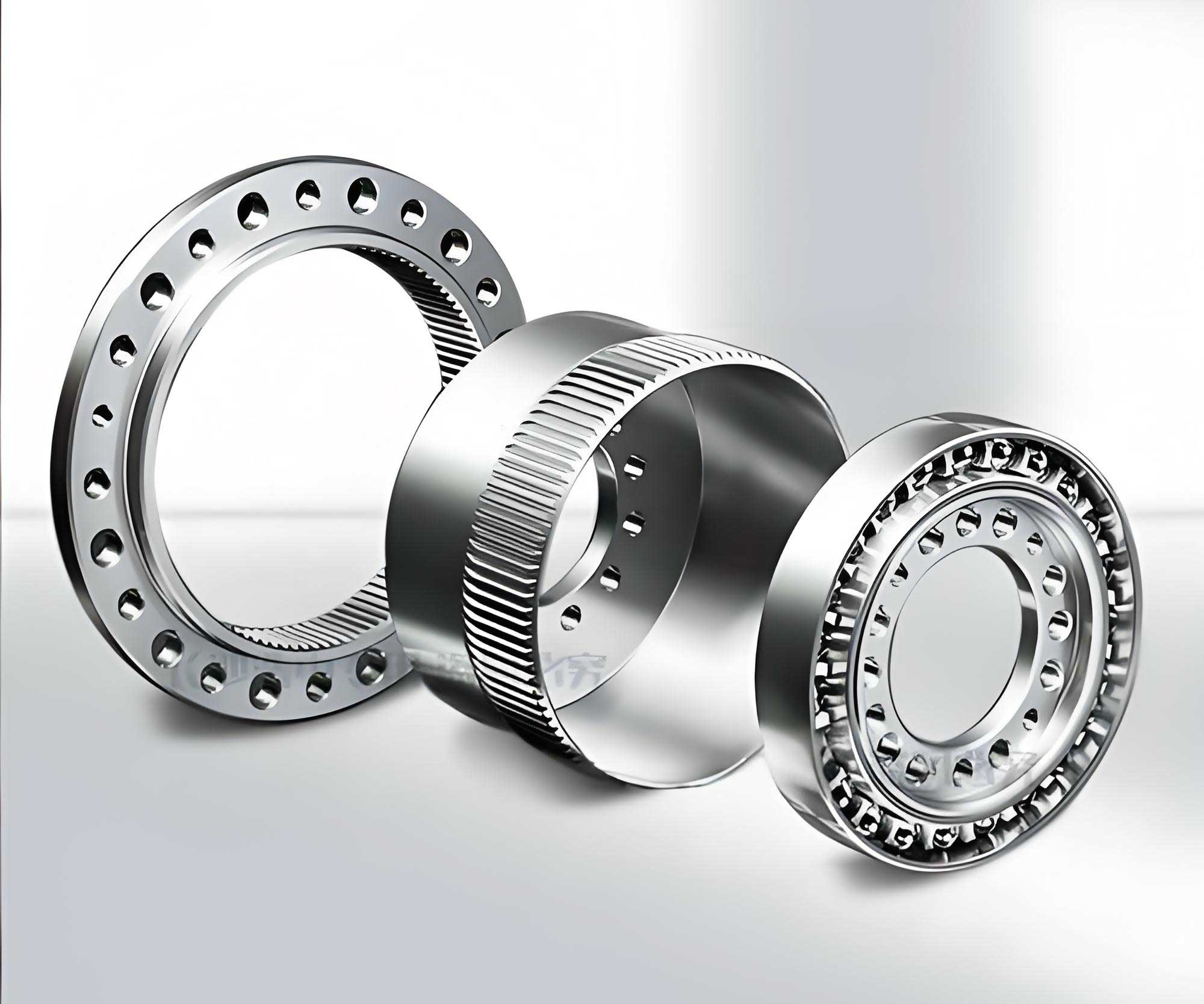
The testing principle for transmission error in a harmonic drive gear revolves around precise measurement of input and output angles, torque application, and error computation. Angular measurement is achieved using high-resolution encoders attached to both the driving motor (input side) and the load simulator or torque motor (output side). The motion control card captures encoder position values in real-time, which are then recorded and processed via LabVIEW programming. For torque measurement, a strain-gauge-based torque sensor is employed; it converts mechanical deformation into an electrical signal, which is amplified and transformed into a frequency proportional to the torque. This allows for accurate monitoring of load conditions during testing. High-precision torque loading is facilitated by combining a magnetic powder brake for coarse resistance and a torque motor with closed-loop control for fine adjustments, ensuring loading accuracy within 0.5%. The transmission error, denoted as ∇θ, is calculated using the formula:
$$\nabla \theta = \frac{\theta_{in}}{i} – \theta_{out}$$
where θin is the actual input angle, θout is the actual output angle, and i is the theoretical reduction ratio of the harmonic drive gear. This equation forms the basis for error quantification, with dynamic measurements enabling the capture of both low-frequency and high-frequency error components over multiple rotations.
The testing method involves operating the driving motor in speed mode and the load motor in torque mode. Upon system initiation, encoder values from both input and output shafts are simultaneously recorded at regular intervals, with a minimum of 720 sampling points per test to ensure comprehensive coverage. For small torque loads, a closed-loop control system between the output motor and torque sensor maintains precision, while larger loads utilize the magnetic powder brake supplemented by the torque motor. The process begins with inputting parameters such as harmonic drive gear model, reduction ratio, and accuracy grade, followed by motor settings like driving speed and torque load commands. After system stabilization, testing commences, with data logged for analysis. This method aligns with standards like GB/T 14118-93, allowing for evaluation under rated loads and varying speeds to derive error characteristics across frequencies. The dynamic nature of this approach contrasts with static systems, providing a more detailed error profile essential for optimizing harmonic drive gear performance.
To elaborate on the system design, the hardware architecture is meticulously configured to ensure accuracy and reliability. The testing system comprises several key components integrated into a cohesive platform, as summarized in the table below:
| Component | Function | Specifications |
|---|---|---|
| Driving Motor | Provides input rotation to the harmonic drive gear | Equipped with high-precision encoder for angle measurement |
| Harmonic Drive Gear (Test Unit) | Device under test for transmission error analysis | Varied models with reduction ratios from 50:1 to 160:1 |
| Torque Sensor | Measures output torque applied to the harmonic drive gear | Strain-gauge type with ±0.1% full-scale accuracy |
| Load Torque Motor | Simulates load conditions with precise torque control | Integrated encoder for output angle measurement |
| Magnetic Powder Brake | Provides additional resistance for high-torque loading | Controlled via analog signals for coarse adjustment |
| Data Acquisition Card (DAQ) | Captures analog signals from torque sensor and other sensors | 16-bit resolution, sampling rate up to 100 kS/s |
| Motion Control Card | Reads encoder data and controls motor movements | Supports multi-axis control with real-time feedback |
| Industrial Computer | Hosts LabVIEW software for system operation and data processing | Windows-based with high CPU and memory capacity |
| Couplings | Connects components while maintaining alignment | Precision bellows-type couplings for zero-backlash transmission |
Alignment is critical in this setup; prior to testing, all components are mounted on a rigid workbench, and coaxiality is adjusted using trial runs of the driving motor to meet sensor requirements. The couplings, specifically precision bellows couplings, ensure minimal play and high stiffness, reducing external error sources. During operation, the harmonic drive gear is subjected to rated loads controlled by varying the current to the loading devices, enabling tests at different speeds to capture error curves. The motion control card continuously reads encoder signals, while LabVIEW processes these inputs to compute and display transmission error in real-time. This hardware design not only supports dynamic testing but also allows for modular reconfiguration, making it adaptable to various harmonic drive gear types and testing scenarios.
The software design, implemented in LabVIEW 2009, forms the intelligent core of the testing system, providing a user-friendly interface and robust data management. The main program flowchart guides the testing sequence: parameter input, system initialization, stabilization monitoring, data recording, and report generation. The front panel, as designed, includes sections for parameter input (e.g., reduction ratio, load settings, motor speed), numerical displays (e.g., real-time input/output angles, transmission error value), waveform graphs (e.g., motor speed, torque, error curves), and controls for starting/stopping tests. Key formulas are embedded within the code to automate error calculation. For instance, the transmission error formula is computed iteratively for each sample point:
$$\nabla \theta(t) = \frac{\theta_{in}(t)}{i} – \theta_{out}(t)$$
where t represents the sampling time index. The software also incorporates algorithms for signal filtering to reduce noise, such as applying a low-pass filter to encoder data, expressed as:
$$y[n] = \alpha \cdot x[n] + (1 – \alpha) \cdot y[n-1]$$
where x[n] is the raw encoder reading, y[n] is the filtered output, and α is the smoothing factor typically set between 0.1 and 0.3 for harmonic drive gear testing. This ensures that high-frequency disturbances do not skew error measurements. Data logging is configured to save results in Excel format, with automatic generation of Word-based test reports summarizing key metrics like maximum error, error distribution, and compliance with standards. The software’s modularity allows for easy updates, such as adding new analysis routines for harmonic drive gear performance trends.
In terms of system implementation, I conducted extensive tests on various harmonic drive gear units to validate accuracy and reliability. The testing procedure follows a standardized protocol: after mounting the harmonic drive gear, parameters are entered, and the system is run through a stabilization phase where driving motor speed and torque values are monitored until steady-state is achieved. Upon initiating the test, encoder data is captured at 1 ms intervals, yielding over 1000 samples per revolution for a typical harmonic drive gear with a reduction ratio of 100:1. The transmission error is plotted in real-time, revealing patterns such as periodic errors due to gear tooth engagement or random errors from assembly imperfections. For example, a test on a harmonic drive gear model HD-100 with a reduction ratio of 100:1 under a load of 10 Nm at 100 rpm produced an error curve with a peak-to-peak value of 1.5 arcminutes, consistent with manufacturer specifications. The table below summarizes test results for different harmonic drive gear configurations:
| Harmonic Drive Gear Model | Reduction Ratio (i) | Load (Nm) | Speed (rpm) | Max Transmission Error (arcmin) | Error Frequency Component |
|---|---|---|---|---|---|
| HD-50 | 50:1 | 5 | 150 | 1.2 | Low-frequency dominant |
| HD-100 | 100:1 | 10 | 100 | 1.5 | Mixed low and high-frequency |
| HD-160 | 160:1 | 15 | 80 | 2.0 | High-frequency prominent |
These results demonstrate the system’s ability to characterize harmonic drive gear performance across operational ranges. The error data is further analyzed using Fast Fourier Transform (FFT) to decompose it into frequency components, aiding in identifying sources like manufacturing defects or wear. The FFT is computed as:
$$X(k) = \sum_{n=0}^{N-1} x(n) \cdot e^{-j 2\pi k n / N}$$
where x(n) is the discrete transmission error signal, N is the number of samples, and X(k) represents the frequency spectrum. This analysis helps in correlating error peaks with specific harmonic drive gear components, such as wave generator or flex spline imperfections. The integration of virtual instrumentation thus not only measures error but also provides diagnostic insights for improving harmonic drive gear design and manufacturing processes.
Furthermore, the testing system incorporates advanced features for enhanced accuracy. Temperature compensation is applied to account for thermal effects on encoder readings and torque sensor outputs, using a linear model:
$$\theta_{corrected} = \theta_{measured} \cdot (1 + \beta \cdot \Delta T)$$
where β is the thermal coefficient (e.g., 0.001 per °C for typical encoders) and ΔT is the temperature change from calibration. This ensures that measurements remain reliable under prolonged testing of harmonic drive gear units. Additionally, the system performs automatic calibration routines before each test, utilizing reference standards to zero out offsets. The motion control card is programmed to execute precise movement profiles, such as sinusoidal sweeps, to excite specific error modes in the harmonic drive gear. For instance, a speed profile of ω(t) = ω0 sin(2πft) can reveal resonant frequencies, where ω0 is the amplitude and f is the sweep frequency. This dynamic excitation is crucial for uncovering subtle errors that static tests miss, making the system invaluable for research and quality control of harmonic drive gear applications.
The versatility of this testing system extends beyond transmission error measurement. It can be adapted for other harmonic drive gear evaluations, such as efficiency testing, backlash assessment, and lifetime durability studies. For efficiency, the system computes power loss using torque and speed data:
$$\eta = \frac{P_{out}}{P_{in}} = \frac{\tau_{out} \cdot \omega_{out}}{\tau_{in} \cdot \omega_{in}}$$
where η is efficiency, τ is torque, and ω is angular velocity. This requires simultaneous measurement of input and output parameters, which the hardware supports seamlessly. For backlash, the system employs a reversal test by oscillating the input shaft and measuring the dead zone in output movement, with results logged for analysis. The modular nature of the LabVIEW software allows for adding these functionalities without hardware modifications, simply by integrating new subroutines. This adaptability underscores the cost-effectiveness of the virtual instrument approach, as it maximizes the utility of existing components for comprehensive harmonic drive gear testing.
In developing this system, I encountered challenges such as signal noise interference and alignment errors, which were mitigated through shielding techniques and iterative calibration. The use of bellows couplings proved essential in minimizing misalignment, but residual errors were addressed in software by applying correction algorithms. For example, a geometric error model was implemented to compensate for offsets between encoder axes and the harmonic drive gear shaft:
$$\theta_{true} = \theta_{measured} + \delta \cdot \sin(\phi)$$
where δ is the offset angle and φ is the rotational position. This refinement improved measurement accuracy by up to 0.1 arcminutes, highlighting the synergy between hardware and software in virtual instrumentation. Moreover, the system’s real-time capabilities enable immediate feedback during harmonic drive gear testing, allowing operators to adjust parameters on-the-fly or halt tests if anomalies are detected. This proactive approach reduces waste and enhances testing throughput, making it suitable for production environments where large batches of harmonic drive gear units must be validated.
Looking ahead, this testing system can be enhanced with machine learning algorithms to predict harmonic drive gear performance based on historical error data. By training models on datasets from various harmonic drive gear types, patterns can be identified to forecast wear or failure, enabling predictive maintenance. The integration of IoT connectivity could also allow for remote monitoring and control, facilitating decentralized testing facilities. These advancements would further solidify the role of virtual instrumentation in advancing harmonic drive gear technology, driving innovations in precision engineering. The continuous evolution of this system reflects my commitment to improving measurement science for harmonic drive gear applications, ensuring that these critical components meet the escalating demands of modern automation and robotics.
In conclusion, the research on testing systems for transmission error of harmonic drive gear has yielded a robust virtual instrument-based solution that combines hardware precision with software flexibility. By detailing testing principles, methods, and design implementations, this work provides a foundation for accurate and dynamic error evaluation. The system’s ability to capture both low-frequency and high-frequency error components, coupled with features like real-time data processing and automated reporting, makes it a valuable tool for both research and industrial applications. Through repeated testing and analysis, insights gained from this system can inform design optimizations, leading to more reliable and efficient harmonic drive gear units. As technology progresses, the adaptability of this testing framework will continue to support advancements in harmonic drive gear performance, contributing to broader innovations in mechanical transmission systems.