
In the field of precision mechanical transmissions, harmonic drive gears have emerged as a critical technology for applications requiring high reduction ratios, compact design, and reliable performance. Among the various configurations, the oscillating-teeth end face harmonic gear drive represents an innovative advancement that combines the benefits of radial harmonic drives and oscillating-teeth mechanisms. This design is particularly suited for high-power reducers and has garnered significant attention due to its potential for robust operation and efficiency. As a researcher deeply involved in the study of gear systems, I have focused on analyzing the meshing area of the working meshing pairs in these harmonic drive gears. Understanding the meshing area is paramount for evaluating the load-carrying capacity, stress distribution, and overall durability of the transmission. In this article, I will delve into the principles governing the meshing area, explore the factors influencing its variation, and derive comprehensive formulas to calculate it under different conditions. The goal is to establish a foundational framework for further research into the strength theory and performance optimization of harmonic drive gears.
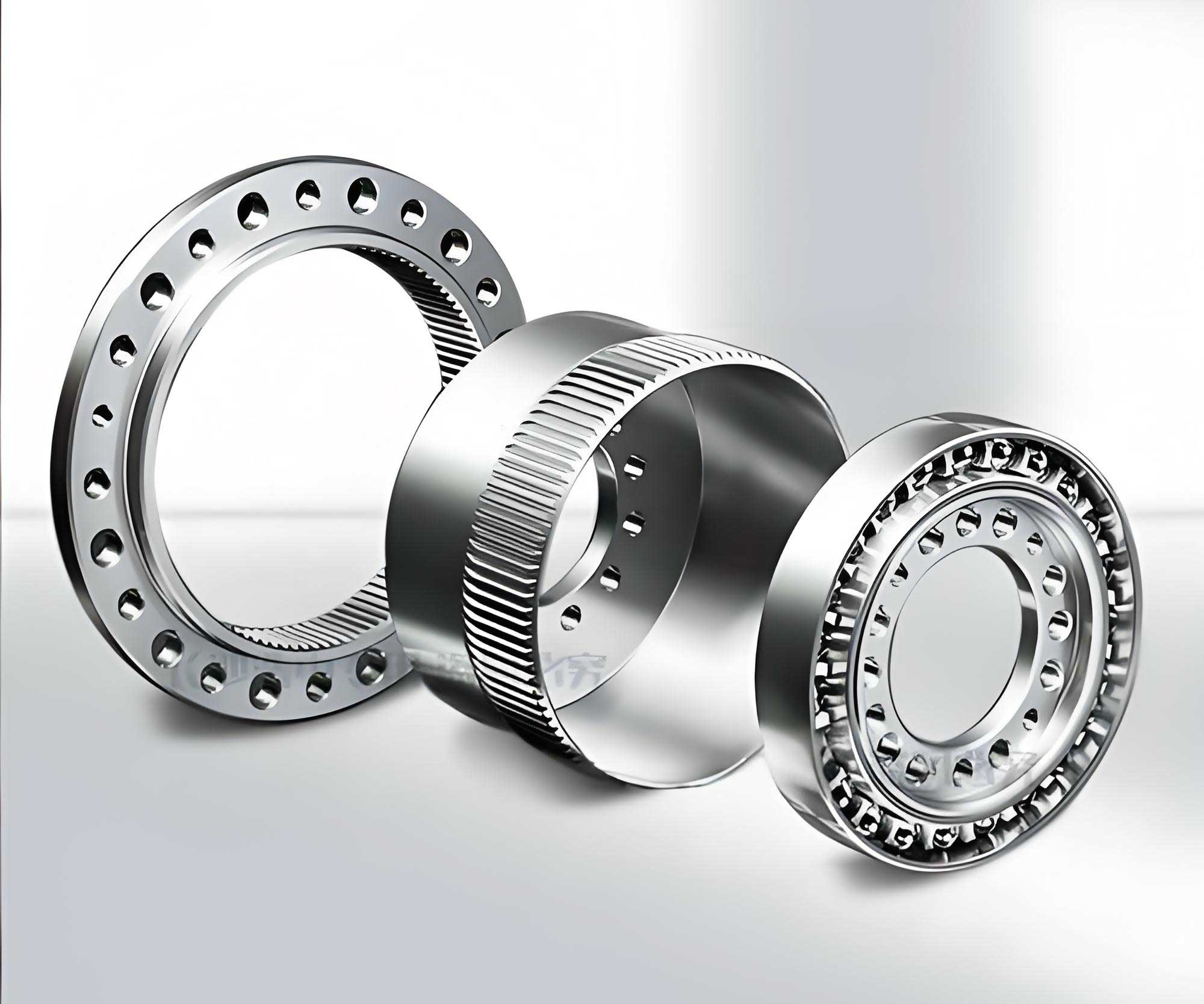
The oscillating-teeth end face harmonic gear drive consists of four primary components: the end face gear, the slot wheel, the oscillating teeth, and the wave generator. This assembly creates meshing pairs between each oscillating tooth and the end face gear, forming the core of the transmission mechanism. The wave generator, typically an elliptical or cam-shaped element, induces a wave-like motion in the flexible components, leading to the engagement and disengagement of teeth. In this system, the oscillating teeth move in a controlled manner, alternating between working meshing (where they transmit torque) and non-working meshing (where they disengage). The dynamic nature of this engagement results in a continuously changing meshing area for each pair, which directly impacts the transmission’s ability to handle loads without failure. To accurately model this behavior, I have developed a geometric representation of the meshing state, which virtualizes the end face gear’s tooth profile to simultaneously account for all oscillating teeth. This model is instrumental in visualizing the periodic variations in meshing area and understanding the sequential handover of meshing states among teeth.
The meshing area in harmonic drive gears is not constant; it fluctuates cyclically as the wave generator rotates. At any given moment, some oscillating teeth are fully engaged with the end face gear, while others are partially engaged or completely disengaged. This variation is crucial because it determines the total contact area available for load transmission, affecting stress concentrations and wear patterns. In my analysis, I have identified that the total meshing area of all working pairs reaches a maximum at specific instants in the cycle, corresponding to when certain teeth are in full engagement. Conversely, the total area minimizes when a tooth transitions from working to non-working meshing. This cyclical pattern is inherent to harmonic drive gears and must be quantified to ensure reliable design. The meshing area per pair, denoted as \( S_e \) for a fully engaged tooth, serves as a reference point. For a single meshing pair, the area changes linearly from zero to \( S_e \) during engagement, and this change is reflected in the aggregate behavior of all pairs. By studying the geometric model, I can derive expressions for the maximum and minimum total meshing areas, which depend on key parameters like the number of oscillating teeth and the wave number.
Several factors influence the meshing area in harmonic drive gears, and I have categorized them to simplify the analysis. First, the transmission type—whether the end face gear is fixed or the slot wheel is fixed—affects the relative motion but not the fundamental meshing area extrema. In both configurations, the geometric model of meshing states remains identical at the points of maximum and minimum area, implying that the formulas for these extrema are universal. Second, the relationship between the number of oscillating teeth \( Z_O \) and the wave number \( U \) of the wave generator plays a pivotal role. When \( Z_O \) is an integer multiple of \( U \) (i.e., \( Z_O/U \) is an integer), the oscillating teeth are evenly distributed across each wave, leading to symmetric meshing patterns. In contrast, if \( Z_O/U \) is not an integer, the distribution is uneven, requiring a more complex model that aggregates all teeth into a single virtual profile. Third, the relationship between \( Z_O \) and the number of end face gear teeth \( Z_E \) (whether \( Z_E > Z_O \) or \( Z_E < Z_O \)) might seem relevant, but my investigations show that it does not alter the total meshing area calculations, provided \( Z_O \) and \( U \) are held constant. This insight simplifies the analysis, allowing me to focus on the \( Z_O/U \) dichotomy.
To systematically analyze the meshing area, I consider two main cases based on the divisibility of \( Z_O \) by \( U \). Each case further divides into subcases depending on whether \( Z_O \) is even or odd, as this affects the symmetry of meshing states. I will derive formulas for the maximum total meshing area \( \sum S_{e \text{ max}} \) and the minimum total meshing area \( \sum S_{e \text{ min}} \), along with their difference, which indicates the amplitude of variation. These formulas are essential for engineers designing harmonic drive gears, as they inform decisions on tooth counts and wave generator selection to optimize load distribution.
Case 1: \( Z_O/U \) is an integer. In this scenario, the oscillating teeth are uniformly distributed across the waves. I examine two subcases: when \( Z_O/U \) is even and when it is odd. For \( Z_O/U \) even, let \( Z_N = Z_O/(2U) \) represent the number of working teeth per wave. The meshing area for each working pair increases stepwise from \( S_e/Z_N \) to \( S_e \). Summing these areas at the instant of maximum engagement yields the total maximum area. Similarly, the minimum occurs when a tooth just exits working meshing. The formulas are:
$$ \sum S_{e \text{ max}} = \frac{Z_O + 2U}{4} S_e $$
$$ \sum S_{e \text{ min}} = \frac{Z_O – 2U}{4} S_e $$
$$ \sum S_{e \text{ max}} – \sum S_{e \text{ min}} = U S_e $$
For \( Z_O/U \) odd, the number of working teeth per wave is \( Z_N = (Z_O + U)/(2U) \). The meshing area progression is similar, but the summation leads to:
$$ \sum S_{e \text{ max}} = \frac{(Z_O + U)^2}{4Z_O} S_e $$
$$ \sum S_{e \text{ min}} = \frac{(Z_O – U)^2}{4Z_O} S_e $$
$$ \sum S_{e \text{ max}} – \sum S_{e \text{ min}} = U S_e $$
Note that in both subcases, the difference between maximum and minimum areas is proportional to \( U \), highlighting the wave generator’s influence on meshing dynamics in harmonic drive gears.
Case 2: \( Z_O/U \) is not an integer. Here, the teeth cannot be evenly grouped by wave, so I aggregate all teeth into a single geometric model. This case also splits based on \( Z_O \) being even or odd. For \( Z_O \) even, let \( Z_N = Z_O/2 \) be the total working teeth. The meshing areas range from \( S_e/Z_N \) to \( S_e \), and summing gives:
$$ \sum S_{e \text{ max}} = \frac{Z_O + 2}{4} S_e $$
$$ \sum S_{e \text{ min}} = \frac{Z_O – 2}{4} S_e $$
$$ \sum S_{e \text{ max}} – \sum S_{e \text{ min}} = S_e $$
For \( Z_O \) odd, the total working teeth is \( Z_N = (Z_O + 1)/2 \), and the area steps are in increments of \( 2S_e/(2Z_N – 1) \). The formulas become:
$$ \sum S_{e \text{ max}} = \frac{(Z_O + 1)^2}{4Z_O} S_e $$
$$ \sum S_{e \text{ min}} = \frac{(Z_O – 1)^2}{4Z_O} S_e $$
$$ \sum S_{e \text{ max}} – \sum S_{e \text{ min}} = S_e $$
In this case, the difference is constant at \( S_e \), independent of \( U \), which underscores a distinct behavior in harmonic drive gears with non-integer tooth-wave ratios.
To summarize these findings, I have compiled the formulas into tables for easy reference. These tables encapsulate the meshing area characteristics for harmonic drive gears under various parameter settings.
| Subcase | Maximum Total Area \( \sum S_{e \text{ max}} \) | Minimum Total Area \( \sum S_{e \text{ min}} \) | Difference \( \sum S_{e \text{ max}} – \sum S_{e \text{ min}} \) |
|---|---|---|---|
| \( Z_O/U \) even | \( \frac{Z_O + 2U}{4} S_e \) | \( \frac{Z_O – 2U}{4} S_e \) | \( U S_e \) |
| \( Z_O/U \) odd | \( \frac{(Z_O + U)^2}{4Z_O} S_e \) | \( \frac{(Z_O – U)^2}{4Z_O} S_e \) | \( U S_e \) |
| Subcase | Maximum Total Area \( \sum S_{e \text{ max}} \) | Minimum Total Area \( \sum S_{e \text{ min}} \) | Difference \( \sum S_{e \text{ max}} – \sum S_{e \text{ min}} \) |
|---|---|---|---|
| \( Z_O \) even | \( \frac{Z_O + 2}{4} S_e \) | \( \frac{Z_O – 2}{4} S_e \) | \( S_e \) |
| \( Z_O \) odd | \( \frac{(Z_O + 1)^2}{4Z_O} S_e \) | \( \frac{(Z_O – 1)^2}{4Z_O} S_e \) | \( S_e \) |
These formulas reveal that in harmonic drive gears, the meshing area variation is directly tied to the wave number when the tooth count is a multiple of it, whereas it becomes wave-independent otherwise. This has practical implications: designers can manipulate \( U \) and \( Z_O \) to control the fluctuation amplitude, potentially reducing stress peaks and enhancing longevity. For instance, in high-load applications, selecting parameters that minimize the difference might be beneficial to ensure smoother load transfer across the harmonic drive gear system.
Beyond the formulas, it is essential to discuss the physical significance of the meshing area in harmonic drive gears. The meshing area directly correlates with the contact pressure between teeth; a larger area distributes loads more evenly, reducing the risk of pitting, wear, or tooth fracture. In harmonic drive gears, the cyclic engagement means that teeth experience alternating stress, which can lead to fatigue if not properly managed. By quantifying the meshing area, I can contribute to more accurate fatigue life predictions and optimize the gear geometry. For example, the value of \( S_e \) depends on tooth dimensions, such as face width and profile curvature, which can be tailored based on these calculations. Furthermore, the harmonic drive gear’s efficiency is influenced by the meshing area, as larger areas may reduce sliding friction and improve torque transmission.
To further elaborate, I consider the role of manufacturing tolerances and alignment errors in harmonic drive gears. Even slight deviations from ideal geometry can alter the actual meshing area, leading to localized overloading. My models assume perfect alignment and uniform tooth profiles, but in practice, factors like tooth flank modifications or lubrication effects might necessitate adjustments. Future research could integrate these real-world complexities into the meshing area analysis, perhaps using finite element simulations to validate the formulas. Nonetheless, the derived expressions provide a robust starting point for understanding the fundamental behavior of harmonic drive gears.
Another aspect to explore is the thermal effects on meshing area in harmonic drive gears. As the gear operates, frictional heat generation can cause thermal expansion, slightly changing tooth dimensions and thus the meshing area. This dynamic interaction could be modeled by incorporating temperature-dependent material properties into the area calculations. Such insights would be valuable for harmonic drive gears used in extreme environments, like aerospace or industrial robotics, where temperature fluctuations are common.
In addition to the oscillating-teeth design, other harmonic drive gear variants, such as strain wave gearing or flexible spline systems, also exhibit meshing area variations. While the principles may differ, the methodology I have developed—using geometric models and parameter relationships—could be adapted to those systems. This universality underscores the importance of meshing area studies in advancing harmonic drive gear technology as a whole.
To illustrate the application of these formulas, let me provide a numerical example. Suppose a harmonic drive gear has \( Z_O = 12 \) oscillating teeth and \( U = 3 \) waves. Since \( Z_O/U = 4 \) is an integer and even, I use Table 1. Assuming \( S_e = 10 \, \text{mm}^2 \), the maximum total meshing area is:
$$ \sum S_{e \text{ max}} = \frac{12 + 2 \times 3}{4} \times 10 = \frac{18}{4} \times 10 = 45 \, \text{mm}^2 $$
The minimum is:
$$ \sum S_{e \text{ min}} = \frac{12 – 2 \times 3}{4} \times 10 = \frac{6}{4} \times 10 = 15 \, \text{mm}^2 $$
The difference is \( 30 \, \text{mm}^2 \), which matches \( U S_e = 3 \times 10 = 30 \, \text{mm}^2 \). This example shows how the meshing area varies by a factor of three, emphasizing the need to consider these extremes in design. For a harmonic drive gear with \( Z_O = 7 \) and \( U = 2 \), where \( Z_O/U = 3.5 \) is not an integer and \( Z_O \) is odd, I use Table 2. With \( S_e = 10 \, \text{mm}^2 \), the maximum is:
$$ \sum S_{e \text{ max}} = \frac{(7 + 1)^2}{4 \times 7} \times 10 = \frac{64}{28} \times 10 \approx 22.86 \, \text{mm}^2 $$
The minimum is:
$$ \sum S_{e \text{ min}} = \frac{(7 – 1)^2}{4 \times 7} \times 10 = \frac{36}{28} \times 10 \approx 12.86 \, \text{mm}^2 $$
The difference is \( 10 \, \text{mm}^2 \), equal to \( S_e \). These calculations demonstrate the practical utility of the formulas for harmonic drive gears.
In conclusion, the meshing area in harmonic drive gears is a dynamic parameter that cycles between maximum and minimum values during operation. Through geometric modeling and analysis, I have derived explicit formulas for these extrema based on the relationships between oscillating tooth count, wave number, and tooth parity. The findings show that when \( Z_O \) is divisible by \( U \), the variation amplitude scales with \( U \), whereas it remains constant at \( S_e \) otherwise. This knowledge is crucial for designing harmonic drive gears with optimal load distribution and durability. Future work could extend this research to include effects like elastic deformation, multi-tooth contact, and dynamic loading, further refining the predictive models for harmonic drive gear performance. As harmonic drive gears continue to evolve, understanding their meshing behavior will remain a cornerstone of innovation in precision transmission systems.
To reinforce the concepts, I have included the tables and formulas throughout this discussion. The harmonic drive gear’s unique characteristics—such as its compactness and high reduction ratio—make it indispensable in modern machinery, and a deep grasp of meshing area dynamics will empower engineers to harness its full potential. By continuing to explore these aspects, I aim to contribute to the advancement of harmonic drive gear technology, ensuring its reliability and efficiency across diverse applications.