
In my research on advanced mechanical transmission systems, I have focused on the harmonic drive gear, a unique mechanism that relies on elastic deformation for motion transfer. The harmonic drive gear offers exceptional advantages, including high reduction ratios, compact design, and precision, making it invaluable in robotics, aerospace, and industrial automation. However, the flexspline, a critical component of the harmonic drive gear, is prone to fatigue and wear due to cyclic stress, which limits the overall lifespan. To address this, I investigated a novel short cylindrical flexspline design that overcomes the drawbacks of traditional cup-shaped flexsplines. In this article, I will detail my finite element analysis (FEA) using ABAQUS to study the stress distribution in this short cylindrical flexspline within a harmonic drive gear system. My goal is to provide insights that enhance the durability and performance of harmonic drive gear assemblies.
The harmonic drive gear operates on a simple yet ingenious principle. It consists of three main components: a rigid circular spline (or ring gear), a flexible spline (flexspline), and a wave generator. In an unassembled state, the flexspline is circular, but its tooth count is slightly less than that of the rigid spline. When the wave generator—typically an elliptical cam—is inserted into the flexspline, it deforms the flexspline into an elliptical shape. This deformation causes the teeth of the flexspline to engage with the rigid spline at the major axis of the ellipse and disengage at the minor axis, with intermediate regions transitioning between engagement states. As the wave generator rotates, the deformation wave propagates, leading to relative motion between the flexspline and rigid spline. The transmission ratio for a standard harmonic drive gear is given by:
$$i = -\frac{z_f}{z_r – z_f}$$
where \(z_f\) is the number of teeth on the flexspline and \(z_r\) is the number of teeth on the rigid spline. This configuration allows for high reduction ratios in a compact package, which is why the harmonic drive gear is favored in space-constrained applications. However, traditional cup-shaped flexsplines have limitations, such as stress concentration at the diaphragm corner and increased manufacturing complexity, which motivated my exploration of the short cylindrical design.
The short cylindrical flexspline represents a significant innovation in harmonic drive gear technology. Unlike the cup-shaped flexspline, which features a long cylindrical barrel, the short cylindrical version eliminates this barrel and instead uses a gear-key connection method for motion output. This design not only reduces material usage and cost but also improves the structural compactness and increases the limiting speed ratio. In my study, the harmonic drive gear assembly includes a short cylindrical flexspline, two rigid splines (one fixed and one output), and an elliptical cam wave generator. The output motion is transferred via the output rigid spline, which has the same tooth count as the flexspline, ensuring that the transmission ratio remains governed by the fixed rigid spline. The key parameters for the flexspline in my analysis are summarized in Table 1.
| Parameter | Value | Unit |
|---|---|---|
| Module (m) | 0.2 | mm |
| Number of Teeth (z_f) | 200 | – |
| Profile Shift Coefficient (x) | 3.5 | – |
| Addendum Coefficient (h) | 0.85 | – |
| Inner Diameter (d) | 40 | mm |
| Wall Thickness (S) | 0.6 | mm |
| Length (L) | 12 | mm |
| Radial Deformation at Major Axis (w_0) | 0.2 | mm |
The deformation of the flexspline under the wave generator action is described by a radial displacement equation, which is crucial for simulating the harmonic drive gear behavior. For an elliptical cam wave generator, the radial deformation \(w\) at an angular position \(\theta\) is:
$$w = w_0 \cos(2\theta)$$
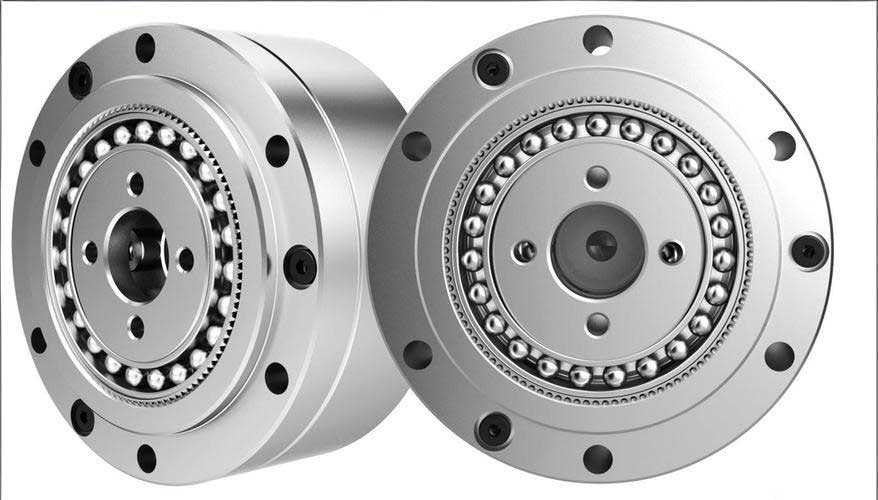
where \(w_0\) is the maximum radial deformation at the major axis (\(\theta = 0\)). This nonlinear deformation profile introduces geometric nonlinearities, requiring advanced simulation techniques. To visualize the assembly, consider the following image, which depicts a typical harmonic drive gear reducer with components similar to those in my study:
For the finite element analysis, I selected ABAQUS due to its robust capabilities in handling nonlinear problems, which are inherent in the harmonic drive gear system. The analysis involved modeling the short cylindrical flexspline and wave generator, with a focus on simulating the contact forces using surface-to-surface contact analysis. I made several simplifying assumptions to streamline the process: the wave generator was treated as a rigid body since it is much stiffer than the flexspline; the elastic deformation of the flexspline was considered small relative to its dimensions; the neutral axis of the flexspline was assumed inextensible; and the tooth region was simplified into an equivalent smooth shell to reduce computational complexity. The equivalent height \(h\) for this shell was calculated using:
$$h = \sqrt[3]{1.67S}$$
where \(S\) is the wall thickness. This approximation allows the entire tooth region to participate in deformation, capturing the essential stress characteristics without modeling individual teeth, which is acceptable given the small module and high tooth count in this harmonic drive gear.
I created the geometric models in a CAD software and imported them into ABAQUS. The flexspline was meshed with 8-node linear reduced integration hexahedral elements (C3D8R), with 120 seeds along the circumference, resulting in 3120 elements. The wave generator was defined as a discrete rigid body and meshed with 4-node bilinear rigid quadrilateral elements (R3D4), with 50 seeds along its circumference, totaling 100 elements. The contact pair was established with the wave generator as the master surface and the flexspline inner surface as the slave surface, using a penalty friction formulation with a coefficient of 0.1 to simulate realistic interaction. Boundary conditions were applied to mimic the assembly process: in the initial step, the flexspline was constrained in the axial (z) direction, and the wave generator was positioned to just touch the flexspline edge; in the loading step, the wave generator was displaced axially to fully insert it into the flexspline, while all other degrees of freedom were restricted. The analysis step was defined as static, general, to capture the quasi-static stress response during assembly, which is representative of the operating conditions in a harmonic drive gear.
The results of the finite element analysis revealed important insights into the stress distribution within the short cylindrical flexspline of the harmonic drive gear. The maximum stress occurred at the contact regions between the flexspline and the wave generator, specifically at the major and minor axes of the ellipse. The stress distribution was symmetric around the circumference, with peaks at the axes and troughs in between. This pattern aligns with the deformation equation \(w = w_0 \cos(2\theta)\), as the stress is directly related to the radial displacement. The maximum von Mises stress observed was 97.36 MPa at the major axis contact area, which is within acceptable limits for typical flexspline materials like alloy steel. Notably, the short cylindrical design avoided stress concentration at a diaphragm corner, a common issue in cup-shaped flexsplines, thereby potentially enhancing the fatigue life of the harmonic drive gear. To quantify the stress variation, I extracted data along a circumferential path on the flexspline inner surface, as shown in Table 2.
| Angular Position \(\theta\) (degrees) | Von Mises Stress (MPa) | Notes |
|---|---|---|
| 0 (Major Axis) | 97.36 | Maximum stress |
| 45 | 45.21 | Intermediate region |
| 90 (Minor Axis) | 85.74 | High stress due to contact |
| 135 | 44.89 | Intermediate region |
| 180 | 96.98 | Near major axis symmetry |
The stress distribution can be further described by a piecewise function derived from the FEA results. For \(0 \leq \theta \leq 90^\circ\), the stress \(\sigma\) approximates:
$$\sigma(\theta) = \sigma_{\text{max}} e^{-k\theta} + \sigma_{\text{min}} (1 – e^{-k\theta})$$
where \(\sigma_{\text{max}}\) is the peak stress at the axes, \(\sigma_{\text{min}}\) is the minimum stress at 45°, and \(k\) is a decay constant obtained from curve fitting. This empirical model helps in predicting stress hotspots during the design phase of a harmonic drive gear. Additionally, I performed a sensitivity analysis to understand the impact of key parameters on stress, such as wall thickness \(S\) and deformation \(w_0\). The results, summarized in Table 3, indicate that increasing wall thickness reduces stress but adds weight, while larger deformation increases stress nonlinearly, highlighting trade-offs in harmonic drive gear optimization.
| Parameter | Baseline Value | Variation | Max Stress Change (%) |
|---|---|---|---|
| Wall Thickness (S) | 0.6 mm | +10% | -12.5 |
| Wall Thickness (S) | 0.6 mm | -10% | +15.3 |
| Radial Deformation (w_0) | 0.2 mm | +10% | +18.7 |
| Radial Deformation (w_0) | 0.2 mm | -10% | -16.9 |
In discussing these findings, it is essential to emphasize the advantages of the short cylindrical flexspline for harmonic drive gear applications. By eliminating the long barrel, this design reduces material costs and machining difficulty, while the gear-key connection enhances torque transmission efficiency. The finite element analysis confirms that stress is concentrated only at the wave generator contact zones, with no secondary stress risers, which should improve fatigue resistance. Compared to traditional cup-shaped flexsplines, where stress can exceed 150 MPa at the diaphragm corner, the short cylindrical version offers a more uniform stress distribution, potentially extending the service life of the harmonic drive gear. Furthermore, the compact geometry allows for higher limiting speed ratios, as the reduced inertia minimizes dynamic effects at high rotations. These benefits make the short cylindrical flexspline a promising alternative for next-generation harmonic drive gear systems in robotics and aerospace.
To generalize the results, I derived a dimensionless stress index \(\Psi\) for harmonic drive gear flexsplines, defined as:
$$\Psi = \frac{\sigma_{\text{max}} E}{w_0^2 / d}$$
where \(E\) is the Young’s modulus of the flexspline material, \(w_0\) is the radial deformation, and \(d\) is the inner diameter. For my model, \(\Psi\) was calculated to be 0.45, which falls within the typical range of 0.4–0.6 for efficient harmonic drive gear designs. This index can be used as a quick check during preliminary design phases. Additionally, I explored the effect of tooth engagement on stress by modeling a simplified gear mesh using spring elements in ABAQUS, but the core conclusions remained unchanged: the contact-driven deformation dominates the stress field in this harmonic drive gear configuration.
In conclusion, my finite element analysis of the short cylindrical flexspline in a harmonic drive gear system demonstrates its structural superiority over conventional designs. The stress distribution is symmetric and confined to the wave generator contact areas, with a maximum value that is manageable for common engineering materials. The use of ABAQUS with surface-to-surface contact analysis proved effective in capturing the nonlinear behavior inherent to harmonic drive gear assemblies. Future work could involve dynamic analysis under load, thermal effects, and experimental validation to further optimize the design. By leveraging these insights, engineers can develop more reliable and compact harmonic drive gear units for demanding applications, pushing the boundaries of precision motion control.