
In my exploration of precision motion control systems, the harmonic drive gear stands out as a pivotal technology. Its unique operating principle, relying on the controlled elastic deformation of a flexspline component, confers exceptional advantages: high single-stage reduction ratios, near-zero backlash, compact form factor, and high torque capacity. These attributes have cemented its role in demanding fields such as aerospace robotics, satellite positioning mechanisms, semiconductor manufacturing equipment, and advanced medical devices. However, the very mechanism that enables its superior performance—the elastic wave generation within the flexspline—also introduces significant design challenges. Paramount among these is the problem of interference during meshing, a phenomenon that induces parasitic friction, generates excessive heat, accelerates wear, and ultimately compromises transmission accuracy and service life. This article details my investigation into this critical issue, employing a rigorous finite element method (FEM) based approach to not only diagnose interference but to actively redesign a key component, the circular spline, for its effective mitigation.
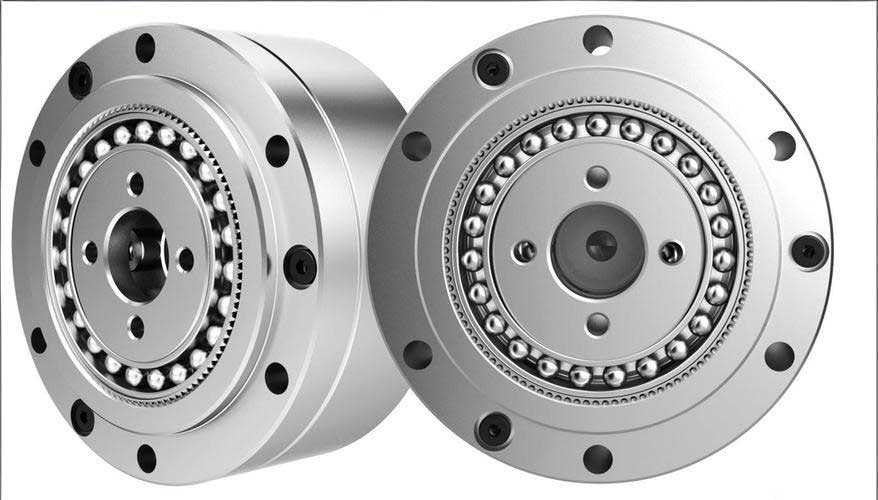
The core of a harmonic drive gear assembly consists of three primary elements: the Wave Generator (WG), an elliptical bearing assembly that serves as the input; the Flexspline (FS), a thin-walled, flexible external gear that deforms under the WG’s influence; and the Circular Spline (CS), a rigid internal gear with a slightly greater number of teeth than the Flexspline, which acts as the stationary or slow-rotation output. The fundamental kinematic relationship is governed by the tooth difference. For a single-wave generator, the gear reduction ratio i is given by:
$$ i = -\frac{N_f}{N_f – N_c} $$
where \( N_f \) is the number of teeth on the flexspline and \( N_c \) is the number of teeth on the circular spline. The negative sign indicates a reversal in the direction of rotation. The transmission occurs in two principal zones along the major axis of the deformed flexspline ellipse. While traditional geometric analysis provides a foundational understanding, it fails to account for the complex, nonlinear stress-strain relationship within the deforming flexspline body, particularly in cup-type designs where a consequential axial tilt or “coning” effect manifests. This tilt causes the tooth profile at the open end of the flexspline cup to deviate radially outward compared to the profile at the closed diaphragm end, leading to severe and uneven interference with a traditionally straight-tooth circular spline.
To move beyond the limitations of pure geometric theory, I adopted a simulation-driven design methodology centered on nonlinear finite element analysis. The objective was to create a high-fidelity virtual prototype capable of simulating the quasi-static assembly process of the wave generator into the flexspline, capturing the resulting stress field and deformed geometry, and subsequently analyzing the meshing interface with the circular spline. This approach allows for visualizing and quantifying interference in a way that closely mirrors physical reality.
The first step was constructing accurate three-dimensional solid models. The harmonic drive gear model was parameterized based on a standard cup-type configuration. The flexspline geometry is defined by the following critical dimensions and gear parameters:
| Parameter | Symbol | Value |
|---|---|---|
| Module | \( m \) | 0.5 mm |
| Number of Teeth (Flexspline) | \( N_f \) | 120 |
| Number of Teeth (Circular Spline) | \( N_c \) | 122 |
| Pressure Angle | \( \alpha \) | 20° |
| Addendum Coefficient | \( h_a^* \) | 0.5 |
| Dedendum Clearance Coefficient | \( c^* \) | 0.25 |
| Profile Shift Coefficient | \( x \) | 1.8 |
| Major Axis of Wave Generator | \( a \) | 30.500 mm |
| Minor Axis of Wave Generator | \( b \) | 29.505 mm |
The modeling of the wave generator was simplified for computational efficiency while preserving the essential kinematics. The complex assembly of a cam and a thin-walled柔性轴承 (flexible bearing) was consolidated into a single, rigid elliptical solid with the prescribed major and minor axes. This simplification is justified because the primary interest lies in the final deformed state of the flexspline imposed by the wave generator’s nominal ellipse, and the areas of worst interference occur where the flexspline is in full contact with the wave generator surface (i.e., along the major axis).
The finite element pre-processing phase is critical for result accuracy. I assigned material properties typical of high-strength alloy steels used in harmonic drive gears:
| Property | Value |
|---|---|
| Young’s Modulus (E) | 1.97 x 10¹¹ Pa |
| Poisson’s Ratio (ν) | 0.3 |
| Density (ρ) | 7850 kg/m³ |
A higher-order 3D solid element, SOLID186 in the ANSYS environment, was selected for its quadratic displacement behavior and suitability for modeling complex geometries and contact. A disciplined meshing strategy was employed: the tooth region of the flexspline, being the area of primary interest, was meshed with a controlled, fine hexahedral mesh to accurately resolve contact stresses and profile geometry. The cup body and diaphragm were meshed with a tetrahedral mesh, balancing detail and computational cost. Contact between the wave generator (target surface) and the flexspline inner bore (contact surface) was defined using a surface-to-surface contact formulation. The contact algorithm accounted for friction, with a coefficient set to 0.1, and used an augmented Lagrange method for robust enforcement. The boundary conditions fixed all degrees of freedom on the inner rim of the flexspline’s mounting diaphragm, simulating a bolted connection to a rigid interface. The wave generator was given a prescribed radial “overclosure” displacement to simulate the press-fit assembly process. This is a nonlinear static analysis involving both material and geometric nonlinearities (large strain). The solver settings were configured accordingly, activating large deflection effects and using a sparse direct solver for stability.
The simulation of the assembly process successfully reveals the deformed state of the harmonic drive gear flexspline under the wave generator’s influence. Post-processing the results allows for the extraction of the precise nodal displacements of the flexspline tooth profile. A critical finding is the non-uniform radial deformation along the tooth face width. Let us define a coordinate system where the Z-axis is aligned with the harmonic drive gear’s rotational axis, positive from the diaphragm towards the open end. The Y-axis is aligned with the major axis of deformation. Analysis of nodes on the major axis at the open-end tooth profile reveals displacement components: \( U_x \approx 0 \), \( U_y \approx 0.6179 \) mm, \( U_z \approx 0.1463 \) mm. This confirms the presence of the tilt: the tooth at the open end is not only displaced radially outward by \( U_y \) but also exhibits a slight axial shift.
To analyze interference, the undeformed geometry of a standard, straight-tooth circular spline is imported into the post-processor and superimposed onto the deformed flexspline mesh. A sectional view through the meshing zone on the major axis provides a clear visual. The interference is severe and concentrated on the flank of the tooth, as the tilted flexspline tooth profile “rams” into the side of the rigid circular spline tooth. Quantitative estimation through localized mesh refinement shows an interference depth of approximately 0.05 mm along the tooth flank normal direction in the worst-case location. This level of interference is unacceptable for precision harmonic drive gear operation.
The finite element results provide the direct, quantitative data needed for a targeted redesign. The core insight is that to achieve conjugate meshing with the elastically deformed and tilted flexspline, the circular spline cannot be a simple cylindrical gear; it must be modified to accommodate the deformation field. The proposed solution is to redesign the circular spline as a conical gear or a gear with a tapered tooth line. The design principle is to align the tooth line of the circular spline with the effective path of the deformed flexspline tooth.
From the simulation data, we can derive the required modification. The effective radial offset \( \Delta R(z) \) of the flexspline tooth profile is a function of the axial position \( z \). At the diaphragm end (z=0), the radial displacement is the nominal wave generator deflection \( w_0 = a – r_{nom} \), where \( r_{nom} \) is the nominal flexspline bore radius. At the open end (z=L, where L is the face width), the radial displacement is \( w_L = w_0 + \Delta w \), where \( \Delta w = U_y \) from our simulation. Assuming a linear tilt (a reasonable first-order approximation), the offset function is:
$$ \Delta R(z) = w_0 + \frac{z}{L} \Delta w $$
Therefore, the effective pitch radius of the conjugate circular spline should vary as:
$$ R_{c,eff}(z) = R_{c, nominal} + \Delta R(z) $$
where \( R_{c, nominal} \) is the pitch radius of the original design. This translates to designing a conical circular spline where the addendum and dedendum circles, and consequently the entire tooth profile, are scaled linearly along the axis. In the specific case studied, the circular spline tooth profile at the open-end mating section is designed with its addendum and dedendum radii increased by \( \Delta w = 0.6179 \) mm compared to the diaphragm-end profile. The face width is also correspondingly adjusted to \( L’ = L – U_z \) to maintain proper axial registration.
To validate this redesign, a new circular spline model conforming to this conical geometry is created. For clarity in post-processing visualization, a cylindrical “slice” representing the gear at the open-end mating section is modeled. This new model is superimposed onto the same deformed flexspline results. The comparative analysis is striking. The severe flank interference observed with the traditional design is completely eliminated. The modified circular spline tooth profile now closely follows the natural deformed path of the flexspline tooth, resulting in a clear and uniform flank clearance along the entire path of contact. This state of near-zero interference, or “kissing contact,” is the ideal condition for a harmonic drive gear, minimizing friction and wear while maintaining full kinematic engagement.
The implications of this FEM-driven redesign methodology for harmonic drive gear development are substantial. The process outlined demonstrates a clear workflow: (1) Construct a detailed nonlinear FEM model of the assembly process. (2) Extract the true deformed geometry of the flexspline, quantifying the tilt effect. (3) Use this displacement field as direct input to redefine the geometry of the mating circular spline, transforming it from a cylindrical to a conical form. This approach possesses key advantages over traditional trial-and-error or purely geometric methods:
| Advantage | Description |
|---|---|
| Fidelity to Physics | Accounts for nonlinear elasticity, large deformation, and contact, providing a result aligned with real-world behavior. |
| Interference Visualization | Enables direct, qualitative and quantitative assessment of meshing quality before physical prototyping. |
| Targeted Design Iteration | Simulation data provides specific, actionable geometric corrections, drastically reducing design cycles. |
| Performance Optimization | By achieving zero interference, transmission efficiency is increased and thermal loading decreased, directly enhancing the harmonic drive gear’s lifespan and reliability. |
Furthermore, this methodology opens avenues for advanced optimization. With a robust FEM model as the core, one can explore the design space more aggressively. For instance, the profile shift coefficient \( x \), the pressure angle \( \alpha \), and even non-standard tooth profile modifications can be parameterized and studied in conjunction with the conical correction to maximize load distribution, minimize stress concentration in the flexspline, and optimize the kinematic error curve of the harmonic drive gear. The face cone angle of the circular spline, initially derived from a linear assumption, can be iteratively refined using the full nonlinear displacement field to achieve perfect conjugacy.
In conclusion, the problem of interference in harmonic drive gears, particularly cup-type designs, is a direct consequence of the elastic deformation mechanics that define their operation. Traditional design rules are insufficient to address the complex tilt and deformation of the flexspline tooth line. By adopting a finite element analysis-based approach, I have demonstrated a powerful framework for diagnosing and solving this problem. The process involves simulating the elastic assembly to capture the true deformed state, analyzing the resulting interference with a standard circular spline, and then using the precise deformation data to redesign the circular spline into a conical configuration that matches the flexspline’s deformed geometry. This method transforms the design process from one of geometrical approximation to one of simulation-informed precision, leading to harmonic drive gear assemblies with significantly reduced interference, lower operating temperatures, higher transmission efficiency, and extended operational life. This represents a critical step forward in the design and optimization of these indispensable components for high-performance mechatronic systems.