
In the field of precision motion control and power transmission, the harmonic drive gear stands out as a revolutionary mechanism. Its operation, based on the controlled elastic deformation of a flexible component, offers unparalleled advantages including high reduction ratios in a single stage, exceptional positional accuracy with minimal backlash, high torque capacity, and a compact, coaxial design. The core of this transmission consists of three primary elements: a rigid circular spline (rigidspline), a flexible spline (flexspline), and an elliptical wave generator. The unique performance characteristics are intrinsically linked to the meshing behavior between the teeth of the flexspline and the rigidspline.
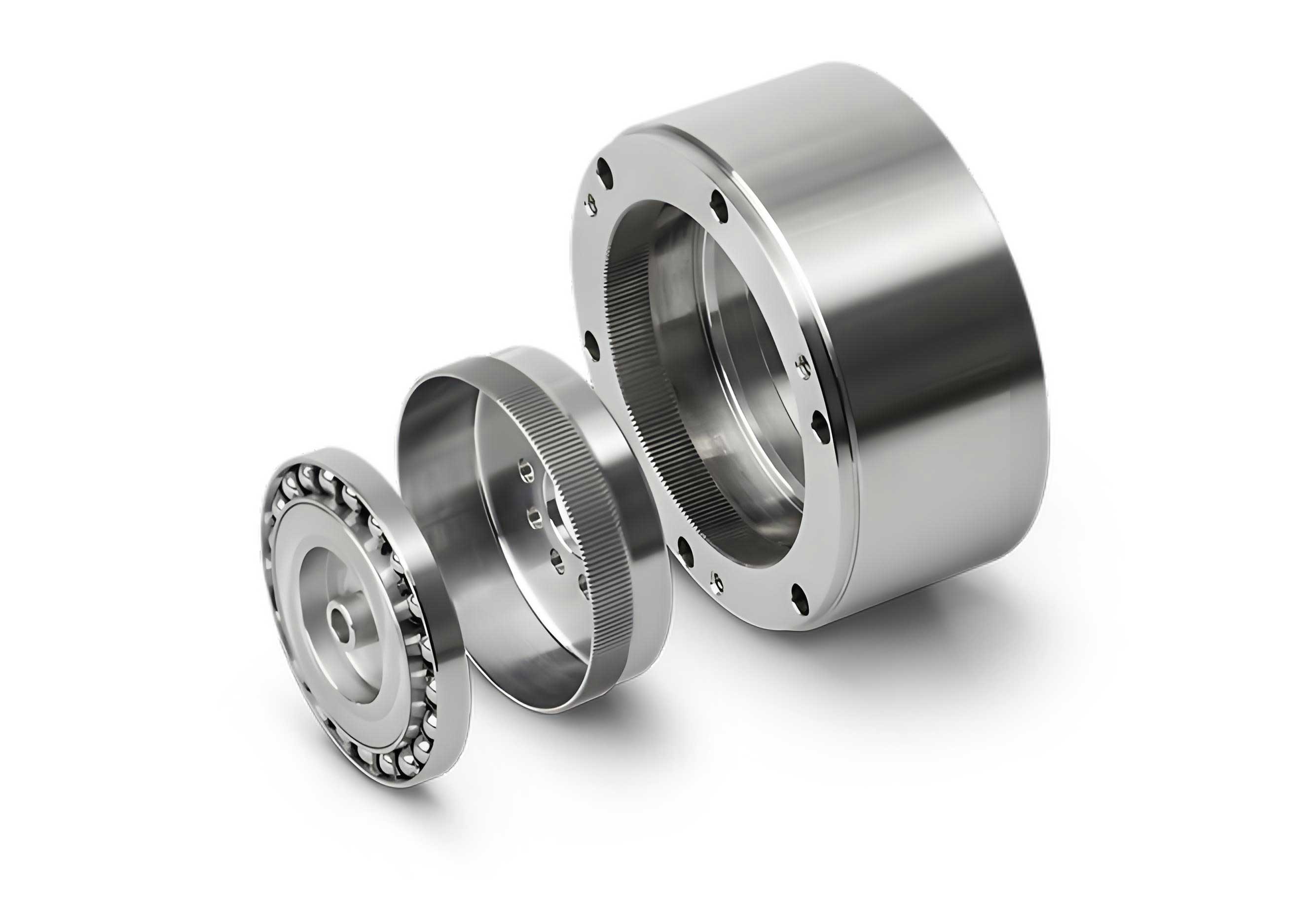
Unlike conventional rigid gear systems where strict conjugate action is paramount, the presence of controlled deformation in the harmonic drive gear system introduces a degree of tolerance. This tolerance shifts the primary design focus from achieving perfect theoretical conjugation to optimizing tooth profile parameters for enhanced load distribution, stress reduction, and manufacturability. This exploration delves into the design and derivation of a specific tooth form known as the CTC double-circular-arc profile for harmonic drive gear applications, utilizing the robust Tooth Profile Normal Method for conjugate generation.
Fundamental Theory: The Tooth Profile Normal Method
The kinematic foundation for generating conjugate gear tooth profiles is encapsulated in the Fundamental Law of Gearing. This law states that for a constant velocity ratio between two gears, the common normal line at the point of contact between two mating tooth profiles must, at every instant, pass through a fixed point on the line of centers, known as the pitch point. The Tooth Profile Normal Method is a direct and powerful application of this law.
In the context of gear generation, such as when a hob (modeled as a rack cutter) produces a gear, the process is equivalent to the pure rolling of the pitch line of the rack against the pitch circle of the gear blank. For a point on the rack cutter profile to become a point of contact on the generated gear profile, its surface normal must intersect the instantaneous center of motion—the pitch point. This geometric condition allows us to systematically determine the locus of all contact points, which forms the conjugate gear tooth profile.
The mathematical implementation involves coordinate transformations. Consider a coordinate system $S_1(x_1, y_1)$ fixed to the rack cutter, with its origin on the rack’s pitch line. Another coordinate system $S_2(x_2, y_2)$ is fixed to the gear blank, with its origin at the gear’s rotation center. The transformation from the rack coordinates to the gear coordinates, accounting for the rolling motion, is given by:
$$
\begin{bmatrix} x_2 \\ y_2 \\ 1 \end{bmatrix} =
\begin{bmatrix}
\cos\varphi_2 & \sin\varphi_2 & \rho_2(\sin\varphi_2 – \varphi_2 \cos\varphi_2) \\
-\sin\varphi_2 & \cos\varphi_2 & \rho_2(\cos\varphi_2 + \varphi_2 \sin\varphi_2) \\
0 & 0 & 1
\end{bmatrix}
\begin{bmatrix} x_1 \\ y_1 \\ 1 \end{bmatrix}
$$
where $\varphi_2$ is the rotation angle of the gear and $\rho_2$ is the radius of its pitch circle. The key is to determine the correct $\varphi_2$ for each point $(x_1, y_1)$ on the cutter profile such that the normal condition is satisfied. This angle is derived from the geometry of the normal line:
$$
l = x_1 + y_1 \cdot \tan\gamma
$$
$$
\text{and} \quad \varphi_2 = \frac{l}{\rho_2}
$$
where $\gamma$ is the angle between the tangent to the cutter profile at $(x_1, y_1)$ and the $x_1$-axis, given by $\tan\gamma = \frac{dy_1/du}{dx_1/du}$ for a parameterized profile. The sign of $l$ indicates the direction of the rack’s translation relative to its starting position.
Design Methodology for CTC Harmonic Drive Gears
The overarching technical strategy for designing a CTC double-circular-arc harmonic drive gear set follows a logical, step-by-step process aimed at practical manufacturability. The flexspline, being an external gear, is typically produced by hobbing. The rigidspline, an internal gear, is produced by shaping (using a pinion cutter). Therefore, the design flow originates from the definition of the tool’s basic tooth profile.
The systematic design flowchart can be summarized as follows:
- Select the basic rack profile (hob profile) with a CTC double-circular-arc form.
- Apply the Tooth Profile Normal Method to generate the theoretical tooth profile of the flexspline from the chosen hob profile.
- Using the generated flexspline tooth profile as the “cutter,” apply the conjugate condition (again via the Tooth Profile Normal Method, but adapted for internal meshing) to derive the theoretical conjugate profile of the rigidspline.
- Since the theoretical rigidspline profile may be complex, fit its discrete coordinate points to a standard CTC double-circular-arc equation using a numerical method like Least Squares. This ensures the final rigidspline profile is manufacturable with a standard or slightly modified pinion cutter.
- Finally, back-calculate the required profile of the pinion cutter that will generate this fitted rigidspline profile.
This methodology ensures that both the flexspline and rigidspline of the harmonic drive gear pair share the same optimized double-circular-arc geometry, promoting favorable meshing characteristics.
CTC Hob Basic Profile and its Parametric Definition
The foundation of the entire process is the CTC (Circular Tip and Circular root with a straight middle section) double-circular-arc basic rack profile. This profile, which defines the hob’s cutting edges, comprises three distinct segments: a convex circular arc at the tip (addendum), a concave circular arc at the root (dedendum), and a straight-line segment connecting them. The parameters defining this profile are crucial for subsequent calculations.
The profile is defined in the hob coordinate system $S_1(x_1, y_1)$ with the $y_1$-axis as the symmetry axis. The parametric equations for each segment are as follows:
1. Tip Circular Arc Segment (AB): This is a convex arc of radius $\rho_f$.
$$ x_1 = \rho_f \cos\alpha – l_f $$
$$ y_1 = -\rho_f \sin\alpha + e_f $$
where $\alpha$ is the parameter angle for this arc.
2. Middle Straight-Line Segment (BC): This is a tangent line connecting the tip and root arcs.
$$ y_1 = k x_1 + b $$
where $k$ is the slope and $b$ is the y-intercept, determined by tangency conditions with the adjacent arcs.
3. Root Circular Arc Segment (CD): This is a concave arc of radius $\rho_a$.
$$ x_1 = -\rho_a \cos\beta + l_a + \frac{\pi m}{2} $$
$$ y_1 = \rho_a \sin\beta + e_a $$
where $\beta$ is the parameter angle for this arc, $m$ is the module, and $\frac{\pi m}{2}$ positions the profile correctly relative to the datum line.
The key geometric parameters for a typical CTC profile are summarized in the table below:
| Parameter | Symbol | Description | Typical Relation |
|---|---|---|---|
| Tip Arc Radius | $\rho_f$ | Radius of the convex addendum arc. | $\rho_f \approx 1.3m$ |
| Root Arc Radius | $\rho_a$ | Radius of the concave dedendum arc. | $\rho_a \approx 1.4m$ |
| Arc Center Offsets | $l_f, e_f, l_a, e_a$ | Coordinates locating the centers of the tip and root arcs. | Defined by pressure angle and arc tangency. |
| Module | $m$ | Standard metric defining gear size. | Primary design variable. |
| Pressure Angle | $\phi$ | Angle of the force transmission line. | Often 20° or 30° for harmonic drives. |
Generation of the Flexspline Tooth Profile
With the hob profile defined, the next step is to generate the tooth profile of the flexspline. As mentioned, this is modeled as the conjugate envelope formed by the hob (rack) rolling without slip around the flexspline gear blank. The generation must be performed segment-by-segment due to the composite nature of the CTC hob profile. The required rotation angle $\varphi_2$ for each point on the hob is calculated using the formula $l = x_1 + y_1 \tan\gamma$.
1. Generation from Hob Tip Arc (AB):
For points on the convex tip arc AB, the calculated rolling distance $l$ is typically negative. This means the rack translates to the left from its starting position, and the gear rotates clockwise ($\varphi_2 < 0$). Substituting the parametric equations of segment AB into the coordinate transformation matrix yields the flexspline root (fillet) profile:
$$
\begin{aligned}
x_2 &= (\rho_f \cos\alpha – l_f)\cos\varphi_2 + (-\rho_f \sin\alpha + e_f)\sin\varphi_2 + \rho_2(\sin\varphi_2 – \varphi_2 \cos\varphi_2) \\
y_2 &= (-\rho_f \sin\alpha + e_f)\cos\varphi_2 – (\rho_f \cos\alpha – l_f)\sin\varphi_2 + \rho_2(\cos\varphi_2 + \varphi_2 \sin\varphi_2)
\end{aligned}
$$
where $\varphi_2$ is a function of $\alpha$ derived from the normal condition.
2. Generation from Hob Middle Straight Line (BC):
The straight-line segment produces the active, involute-like portion of the flexspline tooth flank. Here, the sign of $l$ changes. For points near the lower end (closer to the pitch line), $l$ is negative. For points near the upper end, $l$ becomes positive. The transition point corresponds to where the profile normal passes directly through the pitch point at the start of motion. The conjugate profile for this segment is:
$$
\begin{aligned}
x_2 &= x_1\cos\varphi_2 + (k x_1 + b)\sin\varphi_2 + \rho_2(\sin\varphi_2 – \varphi_2 \cos\varphi_2) \\
y_2 &= (k x_1 + b)\cos\varphi_2 – x_1\sin\varphi_2 + \rho_2(\cos\varphi_2 + \varphi_2 \sin\varphi_2)
\end{aligned}
$$
where $x_1$ is the parameter along the line, and $\varphi_2$ is its corresponding function.
3. Generation from Hob Root Arc (CD):
For points on the concave root arc CD, the rolling distance $l$ is positive. The rack translates to the right, and the gear rotates counterclockwise ($\varphi_2 > 0$). This generates the flexspline tip profile:
$$
\begin{aligned}
x_2 &= (-\rho_a \cos\beta + l_a + \frac{\pi m}{2})\cos\varphi_2 + (\rho_a \sin\beta + e_a)\sin\varphi_2 + \rho_2(\sin\varphi_2 – \varphi_2 \cos\varphi_2) \\
y_2 &= (\rho_a \sin\beta + e_a)\cos\varphi_2 – (-\rho_a \cos\beta + l_a + \frac{\pi m}{2})\sin\varphi_2 + \rho_2(\cos\varphi_2 + \varphi_2 \sin\varphi_2)
\end{aligned}
$$
where $\varphi_2$ is a function of $\beta$.
By calculating discrete points across all three segments, the complete theoretical tooth profile of the flexspline for the harmonic drive gear is obtained.
Derivation of the Conjugate Rigidspline Profile
The core challenge in harmonic drive gear design is determining the rigidspline tooth profile that will correctly mesh with the deformed flexspline. For the initial theoretical derivation, we consider the meshing between the generated flexspline profile (now treated as a “cutter”) and the rigidspline blank. The principle remains the Tooth Profile Normal Method, but the coordinate systems and rolling conditions are adapted for internal gear generation.
Let a coordinate system $S_f(x_f, y_f)$ be attached to the flexspline tooth, and $S_r(x_r, y_r)$ be attached to the rigidspline blank. The relative motion is the rotation of the flexspline relative to the rigidspline, simulating their engagement via the wave generator. The conjugate condition still requires the common normal at the contact point to pass through the instantaneous center of rotation (the pitch point for the internal-external gear pair).
The transformation from the flexspline tooth point $(x_f, y_f)$ to its conjugate point on the rigidspline $(x_r, y_r)$ involves a rotation and translation based on the relative motion angle $\psi$:
$$
\begin{bmatrix} x_r \\ y_r \\ 1 \end{bmatrix} =
\begin{bmatrix}
\cos\psi & -\sin\psi & -C \sin\psi \\
\sin\psi & \cos\psi & C(1 – \cos\psi) \\
0 & 0 & 1
\end{bmatrix}
\begin{bmatrix} x_f \\ y_f \\ 1 \end{bmatrix}
$$
where $C$ is the distance between the centers of the rigidspline and the undeformed flexspline (equal to the difference in their pitch radii), and $\psi$ is the relative rotation parameter. The critical step is determining the function $\psi$ for each point on the flexspline profile. This is found by solving the equation derived from the normal condition:
$$
( y_f’ \cos\psi – x_f’ \sin\psi )(x_f – y_f \frac{dx_f}{dy_f}) – C( x_f’ \sin\psi – y_f’ (1 – \cos\psi) ) = 0
$$
where $x_f’ = dx_f/du$ and $y_f’ = dy_f/du$. Solving this equation numerically for $\psi$ for each discrete point $(x_f, y_f)$ on the flexspline profile allows the application of the transformation matrix to generate the set of discrete conjugate points $(x_r, y_r)$ defining the theoretical rigidspline tooth profile.
Profile Fitting and Practical Implementation
The discrete points $(x_r, y_r)$ obtained from the conjugate derivation do not, in general, lie exactly on a simple, standard CTC arc profile. To ensure manufacturability—specifically, to allow the rigidspline to be cut using a standard or easily fabricated pinion cutter with a double-circular-arc profile—a fitting process is essential. The goal is to find the optimal CTC arc parameters that best approximate the theoretical conjugate points.
The Least Squares Method is employed for this purpose. We define an error function $E$ as the sum of squared distances between the theoretical points and a candidate CTC profile defined by its parameter set $\mathbf{P} = [\rho_{a,r}, \rho_{f,r}, l_{a,r}, e_{a,r}, l_{f,r}, e_{f,r}, k_r, b_r]$ (where subscript $r$ denotes rigidspline parameters).
$$
E(\mathbf{P}) = \sum_{i=1}^{N} d_i(\mathbf{P})^2
$$
Here, $d_i(\mathbf{P})$ is the shortest distance from the $i$-th theoretical point to the composite CTC curve (comprising the three segments). The optimization problem is to find the parameter set $\mathbf{P}^*$ that minimizes $E$:
$$
\mathbf{P}^* = \arg\min_{\mathbf{P}} E(\mathbf{P})
$$
This nonlinear minimization problem is solved using numerical algorithms such as the Levenberg-Marquardt method. The success of the fitting is typically high, demonstrating that the conjugate of a CTC profile is itself very closely approximated by another CTC profile. This is a significant finding for the design of harmonic drive gear sets, as it validates the use of a consistent, manufacturable tooth form for both mating gears. The results of a typical fitting process can be summarized as follows:
| Profile Parameter | Hob (Input) | Theoretical Rigidspline (Calculated) | Fitted Rigidspline (Optimized) | Error (RMS) |
|---|---|---|---|---|
| Tip Arc Radius ($\rho$) | 1.30m | — | ~1.35m | < 0.001m |
| Root Arc Radius ($\rho$) | 1.40m | — | ~1.38m | |
| Pressure Angle ($\phi$) | 30° | — | ~29.5° | |
| Profile Type | CTC Double Arc | Complex Curve | CTC Double Arc |
Determination of the Pinion Cutter Profile
The final step in the manufacturing chain for the harmonic drive gear rigidspline is to design the pinion cutter that will generate its fitted CTC profile. This process essentially reverses the initial logic. The fitted rigidspline profile is now treated as the “internal gear” to be generated. The pinion cutter (an external gear) is the generating tool. Using the same Tooth Profile Normal Method for internal gear generation, but now solving for the cutter profile that would generate the known rigidspline profile, we can derive the required tooth form of the pinion cutter.
The mathematical formulation is analogous to the rigidspline derivation but with the roles reversed. Given the parametric equation of the fitted rigidspline profile $R_r(u)$ and the known kinematics of the shaping process (relative center distance $C_c$ and velocity ratio), we set up the conjugate condition to solve for the corresponding point on the pinion cutter $P_c(v)$ for each parameter value $u$. The resulting set of points $P_c$ defines the cutting edges of the pinion tool. In practice, this profile is also very close to a CTC double-circular-arc form, allowing it to be manufactured by grinding using standard wheel dressing techniques.
Meshing Characteristics and Advantages of the CTC Profile
The choice of the CTC double-circular-arc profile for a harmonic drive gear is driven by its superior meshing and strength properties compared to traditional involute or single-circular-arc designs.
1. Favorable Contact Conditions: The circular arcs allow for a larger radius of curvature at potential contact points. This reduces contact (Hertzian) stress significantly, which is critical in the harmonic drive gear where multiple tooth pairs share the load. The design can approach a condition of “profile conjugation” where contact occurs over a small area rather than a theoretical line, further distributing stress.
2. Improved Load Capacity and Life: Lower contact stress directly translates to higher permissible loads and longer fatigue life for the gear teeth. This is paramount for high-performance and reliable harmonic drive gear applications in robotics, aerospace, and precision machinery.
3. Optimized Stress Distribution in the Flexspline: The smoothly transitioning CTC profile, especially the generous root fillet generated from the hob’s tip arc, minimizes stress concentration at the critical tooth root of the flexspline. This is where maximum bending stress occurs due to the combined effects of transmitted load and the cyclical deformation from the wave generator.
4. Compensation for Manufacturing and Assembly Errors: The slight deviations from perfect theoretical conjugation, inherent in the fitting process and the elastic nature of the system, are more easily accommodated by the forgiving nature of the circular-arc contact. This can lead to smoother operation and reduced sensitivity to misalignment or dimensional tolerances.
5. Stable and Continuous Meshing: The smooth, continuous nature of the CTC profile ensures a gradual transition of load from one tooth pair to the next as the wave generator rotates. This minimizes vibration and torque ripple, contributing to the exceptional positional accuracy for which harmonic drive gear systems are renowned.
Conclusion
The design and analysis of tooth profiles for a harmonic drive gear represent a sophisticated intersection of theoretical gearing principles, computational geometry, and practical manufacturing constraints. The Tooth Profile Normal Method provides a clear, geometrically intuitive, and computationally robust framework for deriving conjugate tooth profiles. By starting from a well-defined CTC double-circular-arc hob profile, generating the flexspline tooth form, conjugating the theoretical rigidspline profile, and finally applying a Least Squares fitting technique, a complete and manufacturable harmonic drive gear tooth geometry is achieved.
The key outcome is the confirmation that a CTC profile on the generating tool leads to a CTC-like profile on both the flexspline and, after fitting, on its conjugate rigidspline. This consistency is of great engineering value, as it allows for the use of standardized or slightly modified circular-arc cutting tools, streamlining the production process for high-performance harmonic drive gear units. The resulting tooth geometry inherently promotes low stress, high load capacity, and smooth motion transmission—attributes that are fundamental to the successful application of harmonic drive gear technology in demanding precision engineering fields.