
The pursuit of perfection in crystal growth, particularly for oxide materials used in advanced piezoelectric and acousto-optic devices, places extraordinary demands on the associated machinery. At the heart of such equipment, often a crystal puller or furnace, lies a critical component responsible for smooth, precise, and reliable rotational motion: the speed reducer. Traditional reducer solutions frequently fall short in meeting the concurrent requirements of high positional accuracy, compactness, substantial torque capacity, and minimal backlash. In this context, the harmonic drive gear transmission system emerges as a uniquely advantageous technology. Having spearheaded the development of a specialized reducer for an oxide single crystal furnace, I will detail the comprehensive design philosophy, analytical methodology, and practical implementation of a novel harmonic drive gear reducer. This system, designed for ultra-precise motion control, leverages the inherent benefits of harmonic drive gear principles to achieve performance metrics surpassing those of conventional counterparts.
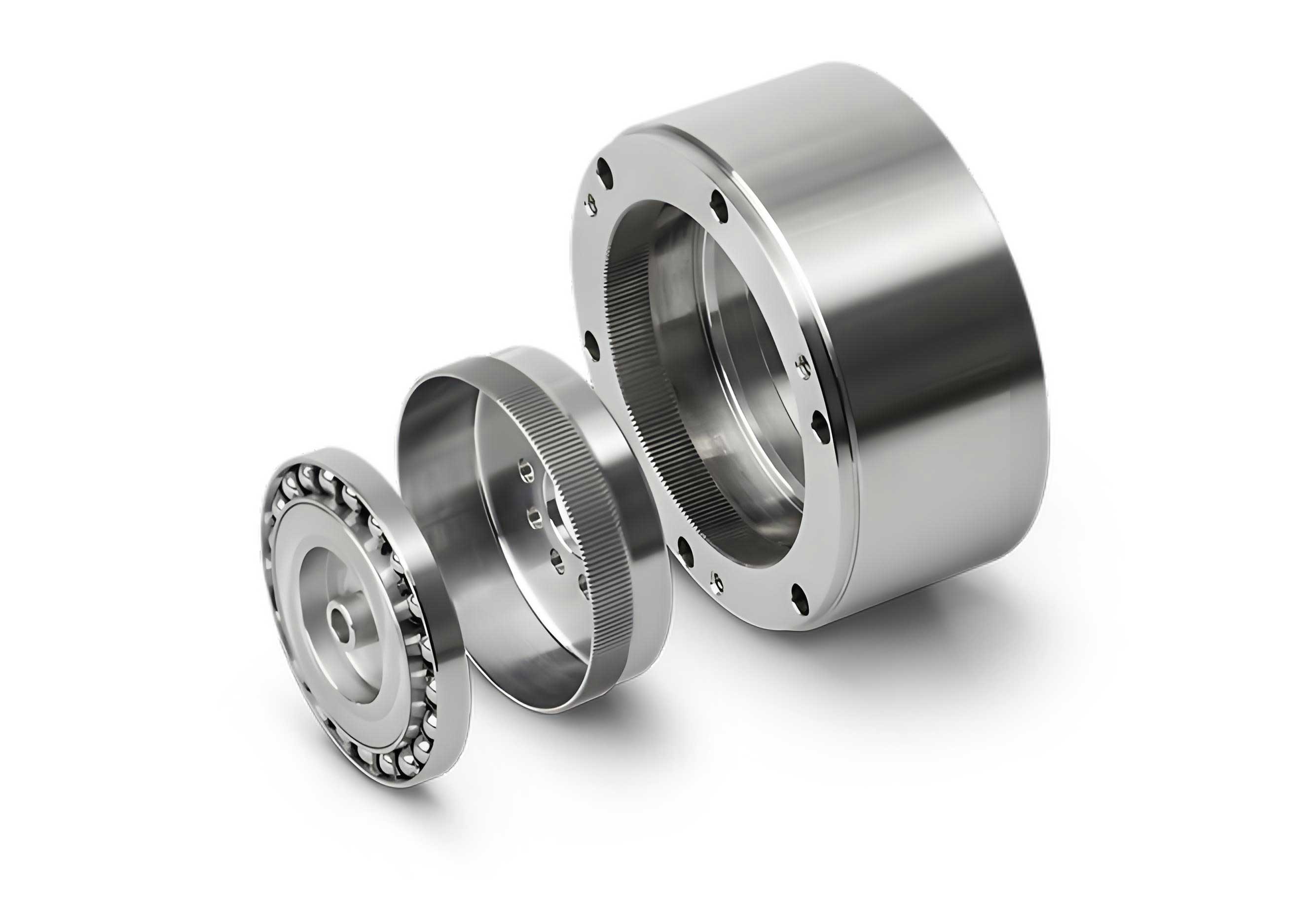
The fundamental operating principle of a harmonic drive gear system is elegantly simple yet mechanically profound. It operates based on controlled elastic deformation rather than rigid-body kinematics. The core assembly consists of three primary elements: a rigid circular spline (often referred to as the “circular spline” or “ring gear”), a flexible spline (the “flexspline” or “cup”), and a wave generator. In the most common configuration for reducers, the circular spline is fixed, the wave generator serves as the high-speed input, and the flexspline acts as the low-speed, high-torque output. The wave generator, typically an elliptical cam surrounded by a specially designed thin-walled ball bearing, is inserted into the bore of the flexspline. This action forces the initially cylindrical flexspline to assume a controlled elliptical shape. The teeth on the external surface of the flexspline are thereby meshed with the internal teeth of the rigid circular spline at the two opposing lobes of the ellipse.
The kinematic magic occurs due to the difference in tooth count between the two splines. The flexspline typically has two fewer teeth (for a standard two-wave generator) than the circular spline. As the wave generator rotates, the region of mesh between the flexspline and circular spline travels circumferentially. Because the flexspline has fewer teeth, for every full revolution of the wave generator, the flexspline must rotate backwards relative to the circular spline by an amount equivalent to the tooth difference. This results in a very high reduction ratio in a single, compact stage. The reduction ratio \( i \) for a standard strain wave gear is given by:
$$ i = -\frac{Z_f}{Z_f – Z_c} $$
where \( Z_f \) is the number of teeth on the flexspline and \( Z_c \) is the number of teeth on the circular spline. The negative sign indicates the reversal of rotation direction between the wave generator (input) and the flexspline (output). For a design where \( Z_c = 200 \) and \( Z_f = 198 \), the reduction ratio calculates to:
$$ i = -\frac{198}{198 – 200} = -\frac{198}{-2} = 99 $$
This elegant principle grants the harmonic drive gear its signature characteristics: high single-stage reduction ratios, exceptional positional accuracy and repeatability (due to the averaging effect of many simultaneously engaged teeth), near-zero backlash, high torque-to-weight ratio, and coaxial input/output shaft alignment.
Design Specifications and Performance Targets
The development project was initiated with clear, stringent performance targets derived from the operational needs of an oxide single crystal puller. The system demanded not only precise speed reduction but also exceptional stability and minimal error propagation to ensure consistent crystal lattice growth. The following table summarizes the key design specifications that guided the entire development process.
| Parameter | Symbol | Target Value | Unit |
|---|---|---|---|
| Transmission Ratio | \( i \) | 99 | – |
| Rated Output Torque | \( M_{rated} \) | ≥ 30 | N·cm |
| Maximum Short-term Torque | \( M_{max} \) | ≥ 100 | N·cm |
| Transmission Error | \( \Delta \theta \) | ≤ 5 | arc-min |
| Backlash | \( j \) | ≤ 1 | arc-min |
| Torsional Stiffness | \( K_t \) | To be maximized | N·m/rad |
| Axial Runout (Output Flange) | – | ≤ 0.02 | mm |
| Radial Runout (Output Shaft) | – | ≤ 0.01 | mm |
| Operating Temperature Range | – | 0 – 80 | °C |
| Required Service Life | \( L_{10} \) | > 10,000 | hours |
Structural Configuration and Component Design
The developed harmonic drive gear reducer, designated XJ-99, employs a cup-type flexspline configuration. This design was chosen for its excellent torque capacity and suitability for integrating into a flange-mounted assembly. The major components are:
- Wave Generator: Comprising an elliptical cam and a dedicated thin-walled ball bearing. The cam profile is critical for inducing a smooth, predictable deformation in the flexspline.
- Flexspline (Cup): A thin-walled, cylindrical cup with external gear teeth machined near its open end. It is the flexible, torque-transmitting element.
- Circular Spline: A rigid ring with internal gear teeth, fixed within the reducer housing.
- Output Flange/Shaft: Rigidly connected to the closed end (dome) of the flexspline, delivering the reduced output motion.
- Housing and Bearings: Provides structural integrity, precise alignment of components, and support for the output shaft.
The functional relationship between these components is visualized in the provided schematic, showing the meshing at the wave generator lobes.
Detailed Meshing Parameter Design and Calculations
The design of the tooth geometry is paramount for the performance, efficiency, and longevity of the harmonic drive gear. We adopted the widely used “S”-type tooth profile, an involute derivative optimized for conformity and stress distribution under deflection. The following parameters were defined as starting points:
- Module, \( m = 0.3 \) mm
- Pressure Angle, \( \alpha = 20^\circ \)
- Tooth Height Coefficient, \( h_a^* = 1.0 \)
- Bottom Clearance Coefficient, \( c^* = 0.35 \)
- Total Deformation Coefficient, \( w_0^* = 1.0 \) (for initial calculation)
Given the transmission ratio \( i = 99 \) for a dual-wave system, the tooth counts are directly determined:
$$ Z_f = 2 \times i = 198 $$
$$ Z_c = Z_f + 2 = 200 $$
The core of the design lies in calculating the appropriate tooth profile shifts (addendum modifications) for both the flexspline and circular spline to ensure proper meshing under deflection, avoid interference, and optimize contact stress. The process involves determining the parameters of an equivalent virtual spur gear pair. The calculations are summarized below.
1. Equivalent Gear Parameters:
The deformation of the flexspline effectively changes its pitch diameter. We calculate the number of teeth \( Z_v \) on a virtual spur gear that would have the same curvature at the major axis of the deformed flexspline.
$$ Z_v = \frac{Z_f^2}{Z_c – Z_f (2 – K)} $$
where \( K \) is a deflection-related factor, typically slightly less than 2. For initial sizing with \( K \approx 1.99 \):
$$ Z_v \approx \frac{198^2}{200 – 198 \times (2 – 1.99)} \approx \frac{39204}{200 – 1.98} \approx \frac{39204}{198.02} \approx 198.0 $$
A more precise calculation considering the actual deformation yields a value used for subsequent steps.
2. Wave Generator Eccentricity:
The eccentricity \( e \) of the wave generator (half the difference between major and minor axis radii) is fundamentally related to the required radial deformation \( w_0 \) of the flexspline.
$$ w_0 = w_0^* \cdot m = 1.0 \times 0.3 = 0.3 \text{ mm} $$
The theoretical eccentricity is approximately equal to this deformation. However, the final cam profile is optimized to provide a conjugate motion, often leading to a slightly different value, which was refined using finite element analysis (FEA).
3. Profile Shift Coefficients:
To achieve a favorable meshing condition and strength balance, significant profile shifts are applied. The shift coefficient \( x_f \) for the flexspline is typically positive, while \( x_c \) for the circular spline is negative. Their determination involves solving a system of equations ensuring correct operating center distance, sufficient tip clearance, and avoidance of undercut. Empirical relations and specialized harmonic drive gear design software were utilized. The resulting values ensured a contact ratio greater than 2.0 across the entire rotation cycle.
4. Critical Diameters:
Based on the selected module, tooth counts, profile shifts, and deformation, the key diameters were calculated:
| Component | Parameter | Formula / Description | Calculated Value (mm) |
|---|---|---|---|
| Flexspline | Reference Diameter | \( d_f = m \cdot Z_f \) | 59.40 |
| Tip Diameter | \( d_{fa} = d_f + 2m(h_a^* + x_f – \sigma) \) (\(\sigma\) is a deformation correction) |
~60.20 | |
| Cup Body Inner Diameter | Critical for stress; based on wall thickness \( t \) \( t \approx k_t \cdot m \sqrt[3]{Z_f} \), \( k_t \approx 0.6 \) |
~58.65 | |
| Circular Spline | Reference Diameter | \( d_c = m \cdot Z_c \) | 60.00 |
| Root Diameter | \( d_{cf} = d_c – 2m(h_a^* + c^* – x_c) \) | ~61.50 | |
| Wave Generator | Cam Major Axis (approx.) | \( D_{cam,maj} \approx d_{f,inner} + 2w_0 \) | ~59.25 |
Stress Analysis and Fatigue Life Prediction
The flexspline is the most critical component from a mechanical integrity standpoint. It undergoes cyclic elastic bending stress with each revolution of the wave generator. A primary failure mode is fatigue crack initiation at the tooth root or in the cup diaphragm. A simplified stress calculation at the critical section (the cup wall near the diaphragm) can be performed using membrane and bending theory for a thin-walled cylinder under radial deflection.
The maximum normal stress \( \sigma_{max} \) in the cup wall can be estimated by:
$$ \sigma_{max} = \sigma_m + \sigma_b = \frac{E w_0}{R} + \frac{3 E w_0 t}{2 R^2} $$
where:
- \( E \) is the Young’s modulus of the flexspline material (≈ 206 GPa for alloy steel),
- \( w_0 \) is the radial deflection (m),
- \( R \) is the nominal radius of the flexspline neutral surface (m),
- \( t \) is the cup wall thickness (m).
For our design parameters (\( R \approx 0.0295 \) m, \( t \approx 0.001 \) m, \( w_0 = 3 \times 10^{-4} \) m):
$$ \sigma_m \approx \frac{206 \times 10^9 \times 3 \times 10^{-4}}{0.0295} \approx 2.1 \times 10^9 \text{ Pa} = 210 \text{ MPa} $$
$$ \sigma_b \approx \frac{3 \times 206 \times 10^9 \times 3 \times 10^{-4} \times 0.001}{2 \times (0.0295)^2} \approx 106 \text{ MPa} $$
$$ \sigma_{max} \approx 210 + 106 = 316 \text{ MPa} $$
This is a high-cycle fatigue stress. The actual stress is more complex and is best analyzed via Finite Element Analysis (FEA). A 3D FEA model was constructed for the flexspline, incorporating the contact forces from the wave generator bearing and the meshing tooth loads. The FEA confirmed stress concentrations at the tooth root fillets and the transition between the cup wall and the diaphragm. The maximum von Mises stress was found to be approximately 450 MPa under peak load.
The fatigue life \( N_f \) (in cycles) was then estimated using the modified Goodman relation and the material’s S-N curve data:
$$ \frac{\sigma_a}{S_e} + \frac{\sigma_m}{S_{ut}} = \frac{1}{n} $$
where:
- \( \sigma_a \) is the stress amplitude (from FEA, ≈ 225 MPa),
- \( \sigma_m \) is the mean stress (from FEA, ≈ 0 MPa for fully reversed bending),
- \( S_e \) is the endurance limit of the material (corrected for surface finish, size, and reliability),
- \( S_{ut} \) is the ultimate tensile strength,
- \( n \) is the design safety factor (target ≥ 1.5).
With proper material selection (alloy steel, quenched and tempered to a surface hardness of HRC 50-55) and a polished surface finish in critical areas, the predicted \( L_{10} \) life exceeded the 10,000-hour target by a significant margin.
Precision and Error Analysis
The exceptional precision of a harmonic drive gear stems from the averaging effect of many teeth (typically 15-30%) being in simultaneous contact. However, errors are introduced by component manufacturing imperfections. The total positional error \( \Delta \theta_{total} \) at the output can be modeled as a combination of several factors:
$$ \Delta \theta_{total} = \Delta \theta_{div} + \Delta \theta_{comp} + \Delta \theta_{tors} + \Delta \theta_{bkg} $$
where:
- \( \Delta \theta_{div} \): Division error of the spline teeth.
- \( \Delta \theta_{comp} \): Error due to non-ideal compliance/wave generator profile.
- \( \Delta \theta_{tors} \): Torsional deflection under load, \( \Delta \theta_{tors} = M / K_t \).
- \( \Delta \theta_{bkg} \): Residual backlash from clearance fits.
To achieve the sub-5 arc-min transmission error target, tight tolerances were specified:
- Tooth profile error: < 8 µm.
- Cumulative pitch error of splines: < 15 arc-sec.
- Radial runout of wave generator bearing raceways: < 5 µm.
- Concentricity of flexspline cup OD to teeth: < 10 µm.
The torsional stiffness \( K_t \) was maximized by optimizing the diaphragm thickness and profile. A stiffness value of over 15 N·m/arc-min was targeted to ensure that under the rated 30 N·cm torque, the elastic deformation contributed less than 2 arc-min to the total error.
Material Selection and Manufacturing Process Considerations
The choice of materials and their processing is as crucial as the geometrical design for a reliable harmonic drive gear.
Flexspline: Material must exhibit high fatigue strength, good fracture toughness, and be amenable to precision machining and heat treatment. A chromium-molybdenum alloy steel (e.g., AISI 4140 or equivalent) was selected. The process flow: Forging > Rough machining > Stress relieving > Semi-finish machining > Tooth hobbing/shaping > Carburizing or induction hardening to achieve a hard, wear-resistant surface (HRC 58-62) with a tough core > Final grinding/polishing of critical surfaces and bore. Special care was taken during the thin-wall machining to minimize residual stresses that could distort the component or accelerate fatigue.
Circular Spline: Requires high hardness for wear resistance and good dimensional stability. A medium-carbon steel (e.g., AISI 1045) hardened to HRC 45-50 was used. Precision grinding of the internal teeth and the mounting faces ensured perpendicularity and concentricity.
Wave Generator & Bearing: The elliptical cam was machined from hardened steel (AISI 52100) with a profile accuracy within 2 µm. The thin-walled flexible ball bearing is the most specialized component. Its outer ring conforms to the cam profile, and its inner ring fits into the flexspline bore. Both rings are made from high-carbon chromium bearing steel (AISI 52100), case-hardened, and ground to exceptional precision. The bearing’s radial compliance is engineered to match the deformation requirements without inducing excessive preload or clearance.
Assembly, Testing, and Performance Validation
Assembly is performed in a clean, controlled environment. The process involves carefully pressing the wave generator bearing onto the cam, inserting this assembly into the flexspline, and then engaging the flexspline teeth with the fixed circular spline. A controlled preload is applied to minimize initial backlash. The assembled harmonic drive gear reducer undergoes a comprehensive test regimen:
- Geometric Accuracy: Measurement of output flange face runout (< 0.02 mm) and output shaft radial runout (< 0.01 mm).
- Backlash Test: Applying a small oscillating torque to the output and measuring the lost motion at the input, confirming values ≤ 1 arc-min.
- Transmission Error Test: Using a high-resolution rotary encoder on both input and output shafts under no-load and loaded conditions, verifying \( \Delta \theta \) < 5 arc-min.
- Efficiency & Temperature Test: Running the reducer at rated speed and torque, measuring input power and output power to calculate efficiency (typically 75-85% for this size and ratio), and monitoring steady-state temperature rise.
- Life Test: Accelerated life testing under cyclic loading to validate the fatigue life predictions.
The performance results from the XJ-99 harmonic drive gear reducer prototypes consistently met or exceeded all design targets. The achieved precision significantly outperformed comparable commercial planetary reducers considered for the application, which typically exhibit higher backlash and transmission error.
Conclusions and Application Outlook
The successful development of this specialized harmonic drive gear reducer underscores the technology’s unparalleled suitability for high-precision, high-fidelity motion control applications. The design process, encompassing kinematic principle application, rigorous stress and life analysis, precision engineering, and meticulous manufacturing control, results in a component that is far more than a simple speed reducer. It is a precision motion interface. The key to harnessing the full potential of a harmonic drive gear lies in understanding and managing the interplay between elastic deformation, gear meshing, and material fatigue.
While developed for an oxide single crystal puller, the design methodology and the inherent advantages of the harmonic drive gear principle make this solution ideal for a vast array of demanding fields. These include aerospace (antenna positioning, satellite mechanisms), robotics (joint actuators for collaborative and industrial robots), semiconductor manufacturing (wafer handling, lithography stages), and medical equipment (surgical robot joints, imaging system components). The ongoing evolution of materials, such as advanced alloys and composites for the flexspline, and improvements in bearing and lubrication technology, promise to further enhance the torque density, efficiency, and longevity of future harmonic drive gear systems, solidifying their role as a cornerstone of precision mechatronics.