
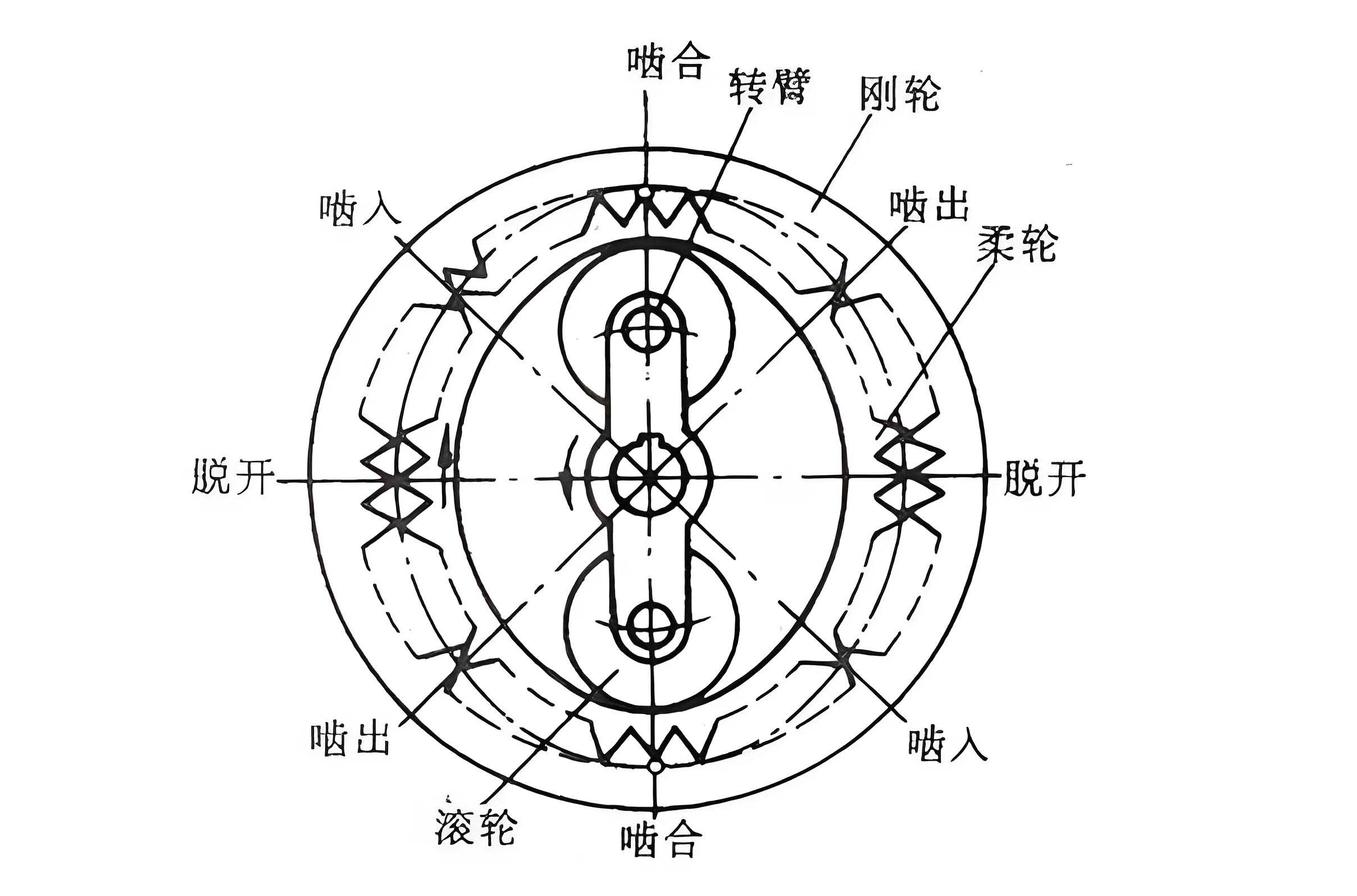
The strain wave gear, also known as a harmonic drive, represents a pivotal advancement in precision motion control. Its operating principle, based on controlled elastic deformation, enables exceptional performance characteristics including high reduction ratios, compactness, high torque capacity, and notably, minimal backlash. This minimal backlash is a defining feature, crucial for applications demanding high positional accuracy and repeatability, such as aerospace actuators, robotic joints, satellite pointing mechanisms, and precision instrumentation. However, despite being “minimal,” backlash in strain wave gears is not zero. It is a complex composite error arising from multiple physical sources within the transmission. Understanding, quantifying, and modeling this backlash, often termed “lost motion” or “angular transmission error under reverse load,” is fundamental for system design, control algorithm development, and performance prediction in high-fidelity applications.
Backlash in a strain wave gear system is defined as the maximum angular displacement difference at the output shaft when the applied load torque is reversed, typically measured under a specified low torque condition. This parameter directly impacts the stability, tracking accuracy, and settling time of servo-controlled systems. A comprehensive model must account for all significant contributors. Based on the working principle, the primary sources of backlash in a strain wave gear can be categorized into four distinct components: the torsional elastic deformation of structural components (namely the output shaft and the flexspline), the inherent tooth flank clearance between the circular spline and the flexspline, and the internal radial clearance (play) within the flexible (wave) bearing. The total backlash \(\Delta_{bl}\) is the sum of these individual contributions:
$$
\Delta_{bl} = \Delta_{bl1} + \Delta_{bl2} + \Delta_{bl3} + \Delta_{bl4}
$$
where \(\Delta_{bl1}\) is from the output shaft torsional compliance, \(\Delta_{bl2}\) from the flexspline torsional compliance, \(\Delta_{bl3}\) from the designed tooth flank clearance, and \(\Delta_{bl4}\) from the flexible bearing radial clearance.
1. Analysis of Backlash Contributing Factors
1.1 Torsional Deformation of Components (\(\Delta_{bl1}\) and \(\Delta_{bl2}\))
When a torque \(T_L\) is applied to the output shaft, both the output shaft and the flexspline undergo elastic twisting. Upon torque reversal, this stored elastic energy is released, contributing directly to the observed angular lost motion. These components act as torsional springs in series. The backlash contributions are directly proportional to the applied load torque and inversely proportional to their respective torsional stiffnesses.
For the output shaft, the backlash contribution is:
$$
\Delta_{bl1} = \frac{2 T_L}{K_e}
$$
For the flexspline, the contribution is:
$$
\Delta_{bl2} = \frac{2 T_L}{K_b}
$$
Here, \(K_e\) is the torsional stiffness of the output shaft assembly, and \(K_b\) is the torsional stiffness of the flexspline. The factor of 2 accounts for the deflection in both forward and reverse loading directions. Calculating \(K_e\) and \(K_b\) involves applying theories of material mechanics and elasticity, considering the geometry (hollow cylindrical shapes with possible keyways or splines), material properties (Young’s modulus \(E\), shear modulus \(G\)), and boundary conditions. The flexspline stiffness \(K_b\) is particularly complex due to its thin-walled, cup-like or hat-like geometry which deforms both in torsion and in the radial/axial directions under load. Empirical formulas or Finite Element Analysis (FEA) are often used for accurate determination.
1.2 Tooth Flank Clearance (\(\Delta_{bl3}\))
A fundamental requirement for proper gear mesh operation and lubrication is the presence of flank clearance, or backlash, between mating teeth. In a strain wave gear, the conjugate action between the flexspline and circular spline teeth requires this clearance to prevent binding, especially considering the elastic deformation wave traveling around the flexspline. This clearance is a deliberate design parameter but directly translates into mechanical lost motion. It can be specified as either the normal backlash \(j_{bn}\) (shortest distance between non-working flanks measured perpendicular to the tooth surface) or the circumferential backlash \(j_{wt}\) (arc length on the pitch circle). For an involute gear pair, they are related by the working pressure angle \(\alpha\):
$$
j_{bn} = j_{wt} \cos \alpha
$$
Assuming the gear pair is non-modified (zero addendum modification) and the operating pitch circle coincides with the standard pitch circle of the circular spline, the angular backlash \(\Delta_{bl3}\) at the flexspline (which has the fewer teeth, \(z_1\)) due to this clearance is derived from the circumferential displacement on the pitch circle:
$$
\Delta_{bl3} = \frac{2 j_{bn}}{m z_1 \cos \alpha}
$$
where \(m\) is the module. This equation shows that backlash is directly proportional to the designed normal clearance \(j_{bn}\) and inversely proportional to gear size (via \(m z_1\)).
1.3 Flexible Bearing Radial Clearance (\(\Delta_{bl4}\))
This is a critical and often dominant source of backlash in strain wave gears. The wave generator consists of an elliptical cam and a specially designed thin-walled ball bearing, the flexible bearing. Ideally, under load from the cam, the bearing’s outer ring deforms perfectly to match the elliptical profile, forcing the flexspline into full mesh with the circular spline at two major axis regions. However, all bearings have internal radial clearance \(c\) to allow for manufacturing tolerances, thermal expansion, and lubrication. This clearance means the outer ring does not deform to the full theoretical ellipse dictated by the cam; its major axis is effectively shortened.
The consequence is that the flexspline teeth are not pushed as deeply into the circular spline teeth as designed. This effectively increases the operating center distance between the two gear members slightly. In gear theory, a reduction in the operating center distance of a gear pair (in this case, an internal-external mesh) introduces additional backlash, even if the gears themselves were initially designed for zero-backlash mesh. This phenomenon can be modeled precisely using the geometry of involute gears.
2. Mathematical Modeling of Backlash Components
2.1 Generalized Model for Tooth Clearance and Bearing Play
The combined effect of designed tooth clearance and bearing-play-induced center distance shift can be modeled by considering the internal-external gear pair formed by the circular spline (internal gear, index 2) and the flexspline (external gear, index 1). Initially, assume a theoretical zero-backlash mesh at the nominal center distance \(a\). The presence of bearing radial clearance \(c\) causes an effective reduction in center distance by \(\Delta a = c/2\).
The nominal center distance is \(a = m(z_2 – z_1)/2\) for an internal mesh. The base circle radii are \(r_{b1} = (m z_1 \cos \alpha)/2\) and \(r_{b2} = (m z_2 \cos \alpha)/2\). After the center distance reduction, the new operating pressure angle \(\alpha’\) is given by:
$$
\alpha’ = \arccos\left( \frac{r_{b2} – r_{b1}}{a – \Delta a} \right) = \arccos\left( \frac{m (z_2 – z_1) \cos \alpha / 2}{a – c/2} \right)
$$
Due to this change, a normal backlash \(j_{bn}’\) appears at the theoretical line of action, even if the gears had zero flank clearance initially. This backlash is derived from the fundamental geometry of involute engagement, analyzing the positions of mating tooth profiles on the line of action before and after the center distance change. The derivation involves the base pitch and the involute function, \(\text{inv}(x) = \tan x – x\). The additional normal backlash \(j_{bn}’\) caused solely by the center distance reduction \(\Delta a\) is:
$$
j_{bn}’ = e_{b2} – s_{b1} + 2(r_{b1} – r_{b2}) \, \text{inv}(\alpha’)
$$
where \(e_{b2}\) is the base circle tooth space width of the internal gear (circular spline) and \(s_{b1}\) is the base circle tooth thickness of the external gear (flexspline). For standard, non-modified gears:
$$
\begin{aligned}
s_{b1} &= \left( \frac{\pi}{2} + 2 z_1 \, \text{inv}(\alpha) \right) m \cos \alpha \\
e_{b2} &= \pi m \cos \alpha – s_{b2} = \left( \frac{\pi}{2} – 2 z_2 \, \text{inv}(\alpha) \right) m \cos \alpha
\end{aligned}
$$
Substituting into the equation for \(j_{bn}’\):
$$
j_{bn}’ = m \cos \alpha \left[ \pi – (z_2 – z_1)\, \text{inv}(\alpha) – (z_2 – z_1)\, \text{inv}(\alpha’) \right] + 2(r_{b1} – r_{b2}) \, \text{inv}(\alpha’)
$$
Noting that \(r_{b1} – r_{b2} = -\frac{m}{2}(z_2 – z_1)\cos\alpha\), the expression simplifies to a more elegant form:
$$
j_{bn}’ = m (z_2 – z_1) \cos\alpha \left[ \text{inv}(\alpha’) – \text{inv}(\alpha) \right]
$$
This is the increase in normal backlash due to the bearing play. The total normal backlash \(j_{bn,\text{total}}\) in the system is the sum of the designed flank clearance \(j_{bn0}\) and this induced clearance:
$$
j_{bn,\text{total}} = j_{bn0} + j_{bn}’
$$
Therefore, the total angular backlash contribution from all gear mesh sources (both designed clearance and bearing play) is:
$$
\Delta_{bl3} + \Delta_{bl4} = \frac{2 j_{bn,\text{total}}}{m z_1 \cos \alpha} = \frac{2}{m z_1 \cos \alpha} \left[ j_{bn0} + m (z_2 – z_1) \cos\alpha \left( \text{inv}(\alpha’) – \text{inv}(\alpha) \right) \right]
$$
This model provides a direct physical relationship between the flexible bearing radial clearance \(c\) (embedded in \(\alpha’\)) and the resulting backlash, eliminating the need for empirical correction coefficients.
2.2 Complete Backlash Model
The comprehensive model for predicting the total backlash \(\Delta_{bl}\) of a strain wave gear under a reverse load torque \(T_L\) is thus:
$$
\boxed{\Delta_{bl} = \frac{2 T_L}{K_e} + \frac{2 T_L}{K_b} + \frac{2}{m z_1 \cos \alpha} \left[ j_{bn0} + m (z_2 – z_1) \cos\alpha \left( \text{inv}(\alpha’) – \text{inv}(\alpha) \right) \right]}
$$
with \(\alpha’ = \arccos\left( \dfrac{m (z_2 – z_1) \cos \alpha}{2a – c} \right)\) and \(a = \dfrac{m(z_2 – z_1)}{2}\).
This formula encapsulates the four key factors: compliance of output elements, compliance of the flexspline, designed gear flank clearance, and the critical effect of flexible bearing internal play.
3. Parametric Analysis and Trends
The derived models allow for analysis of how backlash varies with key design and operational parameters. The following tables and discussions summarize these relationships.
3.1 Influence of Design Parameters on Backlash Components
| Parameter | Effect on \(\Delta_{bl1}\), \(\Delta_{bl2}\) (Compliance) | Effect on \(\Delta_{bl3}\) (Tooth Clearance) | Effect on \(\Delta_{bl4}\) (Bearing Play) | Overall Trend on Total Backlash |
|---|---|---|---|---|
| Load Torque \(T_L\) | Linear increase | No effect (at low torque) | No direct effect* | Linear increase with \(T_L\) |
| Flexspline Stiffness \(K_b\) | Inverse relationship | No effect | No effect | Decreases with higher \(K_b\) |
| Designed Flank Clearance \(j_{bn0}\) | No effect | Linear increase | No effect | Linear increase with \(j_{bn0}\) |
| Flexible Bearing Radial Clearance \(c\) | No effect | No effect | Non-linear increase (\(\alpha’\) change) | Significant increase with larger \(c\) |
| Gear Module \(m\) | May affect \(K_b\) | Inverse relationship (\(1/m\)) | Complex (through \(\alpha’\)) | Generally decreases with larger \(m\) |
| Number of Teeth \(z_1\) | May affect \(K_b\) | Inverse relationship (\(1/z_1\)) | Minor effect | Generally decreases with larger \(z_1\) |
*Note: At very high loads, bearing deformation may become non-linear, but for standard backlash measurement torques, its effect is considered constant.
3.2 Quantitative Sensitivity Analysis
To illustrate the relative magnitude of each component, consider a typical strain wave gear with the following nominal parameters: \(m=0.2 \text{ mm}\), \(z_1=200\), \(z_2=202\), \(\alpha=20^\circ\), \(T_L=0.5 \text{ Nm}\), \(K_e + K_b \approx 1.8 \times 10^4 \text{ Nm/rad}\). The tables below show how different values of \(j_{bn0}\) and \(c\) affect the respective backlash components.
Table 2: Backlash due to Torsional Compliance (\(\Delta_{bl1} + \Delta_{bl2}\))
| Total Stiffness \(K\) (Nm/rad) | Backlash from Compliance (arc-sec) |
|---|---|
| 1.0 × 10⁴ | 20.6″ |
| 1.8 × 10⁴ | 11.5″ |
| 3.0 × 10⁴ | 6.9″ |
Table 3: Backlash due to Designed Flank Clearance \(\Delta_{bl3}(j_{bn0})\)
| Normal Flank Clearance \(j_{bn0}\) (µm) | Angular Backlash \(\Delta_{bl3}\) (arc-sec) |
|---|---|
| 1 | 11.0″ |
| 2 | 22.0″ |
| 3 | 32.9″ |
| 4 | 43.9″ |
| 5 | 54.9″ |
Table 4: Additional Backlash due to Flexible Bearing Play \(\Delta_{bl4}(c)\)
| Bearing Radial Clearance \(c\) (µm) | Induced Normal Backlash \(j_{bn}’\) (µm) | Angular Backlash \(\Delta_{bl4}\) (arc-sec) |
|---|---|---|
| 5 | ~1.7 | 17.8″ |
| 10 | ~3.2 | 33.6″ |
| 15 | ~4.5 | 46.9″ |
| 20 | ~5.4 | 57.0″ |
The analysis reveals that for typical industrial strain wave gears, the contribution from bearing radial clearance (\(\Delta_{bl4}\)) is often comparable to or even greater than that from the designed tooth flank clearance (\(\Delta_{bl3}\)). The compliance component (\(\Delta_{bl1}+\Delta_{bl2}\)) is significant under load but can be minimized with stiff designs. This underscores the paramount importance of specifying and controlling the flexible bearing’s internal clearance for high-precision applications.
4. Model Validation and Experimental Correlation
Empirical validation is essential for confirming the accuracy of the theoretical model. A standard test involves fixing the input shaft of the strain wave gear and applying a low, bi-directional torque \(\pm T_L\) to the output shaft while measuring the angular displacement. The backlash is the total angular travel between the forward and reverse torque endpoints.
Consider a validation case using a size 40 strain wave gear with the parameters close to those used in the sensitivity analysis. Four units were tested with \(T_L = \pm 0.5 \text{ Nm}\).
Table 5: Experimental Backlash Measurement Results
| Unit Number | Angular Position at +0.5 Nm (arc-sec) | Angular Position at -0.5 Nm (arc-sec) | Measured Total Backlash \(\Delta_{bl,\text{exp}}\) (arc-sec) |
|---|---|---|---|
| 1 | +52 | -34 | 86 |
| 2 | +54 | -50 | 104 |
| 3 | +39 | -78 | 117 |
| 4 | +71 | -21 | 92 |
To perform a theoretical comparison, reasonable assumptions for the unknown unit-specific parameters are made based on typical manufacturing ranges:
- Torsional stiffness from compliance: \(K \approx 1.8\times10^4\) Nm/rad \(\rightarrow \Delta_{bl1}+\Delta_{bl2} \approx 11.5″\)
- Designed flank clearance \(j_{bn0}\): Assumed between 2-4 µm \(\rightarrow \Delta_{bl3} \approx 22.0″\) to \(43.9″\)
- Flexible bearing radial clearance \(c\): Assumed between 10-15 µm \(\rightarrow \Delta_{bl4} \approx 33.6″\) to \(46.9″\)
Summing the minimum and maximum of these ranges provides an estimated theoretical backlash envelope:
$$
\Delta_{bl,\text{min}} \approx 11.5″ + 22.0″ + 33.6″ = 67.1″
$$
$$
\Delta_{bl,\text{max}} \approx 11.5″ + 43.9″ + 46.9″ = 102.3″
$$
The experimentally measured values (86″, 104″, 117″, 92″) all fall within or very near the predicted range of 67.1″ to 102.3″. Unit 3’s slightly higher value (117″) may indicate a bearing clearance or tooth clearance at the upper extreme of the assumed tolerances. This strong correlation validates the physical correctness and practical utility of the comprehensive backlash model for the strain wave gear. It confirms that the identified factors—component compliance, tooth flank clearance, and especially flexible bearing radial play—are the primary determinants of lost motion.
5. Implications for Design and Application
The model and analysis have direct consequences for the design, selection, and use of strain wave gears in precision systems.
1. Design for Minimal Backlash: To minimize total backlash, designers must:
- Maximize Torsional Stiffness: Use high-modulus materials and optimize the geometry of the flexspline and output shaft. A shorter, thicker flexspline wall increases \(K_b\) but may affect fatigue life and wave generator compliance.
- Specify Minimal Tooth Flank Clearance: Specify the tightest possible tooth flank clearance \(j_{bn0}\) that still allows for error-free assembly and lubrication under operating temperatures. Precision grinding of teeth is often employed.
- Control Flexible Bearing Clearance Precisely: This is the most critical lever. Specify bearings with “Zero” or “C0” level radial clearance, or even preload the bearing (negative clearance) at assembly. However, preload must be carefully managed to avoid excessive bearing wear, heat generation, and reduced efficiency.
2. System-Level Considerations:
- Load-Dependent Behavior: The model shows backlash has a load-dependent component (\(\propto T_L/K\)). In servo systems, this means the effective backlash may vary with the load condition, affecting control loop stability margins. The controller’s backlash compensation should ideally be adaptive or based on a worst-case estimate.
- Hysteresis vs. Backlash: While this analysis focuses on the kinematic gap (backlash), strain wave gears also exhibit hysteresis due to friction in the bearing and tooth meshes, and material damping in the flexspline. The measured “lost motion” in a test often includes both a backlash “dead zone” and a hysteresis loop. The model presented primarily addresses the reversible, elastic components of lost motion.
- Thermal Effects: Operating temperature changes affect material stiffness (\(E, G\)), dimensions (through thermal expansion altering \(a\), \(c\), \(j_{bn0}\)), and bearing preload/clearance. A comprehensive performance model for critical applications should include thermal sensitivity analyses.
6. Conclusion
The backlash performance of a strain wave gear is a multifaceted characteristic stemming from well-defined mechanical sources. This analysis has decomposed the total lost motion into four primary components: the elastic torsional deflection of the output shaft and the flexspline, the designed clearance between the gear teeth, and the influential radial clearance within the flexible ball bearing. A precise mathematical model has been developed, explicitly linking the angular backlash to fundamental design parameters—load torque, component stiffnesses, gear geometry, and bearing internal clearance. The model successfully transitions from the classical gear theory of involute profiles to the unique elastic mechanics of the strain wave gear, providing a clear physical explanation for the significant impact of bearing play.
Experimental validation on multiple units confirmed that the theoretical predictions align closely with measured data, establishing the model’s reliability for engineering purposes. The key finding is that for many strain wave gear assemblies, the contribution from flexible bearing radial clearance is of the same order of magnitude, or greater, than that from the designed gear tooth clearance. Therefore, achieving ultra-low backlash in a strain wave gear system necessitates a holistic approach focused not only on precision gearing but, crucially, on the specification and control of the wave generator bearing’s internal geometry. This comprehensive understanding enables more informed design choices, accurate system simulation, and the implementation of effective compensation strategies, ultimately unlocking the full potential of strain wave gear technology in the most demanding precision applications. Future work may extend this model to account for non-linear stiffness, dynamic effects, and the interplay between backlash and friction-induced hysteresis.