
Strain wave gear transmission, renowned for its exceptional characteristics such as compactness, high reduction ratios, superior load capacity, and precision, has become indispensable in a wide array of demanding applications. These include satellite attitude control systems, lunar exploration rovers, high-precision robotics, medical instrumentation, and various specialized industrial machinery. The core of its operation involves the controlled elastic deformation of a flexible spline (or “Flexspline”) by a wave generator, which engages it with a rigid circular spline (“Circular Spline”) to achieve high-ratio motion reduction.
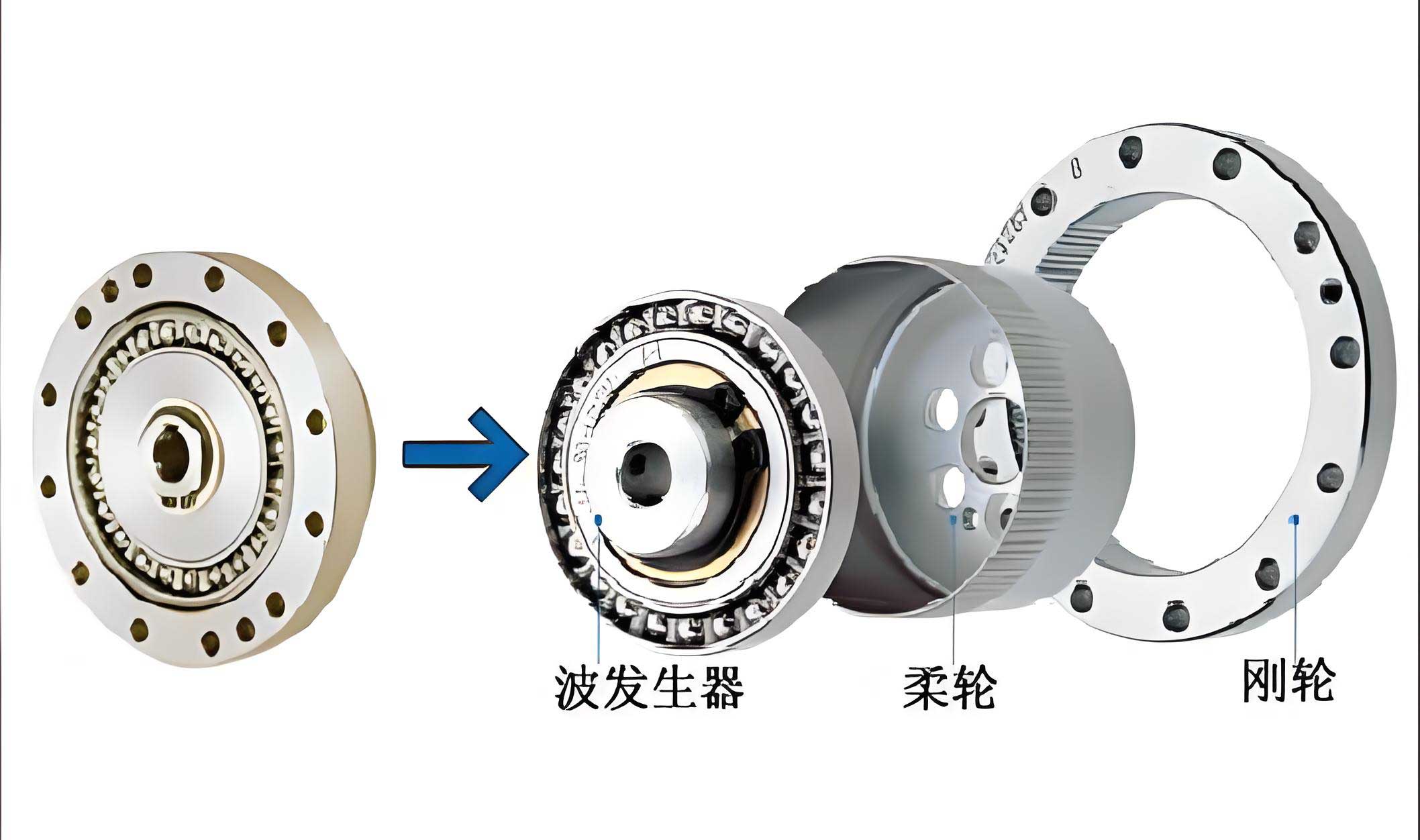
The performance of a strain wave gear, particularly its positional accuracy and stiffness, is critically dependent on the minimization or complete elimination of backlash, which manifests as the clearance between the mating teeth of the flexspline and the circular spline. For precision motion control systems, especially those involving servo drives with frequent bidirectional movement, even minimal backlash can degrade system stability, cause oscillation, and reduce positioning repeatability. Therefore, developing effective and reliable techniques to eliminate backlash is paramount for harnessing the full potential of strain wave gear technology. This article synthesizes and reviews the primary mechanical strategies developed to address both constant and time-varying backlash in strain wave gear drives.
1. Fundamental Concepts and Sources of Backlash
In a perfect theoretical model, a strain wave gear could achieve zero-backlash meshing. However, in practice, backlash arises from several inevitable factors:
- Manufacturing Tolerances: Imperfections in the machining of tooth profiles on both the flexspline and circular spline.
- Assembly Errors: Misalignment between components during assembly.
- Elastic Deformation Under Load: Deflection of the flexspline cup/diaphragm and other components under torque.
- Wear: Progressive material loss from tooth surfaces during operation, leading to a time-varying increase in clearance.
The total effective backlash, $B_{total}$, can be conceptually expressed as a function of these variables:
$$ B_{total} = f(B_{manufacturing}, B_{assembly}, B_{elastic}(T), B_{wear}(t)) $$
where $T$ is the applied torque and $t$ is operational time. The goal of backlash elimination techniques is to drive $B_{total}$ to zero, both at the initial state and throughout the operational life of the strain wave gear.
2. Classification of Backlash Elimination Methods
The strategies can be broadly categorized based on their approach and which component they modify. The following table provides a high-level taxonomy.
| Primary Target | Method Category | Core Principle | Key Advantage | Key Challenge |
|---|---|---|---|---|
| Eliminate Constant Backlash | Precision Design & Manufacturing | Optimize tooth profile and tolerances for theoretical zero clearance. | Fundamental, no added complexity. | Extremely high cost; does not address wear. |
| Preload Application | Introduce a controlled interference fit during assembly. | Simple in concept. | Risk of overheating, reduced efficiency, accelerated wear. | |
| Compensate for Time-Varying Backlash | Adaptive Wave Generator | Dynamically adjust the wave generator’s major axis dimension. | Actively compensates for wear. | Increased mechanical complexity. |
| Flexible Circular Spline | Introduce elasticity into the circular spline structure. | Passive, self-compensating. | Complex manufacturing; potential torsional compliance. | |
| Elastic Interface Elements | Insert compliant elements between wave generator and flexspline. | Simple implementation, absorbs shock. | May limit torque capacity or stiffness. | |
| Axial Adjustment | Axially shift mating components to re-engage teeth. | Can be precise; suitable for certain designs. | Requires re-adjustment; not continuous/automatic. | |
| Alternative Meshing Principles | Use face meshing or other geometries inherently less prone to backlash. | Potentially higher load capacity. | Radical redesign; unproven in widespread application. |
3. Techniques for Eliminating Constant Backlash
The initial goal is to achieve zero or near-zero backlash at the beginning of the strain wave gear’s life. This primarily relies on meticulous design and manufacturing.
3.1 Tooth Profile Optimization
The foundation for zero-backlash meshing lies in the precise mathematical definition of the conjugate tooth profiles. For common profiles like the involute or double-arc, parameters are optimized so that under a specific deformation condition (imposed by the wave generator), the theoretical clearance is zero. An optimization problem can be formulated as:
Find the set of tooth profile parameters $\mathbf{P} = (p_1, p_2, …, p_n)$ that:
$$ \text{minimize } |C(\mathbf{P}, \delta)| $$
$$ \text{subject to: } g_i(\mathbf{P}) \geq 0, \quad i=1,2,…,m $$
where $C$ is the calculated clearance, $\delta$ is the nominal flexspline deformation, and $g_i$ are constraints related to strength, undercutting, and manufacturability. While this method provides a perfect theoretical model, it is exceptionally sensitive to manufacturing deviations.
3.2 Ultra-Precision Manufacturing and Assembly
This is the industry-standard approach for high-end strain wave gear products. It involves machining the flexspline and circular spline teeth with micron-level accuracy and employing precise fixtures and processes during assembly to minimize misalignment. While effective for initial performance, this method does not provide any compensation for the inevitable wear that occurs during the lifespan of the strain wave gear.
4. Techniques for Compensating Time-Varying Backlash (Wear Compensation)
This area represents the most active field of innovation, focusing on designs that can automatically or manually adjust to maintain zero-backlash as wear progresses.
4.1 Adaptive Wave Generator Designs
The wave generator is the active component that deforms the flexspline. Making its effective diameter adaptable allows for continuous compensation of tooth clearance.
4.1.1 Planetary Ball-Based Generators
These designs replace the standard cam with a set of balls or rollers positioned by a planetary mechanism. The radial position of these rolling elements can be adjusted. One classic design uses two conical wheels with opposing wedge slots. The balls sit in these slots, and adjusting the axial distance between the cones forces the balls radially outward, increasing the major axis of the wave generator to take up clearance. A more advanced version incorporates springs behind the rolling elements, allowing for continuous, passive adjustment as wear occurs. The force balance can be modeled to ensure sufficient preload without excessive stress:
$$ F_{spring} = k \cdot x = F_{contact}(\Delta r) $$
where $k$ is the spring constant, $x$ is the spring compression, and $F_{contact}$ is the resultant radial contact force needed to deform the flexspline by an amount $\Delta r$ to eliminate the backlash.
4.1.2 Flexible Cam or Segmented Cam Generators
Here, the cam itself is made elastic or is segmented. One approach uses a cam with strategically placed structural voids or slots in its major axis lobes, granting it localized compliance. As wear increases backlash, the cam elastically deforms slightly more under load, pushing the flexspline outward. Another design splits the cam lobe into a central segment and two side segments, with springs pushing the side segments radially outward. This creates a self-adjusting major axis width. The compensation $\Delta a$ is a function of spring preload and wear $w$:
$$ \Delta a \approx w \cdot \eta $$
where $\eta$ is a geometric factor relating axial spring force to radial displacement of the cam segments.
4.2 Flexible Circular Spline Concepts
Instead of making the wave generator adaptive, this approach introduces controlled elasticity into the traditionally rigid circular spline. The toothed ring of the circular spline is designed as a thin, flexible cylinder connected to a rigid mount. As the wave generator engages, it slightly deforms this flexible toothed ring along with the flexspline. The inherent elasticity of the ring applies a restoring force, maintaining tooth contact and compensating for wear. A critical design consideration is to manage the torsional stiffness of this flexible ring to prevent unacceptable wind-up under load. The required radial flexibility $\delta_{cs}$ is on the same order as the expected maximum wear depth $w_{max}$:
$$ \delta_{cs} \geq w_{max} $$
This principle has also been implemented in designs with conical tooth faces, where axial preloading forces the flexible toothed section of the circular spline into tighter engagement.
4.3 Elastic Interface Elements
This is a simpler, additive approach. A compliant ring or series of elastic pads is inserted between the outer race of the wave generator’s bearing and the inner wall of the flexspline. This elastic layer is installed in a pre-compressed state. It provides a small, controlled “reserve” of elasticity. When initial wear creates clearance, the stored elastic energy in the compressed layer pushes outward, taking up the slack. The material and thickness of this layer are crucial design parameters, trading off compensation range against system stiffness.
4.4 Axial Adjustment Methods
Primarily applicable to designs where the teeth have a slight taper or in configurations using a “hat”-type flexspline with two opposing circular splines. Backlash is eliminated by axially shifting one of the mating components, which alters the effective meshing depth of the tapered teeth. This is often a manual adjustment performed during assembly or maintenance, requiring lockable adjustment mechanisms. While not automatic, it provides a reliable and precise means of setting and resetting backlash to zero.
5. Comparative Analysis of Compensation Methods
The following table compares the key performance indicators and applicability of the main wear-compensation techniques discussed.
| Method | Compensation Mode | Mechanical Complexity | Impact on Torsional Stiffness | Suitability for Miniaturization | Typical Application Scope |
|---|---|---|---|---|---|
| Adaptive Planetary Generator | Passive/Automatic | High | Potentially Reduced (friction-based variants) | Moderate to Low | General-purpose, medium-to-large strain wave gears |
| Flexible/Segmented Cam | Passive/Automatic | Medium | Minimal Reduction | High | Robotic actuators, precision servos |
| Flexible Circular Spline | Passive/Automatic | Medium-High (manufacturing) | Can be Significant (requires careful design) | Moderate | Specialized high-precision strain wave gears |
| Elastic Interface Ring | Passive/Automatic | Very Low | Noticeable Reduction | High | Light-load, cost-sensitive, or miniaturized strain wave gears |
| Axial Adjustment | Manual/Discrete | Low-Medium | No Negative Impact | Low (requires space for adjustment) | Large industrial strain wave gears, maintenance points |
6. Challenges and Future Research Directions
Despite significant progress, the pursuit of the ideal, lifelong zero-backlash strain wave gear continues. Several challenges and corresponding research avenues remain open:
6.1 Integrated Design and Optimization
Future work must focus on the holistic optimization of the entire strain wave gear system for backlash elimination. This involves co-optimizing the wave generator’s adaptive mechanism, the tooth profiles, and the structural compliance of the flexspline and circular spline under multi-physics constraints (stress, stiffness, fatigue life, thermal expansion). Advanced generative design and topology optimization tools, driven by finite element analysis (FEA) and multi-body dynamics simulations, will be crucial. The objective function could be formulated as:
$$ \text{minimize } \left[ \alpha \cdot B(t, T) + \beta \cdot \frac{1}{K_t} + \gamma \cdot M \right] $$
where $B$ is backlash over time and load, $K_t$ is torsional stiffness, $M$ is mass, and $\alpha, \beta, \gamma$ are weighting factors.
6.2 Advanced Materials and Manufacturing
Developing low-cost, high-strength manufacturing processes for flexible components like the circular spline is essential. Techniques such as metal additive manufacturing (3D printing) could enable complex, graded-stiffness structures that are impossible with traditional machining. Furthermore, research into advanced composite materials or surface engineering (e.g., ultra-hard, low-friction coatings like DLC) could drastically reduce the wear rate $dB/dt$, thereby simplifying the compensation task.
6.3 Active and Smart Compensation
Moving beyond passive mechanical methods, the integration of sensing and actuation could lead to “smart” strain wave gears. Embedded sensors (e.g., strain gauges, acoustic emission) could monitor wear or detect the onset of backlash in real-time. Micro-actuators integrated into the wave generator could then make precise, closed-loop adjustments. This mechatronic approach, though complex, promises the highest level of performance and diagnostic capability.
6.4 System Integration and Reliability
Any backlash elimination mechanism must not compromise the overall reliability, compactness, or efficiency of the strain wave gear drive. Research is needed on the long-term fatigue performance of adaptive components (e.g., flexible cams, spring mechanisms), lubrication strategies for preloaded interfaces, and thermal management to dissipate the extra heat potentially generated by constant preload. Ensuring fail-safe operation and predictable degradation modes is critical for adoption in aerospace and safety-critical robotics.
7. Conclusion
The elimination of backlash is a central challenge in advancing strain wave gear technology for ultra-precision applications. While precision manufacturing addresses initial constant backlash, the more persistent problem of time-varying backlash due to wear necessitates innovative design solutions. This review has detailed the spectrum of mechanical strategies, from adaptive wave generators and flexible circular splines to elastic interfaces and axial adjustments. Each method presents a unique trade-off between complexity, performance, and cost. The future of strain wave gear development lies in the intelligent, integrated design of these compensation mechanisms, leveraging advanced materials, manufacturing, and potentially active control systems. Overcoming the remaining challenges will solidify the position of strain wave gear drives as the premier solution for compact, high-ratio, and exceptionally precise motion control across an ever-expanding range of industries.