
The rapid advancement of strain wave gear (harmonic drive) transmission technology has cemented its position as a critical component in high-precision motion control systems. Its applications now span a vast array of fields, including high-end CNC machine tools, medical robotics, communication equipment, precision instrumentation, aerospace technology, and various robotic systems. The defining characteristics of the strain wave gear—its compact structure, lightweight design, exceptionally high and wide range of transmission ratios, high positional accuracy, and smooth, near-zero-backlash operation—make it uniquely suitable for these demanding environments. At its core, a strain wave gear assembly comprises three primary components: a rigid circular spline, a flexible spline (or flexspline), and a wave generator. The fundamental operating principle relies on the controlled elastic deformation of the flexible spline, induced by the wave generator, to create a moving, elliptical wave of engagement with the rigid circular spline, thereby enabling motion and torque transmission.
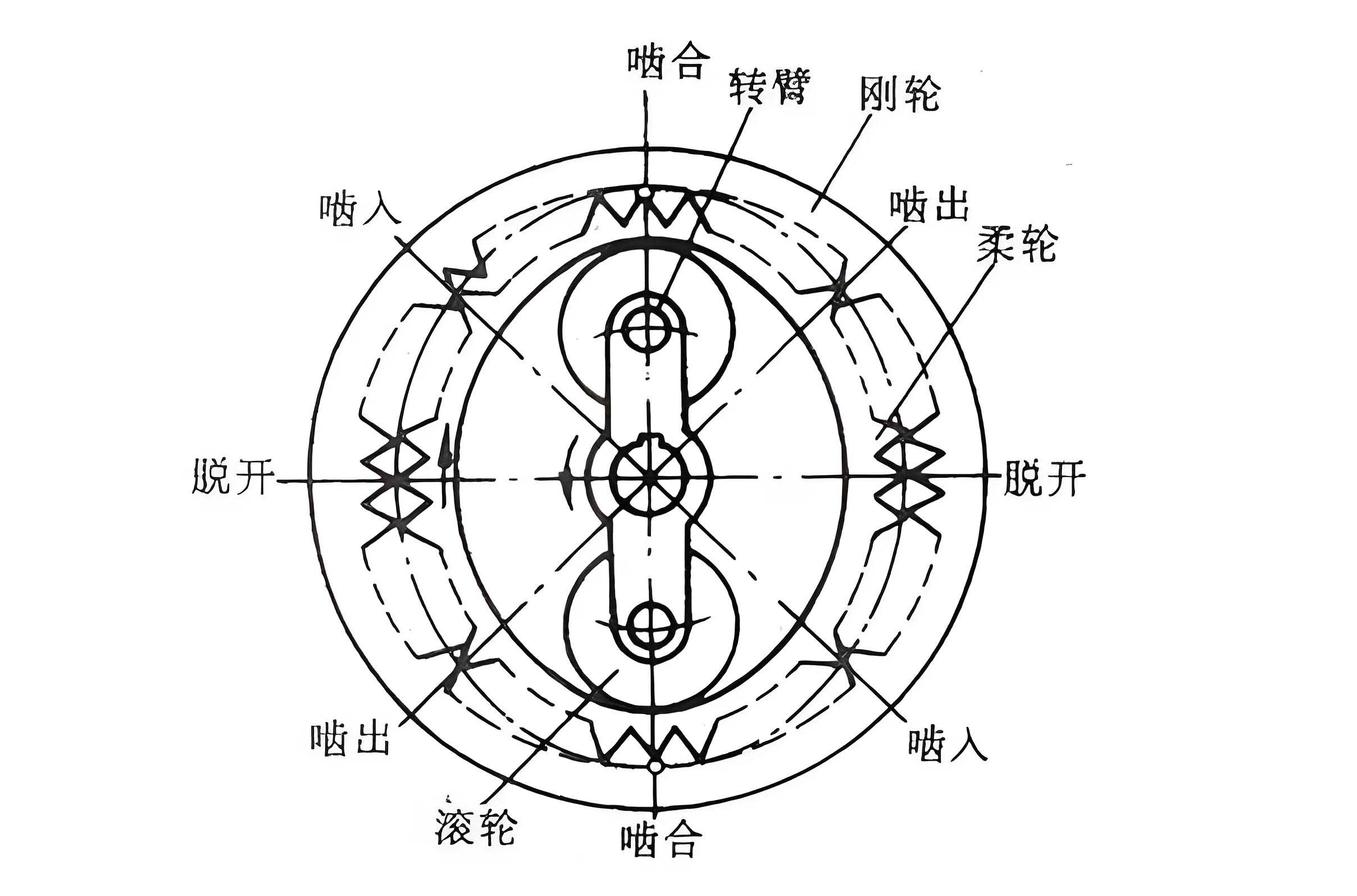
This article details a comprehensive methodology for the design and three-dimensional modeling of a strain wave gear assembly. The focus lies on the theoretical calculation and structural parameterization of the core components, followed by their realization using parametric Computer-Aided Design (CAD) software. This integrated approach of combining analytical design with modern digital tools significantly accelerates the development cycle, reduces prototyping costs, and enhances the first-pass success rate for designing strain wave gear systems. The presented workflow, from initial calculations to final assembly model, serves as a practical reference for engineers and researchers engaged in the development of harmonic drives.
1. Fundamentals and Classification of Strain Wave Gear Transmission
Understanding the basic classification schemes for strain wave gears is essential before delving into detailed design. These classifications are primarily based on the geometry of the deformation wave and the complexity of the transmission stage.
1.1 Classification by Number of Wave Deformations (Wave Number)
The wave number, denoted by \( u \), is defined as the difference in the number of teeth between the rigid circular spline (\( Z_g \)) and the flexible spline (\( Z_r \)): \( u = Z_g – Z_r \). This parameter directly dictates the shape of the deformation wave imposed on the flexible spline.
- Single-Wave Transmission (\( u = 1 \)): In this configuration, the flexible spline experiences an unbalanced meshing force, leading to an oval and asymmetrical deformation. This results in uneven load distribution and higher stress concentrations, making it less common in practical applications.
- Double-Wave Transmission (\( u = 2 \)): This is the most widely used configuration. The double-wave deformation creates a more balanced force distribution on the flexible spline, resulting in lower surface stress, simpler construction, and the ability to achieve high transmission ratios efficiently.
- Triple-Wave Transmission (\( u = 3 \)): Characterized by excellent self-centering properties and minimal radial forces, this configuration offers superior balance. However, its increased mechanical complexity and more challenging manufacturing requirements limit its widespread adoption.
1.2 Classification by Transmission Stage Architecture
- Single-Stage Transmission: This is the simplest and most common form, consisting of one rigid spline, one flexible spline, and one wave generator. It offers a large transmission ratio in a relatively simple package.
- Double-Stage Transmission: This design incorporates two simple strain wave gear stages in series to achieve an ultra-high overall transmission ratio. While powerful, it is mechanically more complex.
- Compound (or “Differential”) Wave Transmission: This advanced configuration features a flexible spline with two distinct tooth rings. A single wave generator acts upon this flexspline, causing it to engage with two separate rigid circular splines simultaneously, creating a compound motion. This architecture is prized for its extreme compactness, very high transmission ratios, and exceptional positional accuracy.
2. Parametric Design and 3D Modeling of Strain Wave Gear Components
This design study focuses on a single-stage, cup-type flexible spline strain wave gear. The chosen transmission scheme has the rigid circular spline fixed, the wave generator as the input, and the flexible spline as the output. For the wave generator, a cam-and-flexible-bearing type is selected. This design offers high radial stiffness to maintain the precise elliptical contour, good operational stability, and relative ease of assembly and standardization. All subsequent calculations and modeling are based on this specific configuration.
2.1 Calculation of Basic Gear Parameters for Rigid and Flexible Splines
The foundation of any strain wave gear design lies in determining the tooth counts and module. We begin with a target transmission ratio \( i \) of 100 and select a double-wave generator (\( u = 2 \)). The fundamental kinematic relationship is given by:
$$ i = \frac{\omega_{generator}}{\omega_{flexspline}} = -\frac{Z_r}{Z_g – Z_r} $$
where \( Z_g \) is the number of teeth on the rigid circular spline, \( Z_r \) is the number of teeth on the flexible spline, and the negative sign typically indicates that the input and output rotate in opposite directions. Since \( u = Z_g – Z_r = 2 \), we can solve for the tooth counts:
$$ Z_r = u \times i = 2 \times 100 = 200 $$
$$ Z_g = u + Z_r = 2 + 200 = 202 $$
The selection of the module \( m \) is often guided by standard tooling. Assuming the use of a double-wave hob or shaper cutter with a standard wave height (radial deformation) \( d = 2.5 \, \text{mm} \), the module is calculated as half the wave height:
$$ m = \frac{d}{2} = \frac{2.5}{2} = 1.25 \, \text{mm} $$
2.2 Rigid Circular Spline: Design and Modeling
2.2.1 Transmission and Structural Parameters
Using the calculated base parameters (\( Z_g = 202, m = 1.25 \, \text{mm} \)) and assuming a standard pressure angle \( \phi = 29.2^\circ \) common for strain wave gears, the key dimensional parameters for the rigid circular spline are computed. A summary is provided in the table below.
| Parameter | Symbol | Formula & Result |
|---|---|---|
| Number of Teeth | \( Z_g \) | 202 |
| Module | \( m \) | 1.25 mm |
| Pressure Angle | \( \phi_g \) | 29.2° |
| Circular Pitch | \( p \) | \( p = \pi m = 3.927 \, \text{mm} \) |
| Pitch Diameter | \( d_g \) | \( d_g = m Z_g = 252.5 \, \text{mm} \) |
| Addendum Diameter | \( d_{ag} \) | \( d_{ag} = d_g + \frac{7}{8}d = 255.0 \, \text{mm} \)* |
| Dedendum Diameter | \( d_{fg} \) | \( d_{fg} = d_g – \frac{9}{8}d = 249.375 \, \text{mm} \)* |
| Tooth Thickness at Pitch Circle | \( S_t \) | \( S_t = 0.435 p \approx 1.708 \, \text{mm} \) |
| Bottom Clearance | \( c \) | \( c = 0.125 d = 0.3125 \, \text{mm} \) |
*Note: Formulas for addendum and dedendum diameters are based on standard harmonic gear tooth profile definitions, where \( d \) is the wave height (2.5 mm).
Beyond the tooth geometry, the overall structural dimensions of the rigid spline must be defined. For mounting flexibility, a flanged configuration is preferred over a simple ring. Key structural parameters are determined based on the flexible spline’s inner diameter (\( d_R \)) and other design heuristics.
| Parameter | Symbol | Formula & Result (Example) |
|---|---|---|
| Outer Diameter of Flange | \( d_{wg} \) | \( d_{wg} \geq 1.4 \times d_R \) (e.g., 198 mm) |
| Body Thickness (Ring Width) | \( b_g \) | 16 mm (based on bearing selection & stiffness) |
| Flange Shoulder Width | \( b_t \) | 4 mm |
| Flange Outer Rim Diameter | \( d_t \) | \( d_t \geq d_{fg} + 6 \, \text{mm} \) (e.g., 256 mm) |
2.2.2 3D Parametric Solid Modeling
With all parameters defined in Tables 1 and 2, a parametric 3D model of the rigid circular spline is created using Pro/ENGINEER (Creo Parametric). The model is driven by the key parameters (module, tooth count, pressure angle, major diameters, flange dimensions). This allows for rapid design iteration; changing a single parameter like the module automatically updates the entire geometry of the strain wave gear component.
2.3 Flexible Spline: Design and Modeling
2.3.1 Transmission and Structural Parameters
The flexible spline shares the same basic tooth generation parameters as the rigid spline (module, pressure angle) but has a different tooth count. Its unique challenge lies in designing the thin-walled cup structure that can undergo repeated elastic deformation without fatigue failure.
| Parameter | Symbol | Formula & Result |
|---|---|---|
| Number of Teeth | \( Z_r \) | 200 |
| Module | \( m \) | 1.25 mm |
| Pressure Angle | \( \phi_r \) | 29.2° |
| Pitch Diameter | \( d_r \) | \( d_r = m Z_r = 250.0 \, \text{mm} \) |
| Addendum Diameter | \( d_{ar} \) | \( d_{ar} = d_r + \frac{7}{8}d = 252.5 \, \text{mm} \) |
| Dedendum Diameter | \( d_{fr} \) | \( d_{fr} = d_r – \frac{9}{8}d = 246.875 \, \text{mm} \) |
The structural design of the cup-type flexspline is critical for performance and life. Key dimensions, such as wall thicknesses and transition radii, are determined using empirical formulas based on the nominal inner diameter \( d_R \) of the cup (where the wave generator bearing sits).
| Parameter | Symbol | Formula & Result (Example) |
|---|---|---|
| Cup Length | \( L \) | \( L = (0.75 \sim 1.0)d_R \) (e.g., 160 mm) |
| Nominal Inner Diameter (for bearing) | \( d_R \) | 145 mm (selected based on load and standard bearing sizes) |
| Tooth Ring Width | \( b_R \) | \( b_R = (0.12 \sim 0.25)d_R \) (e.g., 18 mm) |
| Cylindrical Wall Thickness | \( S_3 \) | \( S_3 = (0.0075 \sim 0.0115)d_R \) (e.g., 2 mm) |
| Flange (Output Hub) Thickness | \( H \) | \( H \geq 3 + 0.01d_R \) (e.g., 8 mm) |
| Wall Thickness under Tooth Ring | \( S_1 \) | \( S_1 = (d_{fr} – d_R)/2 \) (e.g., ~1.1 mm) |
| Critical Transition Radii (R1, R2, R3) | \( R_1, R_2, R_3 \) | Proportions of \( d_R \) (e.g., 4mm, 4mm, 8mm) to reduce stress concentration |
The deformation mechanics of the flexible spline are central to the operation of the strain wave gear. The radial deflection \( w(\theta) \) induced by the wave generator can be approximated for a double-wave configuration as:
$$ w(\theta) \approx \frac{d}{2} \cos(2\theta) $$
where \( \theta \) is the angular position around the spline and \( d \) is the total wave height. This deflection is what enables the alternating zones of engagement and disengagement between the flexible and rigid spline teeth.
2.3.2 3D Parametric Solid Modeling
Creating a parametric model of the flexible spline is more complex due to its intricate thin-walled geometry. Using Pro/E, the model is built by defining the tooth profile on the outer surface based on parameters from Table 3, and then constructing the cup body using the dimensions from Table 4 as driving parameters. Special attention is paid to the smooth blending of all surfaces and the generous application of fillets (R1, R2, R3) in stress-critical transition areas to ensure the model reflects good fatigue-resistant design practice for a strain wave gear component.
2.4 Wave Generator: Design and Component Selection
2.4.1 Cam Profile Design
The cam is the heart of the wave generator. Its profile dictates the precise elliptical deformation pattern imposed on the flexible spline. For a double-wave generator, the ideal cam profile is one that produces a pure cosine wave deflection. A common and effective approximation is a two-lobed elliptical profile. The major axis \( a \) and minor axis \( b \) of this ellipse are related to the nominal bearing inner race diameter \( d_R \) and the wave height \( d \):
$$ a = \frac{d_R}{2} + \frac{d}{2}, \quad b = \frac{d_R}{2} – \frac{d}{2} $$
Substituting \( d_R = 145 \, \text{mm} \) and \( d = 2.5 \, \text{mm} \), we get \( a = 73.75 \, \text{mm} \) and \( b = 71.25 \, \text{mm} \). The cam profile is modeled in Pro/E based on this elliptical geometry, with additional features for shaft mounting and bearing location.
2.4.2 Flexible Bearing Selection
The specialized flexible ball bearing is fitted over the cam and serves as the direct interface that deforms the flexible spline. It has a thin-walled outer ring that conforms to the cam’s elliptical shape. For this design, based on the flexible spline’s inner diameter \( d_R = 145 \, \text{mm} \), a standard bearing from a harmonic drive manufacturer’s catalog is selected (e.g., a bearing corresponding to type 2000921AKT2). The bearing’s key parameters—inner race diameter (matching the cam’s outer profile), outer race diameter (matching \( d_R \)), and width—are critical inputs for finalizing the cam dimensions and the flexible spline’s inner bore tolerance. The parametric assembly model in Pro/E references this bearing as a standard component.
2.5 Final 3D Assembly Model of the Strain Wave Gear
The final step involves assembling all parametrically designed components within the Pro/E environment. The assembly constraints are defined to reflect the real mechanical interfaces: the cam is fixed to the input shaft, the flexible bearing is assembled over the cam, the flexible spline is placed over the bearing (allowing a tight fit on the outer race), and finally, the rigid circular spline is positioned concentrically over the flexible spline, with its teeth engaging those of the flexspline at two opposing points along the major axis of the ellipse. This complete digital prototype of the strain wave gear assembly allows for interference checking, basic kinematic analysis, and serves as the direct basis for generating manufacturing drawings or for export to Finite Element Analysis (FEA) software for detailed stress and fatigue evaluation of the flexible spline.
3. Conclusion
The design and development of a strain wave gear is a multidisciplinary process that seamlessly blends theoretical kinematics, mechanical design principles, material science (for the flexible spline), and modern digital engineering tools. This article has demonstrated a systematic workflow, beginning with the calculation of fundamental transmission parameters like gear ratio and tooth counts, progressing through the detailed mechanical design of the rigid circular spline, the critical flexible spline, and the wave generator assembly, and culminating in the creation of a fully parametric 3D solid model assembly. The use of parametric CAD software like Pro/ENGINEER (Creo Parametric) is a force multiplier in this process. It enables rapid iteration, ensures dimensional consistency across components, facilitates the creation of manufacturing-ready drawings, and allows for early virtual prototyping and validation. This integrated approach, combining analytical design with powerful 3D modeling, is instrumental in shortening the research and development cycle for strain wave gear systems, reducing costs associated with physical prototypes, and significantly increasing the likelihood of a successful first-generation design. As the demand for compact, high-precision, and reliable motion solutions grows in robotics and automation, mastering this design-to-model pipeline for harmonic strain wave gears becomes increasingly valuable for engineers.