
In the realm of precision motion control and miniaturized mechanical systems, the strain wave gear, often referred to as a harmonic drive, plays a pivotal role due to its high torque capacity, compact design, and exceptional positional accuracy. At the heart of this transmission system lies the flexspline, a thin-walled, compliant component that undergoes controlled elastic deformation during operation. As we venture into the domain of miniature strain wave gear systems, where component dimensions are drastically reduced, the mechanical behavior of the flexspline becomes even more critical. The scaling down of parts inherently leads to increased stress concentrations, making a thorough investigation into the flexspline’s load-bearing capacity and structural integrity not just necessary, but paramount for the reliable operation of the entire mechanism. This article presents a comprehensive finite element analysis (FEA) from a first-person perspective, focusing on the stress and displacement fields within the undeformed flexspline of a miniature strain wave gear. The primary objective is to perform a rigorous strength verification to ensure that the designed flexspline can withstand operational loads without failure.
The fundamental principle of a strain wave gear involves three primary components: a rigid circular spline, a flexible flexspline, and an elliptical or planetary wave generator. The wave generator, inserted into the flexspline, deforms its initially circular shape into an elliptical one. This controlled deformation causes the teeth on the flexspline to engage and disengage with those on the circular spline in a progressive manner, resulting in a high reduction ratio. The success of this entire process hinges on the flexspline’s ability to endure cyclic elastic deformation without yielding or suffering from fatigue failure. Therefore, analyzing the stress state within the flexspline, even in its statically loaded, undeformed configuration relative to the wave generator’s influence, provides invaluable insights for design validation. For miniature strain wave gear applications, such as in micro-robotics, aerospace mechanisms, and medical devices, this analysis is indispensable.
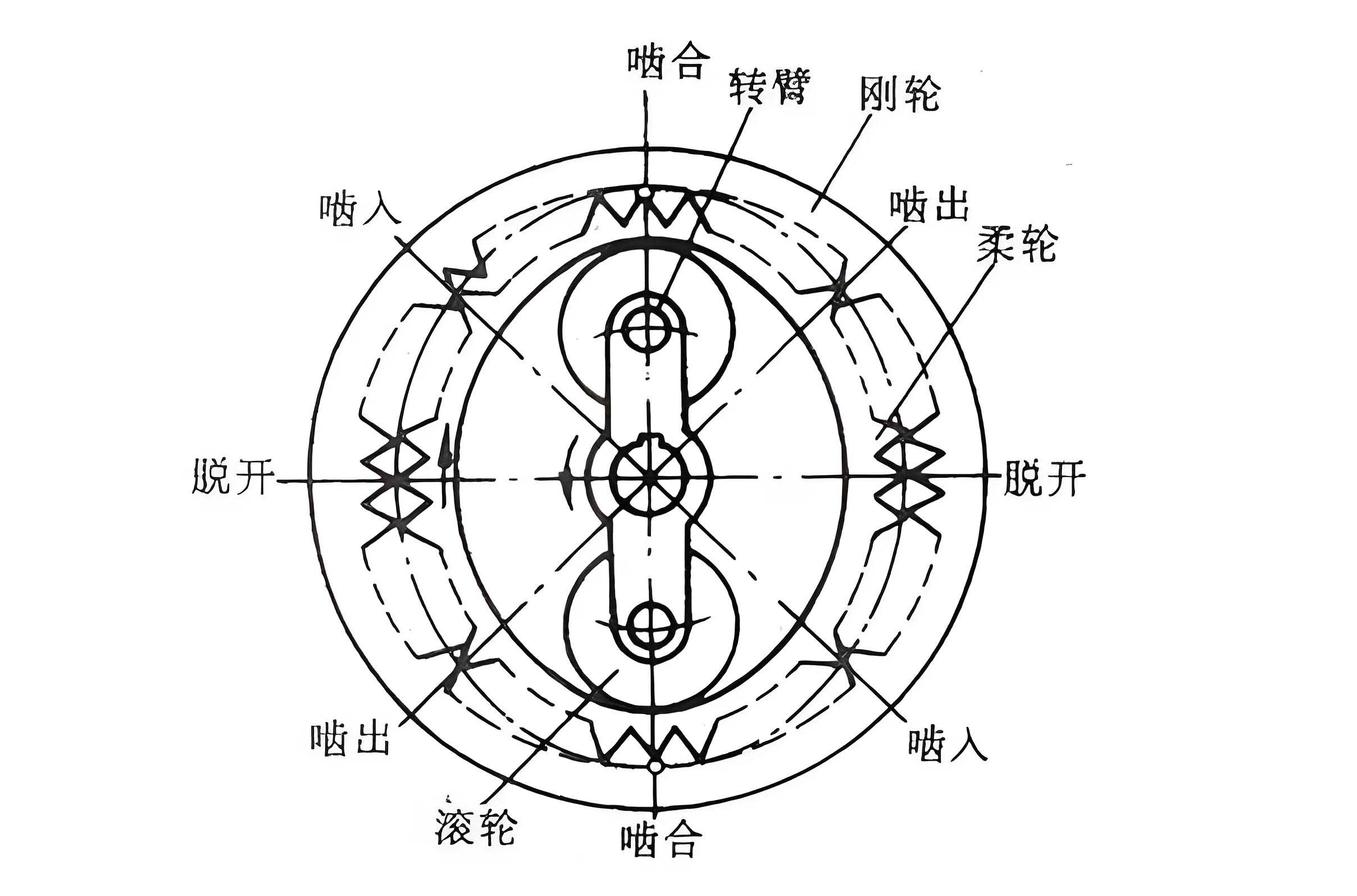
Our study begins with the establishment of a accurate three-dimensional geometric model of the flexspline. The specific miniature strain wave gear system under consideration employs a planetary wave generator configuration, which necessitates a flexspline design featuring both internal and external gear rings. This dual-ring structure adds complexity to the stress distribution. The key geometric parameters for the internal and external gear rings are derived from the primary design calculations and are summarized in the table below. The module is exceptionally small, at 0.04 mm, highlighting the miniature scale of this strain wave gear.
| Parameter | External Gear Ring | Internal Gear Ring |
|---|---|---|
| Module (mm) | 0.04 | 0.04 |
| Number of Teeth | 200 | 200 |
| Profile Shift Coefficient | 2.4 | -2.1 |
| Pitch Diameter (mm) | 8 | 8 |
| Addendum Circle Diameter (mm) | 8.224 | 7.752 |
| Dedendum Circle Diameter (mm) | 8.132 | 7.94 |
| Reference Circle Diameter (mm) | 8.192 | 7.832 |
| Base Circle Diameter (mm) | 7.518 | 7.518 |
| Wall Thickness (mm) | 0.096 | 0.096 |
| Radius of Neutral Circle (mm) | 4.018 | 3.922 |
| Tooth Width (mm) | 1.6384 | 1.5664 |
| Whole Depth of Tooth (mm) | 0.046 | 0.094 |
| Base Pitch (mm) | 0.118 | 0.118 |
| Clearance (mm) | 0.014 | 0.014 |
| Tooth Root Thickness (mm) | 0.083 | 0.102 |
| Space Width (mm) | 0.0426 | 0.0236 |
| Fillet Radius at Tooth Root (mm) | 0.0177 | 0.0196 |
| Circular Pitch (mm) | 0.1256 | 0.1256 |
The material selected for the miniature strain wave gear flexspline is a specialized iron-nickel alloy, chosen for its combination of high strength, good elastic properties, and suitability for micro-gear manufacturing processes. The critical material properties that govern the elastic and plastic behavior under load are essential inputs for the finite element analysis. These properties are consolidated in the following table.
| Property | Value |
|---|---|
| Tensile Strength ($\sigma_b$) | 1920 N/mm² |
| Yield Strength ($\sigma_{ys}$) | 1650 N/mm² |
| Elastic Modulus (E) | 1.4 × 10⁵ N/mm² |
| Poisson’s Ratio ($\nu$) | 0.3 |
| Density ($\rho$) | 8.4 g/cm³ |
| Hardness | 600 HV (approx. 574.4 HB) |
| Allowable Specific Pressure (Lubricated) | 40 N/mm² |
| Magnetic Property | Low Ferromagnetism |
| Surface Roughness | 100 nm |
| Aspect Ratio | 200:1 |
| Manufacturing Tolerance | 1 µm |
| Alloy Composition | 5-30% Iron, balance Nickel |
With the geometry and material defined, we proceed to construct the finite element model. Given that the undeformed flexspline exhibits axisymmetric structural characteristics, we can exploit this symmetry to significantly reduce computational cost without loss of generality. Only one-quarter of the full model is analyzed. This is a standard and effective approach in FEA for symmetric structures. The quarter-model is discretized using solid elements. Specifically, we selected the Brick 8-node 45 element (SOLID45 in ANSYS), which is well-suited for modeling three-dimensional solid structures with plasticity, creep, swelling, stress stiffening, large deflection, and large strain capabilities. The material constants assigned are: Young’s Modulus $E = 1.4 \times 10^5$ MPa, Poisson’s ratio $\mu = 0.3$, and density $\rho = 8.4 \times 10^{-6}$ kg/mm³ (converted from 8.4 g/cm³).
The definition of appropriate boundary conditions is crucial for simulating the physical constraints on the flexspline during assembly with the wave generator. The mechanical model for our analysis is conceptualized as follows. The flexspline is constrained at two specific locations corresponding to the interaction with the wave generator’s major axis. At end A, the flexspline is allowed freedom of movement in the x-direction but is constrained against displacement in the y-direction. Conversely, at end B, the flexspline is free to move in the y-direction but is constrained in the x-direction. Since we are initially addressing a simplified planar stress problem within the three-dimensional context for the core deformation analysis, displacements in the z-direction (axial direction) are constrained to zero for this phase. Most importantly, to simulate the initial deformation imparted by the elliptical wave generator, a prescribed displacement of 0.04 mm is applied at end B (the major axis location) in the negative y-direction. This value represents the maximum radial displacement of points on the flexspline’s contour at the major axis, a key parameter derived from the kinematic design of the strain wave gear.
The governing equations for the linear elastic behavior of the material are based on Hooke’s Law generalized to three dimensions, relating stress and strain tensors. The constitutive relationship is expressed as:
$$ \{\sigma\} = [D]\{\epsilon\} $$
where $\{\sigma\}$ is the stress vector, $\{\epsilon\}$ is the strain vector, and $[D]$ is the material stiffness matrix, which for an isotropic material is defined by $E$ and $\nu$:
$$
[D] = \frac{E}{(1+\nu)(1-2\nu)}
\begin{bmatrix}
1-\nu & \nu & \nu & 0 & 0 & 0 \\
\nu & 1-\nu & \nu & 0 & 0 & 0 \\
\nu & \nu & 1-\nu & 0 & 0 & 0 \\
0 & 0 & 0 & \frac{1-2\nu}{2} & 0 & 0 \\
0 & 0 & 0 & 0 & \frac{1-2\nu}{2} & 0 \\
0 & 0 & 0 & 0 & 0 & \frac{1-2\nu}{2}
\end{bmatrix}
$$
The strain-displacement relationship is given by $\{\epsilon\} = [B]\{u\}$, where $[B]$ is the strain-displacement matrix and $\{u\}$ is the nodal displacement vector. The finite element method assembles the global stiffness matrix $[K]$ from element matrices $[k]^e = \int_{V^e} [B]^T [D] [B] dV$, leading to the system of linear equations $[K]\{U\} = \{F\}$, where $\{U\}$ is the global nodal displacement vector and $\{F\}$ is the global force vector. In our case, the force vector is derived from the applied displacement boundary condition, making it a displacement-controlled analysis.
Meshing is a critical step. Given the miniature scale and the presence of fine gear teeth, a refined mesh is necessary, particularly in regions of anticipated high stress gradients, such as the tooth fillets and the thin wall. The mesh convergence study was performed to ensure that the results were independent of element size. The final quarter-model comprised a sufficient number of elements to capture the stress field accurately while remaining computationally efficient. After applying the boundary conditions and the prescribed displacement, the model is solved using the ANSYS static solver.
Upon solving the finite element model, we obtain detailed contours of stress and displacement across the flexspline. The post-processing results are illuminating. The displacement cloud diagram vividly shows that the maximum displacement magnitude is precisely 0.04 mm, located at the point of application on the major axis, confirming the correct imposition of the boundary condition. The displacement field decays symmetrically from this point, illustrating the elliptical deformation pattern characteristic of a strain wave gear flexspline under load from the wave generator.
The stress analysis reveals more critical design information. The von Mises stress criterion, which is suitable for ductile materials like our iron-nickel alloy, is used to evaluate the equivalent stress. The stress cloud diagram indicates a non-uniform distribution, with concentrations in specific areas. The global maximum von Mises stress in the model is found to be 367.501 MPa. The minimum stress is 0.163442 MPa, occurring in regions far from the deformation zone. A closer examination, by zooming into the high-stress region, reveals that the absolute maximum stress is localized at the root of the teeth that are closest to the major axis of the ellipse. This is a predictable yet critical result, as the tooth root is a classic site for stress concentration due to geometric discontinuity and bending loads.
To put this maximum stress value into perspective, we must compare it against the material’s strength limits. From Table 2, the tensile strength $\sigma_b$ is 1920 MPa, and the yield strength $\sigma_{ys}$ is 1650 MPa. For reliable operation, the working stress must be below the yield strength with a safety factor. Often, an allowable stress $[\sigma]$ is defined. For this high-strength alloy under dynamic loading conditions typical of a strain wave gear, a conservative allowable stress might be derived from the yield strength with a safety factor $n$. For instance, using a safety factor of $n=1.1$ for precision components, the allowable stress would be:
$$ [\sigma] = \frac{\sigma_{ys}}{n} = \frac{1650}{1.1} \approx 1500 \, \text{MPa} $$
Furthermore, the design specifications for the transmission system itself might impose an even lower allowable stress based on fatigue life requirements. The text mentions a system allowable stress of 559.462 MPa. Comparing our FEA result:
$$ \sigma_{max}^{FEA} = 367.501 \, \text{MPa} $$
We can formulate the strength conditions as follows:
1. Condition against tensile failure: $$ \sigma_{max}^{FEA} < \sigma_b \quad \Rightarrow \quad 367.501 \, \text{MPa} < 1920 \, \text{MPa} \quad (\text{Satisfied}) $$
2. Condition against yielding: $$ \sigma_{max}^{FEA} < \sigma_{ys} \quad \Rightarrow \quad 367.501 \, \text{MPa} < 1650 \, \text{MPa} \quad (\text{Satisfied}) $$
3. Condition against material allowable stress: $$ \sigma_{max}^{FEA} < [\sigma]_{material} \quad \Rightarrow \quad 367.501 \, \text{MPa} < 1500 \, \text{MPa} \quad (\text{Satisfied}) $$
4. Condition against system allowable stress: $$ \sigma_{max}^{FEA} < [\sigma]_{system} \quad \Rightarrow \quad 367.501 \, \text{MPa} < 559.462 \, \text{MPa} \quad (\text{Satisfied}) $$
All conditions are satisfied by a significant margin. This indicates that the undeformed flexspline, under the static load representing the wave generator’s deformation, possesses adequate strength. However, this is a static analysis. In a real miniature strain wave gear, the flexspline undergoes millions of cycles of elastic deformation. Therefore, fatigue strength becomes the dominant design criterion. The location of the maximum stress is of utmost importance for fatigue assessment. The stress concentration at the tooth root makes it the most likely site for the initiation of fatigue cracks. The bending stress at the tooth root can be approximated using the Lewis formula for gear teeth, modified for the specific geometry of strain wave gear teeth:
$$ \sigma_b^{tooth} \approx \frac{F_t}{b m} \cdot \frac{1}{Y} $$
where $F_t$ is the tangential tooth load, $b$ is the face width, $m$ is the module, and $Y$ is the Lewis form factor which depends on the tooth shape and the number of teeth. While the FEA provides a more accurate distributed stress field, this formula helps in conceptual understanding. The high stress concentration factor $K_t$ at the fillet radius significantly amplifies the nominal bending stress. For our miniature strain wave gear flexspline, the fillet radius is extremely small (0.0177 mm for the external teeth), contributing to a high $K_t$. The FEA inherently captures this effect.
The analysis of the displacement field also confirms the kinematic fidelity of the model. The prescribed displacement of 0.04 mm generates a deformation pattern that is essential for achieving the required gear meshing and motion transmission in the strain wave gear. The displacement constraints applied at ends A and B correctly simulate the reaction forces from the wave generator’s bearing surfaces.
To delve deeper, we can consider the stress state in different parts of the flexspline. The thin wall connecting the two gear rings experiences a complex state of stress, combining membrane stresses from the overall elliptical bending and local bending stresses from the tooth engagements. The von Mises stress is an effective measure for such multi-axial stress states. The relatively low stress in the majority of the wall area (as seen from the cloud diagram where blue/green colors dominate) suggests that the wall thickness of 0.096 mm is sufficient for carrying the load without excessive stress, at least under this static deformation. However, buckling stability under compressive stresses, which may occur on the minor axis, should also be checked in a more comprehensive analysis.
The choice of material is vindicated by the results. The iron-nickel alloy’s high yield strength (1650 MPa) provides a very large margin against yielding under the operational stress of ~367 MPa. Its high elastic modulus ($1.4 \times 10^5$ MPa) ensures that the deformation remains within the elastic range and that the flexspline returns to its original shape after each cycle, which is critical for the accuracy of the strain wave gear. The low ferromagnetic property is also beneficial in applications where magnetic interference must be minimized.
In conclusion, the finite element analysis of the undeformed flexspline for the miniature strain wave gear has been successfully conducted. The results demonstrate that under the applied deformation simulating the wave generator’s action, the maximum von Mises stress is 367.501 MPa, and the maximum displacement is 0.04 mm. The stress is comfortably below all relevant strength limits: the material’s tensile strength (1920 MPa), yield strength (1650 MPa), a derived material allowable stress (~1500 MPa), and the system’s specified allowable stress (559.462 MPa). Therefore, the flexspline design satisfies the static strength conditions. The critical finding is the localization of the maximum stress at the root of the teeth nearest the major axis. This pinpointing of the critical zone is crucial for further design refinement and fatigue life analysis. While the static strength is adequate, the long-term durability of the miniature strain wave gear will depend on the fatigue performance of the flexspline material at this stress concentration, especially given the cyclic nature of the loading. Future work should involve a full cyclic loading analysis, contact analysis between the flexspline teeth and the circular spline teeth, and thermal analysis if operating temperatures are significant. This foundational FEA provides a strong basis for confidence in the structural design of this key component, ensuring that the miniature strain wave gear can function reliably in its intended precision applications.