
The strain wave gear, also known as a harmonic drive, represents a unique and highly efficient precision gearing mechanism. Its operation fundamentally relies on the controlled elastic deformation of a flexible spline, induced by an elliptical wave generator, to achieve motion transmission with high reduction ratios, near-zero backlash, and compactness. Traditional design methodologies have often simplified this inherently spatial elastokinematic problem by treating the tooth engagement as a planar phenomenon. This simplification, while practical, leads to suboptimal performance characterized by localized high-stress contact, reduced conjugate action zones, and unwanted clearances or interferences. This article presents a comprehensive geometric framework for the design of a spatially-varied tooth profile for the circular spline of a strain wave gear, explicitly accounting for the coning deformation of a cup-shaped flexspline. The core premise is that by tailoring the circular spline’s tooth geometry in three dimensions to match the spatially varying deformed state of the flexspline, meshing performance can be significantly enhanced, backlash minimized, and load distribution improved.
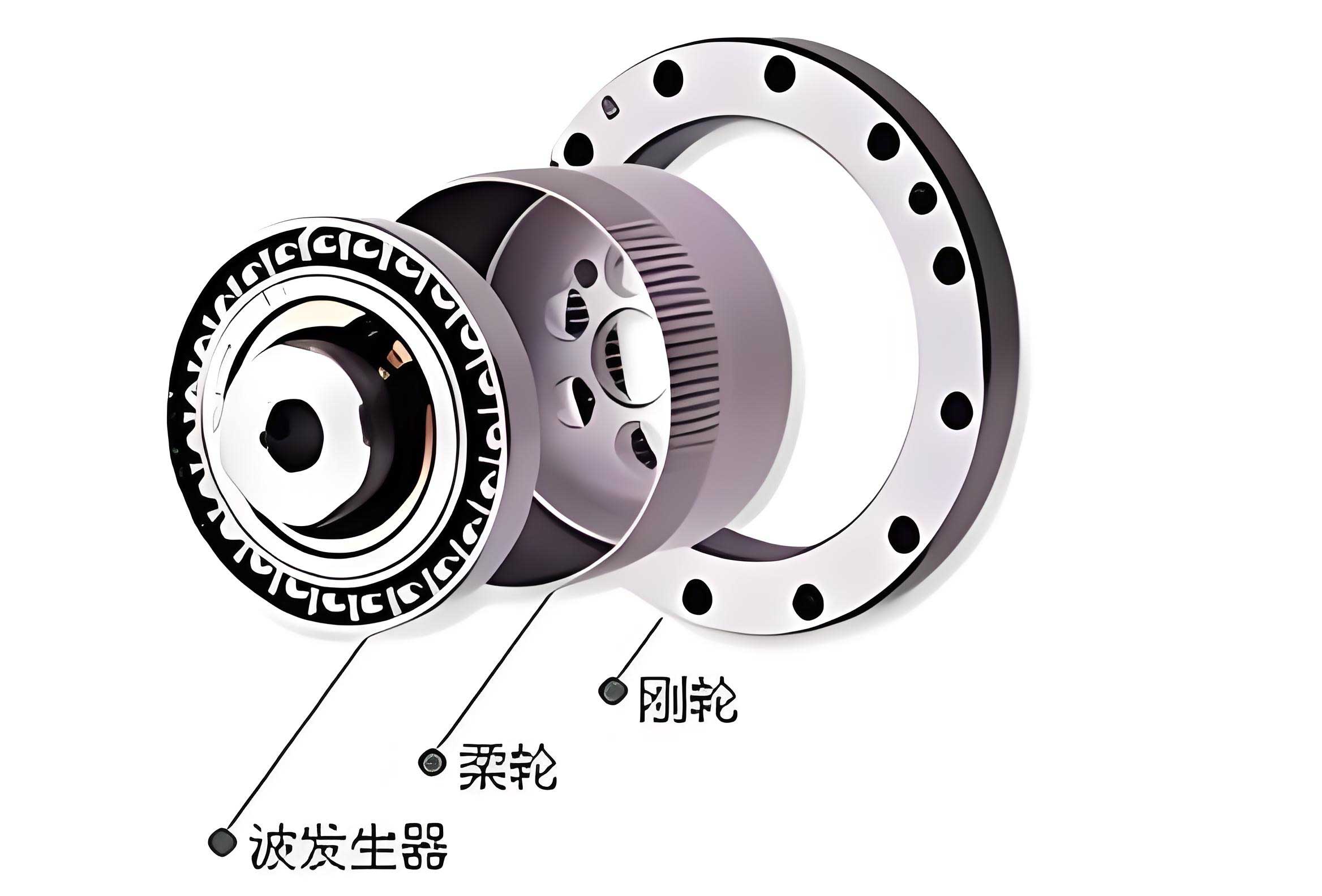
The kinematic foundation of the strain wave gear lies in the elastic deformation of the flexspline’s thin-walled cup. Under the action of the wave generator, the neutral cylindrical surface of the flexspline undergoes a predictable spatial deflection. For a cup-type flexspline, this deformation is not uniform along the axis; the rim near the open end experiences a larger radial displacement compared to the region near the closed bottom. This creates a characteristic taper or “coning” effect. Ignoring this axial variation and designing the circular spline with a constant, prismatic tooth profile leads to a mismatch. The teeth will mesh perfectly only in one specific transverse cross-section, while in other sections along the tooth width, either excessive clearance or destructive interference will occur. Therefore, an accurate geometric model must start with a precise description of this spatial deformation field. The radial displacement \( w \) of a point on the flexspline’s neutral surface, located at an angular coordinate \( \phi \) (measured from the wave generator’s major axis) and an axial coordinate \( z \) (measured from the open end), can be modeled as a separable function:
$$ w(\phi, z) = w(\phi) \cdot \Psi(z) $$
Where \( w(\phi) \) describes the radial displacement pattern in the main cross-section (often taken at the tooth center), and \( \Psi(z) \) is a taper function accounting for the axial decay of deformation. A common linear taper model, considering the cup length \( l \), tooth ring width \( b \), and front transition length \( f \), is:
$$ \Psi(z) = \frac{l – z}{l – b/2 – f} $$
Thus, the maximum radial displacement at the major axis (\( \phi = 0 \)) varies linearly along \( z \):
$$ w(0, z) = \frac{l – z}{l – b/2 – f} \cdot w_0 $$
Here, \( w_0 \) is the maximum radial displacement in the reference cross-section, typically set equal to the gear module \( m \) for standard designs. This spatial deformation model is the first critical step in moving from a planar to a three-dimensional analysis of the strain wave gear.
To design the conjugate tooth profile of the circular spline, the envelope theory is applied. However, instead of a single plane, we consider a series of transverse cross-sections perpendicular to the gear axis. In each section, defined by a specific \( z \) value, the flexspline’s deformation is treated as a planar kinematic problem, but with section-specific parameters derived from the global spatial model. A coordinate system is established for this planar analysis. Let a fixed coordinate system \( S(O-XYZ) \) be attached to the circular spline, with the Y-axis aligned with its major axis. A moving coordinate system \( S_1(o_1-x_1y_1z_1) \) is attached to the flexspline tooth, with its origin \( o_1 \) on the deformed neutral curve and the \( y_1 \)-axis aligned with the tooth’s symmetry line. The wave generator has its own coordinate system \( S_2(o_2-x_2y_2z_2) \).
The key kinematic relationship involves the orientation of the flexspline tooth. As the flexspline deforms and rotates, the symmetry line of a tooth initially at angular position \( \varphi \) (on the undeformed circle) no longer aligns with the radial line. The angle \( \mu \) between the tooth’s symmetry line and the local radial line is a consequence of the non-extensional condition of the neutral surface and is given by the derivative of the radial displacement:
$$ \mu(\phi, z) = -\arctan\left( \frac{ dw(\phi)/d\phi }{ r_m + w(\phi, z) } \right) $$
Here, \( r_m \) is the radius of the flexspline’s neutral circle before deformation. Furthermore, due to the non-extensional condition, the angular coordinate \( \phi \) on the deformed curve relates to the initial angular coordinate \( \varphi \) on the undeformed circle through an integral equation:
$$ \varphi = \int_{0}^{\phi} \sqrt{ \left(1 + \frac{w}{r_m}\right)^2 + \left( \frac{1}{r_m} \frac{dw}{d\phi} \right)^2 } \, d\phi $$
When the flexspline rotates by an angle \( \phi_1 \), the absolute orientation angle \( \Phi \) of the tooth’s symmetry line in the fixed coordinate system \( S \) is the sum of its rotation and its tilt due to deformation:
$$ \Phi(\phi, z) = \phi_1 + \mu(\phi, z) $$
With these kinematic relations established, the conjugate tooth profile for the circular spline in a given cross-section \( z \) can be derived. Let the flexspline tooth profile be defined in its local system \( S_1 \) as a planar curve \( \mathbf{r}_1(u) = (x_1(u), y_1(u))^T \), where \( u \) is a profile parameter. For an involute profile, which is commonly used, this is defined with parameters like base radius and pressure angle. According to the envelope theory, the family of curves traced by this flexspline profile in the fixed system \( S \), as parameterized by the motion parameter \( \phi \) (or \( \phi_1 \)), will envelope the required circular spline profile. The coordinates of a point on the generated family in \( S \) are:
$$
\begin{aligned}
X(u, \phi) &= x_1(u) \cos\Phi + y_1(u) \sin\Phi + \rho \sin\gamma \\
Y(u, \phi) &= -x_1(u) \sin\Phi + y_1(u) \cos\Phi + \rho \cos\gamma
\end{aligned}
$$
Here, \( \rho \) and \( \gamma \) are the polar coordinates of the origin \( o_1 \) in system \( S \), which are functions of \( \phi \) and the deformation. The condition for this point to lie on the envelope (the circular spline tooth) is given by the Jacobian determinant vanishing:
$$ \frac{\partial X}{\partial u} \cdot \frac{\partial Y}{\partial \phi} – \frac{\partial X}{\partial \phi} \cdot \frac{\partial Y}{\partial u} = 0 $$
This equation, combined with the coordinate transformation equations, forms the conjugate system. Solving this system numerically for the parameter \( \phi \) corresponding to each profile point parameter \( u \) yields a set of discrete points \( (X_i, Y_i) \) that define the theoretical conjugate tooth profile of the circular spline for the cross-section at axial position \( z \). This “precision algorithm” is applied independently to multiple cross-sections along the tooth face width, for instance, at the front, middle, and rear of the tooth ring. The following table summarizes the key input and output parameters for this conjugate generation process in different sections for a sample strain wave gear.
| Parameter / Cross-Section | Front Section (z=z_f) | Middle Section (z=z_m) | Rear Section (z=z_r) |
|---|---|---|---|
| Axial Coordinate, z | \( z_f \) | \( z_m = (z_f+z_r)/2 \) | \( z_r \) |
| Taper Factor, \( \Psi(z) \) | \( \Psi_f > 1 \) | \( \Psi_m = 1 \) | \( \Psi_r < 1 \) |
| Max Radial Displacement, \( w(0,z) \) | \( \Psi_f \cdot w_0 \) | \( w_0 \) | \( \Psi_r \cdot w_0 \) |
| Conjugate Solution Range for \( \phi \) | \( [\phi_{f,min}, \phi_{f,max}] \) | \( [\phi_{m,min}, \phi_{m,max}] \) | \( [\phi_{r,min}, \phi_{r,max}] \) |
The resulting theoretical conjugate profiles are discrete point sets that are specific to each cross-section and are not standard gear profiles. For manufacturability and practical application, it is desirable to fit these discrete points with a standard gear tooth profile. The involute curve is a natural choice due to its well-known favorable meshing properties and ease of generation with standard cutting tools. Therefore, for each cross-section’s set of conjugate points \( G_i = (X_{2i}, Y_{2i}) \), we seek the optimal involute profile of the circular spline that best approximates it. The standard involute equation in the circular spline’s coordinate system is:
$$
\begin{aligned}
x_{2w}(u) &= r_2 \left[ -\sin(u – \theta_2) + u \cos\alpha_0 \cos(u – \theta_2 + \alpha_0) \right] \\
y_{2w}(u) &= r_2 \left[ \cos(u – \theta_2) + u \cos\alpha_0 \sin(u – \theta_2 + \alpha_0) \right]
\end{aligned}
$$
Here, \( r_2 \) is the circular spline’s pitch radius, \( \alpha_0 \) is the standard pressure angle, \( u \) is the roll angle parameter, and \( \theta_2 \) is half of the angular tooth thickness on the pitch circle, which is directly related to the profile shift coefficient \( x_2 \). The fitting process aims to find the optimal profile shift coefficient \( x_2(z) \) for each section such that the fitted involute \( G_w \) does not interfere with (i.e., is always inside of) the theoretical conjugate profile \( G \), while minimizing the average normal distance between them. This ensures the designed tooth has the necessary clearance. The optimization condition can be stated as: find \( x_2(z) \) to minimize the average error \( \epsilon_m \), subject to \( \Delta x_K = x_{2w}(u_K) – x_{2K} \ge 0 \) for all corresponding points \( K \).
After determining the optimal involute profile (i.e., its profile shift coefficient \( x_2 \)) for several cross-sections along the tooth width, the three-dimensional tooth surface for the circular spline is constructed. This is achieved using a computer-aided geometric design technique known as lofting or skinning. The involute curves from each defined cross-section (e.g., front, middle, rear) are used as section curves. A smooth surface is generated that interpolates these curves along the axial direction. This surface represents the spatially varying tooth flank of the circular spline. It is no longer a prismatic surface but a carefully sculpted one where the tooth thickness and potentially the effective pressure angle vary along the face width to match the flexspline’s coning deformation. The core advantage of this spatial tooth profile for the strain wave gear is that it aims to maintain a consistent and optimal meshing condition across the entire active tooth face, rather than just at a single line of contact.
To validate the design and quantify its performance, a robust method for calculating the functional backlash is essential. Backlash, or side clearance, is the small gap between non-driving flanks of mating teeth, crucial for preventing jamming and accommodating manufacturing errors. In a strain wave gear with a spatially designed circular spline, backlash varies along the tooth width and with the rotational position. A precise calculation requires locating the exact position of each flexspline tooth after deformation. The initial angular position of the \( i \)-th tooth on the undeformed flexspline is \( \varphi_i = 2\pi i / z_1 \). After deformation, its location is found by solving the integral equation relating \( \varphi_i \) to the deformed angle \( \phi_i \), and its orientation is given by \( \Phi_i = \phi_{1i} + \mu(\phi_i, z) \).
For a given meshing position and a specific cross-section \( z \), the backlash is calculated as the shortest distance between the non-working flanks of a flexspline tooth and the adjacent circular spline tooth. Consider a point \( K_1 \) on the flexspline involute profile. Its coordinates in the fixed global system are obtained by transforming from its local system \( S_1 \) using the orientation \( \Phi \) and the center location of the deformed flexspline neutral curve. Let \( r_{K1} = \sqrt{X_{K1}^2 + Y_{K1}^2} \). An arc of radius \( r_{K1} \) is drawn from the global origin. The intersection of this arc with the adjacent circular spline’s involute profile (designed for section \( z \)) defines point \( K_2 \). The circumferential backlash \( j_t \) at that radial level is approximated by the chordal distance between \( K_1 \) and \( K_2 \):
$$ j_t \approx \sqrt{ (X_{K2} – X_{K1})^2 + (Y_{K1} – Y_{K2})^2 } $$
By performing this calculation for multiple points along the tooth depth (from root to tip) at a given meshing position and cross-section, the minimum value is identified as the functional backlash for that tooth pair at that axial location. Repeating this process for different rotational positions \( \phi_1 \) (or \( \phi \)) generates a backlash distribution map. For a well-designed strain wave gear with involute profiles, the minimum backlash typically occurs either between the flexspline tooth tip and the circular spline flank, or between the circular spline tooth tip and the flexspline flank, depending on the region of the wave generator ellipse.
The mathematical models and design procedures are best illustrated through a concrete example. Consider a double-wave cup-type strain wave gear with the following primary data: flexspline tooth number \( z_1 = 200 \), circular spline tooth number \( z_2 = 202 \), module \( m = 0.5 \) mm, standard pressure angle \( \alpha_0 = 20^\circ \), undeformed flexspline neutral radius \( r_m = 50.375 \) mm, and flexspline profile shift coefficient \( x_1 = 3.0 \). Two cases are analyzed: a standard cup with length \( l = 80 \) mm and a short cup with \( l = 50 \) mm. The tooth ring width \( b \) and transition length \( f \) are assumed accordingly. The circular spline’s spatial tooth profile is designed for three cross-sections: front, middle, and rear of the tooth ring.
The first step is determining the section-specific deformation. For the long cup (\( l=80 \) mm), the taper function yields different maximum displacements. The conjugate equations are then solved numerically in each section, and the resulting discrete conjugate profiles are fitted with optimal involute curves. The key geometric parameters resulting from this fitting process are summarized below. It is crucial to compare these to the parameters that would result from a traditional single-plane design, which would force a single compromise profile shift coefficient (e.g., \( x_2 = 2.7 \)) for the entire tooth width to avoid interference.
| Parameter | Flexspline (Ref.) | Circular Spline – Spatial Design (l=80mm) | ||
|---|---|---|---|---|
| Front Section | Middle Section | Rear Section | ||
| Profile Shift Coeff., \( x \) | 3.0000 | 2.7170 | 2.6676 | 2.6254 |
| Pitch Radius, \( r \) (mm) | 50.000 | 50.500 | 50.500 | 50.500 |
| Tip Radius, \( r_a \) (mm) | 51.8740 | 51.7325 | 51.7076 | 51.6863 |
| Tooth Thickness on Pitch Circle (mm) | 1.8773 | 1.9013 | 1.8790 | 1.8600 |
Several critical observations can be made from this table. First, the optimal profile shift coefficient \( x_2 \) decreases from the front to the rear section. This means the spatial tooth profile of the circular spline is effectively “thinner” at the front (where the flexspline deformation is largest) and “thicker” at the rear. In terms of physical dimensions, the tooth thickness on the pitch circle is greatest in the front section and smallest in the rear. Conversely, the tip radius is smallest in the front and largest in the rear. This creates a tooth that is narrower and shorter at the open end of the cup and wider and taller towards the closed end, perfectly countering the coning deformation of the flexspline.
The conjugate existence intervals, which indicate the angular range over which proper envelope generation occurs, also shift along the axis. For the long cup example: Front section interval is approximately \( [-1.46^\circ, 3.48^\circ] \), middle section is \( [0.91^\circ, 5.90^\circ] \), and rear section is \( [3.93^\circ, 8.98^\circ] \). This sequential engagement is a fundamental advantage of the three-dimensional design. As the wave generator rotates, different axial sections of the teeth come into optimal contact at different times, effectively widening the total angular zone of conjugate action for the entire strain wave gear assembly and distributing the load over more tooth pairs.
The backlash calculation vividly demonstrates this improved meshing. The figure below plots the minimum backlash versus the angular position of a flexspline tooth (relative to the circular spline’s major axis) for the three cross-sections of the long cup design and contrasts it with the backlash from a traditional single-plane design (\( x_2=2.7 \)).
The analysis of the backlash plots reveals the dynamic engagement process. For the spatial design, in the angular region from about \( -20^\circ \) to \( 2.15^\circ \), the front section exhibits the smallest backlash, meaning it is the primary load-carrying zone. From \( 2.15^\circ \) to \( 5.67^\circ \), the middle section has the least backlash and carries the load. Beyond \( 5.67^\circ \), the rear section takes over. This seamless handoff of the meshing action along the tooth face ensures a broader, more uniform load distribution. In contrast, the traditional planar design shows consistently higher backlash across almost the entire engagement zone, indicating poorer contact conditions and a smaller effective contact area. This directly translates to higher stress concentrations for the planar design.
For the short cup design (\( l=50 \) mm), the coning effect is more pronounced. The variation in profile shift coefficient is greater (\( x_2 \) from 2.7511 in front to 2.63 in rear), and the differences in tooth thickness and tip radius are more significant. The backlash analysis shows a similar sequential engagement pattern, but the transition points between sections occur at slightly different angles, reflecting the altered deformation field. This confirms that the spatial design methodology automatically adapts to the specific geometric proportions of the strain wave gear cup.
To verify the geometric validity and absence of interference, a three-dimensional solid model assembly can be created using CAD software like SolidWorks. The process involves: 1) Generating the spatially deformed flexspline model by lofting between cross-sectional sketches of its teeth, positioned according to the precise kinematic localization method described earlier. 2) Generating the circular spline model by lofting between the involute curve sketches defined in the front, middle, and rear planes using their respective calculated parameters. 3) Assembling the models in the nominal meshing position. A full interference check run on this assembly confirms no overlapping volumes, proving the design is physically viable. Visual inspection of the model clearly shows the non-prismatic, sculpted form of the circular spline teeth, which are visibly wider at the base of the cup and narrower at the rim.
The benefits of employing a spatially designed tooth profile in a strain wave gear are multifaceted and significant. Primarily, it leads to a substantial increase in the effective contact area between the flexspline and circular spline. Since multiple axial sections of the tooth flank are engaged in a sequential manner, the total number of tooth pairs in simultaneous contact at any given instant is potentially higher than in a traditional design. This improved load sharing directly reduces the maximum contact stress and bending stress on individual teeth, which is a critical factor in the fatigue life of the flexspline, often the life-limiting component. Enhanced load distribution also contributes to higher torsional stiffness and better positional accuracy of the strain wave gear transmission.
Secondly, the controlled minimization of functional backlash across the entire face width improves the kinematic accuracy and reduces hysteresis. By tailoring the clearance, the risk of edge-loading or tip/to-root interference is eliminated, leading to smoother operation, reduced wear, and lower vibration and noise generation. The design also offers a degree of insensitivity to minor assembly misalignments, as the tooth surfaces are designed to accommodate the inherent spatial deformation.
In conclusion, the transition from a planar to a three-dimensional geometric model is a crucial advancement in the design of high-performance strain wave gears. By rigorously modeling the flexspline’s coning deformation, discretizing the problem into multiple transverse sections, solving for the conjugate profile in each section, fitting manufacturable involute curves with optimized parameters, and finally constructing a spatially varying tooth surface via lofting, a significantly superior circular spline tooth profile is achieved. This methodology directly addresses the limitations of conventional design, effectively increasing the meshing zone, optimizing load distribution, and minimizing harmful clearance. The result is a strain wave gear transmission with predicted enhancements in load capacity, operational smoothness, fatigue life, and positional precision, fulfilling the demanding requirements of modern applications in robotics, aerospace, and precision machinery.
The implementation of this design, while computationally more intensive than traditional methods, is well within the capabilities of modern engineering software. The principles can be extended to other tooth profile forms, such as double-circular-arc profiles, and can be integrated with finite element analysis for coupled structural-geometric optimization. Future work may explore the sensitivity of the performance gains to the number of defining cross-sections, the impact of non-linear deformation models, and the practical manufacturing techniques, such as skiving or precision grinding, required to produce these sophisticated spatial tooth forms reliably. The core insight remains: embracing the three-dimensional nature of the strain wave gear’s kinematics is the key to unlocking its full performance potential.