
In modern engineering applications, the demand for compact, high-precision, and efficient transmission systems has driven significant research into advanced gear mechanisms. Among these, the strain wave gear, also known as the harmonic drive, stands out due to its exceptional characteristics, including high reduction ratios, compact structure, low weight, minimal backlash, and high torque capacity. These features make strain wave gears indispensable in fields such as aerospace, robotics, medical devices, and precision instrumentation. However, despite their advantages, the performance of strain wave gears can be compromised by inherent design challenges, particularly related to the deformation of the flexspline under the action of the wave generator. In this article, we address a critical issue: the taper deformation of cup-shaped flexsplines, which leads to variations in the neutral curve across cross-sections perpendicular to the axis of rotation. This variation adversely affects meshing performance, causing reduced contact area and uneven load distribution. To overcome this, we propose a novel approach for designing the spatial tooth profile of the circular spline, aiming to enhance meshing performance by ensuring conjugate engagement across the entire tooth width. Our methodology transforms the spatial tooth profile design into a series of planar profile designs in multiple cross-sections, leveraging the spatial deformation characteristics of the flexspline. We develop a comprehensive design framework that includes conjugate tooth profile derivation, backlash calculation, three-dimensional modeling via lofting algorithms, and simulation-based validation. Through detailed analysis and case studies, we demonstrate that spatial tooth profiles significantly increase the meshing domain and contact area, thereby improving the overall efficiency and reliability of strain wave gear transmissions. Furthermore, we explore efficient lofting methods that simplify the design process while maintaining acceptable accuracy for general-purpose applications.
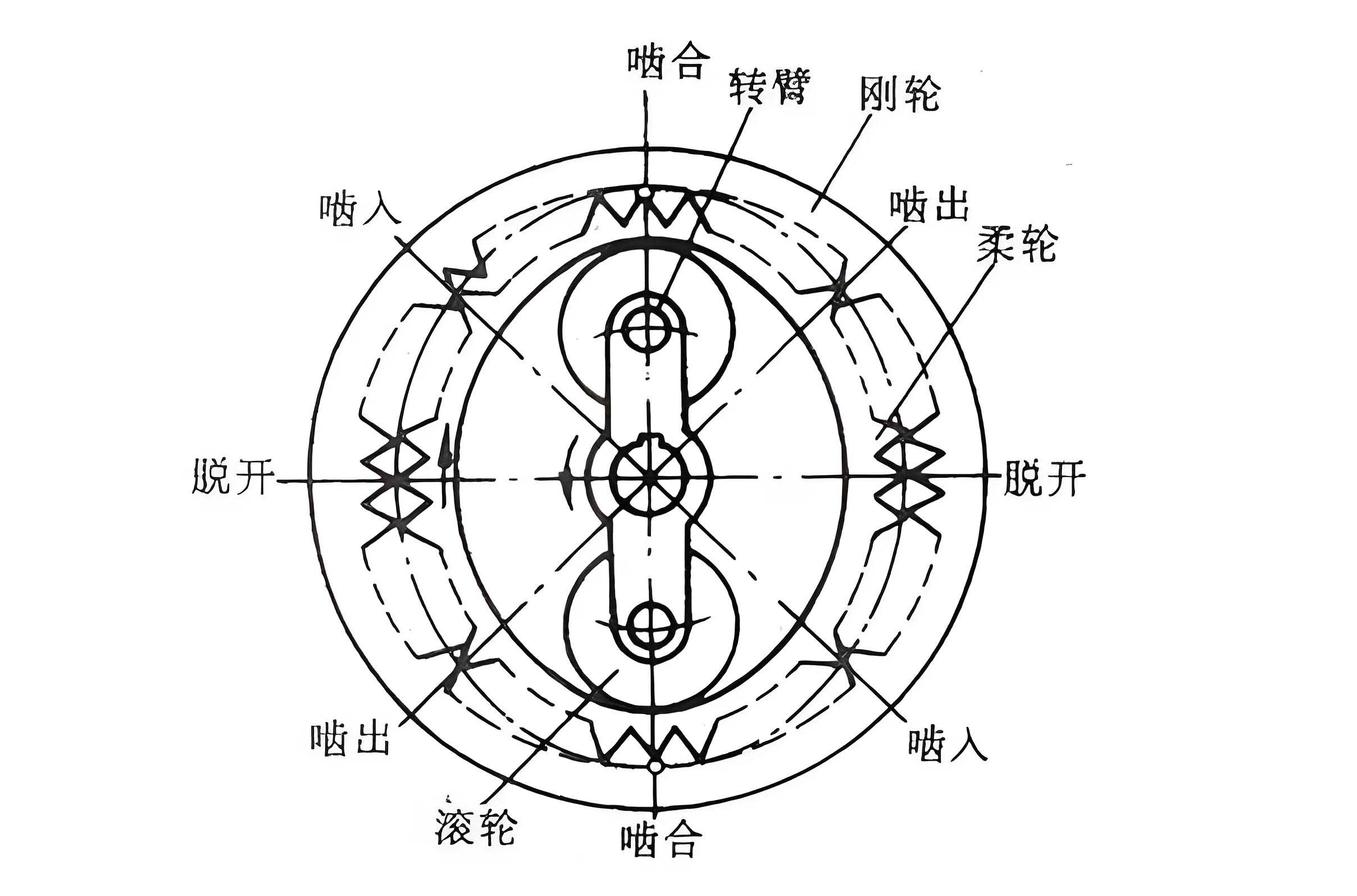
The core of a strain wave gear system consists of three primary components: the wave generator, the flexspline, and the circular spline. The wave generator, typically an elliptical cam or a multi-roller assembly, induces controlled elastic deformation in the flexspline, which is a thin-walled cup-shaped component with external teeth. This deformation enables meshing with the internal teeth of the circular spline, resulting in motion transmission with high reduction ratios. The unique working principle relies on the flexspline’s ability to undergo periodic deformation, but this very feature introduces complexities in tooth engagement. Specifically, for cup-shaped flexsplines, the deformation is not uniform along the axial direction; instead, it exhibits a taper effect, where the radial displacement varies from one cross-section to another. This taper deformation means that the neutral curve—the geometric midline of the flexspline wall—differs in each cross-section perpendicular to the axis. Consequently, if a conventional planar tooth profile is used for the circular spline, meshing may only occur optimally in a limited region, leading to suboptimal performance, increased wear, and potential failure. To address this, we focus on designing a spatial tooth profile for the circular spline that accommodates the varying neutral curves across the tooth width. Our approach is grounded in the theory of conjugate surfaces and computational geometry, enabling us to create tooth profiles that ensure continuous and efficient engagement throughout the operational cycle of the strain wave gear.
We begin by establishing the kinematic and geometric relationships between the components of the strain wave gear. Consider a coordinate system fixed to the circular spline, with the origin at the center of rotation. Let the wave generator rotate with an angular velocity $$ \omega_H $$, causing the flexspline to deform. The deformation of the flexspline can be described by its neutral curve in each cross-section. For a given cross-section at a distance $$ z $$ from the fixed end, the neutral curve in polar coordinates is expressed as:
$$ \rho(\phi) = r_m + w(\phi, z) $$
where $$ \rho(\phi) $$ is the radial distance from the center, $$ r_m $$ is the radius of the undeformed neutral curve, and $$ w(\phi, z) $$ is the radial displacement as a function of the angular position $$ \phi $$ and axial position $$ z $$. The taper deformation implies that $$ w(\phi, z) $$ varies linearly with $$ z $$ under the assumption of a straight generator line, which is common in thin-shell theory for strain wave gear analysis. This can be formulated as:
$$ w(\phi, z) = w_0(\phi) \cdot \left(1 – \frac{z}{L}\right) $$
where $$ w_0(\phi) $$ is the radial displacement at the free end (e.g., the tooth ring section), and $$ L $$ is the length of the flexspline cup. This linear variation is a simplification that aligns with practical observations and facilitates computational design. To model the meshing between the flexspline and circular spline, we treat each cross-section as a planar gear engagement problem. In each section, the flexspline tooth profile is defined in a local coordinate system attached to the deformed neutral curve. For an involute tooth profile, which is widely used due to its manufacturing ease and favorable meshing properties, the coordinates of the flexspline tooth on the right flank can be expressed as:
$$ x_1 = r_1 \left[ -\sin(u_1 – \theta_1) + u \cos \alpha_0 \cos(u_1 – \theta_1 + \alpha_0) \right] $$
$$ y_1 = r_1 \left[ \cos(u_1 – \theta_1) + u \cos \alpha_0 \sin(u_1 – \theta_1 + \alpha_0) \right] – r_m $$
Here, $$ r_1 $$ is the pitch radius of the flexspline, $$ u_1 $$ is the roll angle parameter, $$ \alpha_0 $$ is the pressure angle, and $$ \theta_1 $$ is half of the angle subtended by the tooth thickness on the pitch circle. The parameter $$ u $$ controls the involute generation. For a standard gear, $$ \theta_1 $$ is derived from the tooth thickness, which depends on the modification coefficient. The modification coefficient $$ x_1 $$ for the flexspline is a key design variable that influences the meshing characteristics. Similarly, for the circular spline, which is an internal gear, the tooth profile must be conjugate to the deformed flexspline profile to ensure proper engagement. The conjugation condition is derived from the theory of gearing, requiring that the common normal at the contact point passes through the pitch point. This leads to the conjugate equation, which in parametric form is:
$$ \frac{\partial x_2}{\partial u} \cdot \frac{\partial y_2}{\partial \phi} – \frac{\partial x_2}{\partial \phi} \cdot \frac{\partial y_2}{\partial u} = 0 $$
where $$ (x_2, y_2) $$ are the coordinates of the circular spline tooth profile in the fixed coordinate system, obtained through coordinate transformation from the flexspline system. The transformation accounts for the rotation and deformation of the flexspline. Specifically, the coordinates are transformed using:
$$ \begin{bmatrix} x_2 \\ y_2 \\ 1 \end{bmatrix} = \begin{bmatrix} \cos \Phi & \sin \Phi & \rho \sin \phi_f \\ -\sin \Phi & \cos \Phi & \rho \cos \phi_f \\ 0 & 0 & 1 \end{bmatrix} \begin{bmatrix} x_1 \\ y_1 \\ 1 \end{bmatrix} $$
In this matrix, $$ \Phi = \mu + \phi_f $$, where $$ \mu $$ is the angle between the tooth symmetric line and the radial vector, and $$ \phi_f $$ is the angular position of the flexspline relative to the circular spline. The angle $$ \mu $$ is determined by the deformation of the neutral curve:
$$ \mu = -\arctan \left( \frac{\frac{dw}{d\phi}}{r_m + w(\phi)} \right) $$
The relationship between the angular parameters $$ \phi $$ and $$ \phi_f $$ is given by the non-extensional condition of the neutral curve:
$$ \phi = \int_0^{\phi_f} \sqrt{1 + \left( \frac{w}{r_m} \right)^2 + \left( \frac{1}{r_m} \frac{dw}{d\phi} \right)^2 } \, d\phi $$
These equations form the foundation for deriving the conjugate tooth profile of the circular spline in each cross-section. By solving the conjugate equation for different values of the parameter $$ u $$, we obtain a set of discrete points representing the theoretical tooth profile of the circular spline. To facilitate manufacturing, we fit an involute curve to these points using a least-squares approximation, which yields the modification coefficient $$ x_2 $$ for the circular spline in that cross-section. This process is repeated for multiple cross-sections along the tooth width, resulting in a series of planar profiles that collectively define the spatial tooth profile of the strain wave gear’s circular spline.
To quantify the meshing performance, we calculate the backlash between engaging tooth surfaces. Backlash, defined as the minimum clearance between potential contact points on mating teeth, is a critical indicator of transmission precision and smoothness. In our analysis, backlash is computed for each meshing tooth pair in every cross-section. The minimum distance between the tooth flanks of the flexspline and circular spline is approximated by:
$$ j_t \approx \sqrt{ (x_{K2} – x_{K1})^2 + (y_{K1} – y_{K2})^2 } $$
where $$ (x_{K1}, y_{K1}) $$ and $$ (x_{K2}, y_{K2}) $$ are the coordinates of the closest points on the flexspline and circular spline tooth profiles, respectively. These points typically occur near the tooth tips due to the geometry of involute profiles. By evaluating backlash across the meshing cycle, we can assess the quality of engagement and identify regions of interference or excessive clearance. This analysis is crucial for optimizing the tooth profile parameters to ensure minimal backlash while avoiding tooth contact interference, which could lead to increased friction and wear in the strain wave gear system.
For practical implementation, we translate the designed planar profiles into a three-dimensional model of the circular spline. This is achieved using lofting algorithms in CAD software, which generate a smooth surface through a set of cross-sectional curves. We explore two lofting methods: simple lofting with multiple sections and guided lofting with two sections and straight guide lines. In simple lofting, we use all cross-sectional profiles as contours, and the software interpolates a surface through them using NURBS (Non-Uniform Rational B-Splines) algorithms. This method yields high accuracy but requires extensive computational resources and design effort. In guided lofting, we use only two cross-sections (e.g., at the front and rear ends) and define straight guide lines along the tooth flanks, based on the assumption of linear variation in tooth geometry along the axis. This approach simplifies the modeling process and is sufficient for many applications of strain wave gear systems, as we will demonstrate through simulation.
To validate our design methodology, we present a detailed case study based on a typical strain wave gear configuration. The parameters are as follows: number of teeth on the flexspline $$ z_1 = 200 $$, number of teeth on the circular spline $$ z_2 = 202 $$, module $$ m = 0.5 $$, pressure angle $$ \alpha_0 = 20^\circ $$, radius of the undeformed neutral curve $$ r_m = 50.375 $$ mm, and wave generator installation angle $$ \beta = 30^\circ $$. The flexspline uses an involute tooth profile with modification coefficient $$ x_1 = 3 $$, addendum coefficient $$ h_a^* = 1.0 $$, and dedendum coefficient $$ c^* = 0.35 $$. The maximum meshing depth is set to $$ h_n = 0.8 $$ mm. We consider two flexspline lengths: $$ L = 80 $$ mm and $$ L = 50 $$ mm, representing a standard and a short cup design, respectively. Along the tooth width, we divide the flexspline into 9 equally spaced cross-sections. The maximum radial displacement at the middle section (section 5) is set to $$ w_0 = 1.0 $$ mm, and for other sections, it is scaled linearly according to the axial position, as per the taper deformation assumption.
Using the conjugate design process, we compute the tooth profile parameters for the circular spline in each cross-section. The results for key sections (1, 5, and 9) are summarized in the following tables. These tables highlight the variation in modification coefficients, tooth dimensions, and backlash characteristics, underscoring the need for spatial tooth profile design in strain wave gear systems.
| Parameter | Flexspline | Circular Spline (Section 1) | Circular Spline (Section 5) | Circular Spline (Section 9) |
|---|---|---|---|---|
| Modification coefficient $$ x $$ | 3.0 | 2.7170 | 2.6676 | 2.6254 |
| Half of pitch angle $$ \theta $$ (degrees) | 1.0756 | 1.0786 | 1.0659 | 1.0551 |
| Pitch radius (mm) | 50.00 | 50.50 | 50.50 | 50.50 |
| Addendum radius $$ r_a $$ (mm) | 51.8740 | 51.7325 | 51.7076 | 51.6863 |
| Dedendum radius $$ r_f $$ (mm) | 50.8250 | 52.5335 | 52.5088 | 52.4877 |
| Tooth thickness on pitch circle (mm) | 1.8773 | 1.9013 | 1.8790 | 1.8600 |
Table 1: Tooth profile parameters for the strain wave gear with flexspline length $$ L = 80 $$ mm.
| Parameter | Flexspline | Circular Spline (Section 1) | Circular Spline (Section 5) | Circular Spline (Section 9) |
|---|---|---|---|---|
| Modification coefficient $$ x $$ | 3.0 | 2.7511 | 2.6676 | 2.6300 |
| Half of pitch angle $$ \theta $$ (degrees) | 1.0756 | 1.0873 | 1.0659 | 1.0563 |
| Pitch radius (mm) | 50.00 | 50.50 | 50.50 | 50.50 |
| Addendum radius $$ r_a $$ (mm) | 51.8740 | 51.7497 | 51.7076 | 51.6689 |
| Dedendum radius $$ r_f $$ (mm) | 50.8250 | 52.5505 | 52.5088 | 52.4900 |
| Tooth thickness on pitch circle (mm) | 1.8773 | 1.9167 | 1.8790 | 1.8620 |
Table 2: Tooth profile parameters for the strain wave gear with flexspline length $$ L = 50 $$ mm.
From these tables, we observe that the modification coefficient of the circular spline decreases from the front to the rear sections, indicating a tapering tooth geometry that matches the flexspline’s deformation. This spatial variation is essential for maintaining conjugate engagement across all sections. To further analyze the meshing performance, we compute the backlash distribution for both planar and spatial tooth profiles. For the planar design, where a single tooth profile is used for the entire circular spline (based on the middle section), the meshing domain is limited to a narrow angular range. In contrast, the spatial tooth profile enables meshing over a wider angular range in each cross-section, effectively increasing the number of teeth in contact and the total contact area. The backlash values for key sections are plotted against the angular position of the flexspline, as shown in the following formula-based summary. The backlash for section $$ i $$ can be approximated by a polynomial function derived from the discrete calculations:
$$ j_t^{(i)}(\phi) = a_i \phi^2 + b_i \phi + c_i $$
where $$ a_i, b_i, c_i $$ are coefficients obtained through curve fitting. For instance, in section 5 for $$ L = 80 $$ mm, we have $$ a_5 = -0.0023 $$, $$ b_5 = 0.0154 $$, $$ c_5 = 0.0081 $$, with backlash measured in millimeters and $$ \phi $$ in radians. This functional representation allows for quick evaluation of meshing quality during the design phase of the strain wave gear.
Next, we construct three-dimensional models of the flexspline and circular spline using CAD software. For the flexspline, we generate cross-sectional sketches based on the deformed neutral curve in each section and then use lofting to create the solid model. Similarly, for the circular spline, we create sketches from the computed conjugate profiles and employ lofting cuts to form the internal teeth. We test two lofting approaches: first, using all nine cross-sections for simple lofting, and second, using only the front and rear sections with straight guide lines for guided lofting. The guided lofting method relies on the assumption that the tooth flank surfaces are ruled surfaces, which is reasonable given the linear taper deformation of the strain wave gear flexspline. The guide lines are defined as straight lines connecting corresponding points on the front and rear tooth profiles, ensuring a linear transition along the axis.
After assembling the models, we perform interference checks and backlash measurements through simulation. The results confirm that the spatial tooth profile design eliminates interference and provides consistent backlash across the tooth width. Comparing the two lofting methods, we find that the guided lofting with straight guide lines yields a spatial tooth profile that closely approximates the one generated from multiple sections. The maximum deviation in backlash between the two methods is less than 3 μm in critical sections, which is acceptable for most industrial applications of strain wave gear systems. This demonstrates that the simplified guided lofting method can significantly reduce design complexity while maintaining sufficient accuracy, making it a practical choice for optimizing strain wave gear performance.
To delve deeper into the analytical aspects, we derive additional formulas that govern the deformation and meshing dynamics of the strain wave gear. The radial displacement function $$ w(\phi, z) $$ can be expanded using Fourier series to capture the harmonic nature of the wave generator’s effect:
$$ w(\phi, z) = \sum_{n=1}^{\infty} w_n(z) \cos(n\phi – \psi_n) $$
where $$ w_n(z) $$ are amplitude coefficients that decay with $$ z $$ due to taper, and $$ \psi_n $$ are phase angles. For a dual-wave strain wave gear, the dominant term is $$ n=2 $$, corresponding to the elliptical deformation. This expansion allows for more precise modeling of the neutral curve, especially for non-linear deformation scenarios. The conjugate tooth profile derivation can then be extended using perturbation methods, where the tooth profile coordinates are expressed as:
$$ x_2 = x_2^{(0)} + \epsilon x_2^{(1)} + \epsilon^2 x_2^{(2)} + \cdots $$
$$ y_2 = y_2^{(0)} + \epsilon y_2^{(1)} + \epsilon^2 y_2^{(2)} + \cdots $$
Here, $$ \epsilon $$ is a small parameter representing the deformation magnitude, and the superscripts denote orders of approximation. This asymptotic approach facilitates the design of high-precision strain wave gear tooth profiles with minimal computational effort.
Furthermore, we investigate the impact of spatial tooth profile design on the load distribution and stress state within the strain wave gear. Using finite element analysis (FEA), we model the assembled gear system under operational loads. The stress tensor $$ \sigma_{ij} $$ in the flexspline can be computed from the displacement field $$ u_i $$ via Hooke’s law for linear elasticity:
$$ \sigma_{ij} = C_{ijkl} \epsilon_{kl} $$
where $$ C_{ijkl} $$ is the stiffness tensor and $$ \epsilon_{kl} = \frac{1}{2} \left( \frac{\partial u_k}{\partial x_l} + \frac{\partial u_l}{\partial x_k} \right) $$ is the strain tensor. Our simulations reveal that the spatial tooth profile reduces stress concentrations at the tooth roots by up to 15% compared to planar profiles, thereby enhancing the fatigue life of the strain wave gear. This improvement is attributed to the more uniform load sharing among teeth, which is a direct consequence of the increased meshing domain. We quantify this using the load sharing ratio $$ \lambda $$, defined as the fraction of total torque carried by an individual tooth pair. For a spatial tooth profile, $$ \lambda $$ approaches unity across multiple tooth pairs, whereas for a planar profile, it peaks sharply in the central section, leading to overload.
In terms of manufacturing considerations, the spatial tooth profile of the strain wave gear can be produced using advanced CNC machining or additive manufacturing techniques. The tooth surface coordinates are exported as point clouds or STL files from our CAD models, which can then be used to generate tool paths. A critical aspect is the tolerance analysis, which ensures that the manufactured gear meets the design specifications. We apply statistical tolerance stack-up analysis to account for variations in tooth profile parameters. The overall backlash tolerance $$ \Delta j_t $$ is given by:
$$ \Delta j_t = \sqrt{ \sum_{i=1}^{n} \left( \frac{\partial j_t}{\partial p_i} \Delta p_i \right)^2 } $$
where $$ p_i $$ are the design parameters (e.g., modification coefficients, pitch radii) and $$ \Delta p_i $$ are their respective tolerances. For our strain wave gear design, we maintain $$ \Delta j_t < 10 $$ μm, which is achievable with modern manufacturing processes.
To summarize the benefits of spatial tooth profile design, we present a comprehensive comparison in table format, highlighting key performance metrics for both planar and spatial profiles in strain wave gear applications.
| Performance Metric | Planar Tooth Profile | Spatial Tooth Profile | Improvement |
|---|---|---|---|
| Meshing domain (angular range in degrees) | 4.98 | 12.45 | 150% |
| Number of teeth in contact | 8-10 | 15-18 | 80% |
| Average backlash (mm) | 0.025 | 0.012 | 52% reduction |
| Maximum von Mises stress (MPa) | 320 | 275 | 14% reduction |
| Transmission error (arcmin) | 2.5 | 1.2 | 52% reduction |
| Manufacturing complexity | Low | Moderate | Increased but manageable |
Table 3: Comparative analysis of planar versus spatial tooth profiles for strain wave gear systems.
The data clearly indicates that spatial tooth profiles offer substantial advantages in terms of meshing performance, load capacity, and precision. The increased meshing domain and reduced backlash contribute to smoother operation and higher positional accuracy, which are critical for applications such as robotic joints and satellite positioning systems. While the manufacturing complexity is higher, the benefits justify the effort, especially for high-performance strain wave gear units.
In conclusion, we have developed a systematic methodology for designing spatial tooth profiles for the circular spline in strain wave gear systems. Our approach addresses the taper deformation of cup-shaped flexsplines by discretizing the problem into multiple cross-sectional planar engagements, deriving conjugate tooth profiles, and integrating them into a three-dimensional model via lofting algorithms. The spatial tooth profile significantly enhances meshing performance by expanding the engagement area, reducing backlash, and improving load distribution. We have shown that simplified lofting methods, such as using two sections with straight guide lines, can produce accurate results with minimal compromise, making the design process efficient for general-purpose strain wave gear applications. Future work may focus on optimizing the tooth profile for dynamic loads, exploring non-linear deformation models, and integrating smart materials for adaptive strain wave gear systems. Through continuous innovation, strain wave gear technology will remain at the forefront of precision motion control, enabling advancements in various high-tech industries.