
The design and performance of strain wave gears, also known as harmonic drives, present unique challenges due to the complex interaction between elastic deformation and gear meshing. A primary point of failure in these systems is the thin-walled flexspline, which undergoes cyclic stress leading to fatigue. Traditional design methods for meshing parameters often prioritize kinematic conjugacy or backlash control, sometimes overlooking the direct implications on the mechanical stress state of critical components. This work proposes a novel multi-objective optimization methodology that explicitly incorporates mechanical characteristics into the meshing parameter design process for involute strain wave gears with elliptical wave generators. The goal is to enhance reliability by simultaneously expanding the functional meshing interval and reducing stress-inducing deformation.
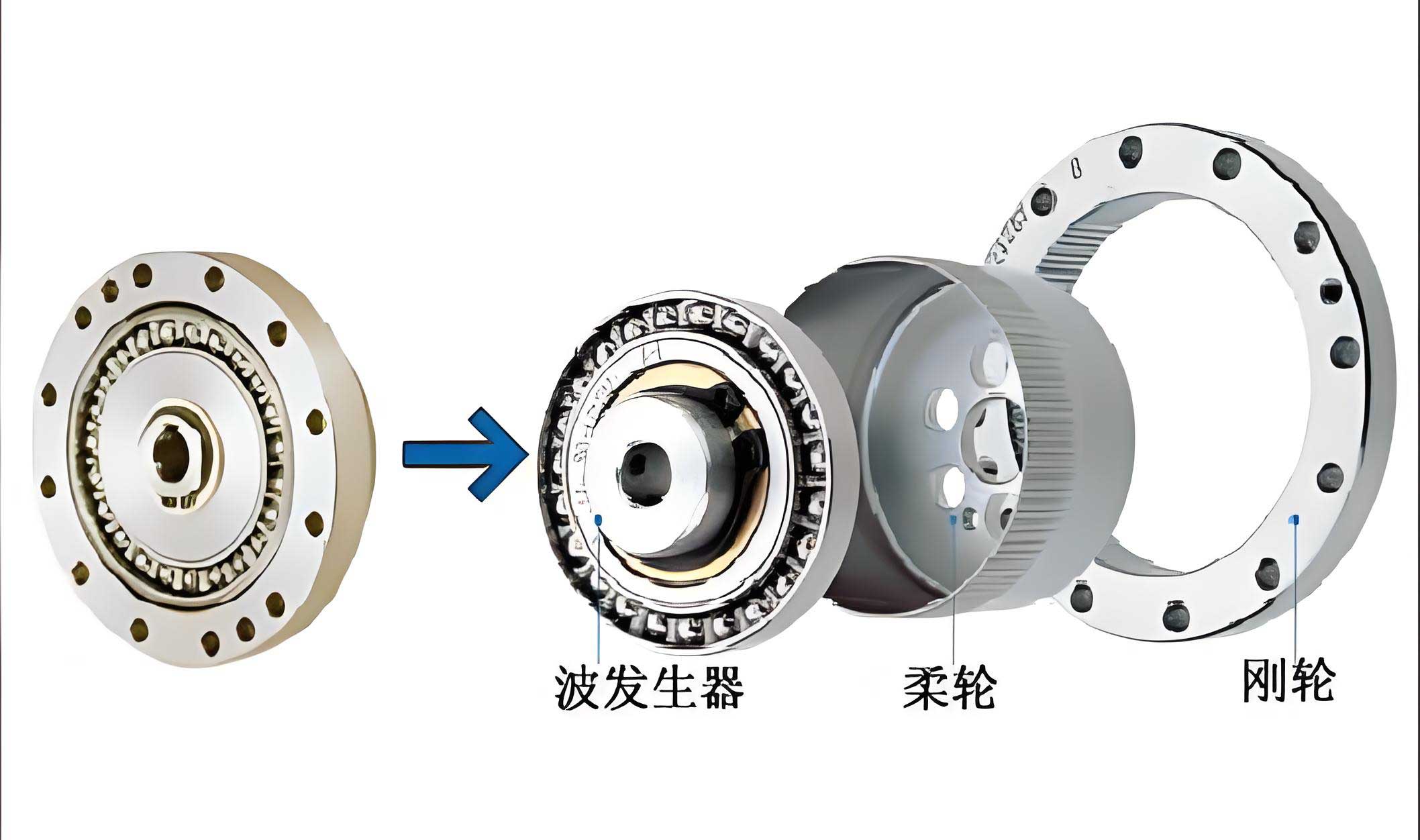
The fundamental operation of a strain wave gear relies on the controlled elastic deformation of the flexspline by the wave generator. For an elliptical cam type, the cam profile is defined in polar coordinates. The radial deformation induced by the wave generator is a critical parameter, directly influencing the stress in the flexspline wall. According to thin-shell elastic theory, the dominant circumferential stress in the flexspline can be expressed as:
$$ \sigma_{\phi k} = K_{\sigma} K_{M} K_{d} C_{\sigma} \delta_{\omega 0} \frac{E \delta_{f0}}{r^2} $$
where \( \sigma_{\phi k} \) is the circumferential stress, \( K_{\sigma} \), \( K_{M} \), \( K_{d} \) are stress concentration, distortion, and dynamic load coefficients respectively, \( C_{\sigma} \) is the positive stress coefficient, \( \delta_{\omega 0} \) is the radial deformation quantity, \( E \) is the modulus of elasticity, \( \delta_{f0} \) is the cup wall thickness, and \( r \) is the radius of the flexspline’s neutral layer. This equation highlights that reducing \( \delta_{\omega 0} \) is an effective direct means to lower flexspline stress, forming one cornerstone of our optimization strategy.
Simultaneously, the meshing performance is governed by the interaction between the deformed flexspline teeth and the circular spline teeth. The “mating curve” or “conjugate curve” defines the neutral layer of the deformed flexspline. The geometric relationship between the elliptical cam profile \( \rho_e(\theta) \), the mating curve \( \rho(\theta) \), and the tooth profiles is complex. The coordinates of a point on the flexspline tooth profile, when transformed into the circular spline coordinate system \( \{o_2x_2y_2\} \), are given by:
$$
\begin{aligned}
x_{2\_1} &= r_{b1}(-\sin(u – \theta_{h1} – \Phi) + u\cos(u – \theta_{h1} – \Phi)) – r\sin\Phi + \rho\sin(\Phi – \theta_d) \\
y_{2\_1} &= r_{b1}(\cos(u – \theta_{h1} – \Phi) + u\sin(u – \theta_{h1} – \Phi)) – r\cos\Phi + \rho\cos(\Phi – \theta_d)
\end{aligned}
$$
where \( r_{b1} \) is the base circle radius of the flexspline, \( u \) is the involute parameter, \( \theta_{h1} \) is the flexspline tooth symmetry angle, \( \Phi \) is the relative rotation angle between tooth centroids, \( \rho \) is the mating curve vector magnitude, and \( \theta_d \) is the angle between the mating curve normal and its vector. The corresponding point on the circular spline profile is:
$$
\begin{aligned}
x_{2\_2} &= r_{b2}(-\sin(v – \theta_{h2}) + v\cos(v – \theta_{h2})) \\
y_{2\_2} &= r_{b2}(\cos(v – \theta_{h2}) + v\sin(v – \theta_{h2}))
\end{aligned}
$$
The normal backlash \( c \) at a given angular position \( \theta \) is a key indicator of meshing quality. It is defined as the normal distance from the flexspline tooth tip to the circular spline tooth profile. Its calculation involves finding the intersection point of the circular spline profile with the line normal to the flexspline tip. A precise iterative method, such as Newton’s method, is used to solve for the corresponding involute parameter \( v_c \). The backlash is then calculated as:
$$ c = \frac{y_{2\_2}(v_c) – y_{2\_1}(T_{a1})}{\sin(T_{a1} – \theta_{h1} – \Phi)} $$
where \( T_{a1} \) is the pressure angle parameter at the flexspline tooth tip. A positive \( c \) indicates clearance, while a negative value signifies interference. The meshing interval \( \Phi_a \) is defined as the angular range over which the backlash \( c \) remains below a specified functional threshold \( J_m \), typically measured in micrometers. A wider \( \Phi_a \) implies more tooth pairs are in a state of near-conjugate contact, which improves load sharing and torsional stiffness.
Formulation of the Multi-Objective Optimization Model
The core of the proposed methodology is to treat the meshing parameter design as an optimization problem with two competing objectives: maximizing the meshing interval and minimizing the radial deformation. These are combined into a single scalar objective function using weighted coefficients:
$$ F(\mathbf{X}) = \alpha \Phi_a + \beta (-\delta_{\omega 0}) $$
where \( \mathbf{X} \) is the vector of design variables, \( \alpha \) and \( \beta \) are weighting coefficients that balance the importance of meshing performance versus mechanical stress. Maximizing \( F(\mathbf{X}) \) means seeking a larger \( \Phi_a \) and a smaller \( \delta_{\omega 0} \).
The design variables are carefully chosen parameters that significantly influence both the geometry of the tooth engagement and the deformation of the strain wave gear assembly. They include parameters from the wave generator, flexspline, and circular spline.
| Design Variable Symbol | Description | Relationship |
|---|---|---|
| \( x_1 = e_1 \) | Flexspline addendum modification coefficient | Shifts the flexspline tooth profile radially. |
| \( x_2 = e_2 \) | Circular spline addendum modification coefficient | Shifts the circular spline tooth profile radially. |
| \( x_3 = h_1 \) | Flexspline tooth height coefficient | \( h_1 = \text{Addendum} / m \). |
| \( x_4 = h_2 \) | Circular spline tooth height coefficient | Typically set equal to \( h_1 \). |
| \( x_5 = \delta_{\omega}^* \) | Radial deformation coefficient | \( \delta_{\omega 0} = m \cdot \delta_{\omega}^* \). |
| \( x_6 = c^* \) | Tip clearance coefficient | Defines the non-working clearance between tooth tips. |
The optimization is subject to several practical constraints to ensure manufacturability and proper function:
- Tooth Tip Thickness Constraint: \( g_1(\mathbf{X}) = s_1 – 0.25m \ge 0 \), \( g_2(\mathbf{X}) = s_2 – 0.25m \ge 0 \). Ensures teeth are not too pointed.
- Non-Interference Constraint: \( g_3(\mathbf{X}) = c – J_0 \ge 0 \) for all \( \theta \). Prevents tooth gouging during meshing (\( J_0 \) is a minimum allowed clearance).
- Sufficient Working Depth Constraint: \( g_4(\mathbf{X}) = h_0 – m \ge 0 \), where \( h_0 = h_1 – c^* \). Ensures adequate contact depth for load capacity.
- Disengagement Interference Constraint: \( g_5(\mathbf{X}) = c’ – J_c \ge 0 \). Prevents interference as teeth disengage, where \( c’ \) is the backlash at the disengagement point and \( J_c \) is its minimum limit.
The complete constrained optimization problem is:
$$ \max \ F(\mathbf{X}), \quad \mathbf{X} = [x_1, x_2, x_3, x_4, x_5, x_6] $$
$$ \text{subject to} \quad g_k(\mathbf{X}) \ge 0, \quad k = 1, 2, …, 5 $$
Solution Strategy and Algorithm Implementation
Solving this nonlinear, constrained optimization problem requires a robust global search algorithm. We employ a Genetic Algorithm (GA) due to its effectiveness in handling complex, multi-modal design spaces. To manage the constraints, the penalty function method is integrated. An auxiliary function \( G(\mathbf{X}) \) is constructed:
$$ G(\mathbf{X}) = \begin{cases}
F(\mathbf{X}), & \text{if } \mathbf{X} \in D_G \\
-\infty, & \text{if } \mathbf{X} \notin D_G
\end{cases} $$
where \( D_G \) is the feasible domain defined by the constraints \( g_k(\mathbf{X}) \ge 0 \). Assigning a fitness of \( -\infty \) to infeasible individuals guarantees their elimination through the GA’s selection process, effectively transforming the problem into an unconstrained maximization of \( G(\mathbf{X}) \).
The computational flow involves a nested loop structure. The outer loop is the GA’s evolutionary cycle (selection, crossover, mutation). For each individual (a set of design variables \( \mathbf{X} \)), an inner loop executes. This inner loop rotates the flexspline tooth through its potential engagement positions (angle \( \theta \)), calculating the mating curve geometry, tooth profiles, normal backlash, and all constraint values at each step. The meshing interval \( \Phi_a \) is accumulated from these calculations. The fitness \( G(\mathbf{X}) \) is then evaluated and fed back to the GA.
Case Study: Optimization and Comparative Analysis
To validate the methodology, it was applied to a specific strain wave gear model. Key fixed parameters include: flexspline teeth \( z_1 = 150 \), circular spline teeth \( z_2 = 152 \), module \( m = 0.4 \) mm, nominal pressure angle \( \alpha = 20^\circ \), and flexspline cup wall thickness \( \delta = 0.75 \) mm. The initial design, derived from a traditional backlash-control method, served as the baseline for comparison.
Different weight coefficients \( (\alpha, \beta) \) were tested to explore the trade-off between meshing interval and radial deformation. The results guided the selection of a balanced set of weights.
| Optimization Run | Weight \( \alpha \) | Weight \( \beta \) | Meshing Interval \( \Phi_a \) (°) | Radial Deform. \( \delta_{\omega 0} \) (mm) | Max. Equivalent Stress (MPa)* |
|---|---|---|---|---|---|
| Initial Design | – | – | 9.25 | 0.425 | 457.66 |
| Opt. I | 1.0 | 2.5 | 12.5 | 0.364 | 339.66 |
| Opt. II | 1.0 | 2.0 | 13.5 | 0.368 | 342.89 |
| Opt. III (Balanced) | 1.0 | 1.0 | 16.25 | 0.356 | 313.46 |
| Opt. IV | 1.0 | 0.5 | 11.5 | 0.388 | 383.73 |
*Stress values are from Finite Element Analysis (FEA) for comparison.
The selected optimal design (Opt. III) shows a significant improvement. The meshing interval increased by approximately 76%, and the radial deformation decreased by about 16%. The final optimized design variables are summarized below.
| Parameter | Initial Design Value | Optimized Design Value | Change |
|---|---|---|---|
| Flexspline Mod. Coeff. \( e_1 \) | 3.225 | 3.785 | +17.4% |
| Circ. Spline Mod. Coeff. \( e_2 \) | 3.275 | 3.705 | +13.1% |
| Tooth Height Coeff. \( h_1, h_2 \) | 1.800 | 1.725 | -4.2% |
| Radial Deform. Coeff. \( \delta_{\omega}^* \) | 1.0625 | 0.8900 | -16.2% |
| Tip Clearance Coeff. \( c^* \) | 0.2875 | 0.6725 | +134% |
Verification via Finite Element Analysis of Mechanical Characteristics
The performance gains predicted by the optimization were verified through detailed Finite Element Analysis (FEA) of the full strain wave gear assembly, including contact pairs between the wave generator and flexspline, and between the flexspline and circular spline teeth under load.
1. Contact State: The optimized design showed a substantially larger zone of tooth pairs in active contact. The percentage of tooth pairs in simultaneous contact increased from 18% in the initial design to 32% in the optimized design—an increase of 14 percentage points. This directly results from the expanded meshing interval \( \Phi_a \).
2. Torsional Stiffness: The torsional stiffness, calculated from the torque vs. rotation curve at the flexspline cup, showed a minor decrease of about 6.7% (from \( 3.58 \times 10^4 \) Nm/rad to \( 3.34 \times 10^4 \) Nm/rad). This slight reduction is acceptable given the other significant benefits and is attributed to the reduced working tooth depth (\( h_0 \)). Importantly, the expanded contact zone helps mitigate a more severe stiffness loss.
3. Flexspline Stress: This is the most critical validation. The FEA results confirmed a dramatic reduction in the maximum equivalent (von Mises) stress in the flexspline. The stress decreased from 457.66 MPa in the initial design to 313.46 MPa in the optimized strain wave gear—a reduction of **31.5%**. This reduction is primarily a direct consequence of the reduced radial deformation \( \delta_{\omega 0} \), as predicted by the theoretical stress formula, and is further aided by the improved load sharing from more contacting teeth.
| Performance Metric | Initial Design | Optimized Design | Improvement |
|---|---|---|---|
| Simultaneous Contact Tooth Pair Ratio | 18% | 32% | +14 p.p. |
| Working Tooth Height Coefficient \( h_0 \) | 1.5125 | 1.0525 | -30.4% |
| Contact Area Ratio | ~4.05% | ~4.00% | ≈ Stable |
| Torsional Stiffness \( K \) (Nm/rad) | 3.58 × 10⁴ | 3.34 × 10⁴ | -6.7% |
| Max. Flexspline Equivalent Stress (MPa) | 457.66 | 313.46 | -31.5% |
Conclusion
This work has successfully developed and demonstrated an optimization methodology for strain wave gear meshing parameters that integrates mechanical characteristics directly into the design objective. By formulating a multi-objective function that seeks to maximize the functional meshing interval while minimizing the wave generator’s radial deformation, the method addresses the root cause of flexspline fatigue failure. The use of a Genetic Algorithm combined with a penalty function provides an effective solver for this constrained, nonlinear problem.
The case study clearly validates the approach. Compared to a design derived from traditional backlash-control methods, the optimized strain wave gear parameters achieved a major expansion of the simultaneous contact zone and, most importantly, a reduction of over 31% in the maximum stress within the critical flexspline component. This stress reduction is achieved with only a minor trade-off in torsional stiffness. Consequently, this methodology provides a powerful design tool for enhancing the reliability and longevity of strain wave gears by proactively improving the stress state of their most vulnerable part during the parameter calculation phase itself.