
In the field of precision transmission systems, the planetary roller screw assembly stands out as a critical component for converting rotational motion into linear motion with high efficiency and accuracy. Its applications span across aerospace, robotics, and industrial machinery, where dynamic performance and reliability are paramount. However, the inherent complexity of the planetary roller screw assembly, characterized by multiple contacting interfaces and nonlinear interactions, often leads to vibrational challenges that can compromise system integrity. In this article, I delve into the nonlinear vibrational behavior of the planetary roller screw assembly under coupled excitations, focusing on the interplay between gear meshing dynamics and thread elastic deformation. By developing a comprehensive dynamic model, I aim to elucidate the mechanisms driving bifurcations, chaos, and global stability, thereby providing insights for optimizing the design and control of such assemblies.
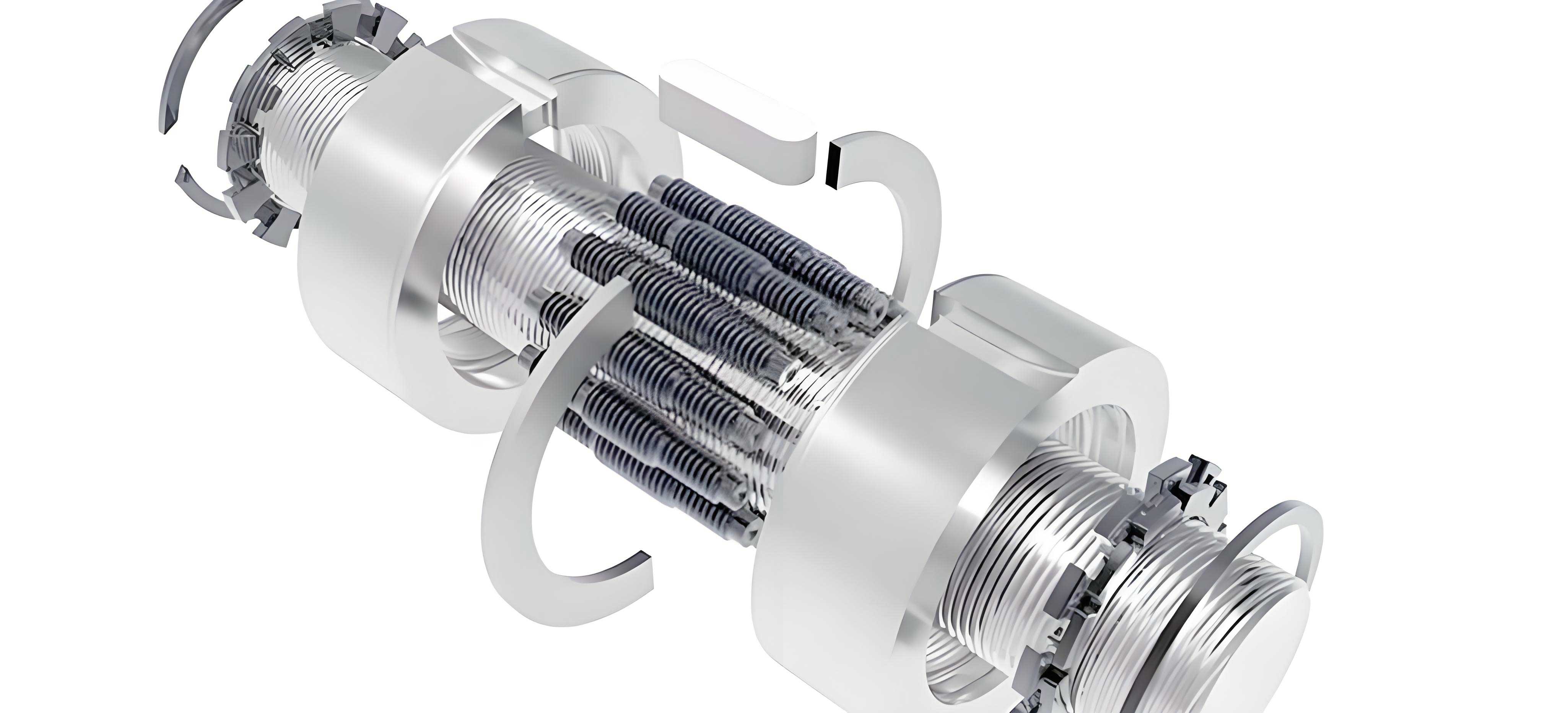
The planetary roller screw assembly comprises a central screw, multiple rollers arranged in a planetary configuration, and a nut, all interacting through threaded surfaces and gear engagements. Traditional models often treat these components as rigid bodies, neglecting the elastic deformations that occur under operational loads. This simplification can lead to inaccuracies in predicting dynamic responses, especially when coupled excitations from gear meshing are present. In my analysis, I incorporate both thread deformation and gear-induced激励 to construct a more realistic model. The key aspects I explore include the kinematic relationships, force distributions, and the derivation of governing equations for vibration. Throughout this discussion, the term “planetary roller screw assembly” will be emphasized to underscore the integrated nature of this system.
To begin, let me outline the fundamental kinematics of the planetary roller screw assembly. Consider a global coordinate system \(O-xyz\) fixed in space, with the origin at the left end of the screw. The screw rotates with an angular velocity \(\omega_s\), leading to an axial velocity \(v_N\) of the nut given by:
$$ v_N = \frac{p}{2\pi} \omega_S $$
where \(p\) is the pitch of the thread. The axial displacement \(x_N\) of the nut relates to the screw rotation angle \(\phi_s\) as:
$$ x_N = \frac{p}{2\pi} \phi_S $$
In a planetary roller screw assembly, the rollers not only rotate but also revolve around the screw, maintaining synchronized motion with the nut. This intricate movement is governed by the geometry of the threads and the gear engagements between the rollers and the nut’s internal gear ring. For instance, if we denote the number of rollers as \(n_{\text{roller}}\), each roller experiences combined rolling and sliding contacts, which contribute to the overall dynamics. Below, I summarize the primary parameters used in modeling a typical planetary roller screw assembly:
| Parameter | Symbol | Typical Value | Description |
|---|---|---|---|
| Pitch | \(p\) | 2.5 mm | Distance between threads |
| Screw Major Diameter | \(D_S\) | 25 mm | Outer diameter of screw |
| Nut Major Diameter | \(D_N\) | 45 mm | Inner diameter of nut |
| Roller Major Diameter | \(D_R\) | 10 mm | Diameter of rollers |
| Thread Flank Angle | \(\beta\) | 45° | Angle of thread surface |
| Number of Rollers | \(n_{\text{roller}}\) | 5 | Planetary configuration count |
| Modulus of Elasticity | \(E\) | 210 GPa | Material stiffness |
| Poisson’s Ratio | \(\mu\) | 0.3 | Material property |
Moving to the deformation analysis, the threads in a planetary roller screw assembly undergo elastic deformation under load, which significantly affects contact forces and vibrational responses. The deformation includes radial compression, bending, shear, and tilting of the thread teeth. For the screw or roller threads, the radial deformation \(\delta^i_r\) due to a radial force \(F_r\) can be expressed as:
$$ \delta^i_r = \frac{(1 – \mu) F_r}{E} \frac{D_i}{p} \frac{1}{2 \tan^2 \beta_i} $$
where \(i\) denotes either the screw (S) or roller (R). For the nut threads, the radial deformation is:
$$ \delta^N_r = \left( \frac{D_N^2 + d_N^2}{D_N^2 – d_N^2} + \mu \right) \frac{F_r}{E} \frac{d_N}{p} \frac{1}{2 \tan^2 \beta_N} $$
Here, \(d_N\) is the minor diameter of the nut. The axial deformation \(\delta^i_a\) comprises bending (\(\delta^i_{\text{bend}}\)), shear (\(\delta^i_{\text{cut}}\)), and tilting (\(\delta^i_{\text{tilt}}\)) components, given by:
$$ \delta^i_a = \delta^i_{\text{bend}} + \delta^i_{\text{cut}} + \delta^i_{\text{tilt}} $$
with detailed formulas as follows:
$$ \delta^i_{\text{bend}} = \frac{3F_a (1 – \mu)^2}{4E} \left[ 1 – \left( \frac{2 – b_i}{a_i} \right) + 2 \ln \left( \frac{b_i}{a_i} \right) \right] \tan^3 \beta_i – \frac{3F_a (1 – \mu)^2}{4E} \left( \frac{b_i}{a_i} \right)^2 \frac{4}{\tan \beta_i} + \frac{6F_a (1 + \mu)}{5E \tan^3 \beta_i} \ln \left( \frac{b_i}{a_i} \right) $$
$$ \delta^i_{\text{cut}} = \frac{12F_a (1 – \mu^2) c_i}{\pi E a_i^2} \left( c_i – \frac{b_i \tan \beta_i}{2} \right) $$
$$ \delta^i_{\text{tilt}} = \frac{2F_a (1 – \mu^2)}{\pi E} \frac{p}{a_i} \ln \left( \frac{p + a_i/2}{p – a_i/2} \right) + \frac{2F_a (1 – \mu^2)}{\pi E} \frac{1}{2} \ln \left( \frac{4p^2}{a_i^2} – 1 \right) $$
In these equations, \(F_a\) is the axial force, and \(a_i\), \(b_i\), \(c_i\) are geometric parameters related to thread dimensions. The axial stiffness \(k_{iz}\) of the thread can then be derived as:
$$ k_{iz} = \frac{F_a}{\delta^i_a} $$
This deformation model is crucial for accurately capturing the load distribution in a planetary roller screw assembly, as it influences the contact forces between the screw, rollers, and nut.
Next, I consider the gear meshing激励 within the planetary roller screw assembly. The gears, typically between the rollers and the nut’s internal ring, introduce dynamic excitations due to meshing impacts and time-varying stiffness. When a roller gear tooth engages with the internal gear ring, an impact occurs if there is a discrepancy in normal pitch, leading to a冲击 velocity \(v_m\). The maximum impact force \(F_{\text{max}}\) can be calculated using:
$$ F_{\text{max}} = v_m \sqrt{\frac{b I_1 I_2}{(I_1 r^{\prime 2}_R + I_2 r^2_G) l}} $$
where \(v_m = \omega_G r_G – \omega_R r^{\prime}_{\text{ring}}\), with \(\omega_G\) and \(\omega_R\) being angular velocities, \(r_G\) and \(r^{\prime}_{\text{ring}}\) engagement radii, \(I_1\) and \(I_2\) moments of inertia, \(b\) gear width, and \(l\) equivalent compliance. This impact force is often modeled as a half-sine pulse:
$$ F_m(t) = F_m \sin(\pi t / t_m) = F_m \sin(\omega_m t) $$
where \(t_m\) is the impact duration and \(\omega_m = \pi / t_m\). Additionally, the time-varying meshing stiffness \(k_m(t)\) of the gear pair is another key excitation source. It accounts for the alternating single and double tooth contact regions and can be expressed as:
$$ k_m(t) = \frac{1}{\frac{1}{\xi_G k_G} + \frac{1}{k_{\text{coin}}} + \frac{1}{\xi_{\text{ring}} k_{\text{ring}}}} $$
Here, \(\xi_G\) and \(\xi_{\text{ring}}\) are correction factors, \(k_G\) and \(k_{\text{ring}}\) are base stiffness values, and \(k_{\text{coin}}\) is the stiffness due to contact重合度, computed as:
$$ k_{\text{coin}} = \sum_{j=1}^{\gamma} k^j_{\text{coin}} = \sum_{j=1}^{\gamma} \frac{1}{\frac{1}{k^j} + \frac{1}{k^j_G} + \frac{1}{k^j_{\text{ring}}}} $$
where \(k^j\) is the Hertzian contact stiffness for the \(j\)-th tooth pair. The net gear meshing force \(F_G\) acting on the planetary roller screw assembly is then:
$$ F_G = k_m(t) [y_{\text{ring}}(t) – y_G(t)] $$
with \(y_{\text{ring}}(t)\) and \(y_G(t)\) being vibrational displacements of the gear ring and roller gear, respectively.
The coupling between gear激励 and thread contact forces in a planetary roller screw assembly is profound. For the screw-roller contact, the force \(f_{SR}\) varies dynamically due to gear effects:
$$ f_{SR} = \begin{cases}
f^{\text{max}}_{SR} + 2F_m & (0 < t \leq t_s) \\
f^{\text{max}}_{SR} + 2F_G & (t_s < t \leq t_e)
\end{cases} $$
Similarly, for the nut-roller contact \(f_{NR}\):
$$ f_{NR} = \begin{cases}
f^{\text{max}}_{NR} + 2F_m & (0 < t \leq t_s) \\
f^{\text{max}}_{NR} + 2F_G & (t_s < t \leq t_e)
\end{cases} $$
where \(t_s\) is the impact time and \(t_e\) the meshing period. These variable forces alter the load distribution across the threads. By applying deformation compatibility conditions—where the axial deformation of the roller equals that of the nut—I derive the dynamic load distribution equations. For the nut-roller side of the planetary roller screw assembly:
$$ \sum_{j=1}^{i} \frac{f_{NRj}}{k_{Na}} + \frac{f_{NRi} – f_{NRi+1}}{k_{Nz}} + \frac{f_{NRi}}{k_{NRa}} = \frac{f_{NRi+1} – f_{NRi}}{k_{Rz}} + \frac{f_{NRi+1}}{k_{NRa}} + \frac{\sum_{j=0}^{\lfloor i/2 \rfloor} (f_{NRj} – f_{SRj}) + f_{NR(\lfloor i/2 \rfloor + 1)}}{k_{Ra}} + \frac{\sum_{j=0}^{\lfloor i/2 \rfloor} (f_{NRj} – f_{SRj})}{k_{Ra}} $$
And for the screw-roller side:
$$ \frac{\sum_{j=1}^{n} f_{SRj} – \sum_{j=1}^{i} f_{SRj}}{k_{Sa}} + \frac{f_{SRi+1} – f_{SRi}}{k_{Sz}} + \frac{f_{SRi+1}}{k_{SRa}} = \frac{f_{SRi}}{k_{SRa}} + \frac{f_{SRi} – f_{SRi+1}}{k_{Rz}} + \frac{2\sum_{j=0}^{\lfloor i/2 \rfloor} (f_{NRj} – f_{SRj}) + f_{NR(\lfloor i/2 \rfloor + 1)}}{k_{Ra}} $$
In these equations, \(k_{ia}\) and \(k_{iz}\) represent axial stiffness of thread segments and teeth, while \(k_{NRa}\) and \(k_{SRa}\) are contact stiffness values. Solving these yields the瞬态 load distribution, which is essential for dynamic analysis.
With the force interactions established, I now formulate the nonlinear dynamics of the planetary roller screw assembly. Considering 12 degrees of freedom—including translations and rotations of the screw, rollers, nut, and carrier—I use a lumped mass approach. The generalized coordinates are:
$$ \mathbf{X} = [z_S, x_{pn}, y_{pn}, z_{pn}, u_{pn}, x_c, y_c, u_c, x_r, y_r, u_r] \quad (n=1,2,\dots,n_{\text{roller}}) $$
where subscripts denote: \(S\) for screw, \(pn\) for \(n\)-th roller gear, \(c\) for carrier, and \(r\) for nut (ring). The equations of motion incorporate masses, damping, stiffness, and nonlinear forces from contacts and gear meshing. For instance, the screw’s axial vibration is governed by:
$$ m_S \frac{d^2 z_S}{dt^2} + c_{Sz} \frac{d z_S}{dt} + k_{Sz} z_S + f_{SR} + M_{Sqz} = 0 $$
Here, \(m_S\) is screw mass, \(c_{Sz}\) damping, \(k_{Sz}\) stiffness, \(f_{SR}\) screw-roller contact force, and \(M_{Sqz}\) friction moment. For each roller in the planetary roller screw assembly, the equations include radial, axial, and torsional dynamics:
$$ m_q \left( \frac{d^2 x_{pn}}{dt^2} – 2\omega_q \frac{d y_{pn}}{dt} – \omega_q^2 x_{pn} \right) + J_{Sqx} + J_{rqx} + M_{Sqx} + M_{rqx} – k_{qx} \delta_{rn} \sin \phi_{rn} – k_{qx} \delta_{cnx} – c_{qx} \frac{d \delta_{xn}}{dt} = 0 $$
$$ m_q \left( \frac{d^2 y_{pn}}{dt^2} + 2\omega_q \frac{d x_{pn}}{dt} – \omega_q^2 y_{pn} \right) + J_{Sqy} + J_{rqy} + M_{Sqy} + M_{rqy} – k_{qy} \delta_{rn} \cos \phi_{rn} – k_{qy} \delta_{cny} – c_{qy} \frac{d \delta_{yn}}{dt} = 0 $$
$$ m_q \frac{d^2 z_{pn}}{dt^2} + c_{qz} \frac{d \delta_{zn}}{dt} + k_{qz} \delta_{zn} + f_{SR} + f_{NR} = 0 $$
$$ \frac{I_q}{r_q^2} \frac{d^2 u_{pn}}{dt^2} – k_{qu} \delta_{rn} – c_{qu} \frac{d \delta_{un}}{dt} – \frac{T_{\text{in}}}{r_q} = 0 $$
Similarly, for the carrier and nut:
$$ m_c \left( \frac{d^2 x_c}{dt^2} – 2\omega_q \frac{d y_c}{dt} – \omega_q^2 x_c \right) + \sum_{n=1}^{n_r} k_{qx} \delta_{cnx} + k_{cx} x_c + c_{cx} \frac{d x_c}{dt} = 0 $$
$$ m_c \left( \frac{d^2 y_c}{dt^2} + 2\omega_q \frac{d x_c}{dt} – \omega_q^2 y_c \right) + \sum_{n=1}^{n_r} k_{qy} \delta_{cny} + k_{cy} y_c + c_{cy} \frac{d y_c}{dt} = 0 $$
$$ \frac{I_c}{r_c^2} \frac{d^2 u_c}{dt^2} + \sum_{n=1}^{n_r} k_{qu} \delta_{cnu} + k_{cu} u_c + c_{cu} \frac{d u_c}{dt} = 0 $$
$$ m_{nr} \left( \frac{d^2 x_{nr}}{dt^2} – 2\omega_q \frac{d y_{nr}}{dt} – \omega_q^2 x_{nr} \right) + J_{rqx} + M_{rqx} – \sum_{n=1}^{n_r} k_{rx} \delta_{rn} \sin \phi_{rn} + k_{rx} x_r + c_{rx} \frac{d x_{nr}}{dt} = 0 $$
$$ m_{nr} \left( \frac{d^2 y_{nr}}{dt^2} + 2\omega_q \frac{d x_{nr}}{dt} – \omega_q^2 y_{nr} \right) + J_{rqy} + M_{rqy} + \sum_{n=1}^{n_r} k_{ry} \delta_{rn} \cos \phi_{rn} + k_{ry} y_r + c_{ry} \frac{d y_{nr}}{dt} = 0 $$
$$ m_{nr} \frac{d^2 z_{nr}}{dt^2} + c_{rz} \frac{d z_{nr}}{dt} + k_{rz} z_{nr} + f_{NR} = 0 $$
$$ \frac{I_{nr}}{r_{nr}^2} \frac{d^2 u_{nr}}{dt^2} – \sum_{n=1}^{2} k_{ru} \delta_{rn} + k_{ru} u_{nr} + c_{ru} \frac{d u_{nr}}{dt} – \frac{T_{\text{out}}}{r_{nr}} = 0 $$
In these equations, \(\delta_{rn}\) represents the relative displacement along the gear meshing line:
$$ \delta_{rn} = (x_{pn} – x_r) \sin \phi_{rn} + (y_r – y_{pn}) \cos \phi_{rn} + u_r + u_n + \gamma_{rn}(t) $$
where \(\gamma_{rn}(t)\) accounts for transmission errors. To handle numerical stability, I non-dimensionalize the equations using characteristic length \(b_m\) (half of gear backlash) and frequency \(\omega\) defined as:
$$ \omega = \sqrt{k_m \left( \frac{1}{m_q} + \frac{1}{m_{nr}} \right)} $$
with dimensionless time \(\tau = \omega t\). The gear backlash nonlinearity is incorporated via a clearance function \(h(x)\):
$$ h(x) = \begin{cases}
x – b_m & (x > b_m) \\
0 & (|x| < b_m) \\
x + b_m & (x < -b_m)
\end{cases} $$
This completes the dynamic model of the planetary roller screw assembly, which I solve numerically to investigate vibrational responses.
Now, I proceed to analyze the dynamic behavior of the planetary roller screw assembly under varying external excitation frequencies \(\omega_e = \omega_s / \omega\), where \(\omega_s\) is the screw rotational speed. Using numerical integration techniques, I compute time-domain responses, frequency spectra, phase portraits, and Poincaré sections. For instance, at \(\omega_e = 0.96\), the gear meshing displacement exhibits chaotic motion: time-series show aperiodic fluctuations, spectra contain broad-band components, phase plots are erratic, and Poincaré points are scattered. In contrast, at \(\omega_e = 1.15\), the system transitions to period-2 motion, characterized by regular oscillations with two distinct frequencies in the spectrum and two concentrated points in the Poincaré section. These patterns highlight the sensitivity of the planetary roller screw assembly to excitation conditions.
To quantify this, I present bifurcation diagrams that depict the evolution of vibrational amplitudes as \(\omega_e\) varies from 0.7 to 1.6. For the gear meshing displacement \(\delta_{rn}\), the diagram reveals a route from chaos (via period-doubling bifurcations) to periodic motions. Specifically, chaos occurs around \(\omega_e \in (0.76, 1.08)\), followed by period-2 at \(\omega_e \approx 1.08\), and stable period-1 beyond \(\omega_e = 1.20\). Similarly, for the screw axial displacement \(z_S\), bifurcations show simpler transitions, with quasi-periodic behavior emerging at higher frequencies. The table below summarizes the observed dynamic regimes in the planetary roller screw assembly:
| Excitation Frequency Range (\(\omega_e\)) | Gear Meshing Response | Screw Axial Response | Remarks |
|---|---|---|---|
| 0.70 – 0.89 | Period-1 (P1) | Period-1 (P1) | Stable synchronous motion |
| 0.89 – 0.96 | P3 and Chaos coexisting | Transition to chaos | Onset of nonlinearity |
| 0.96 – 1.09 | Multiple coexisting states (Chaos, P2, P3) | Chaotic dominated | High sensitivity to initial conditions |
| 1.12 – 1.16 | Period-2 (P2) and Period-3 (P3) | Period-2 (P2) emerging | Bifurcation pathways |
| 1.19 – 1.60 | Period-1 (P1) | Quasi-periodic and Period-1 | Stabilization at higher speeds |
The rich dynamics underscore the importance of considering coupled excitations in a planetary roller screw assembly, as gear-Thread interactions amplify nonlinear effects.
Beyond local bifurcations, I explore the global characteristics of the planetary roller screw assembly using cell mapping methods. This approach maps the state space into discrete cells to track long-term behaviors and吸引 domains. For the gear meshing vibration, the global bifurcation diagram over \(\omega_e \in (0.7, 1.6)\) displays multiple attractors coexisting, indicated by different colors for P1, P2, and chaotic (PN) states. The boundaries between these attractors exhibit fractal structures, implying that slight changes in initial conditions can lead to vastly different steady-state responses. Similarly, for the screw axial vibration, the global analysis reveals simpler吸引 domains but still with coexisting periodic orbits, especially in ranges like \(\omega_e \in (1.18, 1.28)\) where two types of P2 responses exist. The sensitivity to initial conditions is more pronounced in the gear subsystem, highlighting its dominant role in the overall dynamics of the planetary roller screw assembly.
To further illustrate, I derive key metrics from the global analysis. Let the state vector be \(\mathbf{Y} = [\delta_{rn}, \dot{\delta}_{rn}, z_S, \dot{z}_S]^T\). The cell mapping reveals that for a given \(\omega_e\), the basin of attraction for chaotic motion occupies a significant portion of the state space at lower frequencies, whereas periodic attractors dominate at higher frequencies. This has practical implications: in operational regimes where the planetary roller screw assembly experiences variable loads, designers must account for these multistabilities to avoid undesirable vibrational modes.
In conclusion, my investigation into the nonlinear vibration of the planetary roller screw assembly demonstrates that coupling between gear meshing激励 and thread elastic deformation induces complex dynamic behaviors, including bifurcations, chaos, and multistability. The integrated model I developed captures these phenomena by incorporating time-varying stiffness, impact forces, and deformation compatibility. Key findings are:
- The gear meshing excitation significantly modulates the thread contact forces in the planetary roller screw assembly, causing periodic fluctuations in load distribution and triggering nonlinear vibrations.
- As the external excitation frequency varies, the system undergoes transitions from periodic to chaotic states via period-doubling bifurcations, with critical ranges identified for operational stability.
- Global analysis reveals that the planetary roller screw assembly exhibits sensitivity to initial conditions, particularly in the gear subsystem, necessitating careful consideration in control strategies.
These insights can guide the design of more robust planetary roller screw assemblies, for instance, by optimizing thread geometry to reduce deformation effects or implementing damping mechanisms to mitigate gear-induced vibrations. Future work could explore real-time monitoring techniques or advanced control algorithms to suppress nonlinear oscillations in practical applications. Throughout this study, the recurring theme has been the interconnected nature of components in a planetary roller screw assembly, affirming that holistic modeling is essential for unlocking its full potential in high-performance systems.