
The planetary roller screw assembly represents a significant advancement in precision power transmission, offering superior capabilities in load capacity, positioning accuracy, and operational longevity compared to traditional ball screw systems. Among its various configurations, the inverted planetary roller screw assembly (IPRS) stands out due to its compact design, where the nut rotates and the screw translates, making it particularly suitable for applications requiring high force density in constrained spaces, such as aerospace actuators, heavy-duty machine tools, and robotics. However, the very features that grant these advantages—multiple interacting components (nut, screw, rollers, cage), numerous points of contact (thread and gear interfaces), and complex kinematic couplings—also render the accurate prediction of its dynamic behavior exceptionally challenging. Simplified models often fail to capture the intricate interplay of contact deformations, frictional forces, and load distribution, leading to discrepancies between predicted and actual performance. This gap necessitates the development of high-fidelity dynamic models that can faithfully simulate the multi-body interactions within the planetary roller screw assembly. This study aims to address this need by constructing and validating a comprehensive multi-body dynamics model for an IPRS using advanced simulation software. The validated model is then employed to conduct a detailed quantitative investigation into the influence of key operational parameters, namely nut rotational speed and screw axial load, on critical transmission characteristics including inter-component contact forces and positional error.
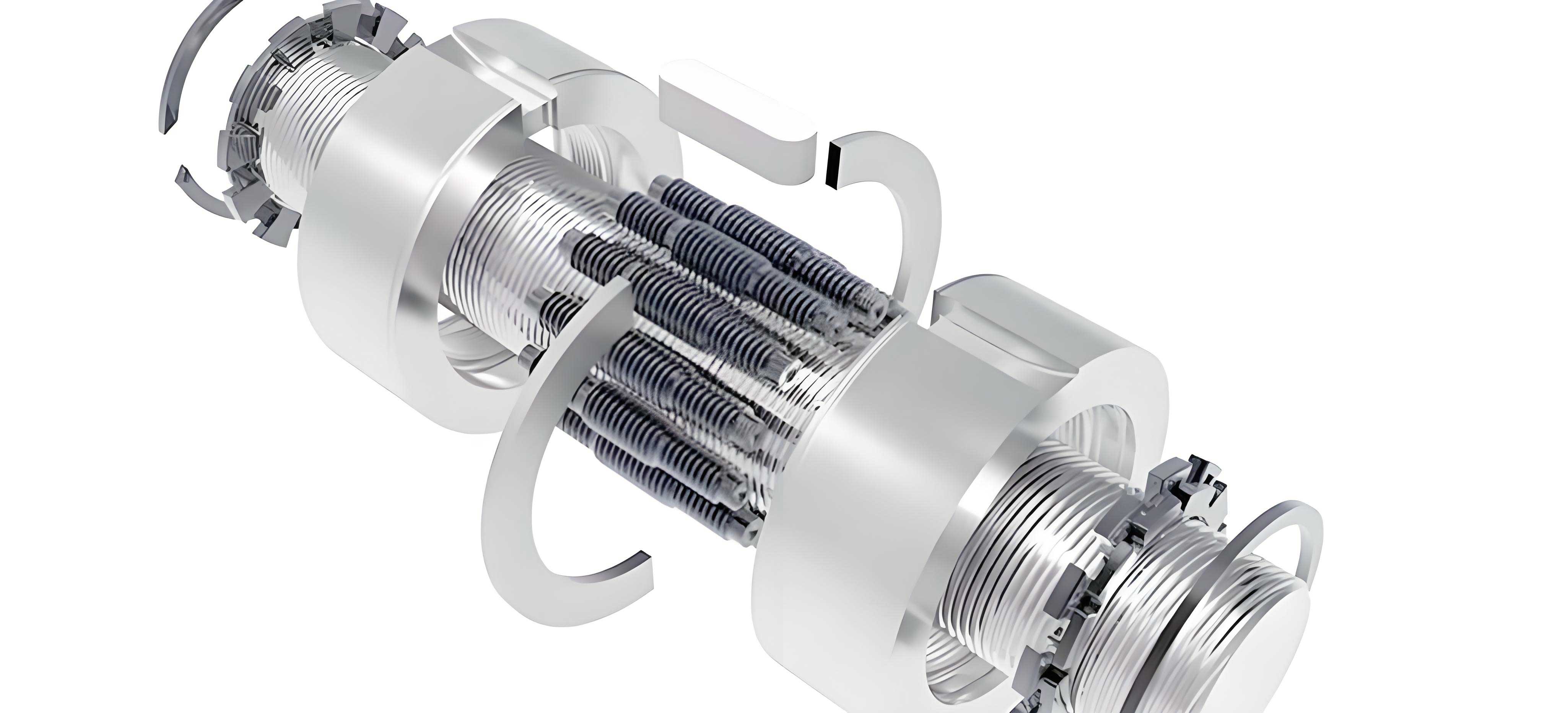
The fundamental structure of an inverted planetary roller screw assembly comprises four core components: a central translating screw, a rotating nut, several planetary rollers distributed circumferentially, and a cage that retains the rollers. The power transmission is achieved through two synchronized meshing actions. Primarily, the threads on the screw, nut, and rollers engage to convert the nut’s rotation into the screw’s linear motion. Secondly, gear teeth machined on the ends of the screw and each roller mesh to synchronize the planetary motion, ensuring the rollers orbit without axial displacement relative to the screw. This dual meshing mechanism is the cornerstone of the planetary roller screw assembly‘s functionality. The kinematic relationships, assuming ideal rigid bodies and perfect geometry, are well-established. For an assembly with a specific geometry, the kinematic parameters can be derived.
Let \(d_s\) and \(d_r\) be the pitch diameters of the screw and roller threads, respectively. The ratio \(k_m\) is defined as:
$$ k_m = \frac{d_s}{d_r} $$
If the nut rotates with an angular velocity \(\omega_n\), the angular velocity of the roller’s revolution (orbit) around the screw, \(\omega_p\), and its rotation (spin) about its own axis, \(\omega_r\), are given by:
$$ \omega_p = \frac{k_m + 2}{2(k_m + 1)} \omega_n $$
$$ \omega_r = \frac{k_m(k_m + 2)}{2(k_m + 1)} \omega_n $$
Furthermore, the translational velocity of the screw, \(v_{sz}\), is directly proportional to the nut’s speed:
$$ v_{sz} = \frac{\omega_n}{2\pi} n_n P $$
where \(n_n\) is the number of thread starts on the nut and \(P\) is the pitch. These equations provide the theoretical baseline for motion, against which the results of dynamic simulations, which account for elasticity and contact, can be compared. A typical set of design parameters for an IPRS is summarized in the table below.
| Component | Pitch Diameter (mm) | Pitch (mm) | Number of Starts | Gear Teeth / Module (mm) |
|---|---|---|---|---|
| Screw | 22.5 | 1.5 | 3 | 45 / 0.5 |
| Nut | 37.5 | 1.5 | 3 | – |
| Roller | 7.5 | 1.5 | 1 | 15 / 0.5 |
The primary challenge in dynamic modeling lies in accurately representing the contact forces between components. In this study, a penalty-based method within a multi-body dynamics environment is utilized. The normal contact force \(f_n\) between two bodies is calculated based on an equivalent spring-damper model that relates force to the penetration depth \(\delta\) and its rate \(\dot{\delta}\):
$$ f_n = k \delta^{m_1} + c \dot{\delta} | \dot{\delta} |^{m_2} \delta^{m_3} $$
Here, \(k\) is the contact stiffness coefficient, \(c\) is the damping coefficient, and \(m_1\), \(m_2\), \(m_3\) are exponents determining the nonlinear behavior of the stiffness and damping terms. The tangential friction force \(f_f\) is governed by a velocity-dependent friction coefficient \(\mu(v)\):
$$ f_f = \mu(v) | f_n | $$
The friction coefficient \(\mu(v)\) transitions smoothly from a static value \(\mu_s\) at low relative velocity to a dynamic value \(\mu_d\) at higher velocities, with transition velocities \(v_s\) and \(v_d\) defining the curve’s shape. This formulation is applied to all critical contact interfaces within the planetary roller screw assembly: screw-thread-to-roller-thread, nut-thread-to-roller-thread, screw-gear-to-roller-gear, roller-journal-to-cage-hole, and cage-face-to-washer. Appropriate parameters for these contacts are selected based on material properties and engineering judgment.
| Normal Force Parameters | Friction Parameters | ||||
|---|---|---|---|---|---|
| Parameter | Value | Parameter | Value | ||
| Stiffness, \(k\) (N/mm) | 100,000 | Static Friction, \(\mu_s\) | 0.15 | ||
| Damping, \(c\) (N/(m/s)) | 10 | Dynamic Friction, \(\mu_d\) | 0.10 | ||
| Stiffness Exponent, \(m_1\) | 2 | Static Threshold Vel., \(v_s\) (mm/s) | 1.0 | ||
| Damping Exponent, \(m_2\) | 1 | Dynamic Threshold Vel., \(v_d\) (mm/s) | 1.5 | ||
| Penetration Exponent, \(m_3\) | 2 | – | – | ||
Kinematic joints are defined to constrain the permissible motions of the main components. The nut is connected to the ground via a revolute joint, allowing only rotation about its axis. The screw is connected via a translational (prismatic) joint, permitting only axial translation. Retaining elements like washers and locknuts are fixed to the screw. Crucially, no ideal joints are defined between the rollers and the screw, nut, or cage; their motion emerges entirely from the resolution of contact forces at the thread, gear, and journal interfaces. This approach is key to capturing the true dynamic coupling within the planetary roller screw assembly. Operational conditions are applied to the nut’s revolute joint (angular velocity) and the screw’s prismatic joint (axial resistive force). To ensure numerical stability, the speed and load are ramped up smoothly from zero to their target values over the first full revolution of the nut before being held constant for subsequent analysis.
The validity of the constructed multi-body dynamics model is confirmed by comparing its steady-state kinematic outputs with the theoretical rigid-body kinematics defined earlier. Under a constant nut speed of 1200 rpm and a screw load of 20,000 N, the simulated average roller revolution speed \(\omega_p\), rotation speed \(\omega_r\), and screw translational velocity \(v_{sz}\) are extracted. The results show excellent agreement with theory, with relative errors all below 2%. The minor discrepancies are attributed to contact deformations and dynamic vibrations not considered in the ideal kinematic formulas. Notably, the simulated roller spin velocity \(\omega_r\) exhibits periodic fluctuations, a direct consequence of the discrete, cyclical meshing of the roller and screw gear teeth—an effect captured by the dynamic model but absent from the constant theoretical value. This successful validation establishes confidence in the model’s ability to accurately predict the complex internal mechanics of the planetary roller screw assembly.
| Parameter | Simulation Avg. Value | Theoretical Value | Relative Error |
|---|---|---|---|
| Roller Revolution, \(\omega_p\) (rad/s) | 77.63 | 78.50 | 1.1% |
| Roller Spin, \(\omega_r\) (rad/s) | 232.79 | 235.50 | 1.2% |
| Screw Velocity, \(v_{sz}\) (mm/s) | 89.47 | 89.95 | 0.5% |
With a validated model, a systematic investigation into the transmission characteristics of the planetary roller screw assembly under varying operational conditions is conducted. Two primary factors are studied: the rotational speed of the nut and the axial load on the screw. The analysis focuses on the average contact forces at critical interfaces and the resulting transmission error of the screw.
The first series of simulations examines the effect of nut speed, varying it from 300 rpm to 1200 rpm while maintaining a constant screw load of 20,000 N. The average contact force on the threaded flank between a single roller and the screw (\(F_{rs}\)) and between the roller and the nut (\(F_{rn}\)) are calculated. Results indicate a slight positive correlation with speed, primarily due to increased inertial and vibration effects. Furthermore, \(F_{rn}\) is consistently higher than \(F_{rs}\), a consequence of the load-induced deformation which shifts the roller’s equilibrium position slightly outward, increasing pressure on the nut-thread interface.
$$ \text{Average } F_{rs} (300 \text{ rpm}) \approx 3560 \text{ N} \rightarrow \text{Average } F_{rs} (1200 \text{ rpm}) \approx 3625 \text{ N} $$
$$ \text{Average } F_{rn} (300 \text{ rpm}) \approx 3815 \text{ N} \rightarrow \text{Average } F_{rn} (1200 \text{ rpm}) \approx 3846 \text{ N} $$
A more revealing dynamic phenomenon is observed at the gear and journal contacts. In an ideal, rigid planetary roller screw assembly, the gear teeth theoretically carry no load, serving only for phasing. However, the dynamic model reveals that contact deformations cause minor misalignments, such as pitch circle mismatch and axis tilting of the rollers. This misalignment forces the gear teeth to carry a share of the load. The analysis shows unequal load distribution between the left and right flanks of the gear teeth, and this load also increases slightly with nut speed. Similarly, the contact forces at the left and right journals of the roller against the cage hole are uneven, with the force on the left journal increasing and on the right journal decreasing as speed rises. This asymmetry confirms that rollers do not run in a perfectly aligned state, and their dynamic posture is speed-dependent.
The transmission error \(\Delta L_s\) is defined as the difference between the simulated screw position \(L’_s\) and its theoretical position \(L_s\) derived from the nut’s rotation: \(\Delta L_s = L’_s – L_s\). The peak-to-peak value of this error over a steady-state operation cycle is a key precision metric. The simulations show that the instantaneous transmission error fluctuates within a band of approximately ±3 μm. Importantly, the magnitude of this error band increases with nut speed, as summarized below. This is attributed to heightened dynamic vibrations and more significant periodic impacts at the gear meshes at higher speeds.
| Nut Speed (rpm) | Min. Error (μm) | Max. Error (μm) | Peak-to-Peak Error (μm) |
|---|---|---|---|
| 300 | -1.82 | 1.23 | 3.05 |
| 600 | -2.10 | 1.48 | 3.58 |
| 900 | -1.41 | 2.41 | 3.82 |
| 1200 | -2.24 | 1.66 | 3.90 |
The second series of simulations investigates the influence of screw axial load, varying it from 5,000 N to 20,000 N while keeping the nut speed constant at 1200 rpm. The effect on thread contact forces is pronounced and linear, as these interfaces directly bear the primary operational load. The forces increase substantially with applied load, clearly demonstrating the load-bearing function of the thread meshes in the planetary roller screw assembly.
$$ \text{Average } F_{rs} (5,000 \text{ N}) \approx 946 \text{ N} \rightarrow \text{Average } F_{rs} (20,000 \text{ N}) \approx 3625 \text{ N} $$
$$ \text{Average } F_{rn} (5,000 \text{ N}) \approx 955 \text{ N} \rightarrow \text{Average } F_{rn} (20,000 \text{ N}) \approx 3846 \text{ N} $$
In contrast, the average contact forces on the gear teeth show a different trend: they increase from low to medium loads but tend to saturate at higher loads. This suggests that while initial load application exacerbates roller misalignment, further increases in load do not proportionally worsen this condition; the primary load path shifts increasingly to the threads. The load distribution between the left and right roller journals becomes more uneven as the axial load increases, indicating that the deformation-induced misalignment is load-sensitive.
Finally, the transmission error analysis under varying loads reveals that increased load leads to greater elastic deformation at all contact points, which in turn increases the positional error of the screw. The peak-to-peak error grows monotonically with the applied axial load, highlighting a fundamental trade-off between load capacity and positional accuracy in the planetary roller screw assembly.
| Screw Load (N) | Min. Error (μm) | Max. Error (μm) | Peak-to-Peak Error (μm) |
|---|---|---|---|
| 5,000 | -1.48 | 1.82 | 3.30 |
| 10,000 | -1.81 | 1.83 | 3.64 |
| 15,000 | -1.63 | 2.13 | 3.76 |
| 20,000 | -2.24 | 1.66 | 3.90 |
In conclusion, this study successfully develops a high-fidelity multi-body dynamics model for an inverted planetary roller screw assembly that accurately accounts for the complex contact interactions among its components. The model’s validity is rigorously confirmed against theoretical kinematics. Utilizing this model, the research provides detailed quantitative insights into the dynamic transmission characteristics of the assembly. Key findings are that the average thread contact forces correlate positively with both nut speed and screw load, with load being the dominant factor. The analysis uncovers significant internal load redistribution phenomena, including unequal loading on gear tooth flanks and roller journals, which arise from contact deformations and are influenced by both speed and load. Furthermore, the transmission error, a critical precision metric, is shown to increase with both operational speed and load. These results underscore the intricate and coupled nature of dynamics within a planetary roller screw assembly and provide a valuable foundation and tool for engineers to optimize its design, predict its performance under specific operating conditions, and enhance its reliability and accuracy in advanced mechanical systems.