
The advancement of oilfield development into its middle and late stages presents significant challenges for artificial lift systems. Conventional rodless pumping equipment often proves inadequate for wells characterized by low production rates, high deviation angles, and severe rod/tubing wear. Existing solutions, primarily utilizing subsurface permanent magnet linear motors to directly drive plunger pumps, are hampered by inherent limitations such as low motor efficiency, insufficient thrust generation, and high failure rates, which collectively constrain their widespread adoption. To address these critical shortcomings, we have designed and developed a novel submersible electric cylinder plunger pump. The core innovation of this system lies in its utilization of a planetary roller screw assembly to convert the rotary motion of an electric motor into precise linear motion, which then drives the plunger pump for efficient fluid lifting.
1. Overall System Design
The submersible electric cylinder plunger pump comprises four main subsystems: the plunger pump module, the planetary roller screw assembly, the protector, and the rotary electric motor. The system’s operational logic is as follows:
- Plunger Pump Module: This component employs an inverted structure with a fixed valve at the top. It is responsible for the direct displacement and lifting of wellbore fluid.
- Planetary Roller Screw Assembly: This is the central transmission mechanism. It efficiently transforms the rotary mechanical power input from the motor into a high-force linear output to actuate the plunger.
- Protector: Equipped with a breathing bladder, this unit compensates for volume changes in the lubricating oil within both the transmission assembly and the motor chambers, maintaining internal pressure balance and excluding wellbore fluids.
- Rotary Electric Motor: A multi-stage, slow-speed permanent magnet synchronous motor (PMSM) provides the primary rotary power. Its speed and torque can be tailored by connecting multiple motor sections in series to meet specific power and flow rate demands.
The integrated system workflow can be summarized by the following functional chain:
$$ \text{Rotary Motor} \xrightarrow{\text{Rotary Output}} \text{Planetary Roller Screw Assembly} \xrightarrow{\text{Linear Output}} \text{Plunger Pump} \xrightarrow{\text{Reciprocation}} \text{Fluid Lift} $$
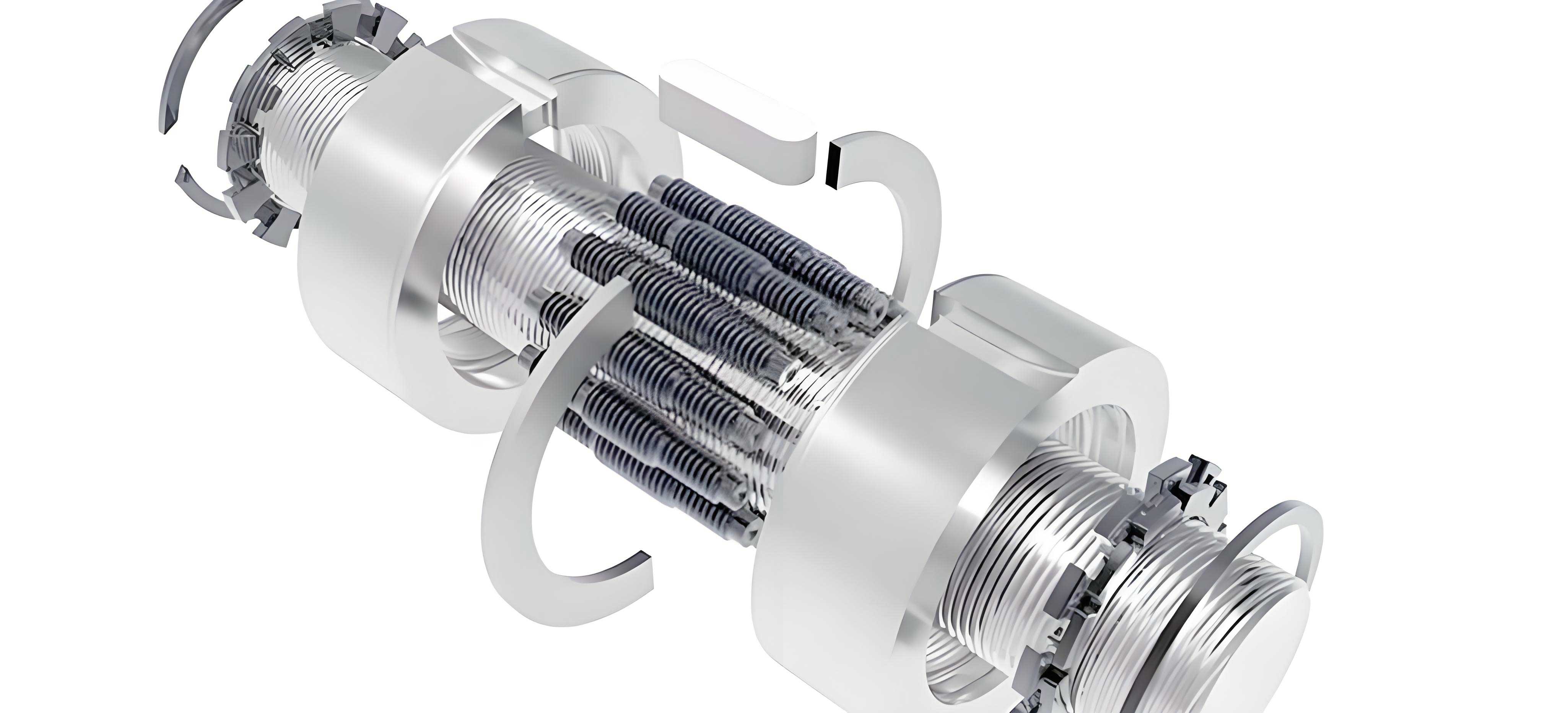
2. The Core Transmission: Planetary Roller Screw Assembly
The planetary roller screw assembly is a precision mechanical device consisting of a threaded screw, a nut, multiple threaded rollers arranged planetarily around the screw, retaining rings, and keys. In our application, the screw is directly coupled to the motor shaft and undergoes pure rotation. The rollers, engaged with both the screw and the nut, translate this rotation. The nut, which is connected to the pump plunger, is prevented from rotating and is thus forced to move in a linear, reciprocating fashion.
To ensure reliable operation in the harsh downhole environment, the standalone planetary roller screw assembly is integrated into a larger, purpose-built transmission module featuring several critical ancillary mechanisms.
2.1 Structural Composition of the Transmission Module
The complete transmission module is engineered with four key subsystems:
| Subsystem | Primary Components | Primary Function |
|---|---|---|
| Sealing Mechanism | Locknut, adjusting ring, multiple shaft seals, seal adapter, push rod. | Isolates the internal lubricated planetary roller screw assembly from the wellbore fluid. Uses staged seals with lubrication grooves for heat dissipation and longevity. |
| Anti-Rotation Mechanism | Anti-rotation rod, pressure plate, tungsten carbide wear plates, guide sub. | Constrains the nut of the planetary roller screw assembly from rotating, ensuring it executes only linear motion. The rod typically has a polygonal cross-section engaging a matching bore. |
| Planetary Roller Screw Mechanism | Planetary roller screw assembly, anti-collision ring, ring springs, spring seat, guide bushing. | The core conversion unit. Includes damping springs to absorb reversal impact and a guide bushing to stabilize the free end of the rotating screw. |
| Thrust Bearing Mechanism | Connecting shaft, needle roller bearings, cylindrical thrust roller bearings, bearing housing, protector adapter. | Absorbs and manages the axial reaction forces generated by the pump pressure acting on the planetary roller screw assembly. Uses opposing sets of bearings to handle both upward and downward thrust. |
The integration of these mechanisms results in a transmission module that offers exceptional advantages for downhole use: high transmission efficiency and precision, minimal friction loss, smooth motion without creep, low noise, high reliability, reduced maintenance, and extended service life.
2.2 Stress Analysis of Key Components
The anti-rotation mechanism is critically loaded. The anti-rotation rod must transmit the full torsional load from the planetary roller screw assembly nut to the stationary housing via the wear plates. Ensuring structural integrity requires rigorous stress analysis.
For a prismatic anti-rotation rod (e.g., triangular), the shear stress ($\tau$) on the engaging faces and the contact pressure ($P_c$) on the wear plates are key design parameters. The torsional torque ($T$) from the screw assembly is related to the axial pump force ($F_a$) and the screw lead ($L_h$):
$$ T = \frac{F_a \cdot L_h}{2\pi \eta} $$
where $\eta$ is the mechanical efficiency of the planetary roller screw assembly. The resultant shear stress on an anti-rotation rod with $n$ faces, face width $w$, and effective engagement length $l$ can be approximated by:
$$ \tau \approx \frac{T}{n \cdot (w \cdot l) \cdot r_m} $$
where $r_m$ is the mean radius from the axis to the contact faces. The contact pressure on the wear plates is given by:
$$ P_c = \frac{T}{n \cdot A_{contact} \cdot \mu \cdot r_m} $$
where $A_{contact}$ is the area of each wear plate and $\mu$ is the coefficient of friction. Finite Element Analysis (FEA) is employed to validate the design. The analysis focuses on von Mises stress ($\sigma_{v}$) to guard against yield failure, ensuring $\sigma_{v} < S_y / N$, where $S_y$ is the yield strength of the material and $N$ is the safety factor.
| Parameter | Symbol | Typical Value / Condition |
|---|---|---|
| Max Axial Pump Force | $F_a$ | 60 kN |
| Screw Lead | $L_h$ | 24 mm |
| Transmission Efficiency | $\eta$ | |
| Calculated Torque | $T$ | ~255 N·m |
| Anti-rotation Faces | $n$ | 3 |
| Material Yield Strength | $S_y$ | ≥ 850 MPa (Alloy Steel) |
| Target Safety Factor | $N$ | > 2 |
3. Integrated System Components & Performance
3.1 Inverted Plunger Pump
Unlike conventional beam-pumped rod pumps, our design uses an inverted configuration. The stationary valve (standing valve) is positioned above the traveling barrel/plunger. This layout is optimal for integration with the upward-pushing linear stroke generated by the planetary roller screw assembly.
Pump Cycle:
Upstroke (Plunger Ascending): The traveling valve closes, the standing valve opens. Fluid from the wellbore enters the tubing above the pump.
Downstroke (Plunger Descending): The standing valve closes, the traveling valve opens. Fluid from below fills the pump barrel.
The theoretical displacement per stroke ($Q_{stroke}$) is:
$$ Q_{stroke} = A_p \cdot S $$
where $A_p$ is the plunger cross-sectional area and $S$ is the effective stroke length provided by the planetary roller screw assembly nut travel.
3.2 Dual-Chamber Protector System
The system employs a dual-chamber protector. The upper chamber is connected to the planetary roller screw assembly housing, and the lower chamber to the motor. Each contains a flexible bladder that “breathes” to compensate for oil thermal expansion/contraction and pressure differentials, effectively sealing the clean oil systems from the wellbore environment.
3.3 Motor Specifications & System Tuning
The slow-speed PMSM is characterized by its high torque density. The system’s output is finely tuned by controlling motor speed and stroke parameters. The relationship between pump flow rate ($Q$), motor speed ($N$ in RPM), lead ($L_h$), and pump efficiency ($\eta_{vol}$) is:
$$ Q = A_p \cdot L_h \cdot N \cdot \eta_{vol} $$
This equation highlights the direct tunability of flow rate by adjusting the easily controlled motor speed $N$, a significant advantage over fixed-rate systems.
4. Experimental Validation and Results
The performance of the planetary roller screw assembly-based pump was validated through rigorous factory and field testing.
4.1 Factory Testing
Factory tests included mechanical robustness checks (for impact, vibration) and control system validation (stroke control, cycle timing, error accumulation). Load testing was performed incrementally up to 18 MPa. Electrical parameters (voltage, current, power) and flow rates were monitored, confirming all designs met specifications.
4.2 Field Industrial Trial
A prototype system was installed in a well with the following conditions: Pump Depth: 1600 m; Casing: 5½”; Well Fluid: 86% Water Cut.
System Configuration & Test Parameters:
| Component | Key Parameter | Value |
|---|---|---|
| Plunger Pump | Pump Diameter | 57 mm |
| Planetary Roller Screw Assembly | Lead | 24 mm |
| Max Thrust | 60 kN (6 t) | |
| Max Stroke | 650 mm | |
| Motor | Power / Rated Speed | 9 kW / 300-500 RPM |
The system was operated with a controlled stroke of 550 mm and a motor speed of 500 RPM. The operating cycle was managed via a programmable controller setting acceleration, deceleration, and dwell times.
Trial Results: The system achieved a stable flow rate of 6.5 m³/day with a discharge pressure of 0.5 MPa, successfully meeting the well’s production requirements. The test confirmed the reliability, precise controllability, and efficiency of the planetary roller screw assembly driven system.
5. Advantages and Application Prospects
The field trial and technical analysis demonstrate that the submersible electric cylinder plunger pump, centered on the planetary roller screw assembly, offers a transformative solution for artificial lift. Its advantages are comprehensive:
| Aspect | Advantage of Planetary Roller Screw Pump | Comparison to Conventional Systems |
|---|---|---|
| Adaptability | Excels in low-rate, highly deviated, and horizontal wells. Eliminates rod string, solving tubing wear issues. | Rod pumps fail in deviated wells. Linear motor pumps have low thrust/efficiency. |
| Energy Efficiency | High mechanical efficiency of the planetary roller screw assembly and no rod friction losses lead to significant power savings. | Beam pumps have high surface mechanical losses and rod friction. Linear motors are inherently less efficient. |
| Control & Monitoring | Fully digital control enables remote monitoring, real-time adjustment of speed and stroke, and accurate data acquisition. | Conventional systems offer limited control and remote capabilities. |
| Reliability & Run Life | Robust mechanical design, reduced number of moving parts downhole, and effective sealing contribute to extended mean time between failures. | Higher failure rates associated with rod/tubing wear or linear motor stator issues. |
| Economic Cost | While initial hardware cost may be comparable, savings from reduced energy consumption, longer run life, and lower workover frequency yield a lower total cost of ownership. | Higher operational costs due to energy use, frequent repairs, and workovers. |
The governing equations for system capacity and force are modular, allowing for scalable design:
$$ \text{Flow Rate: } Q = f(A_p, L_h, N) $$
$$ \text{Required Motor Torque: } T_{motor} = \frac{F_{pump} \cdot L_h}{2\pi \eta_{PRS} \cdot \eta_{coupling}} $$
$$ \text{Axial Force: } F_{pump} = A_p \cdot \Delta P $$
where $\Delta P$ is the pressure differential across the pump, and $\eta_{PRS}$ is the efficiency of the planetary roller screw assembly.
In conclusion, the submersible electric cylinder plunger pump, driven by a high-efficiency planetary roller screw assembly, represents a significant technological advancement. It provides a reliable, efficient, and highly controllable artificial lift method tailored for the complex well configurations prevalent in mature oil fields. Its ability to enhance production efficiency, reduce energy consumption, and lower operational costs ensures it has a broad and promising application future in the global oil and gas industry.