
The planetary roller screw assembly (PRSA) stands as a pinnacle of mechanical translation technology, renowned for its exceptional load capacity, high stiffness, and longevity. This mechanism, often considered the high-performance successor to the ball screw, finds critical application in sectors demanding utmost reliability and precision—from aerospace actuation systems and advanced robotics to precision machine tools and medical devices. At the heart of its performance lies a fundamental characteristic: the distribution of the applied axial load among the multiple, simultaneously engaged threads of the rollers, nut, and screw. An uneven load distribution can lead to premature wear, reduced fatigue life, elevated operating temperatures, and ultimately, catastrophic failure. Therefore, a comprehensive understanding and accurate prediction of this distribution under realistic operating conditions is paramount for optimal design and reliable deployment.
Traditional models for analyzing planetary roller screw assembly performance often simplify the system to an idealized state, assuming perfect geometry and isothermal operation. However, in practice, a planetary roller screw assembly operates under a complex, coupled regime of inherent manufacturing imperfections, progressive wear, and significant thermal fluctuations due to friction and environmental factors. These elements do not act in isolation; they interact synergistically to drastically alter the contact mechanics and force equilibrium within the assembly. This article presents a detailed, first-principles exploration of the load distribution in a planetary roller screw assembly, explicitly incorporating the coupled effects of thread errors, adhesive wear, and differential thermal expansion. We will develop the governing equations, present analytical and numerical results, and discuss strategies for mitigating adverse distribution effects.
Fundamental Mechanics and Modeling Approach
The core principle for determining load distribution in a statically loaded planetary roller screw assembly is the condition of deformation compatibility. This condition mandates that the relative axial displacement between the screw and the nut, considering both structural elastic deformation and contact elastic deformation at each thread, must be consistent across all engaged threads. Figure 1 illustrates the contact geometry and the key parameters involved in this analysis for a single roller interacting with the screw and nut.
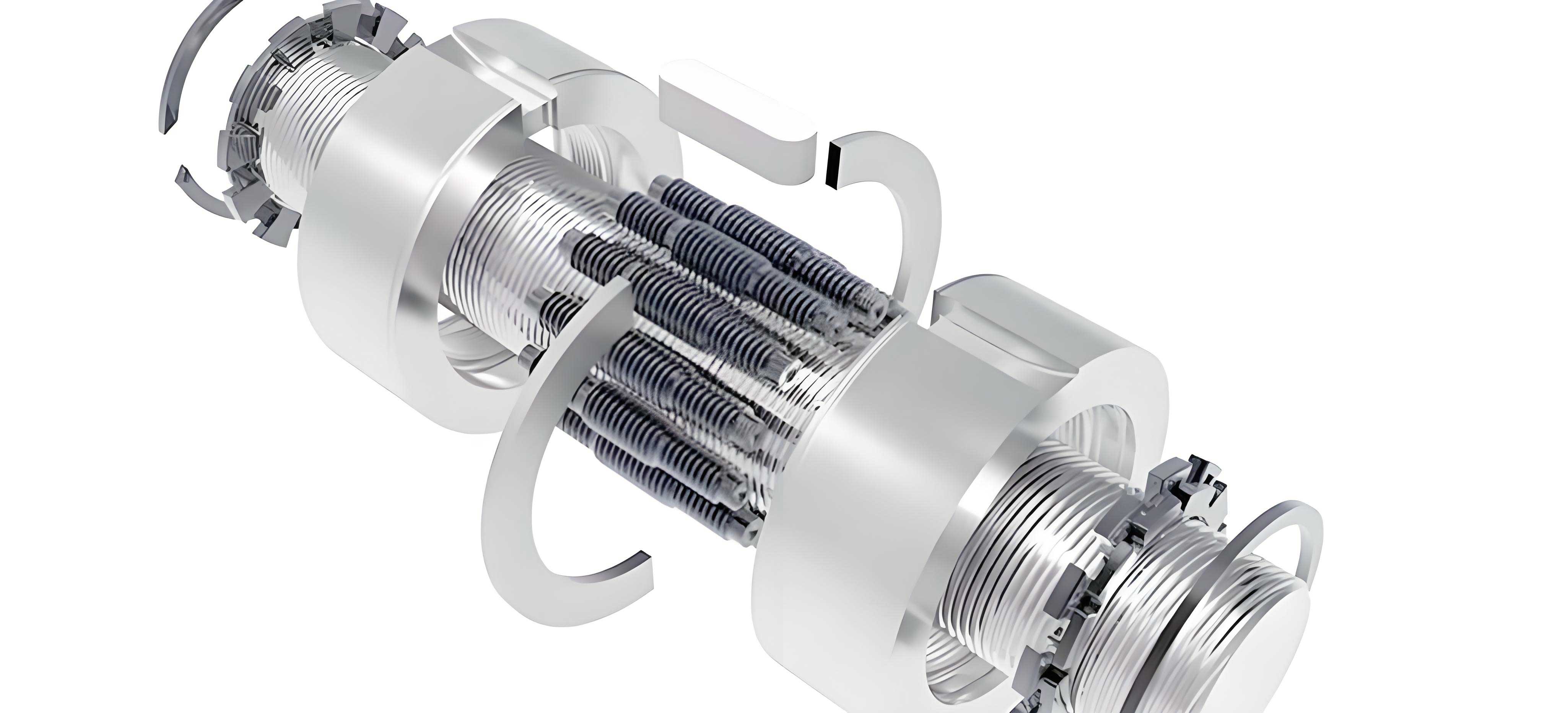
The fundamental geometry of a planetary roller screw assembly is defined by several key parameters which are summarized in the table below.
| Parameter Symbol | Description | Unit |
|---|---|---|
| \( d_s \) | Screw Pitch Diameter | mm |
| \( d_r \) | Roller Pitch Diameter | mm |
| \( D_n, d_n \) | Nut Major and Pitch Diameter | mm |
| \( p \) | Thread Lead (Pitch for single-start) | mm |
| \( \lambda_s \) | Helix Angle at Screw | ° |
| \( \beta \) | Thread Flank Contact Angle | ° |
| \( N \) | Number of Threads per Roller | – |
| \( M \) | Number of Rollers | – |
| \( n \) | Number of Thread Starts | – |
When an axial force \( F \) is applied (typically tension on the screw and compression on the nut), it is transmitted through \( M \) rollers. Each roller shares the load, and on each roller, the load is distributed among \( N \) engaged thread teeth. Let \( P_i \) be the normal contact force at the \( i \)-th thread pair (considering one side, screw or nut). The relationship between the total axial force and the individual normal thread forces is given by:
$$ F = M \sum_{j=1}^{N} P_j \sin \beta \cos \lambda_s $$
The axial force acting on the structural members between the \( (i-1) \)-th and \( i \)-th threads, denoted \( F_{si} \) for the screw (in tension) and \( F_{ni} \) for the nut (in compression), can be expressed from equilibrium:
$$ F_{si} = F_{ni} = F – M \sum_{j=1}^{i-1} P_j \sin \beta \cos \lambda_s $$
The axial elongation of the screw shaft and compression of the nut body between two consecutive thread contact points are governed by their simplified cross-sectional areas and material properties:
$$ \text{Axial Screw Deformation: } \Delta L_{s,(i-1,i)} = \frac{F_{si} \cdot p}{E’_s A_s} $$
$$ \text{Axial Nut Deformation: } \Delta L_{n,(i-1,i)} = \frac{F_{ni} \cdot p}{E’_n A_n} $$
where \( E’_s, E’_n \) are effective Young’s moduli, \( A_s = \pi d_s^2 / 4 \) is the screw cross-section, and \( A_n = \pi (D_n^2 – d_n^2) / 4 \) is the nut annular cross-section. The local elastic contact deformation at the \( i \)-th thread, based on Hertzian theory for point contact, is:
$$ \delta_{si} = C_s P_i^{2/3}, \quad \delta_{ni} = C_n P_i^{2/3} $$
The stiffness coefficients \( C_s \) and \( C_n \) are complex functions of the contact geometry and material properties:
$$ C_s = \left( \frac{2K(e)}{\pi m_a} \right)^{2/3} \left( \frac{9}{8 E’_s^2 \sum \rho_s} \right)^{1/3}, \quad C_n = \left( \frac{2K(e)}{\pi m_a} \right)^{2/3} \left( \frac{9}{8 E’_n^2 \sum \rho_n} \right)^{1/3} $$
Here, \( K(e) \) is the complete elliptic integral of the first kind, \( m_a \) is a dimensionless parameter, and \( \sum \rho \) is the sum of principal curvatures at the contact. The compatibility of deformation requires that the combined axial displacement from structural stretch/compression equals the difference in the axial components of the local contact deformations between adjacent threads. For a perfect geometry, this leads to the classic load distribution equation:
$$ P_{i-1}^{2/3} = P_i^{2/3} + \left( \frac{1}{E’_s A_s} + \frac{1}{E’_n A_n} \right) \frac{M p}{C_s + C_n} \sum_{j=i}^{N} P_j \sin^2 \beta \cos^2 \lambda_s $$
This equation forms the baseline from which we will build our comprehensive model.
The Coupled Model: Integrating Errors, Wear, and Thermal Effects
The idealized model above fails to predict the real-world behavior of a planetary roller screw assembly. We now introduce three critical perturbative factors: geometric errors (\( h_i \)), cumulative thread wear (\( \chi_i \)), and differential thermal expansion (\( \gamma_i \)). All these factors manifest as an effective axial “deviation” or “mismatch” at the \( i \)-th thread contact location, altering the kinematic chain and thus the load balance.
The generalized deviation term \( \Delta_i \) for the \( i \)-th thread is defined as:
$$ \Delta_i = h_i + \chi_i + \gamma_i $$
Incorporating this into the deformation compatibility condition modifies the fundamental governing equation. The relative axial displacement between threads \( i-1 \) and \( i \) now must account for the difference in these deviations. The extended load distribution equation becomes:
$$ P_{i-1}^{2/3} = P_i^{2/3} + \frac{2}{C_s + C_n} \left[ (\Delta_{i-1}) – (\Delta_{i}) \right] + \left( \frac{1}{E’_s A_s} + \frac{1}{E’_n A_n} \right) \frac{M p}{C_s + C_n} \sum_{j=i}^{N} P_j \sin^2 \beta \cos^2 \lambda_s $$
This equation is the cornerstone of our coupled analysis. Let’s break down each component of \( \Delta_i \).
1. Geometric Thread Errors (\( h_i \))
Manufacturing imperfections are unavoidable. In a planetary roller screw assembly, the primary error sources include lead (pitch) error, thread flank angle error, and for multi-start designs, indexing (phase) error between starts. For modeling purposes, these can be equivalently represented as an effective axial lead error at each thread engagement point. A practical assumption is that these errors follow a statistical distribution, such as a normal distribution with zero mean and a standard deviation derived from manufacturing tolerance data. The error \( h_i \) represents the equivalent axial position error of the \( i \)-th thread contact in the loaded state.
2. Adhesive Wear Depth (\( \chi_i \))
During operation, a combination of rolling and sliding contact occurs. The most significant wear mechanism in the mixed sliding-rolling regime of thread flanks is adhesive wear. We employ the Archard wear model to estimate the wear volume \( W_i \) at the \( i \)-th thread contact over a sliding distance \( L \):
$$ W_i = K \frac{L P_i}{3 \sigma_y} $$
Here, \( K \) is the dimensionless wear coefficient, \( L \) is the total sliding distance, \( P_i \) is the normal load, and \( \sigma_y \) is the yield stress of the softer material. For a planetary roller screw assembly, the primary sliding occurs between the roller and the screw threads (assuming the roller is prevented from rotating relative to the nut via a gear ring). The sliding distance for a given operating time \( t \) and screw speed \( n_s \) is:
$$ L = \frac{2 \pi r_s n_s t}{\cos \lambda_s} $$
The wear volume manifests as a loss of material, creating a wear depth. Assuming the wear scar approximates the Hertzian contact ellipse (with semi-axes \( a_i \) and \( b_i \)), the wear depth in the axial direction is:
$$ \chi_i = \frac{W_i}{\pi a_i b_i \cos \lambda_s} = K \frac{2 r_s n_s t P_i}{3 \sigma_y \pi a_i b_i \cos^2 \lambda_s} $$
Where \( a_i \) and \( b_i \) are themselves functions of \( P_i \), as per Hertzian contact theory. This creates a feedback loop: load affects wear, and wear redistributes the load.
3. Differential Thermal Expansion (\( \gamma_i \))
Frictional heat generation and ambient temperature changes cause thermal expansion. Crucially, the screw, rollers, and nut are often made from different materials (e.g., alloy steel for screw/nut and bearing steel for rollers) with different coefficients of thermal expansion (CTE), \( \alpha_s, \alpha_r, \alpha_n \). A uniform temperature change \( \Delta T = T – T_{ref} \) causes differential growth. Considering the screw-roller contact, the effective axial deviation at the \( i \)-th thread due to thermal effects is:
$$ \gamma_i^{s-r} = (i-1) p (\alpha_r – \alpha_s) \Delta T $$
If \( \alpha_r > \alpha_s \), the roller expands more than the screw, effectively pushing the roller thread away from the screw thread at the nut-end, which can be modeled as a positive deviation \( \gamma_i \). A similar term exists for the nut-roller interface. The net thermal deviation \( \gamma_i \) in the model is a combination of these effects, which can either alleviate or exacerbate the geometric mismatch.
Analytical Results and Parametric Study
To solve the nonlinear, recursive load distribution equation with the coupled deviation terms, a numerical iterative approach is employed. We consider a representative planetary roller screw assembly with the parameters listed in the following table for analysis.
| Parameter | Symbol | Value | Unit |
|---|---|---|---|
| Screw Pitch Diameter | \( d_s \) | 24 | mm |
| Lead | \( p \) | 2 | mm |
| Contact Angle | \( \beta \) | 45 | ° |
| Number of Rollers | \( M \) | 10 | – |
| Threads per Roller | \( N \) | 20 | – |
| Axial Load | \( F \) | 50,000 | N |
| Young’s Modulus | \( E_s, E_n \) | 210 | GPa |
| Screw CTE | \( \alpha_s \) | 11.0 × 10⁻⁶ | /°C |
| Roller CTE | \( \alpha_r \) | 13.5 × 10⁻⁶ | /°C |
| Wear Coefficient | \( K \) | 5.0 × 10⁻⁷ | – |
| Sliding Time | \( t \) | 1200 | min |
Model Validation
Before proceeding with the coupled analysis, the baseline model (with all \( \Delta_i = 0 \)) was validated against established computational models from literature, such as finite element analysis and discrete spring-mass models. Under an axial load of 30 kN, the predicted load profile showed excellent agreement. The maximum normal load predicted by the presented analytical model was within 2.8% and 8.4% of the values from two independent reference models, respectively, while the average load values were virtually identical. This confirms the robustness of the analytical foundation for the planetary roller screw assembly load distribution model.
Impact of Individual and Coupled Factors
The following analysis presents the load distribution results under various conditions, illustrating the profound impact of the coupled factors.
Case 1: Perfect Geometry (Baseline). The load distribution in an ideal planetary roller screw assembly is highly nonlinear due to the varying stiffness of the screw and nut as a function of position. Typically, the threads closest to the point of load application (often the nut’s fixed end) carry disproportionately higher loads, while threads towards the free end carry progressively less. This inherent unevenness is purely structural.
Case 2: Geometric Errors Only. Introducing a normally distributed lead error (mean 0 μm, std. dev. 2 μm) superimposes significant, quasi-random fluctuations onto the baseline structural distribution. Errors are the primary cause of localized load spikes and troughs. A single thread with a large negative error (effectively “shorter”) may become severely overloaded, while one with a large positive error may be completely unloaded, compromising the overall capacity and life of the planetary roller screw assembly.
Case 3: Errors and Wear. When the adhesive wear model is activated alongside errors, the situation deteriorates further. Wear preferentially removes material from the most heavily loaded threads (those often spiked due to errors). This increases their local deviation \( \chi_i \), which, according to the governing equation, can further shift load away from or onto them depending on the sign of the deviation change relative to neighbors. The result is an amplification of the unevenness and a more severe localization of load, accelerating the failure process in a planetary roller screw assembly.
Case 4: Full Coupling (Errors, Wear, and Thermal \(\Delta T = +40°C\)). This is the most realistic operational scenario. The introduction of a +40°C temperature rise, with \( \alpha_r > \alpha_s \), produces a transformative effect. The thermal deviation \( \gamma_i \) is linearly proportional to the thread index \( i \) and positive in this case. This systematic deviation counteracts the natural structural stiffness gradient. The resulting load distribution curve is fundamentally reshaped: loads on the initially high-load threads (near the load application) are reduced, while loads on the initially low-load threads (towards the free end) are increased. The distribution becomes markedly more uniform compared to the error-only or error-and-wear cases. Remarkably, thermal effects can be a potent, albeit unintentional, load-equalizing factor in a planetary roller screw assembly.
| Analysis Case | Key Characteristic of Load Distribution | Maximum Load (Relative to Baseline) | Uniformity Index* |
|---|---|---|---|
| Perfect Geometry (Baseline) | Non-linear decay from fixed end. | 1.00 (Reference) | 0.62 |
| Geometric Errors Only | Baseline curve with large, random fluctuations. | ~1.15 – 1.25 | 0.48 |
| Errors + Wear | Amplified fluctuations, more localized peaks. | ~1.30 – 1.45 | 0.41 |
| Full Coupling (\(\Delta T=+40°C\)) | Reshaped, more uniform, symmetric tendency. | ~1.05 | 0.75 |
| Full Coupling (\(\Delta T=+80°C\)) | Over-compensation, high load shift to free end. | ~1.10 | 0.68 |
*A hypothetical metric where 1.0 represents perfectly uniform distribution.
Sensitivity to Temperature Change
The effect of temperature is non-monotonic concerning uniformity. As shown in the table and further detailed here, an increase from \( \Delta T = 0°C \) to \( \Delta T = +40°C \) improves uniformity. However, a further increase to \( \Delta T = +80°C \) causes the thermal deviation to over-compensate. The load distribution essentially “flips,” now placing the highest loads on the threads farthest from the point of load application. At \( \Delta T = +80°C \), the maximum thread load increased by approximately 9-10% compared to the maximum load in the perfect geometry case, demonstrating that uncontrolled temperature rise can induce overloading in previously underloaded regions of the planetary roller screw assembly.
The governing behavior can be summarized by the interaction in the coupled deviation term. The net effect on load at thread \( i \) depends on the difference \( (\Delta_{i-1} – \Delta_i) \). A positive difference increases \( P_{i-1} \) relative to \( P_i \). Therefore, a carefully controlled thermal gradient or material CTE selection can be designed to make this difference counteract the natural load decay, promoting uniformity.
Conclusions and Strategies for Load Distribution Improvement
This detailed analysis unequivocally demonstrates that the operational load distribution in a planetary roller screw assembly is governed by the intricate coupling of manufacturing imperfections, progressive wear, and thermal dynamics. Key conclusions are:
- Geometric errors are the primary source of load irregularity and localized stress concentrations. They introduce unpredictable fluctuations that degrade performance and life.
- Adhesive wear acts as a positive feedback mechanism. It preferentially alters the geometry at high-load points, often exacerbating the non-uniformity initiated by errors and accelerating the degradation process.
- Differential thermal expansion is a powerful, systemic factor that can radically reshape the load profile. Depending on the magnitude and sign of the temperature change relative to material CTEs, it can either improve load uniformity or induce a dangerous load shift to other regions of the assembly. There exists an “optimal” thermal condition for load equalization.
Based on these insights, several strategies can be proposed to improve the load distribution in a planetary roller screw assembly:
| Strategy | Method | Expected Benefit |
|---|---|---|
| Precision Manufacturing & Error Compensation | Implement ultra-precise grinding, active in-process measurement, and selective assembly or lead crowning to compensate for systematic errors. | Directly reduces the source of random fluctuations \( h_i \), leading to a smoother, more predictable load distribution closer to the ideal structural curve. |
| Active Thermal Management | Employ integrated cooling channels, thermoelectric elements, or controlled lubrication flow to regulate the operating temperature of the assembly, aiming to maintain it near the empirically determined optimal \( \Delta T \) for uniformity. | Exploits the thermal effect beneficially to counteract structural stiffness gradients, promoting load equalization across all threads. |
| Material & Coating Selection | Choose material pairings not only for strength and wear resistance but also with specific CTE relationships. Advanced coatings like DLC (Diamond-Like Carbon) can drastically reduce the wear coefficient \( K \). | Minimizes the wear depth \( \chi_i \) and allows for the thermal deviation \( \gamma_i \) to be engineered. Low-wear coatings preserve original geometry longer. |
| Predictive Maintenance via Modeling | Utilize the coupled analytical model presented here as a digital twin. Feed it with operational data (temperature, load cycles) to predict wear progression and forecast the remaining useful life or the need for re-lubrication/adjustment. | Enables condition-based maintenance, preventing failures by intervening when the model predicts excessive load localization beyond safe limits. |
In summary, mastering the load distribution in a planetary roller screw assembly requires moving beyond static, idealized models. Engineers must adopt a holistic, coupled-system perspective that accounts for the dynamic interplay of geometry, wear, and heat. The analytical framework developed here provides a powerful tool for this purpose, enabling the design of more robust, efficient, and longer-lasting high-performance linear actuation systems.