
The drive to enhance energy efficiency and performance in traditional manufacturing sectors, such as metal forming, necessitates the evolution of core equipment. As a fundamental forging apparatus, the screw press is ubiquitous in industry. However, conventional designs employing trapezoidal thread sliding screw pairs are plagued by significant drawbacks: difficulties in lubrication, high coefficients of friction, low mechanical efficiency (typically below 50%), and consequently, high energy consumption. To address these challenges, we propose and investigate the integration of a planetary roller screw assembly as the primary motion conversion mechanism in a 16MN gear-type electric screw press. This transformation replaces sliding friction with rolling friction, promising a dramatic leap in efficiency and reliability.
The working principle of the gear-type electric screw press involves multiple motors driving a large gear (flywheel), which is rigidly connected to the screw. The nut, fixed to the press slide, converts the screw’s rotation into linear motion via the screw pair. For our 16MN target machine, key technical parameters are established as shown in Table 1.
| Technical Parameter | Value |
|---|---|
| Nominal Force (kN) | 16,000 |
| Maximum Cold Strike Force (kN) | 32,000 |
| Long-term Allowable Strike Force (kN) | 25,600 |
| Slide Stroke (mm) | 650 |
| Stroke Frequency (strokes/min) | 15 |
The core innovation lies in substituting the trapezoidal sliding pair with a standard-type planetary roller screw assembly. This assembly, depicted conceptually below, consists of a central screw, a nut, multiple threaded rollers, two internal gear rings, retainers, and spacers. The screw and nut feature multi-start triangular threads, while each roller has a single-start thread with a circular profile. Gears machined at the ends of the rollers mesh with the fixed internal gear rings on the nut, ensuring proper phasing and preventing skewing moments.
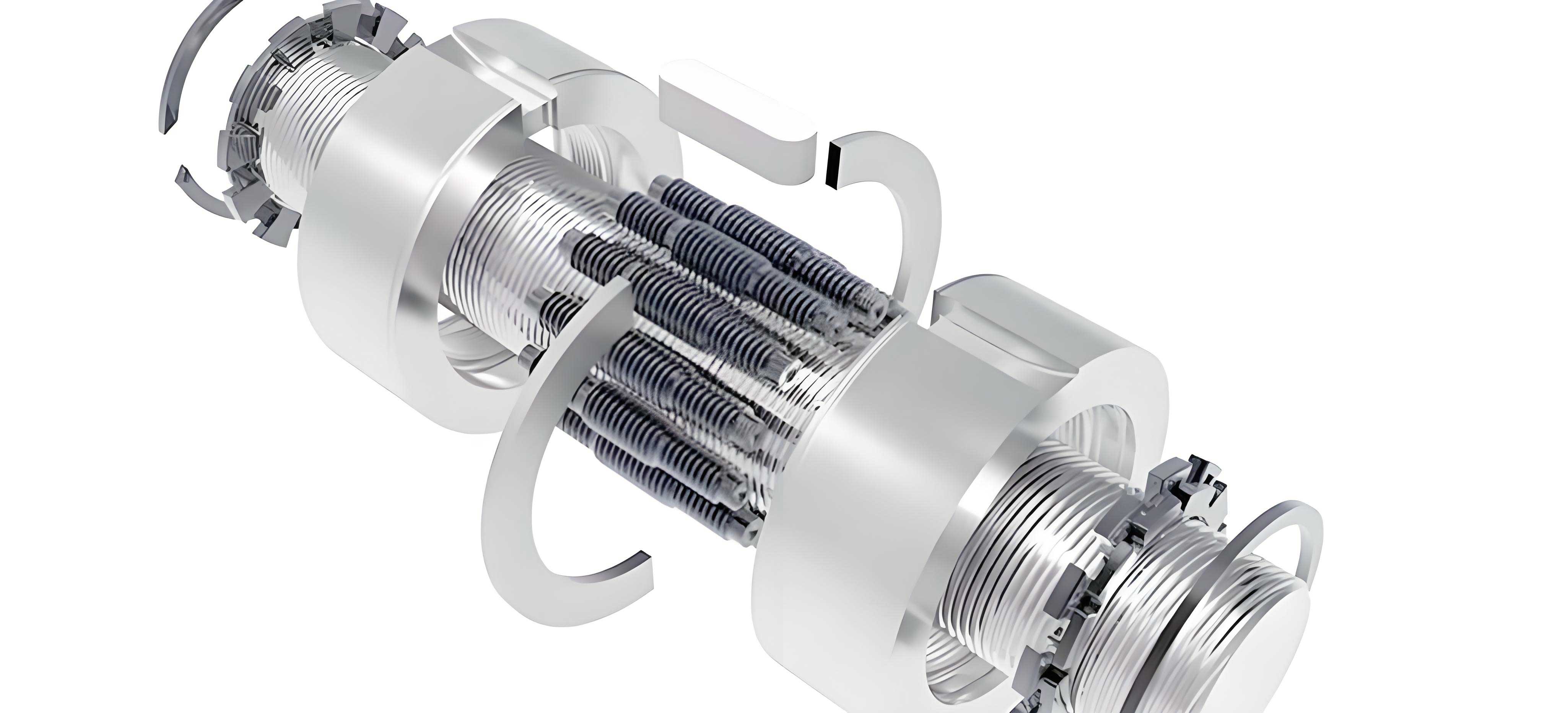
The advantages of the planetary roller screw assembly are manifold compared to its alternatives. It offers a higher load capacity and longer life than ball screws due to more contact points and lines. Most critically, its rolling contact mechanism achieves efficiencies upwards of 90%, a stark contrast to the inefficient sliding friction of traditional screw pairs. This directly translates to lower energy consumption for the same output force.
The design of the planetary roller screw assembly for this heavy-duty application follows a rigorous, iterative process. It begins with theoretical calculations based on the press’s operational requirements, proceeds through component sizing and interference analysis, and is validated via static and dynamic simulation.
Theoretical Design and Parameter Calculation
The fundamental relationship between input torque and output thrust for a screw mechanism is given by:
$$ M = \frac{F \cdot n_s \cdot p}{2\pi \eta} $$
where \( M \) is the input torque (N·mm), \( F \) is the axial force (N), \( n_s \) is the number of screw starts, \( p \) is the pitch (mm), and \( \eta \) is the transmission efficiency. For initial sizing under the maximum cold strike force of 32,000 kN, with \( n_s = 6 \), \( p = 25 \) mm, and \( \eta = 0.85 \), the required input torque is calculated.
The screw shaft is subjected to combined compression and torsion. Using the von Mises (Fourth Strength) theory, the equivalent stress must satisfy:
$$ \sigma_{r4} = \sqrt{ \left( \frac{4F}{\pi d_{s1}^2} \right)^2 + 3 \left( \frac{16M}{\pi d_{s1}^3} \right)^2 } \le \frac{\sigma_s}{n} $$
where \( d_{s1} \) is the screw minor diameter (mm), \( \sigma_s \) is the yield strength of the material (GCr15, 1617 MPa), and \( n \) is the safety factor (taken as 4). Solving this inequality provides the minimum permissible screw minor diameter. A larger mean diameter is initially selected to enhance load capacity, setting \( d_s = 480 \) mm as the screw mean diameter.
The kinematics of a standard planetary roller screw assembly dictate specific geometric relationships. The transmission ratio between the screw and the nut/rollers is governed by the thread starts and gear teeth:
$$ \frac{n_s}{n_n} = \frac{z_n}{z_r} = \frac{d_n}{d_r} $$
where \( n_n \) is the number of nut starts, \( z_n \) and \( z_r \) are the number of teeth on the internal ring gear and roller gear respectively, and \( d_n \) and \( d_r \) are the mean diameters of the nut and roller threads. The diameters are related by:
$$ d_n = d_s + 2d_r $$
The roller gear pitch diameter is \( d_{rg} = m z_r \), where \( m \) is the gear module. Based on the chosen screw parameters (\( n_s=6, d_s=480 \) mm) and selecting \( m=4 \), \( z_r=30 \), we derive: \( n_n=6 \), \( d_r=120 \) mm, \( d_n=720 \) mm, and \( z_n=180 \). The thread profiles are defined as triangular (90° included angle) for the screw and nut, and circular for the roller. Key dimensional parameters for the planetary roller screw assembly threads are summarized in Table 2.
| Component | Mean Diameter (mm) | Major Diameter (mm) | Minor Diameter (mm) | Pitch (mm) | Number of Starts | Thread Angle |
|---|---|---|---|---|---|---|
| Screw | 480 | 488 | 470 | 25 | 6 | 90° |
| Roller | 120 | 128 | 110 | 25 | 1 | 90° (Circular) |
| Nut | 720 | 730 | 712 | 25 | 6 | 90° |
Interference Analysis and Static Strength Validation
A critical step in designing a functional planetary roller screw assembly is ensuring proper meshing without interference between the screw and roller threads. We developed an analytical meshing model based on the mathematical definition of the helical surfaces. Using MATLAB to solve the contact equations, the theoretical interference between the screw and roller threads was quantified. To eliminate this interference, the semi-thickness of the roller thread was reduced by 0.66 mm, a modification verified in the 3D CAD model.
Next, the contact strength of the thread teeth under load was evaluated. A simplified finite element model of a single screw thread in contact with a single roller thread was created in ABAQUS. The model used a refined mesh at the contact region and assigned GCr15 material properties, including its plastic stress-strain curve. An axial load was applied to the screw segment, and the permanent deformation of the roller thread after unloading was examined. The allowable load per thread contact was defined as that which caused permanent deformation less than 0.001% of the roller diameter (0.017 mm). This criterion was met at a load of approximately 92 kN per thread contact.
Given this allowable load per contact point, the total number of rollers, and the thread starts, the required engaged length of the roller threads to safely carry the 32,000 kN force was calculated, determining the necessary length of the rollers within the planetary roller screw assembly.
Dynamic Simulation and Performance Verification
Prior to physical manufacturing, a virtual prototype was constructed in ADAMS to validate the kinematic correctness of the designed planetary roller screw assembly. A simplified 3D model was imported, and appropriate joints and constraints were applied: a revolute joint for the screw to ground, a translational joint for the nut to ground, fixed joints for the ring gears to the nut, revolute joints for the retainers to the ring gears, and revolute joints for the rollers to the retainers. Contact forces with Coulomb friction were defined between all interacting threaded surfaces and gear teeth.
In the simulation, the screw was driven at a constant rotational speed of 780 deg/s, and a 32,000 kN axial load was applied to the nut. The dynamic response over a 2-second period was analyzed. The simulation results showed some velocity fluctuations, attributable to contact dynamics and clearances, but the averaged values aligned well with theoretical predictions. The key kinematic outputs are compared below:
| Parameter | Theoretical Value | Simulation Average | Relative Error |
|---|---|---|---|
| Roller Angular Velocity (deg/s) | 1560 | 1480 | 5.13% |
| Retainer Angular Velocity (deg/s) | 312 | 294.5 | 5.61% |
| Nut Linear Velocity (mm/s) | 325 | 332.8 | 2.4% |
| Nut Linear Displacement (mm) | 650 | 645.75 | 0.65% |
The close agreement between the simulated dynamic behavior and the theoretical kinematic values confirms the rationality of the structural parameter design for this heavy-duty planetary roller screw assembly. The minor discrepancies are within acceptable limits for engineering design validation.
Conclusion
This work presents a comprehensive design and analysis methodology for implementing a high-capacity planetary roller screw assembly in a 16MN electric screw press. The proposed system directly addresses the critical shortcomings of traditional trapezoidal sliding screw pairs—namely, lubrication challenges, high friction, and low efficiency. Through systematic theoretical calculation, static finite element analysis for contact strength, and dynamic multi-body simulation, we have demonstrated that a standard-type planetary roller screw assembly can be feasibly designed to meet the extreme load requirements of heavy-duty forging equipment.
The core benefit of this technology transformation is the shift from sliding friction to rolling friction within the press’s primary drive mechanism. This fundamentally alters the performance envelope, enabling mechanical efficiencies to rise from below 50% to potentially over 90%. Consequently, for the same forging output, the energy consumption of the press can be significantly reduced. Furthermore, reduced friction mitigates wear and thermal issues, potentially enhancing component life and reliability. The successful virtual prototyping and kinematic validation underscore the practicality of this upgrade path. Therefore, the adoption of the planetary roller screw assembly represents a pivotal step towards modernizing traditional screw presses, aligning them with the imperatives of green manufacturing, energy conservation, and enhanced operational performance.