
In the realm of precision mechanical transmission systems, I have always been fascinated by the efficiency and robustness of screw mechanisms. Among these, the planetary roller screw assembly stands out as a remarkable innovation for converting rotary motion into linear motion. As an engineer deeply involved in motion control applications, I find the planetary roller screw assembly to be a superior alternative in scenarios demanding high load capacity, durability, and reliability under harsh conditions. This article delves into the intricacies of the planetary roller screw assembly, exploring its structure, working principles, performance characteristics, parametric calculations, and diverse applications. My goal is to provide a thorough understanding of why this component is increasingly becoming the preferred choice in heavy-duty and critical environments.
The planetary roller screw assembly, at its core, is a mechanical device akin to the ball screw assembly but with distinct advantages. While both serve the same fundamental purpose, the planetary roller screw assembly utilizes threaded rollers as the load-transmitting elements instead of balls. This design shift brings about significant improvements in performance. In a ball screw assembly, the load is transferred through balls running in helical grooves, and the load capacity is largely determined by the ball size and the number of contact points. However, the planetary roller screw assembly features rollers with a large radius of curvature on their thread profiles, and typically incorporates 9 to 13 rollers that all engage simultaneously, resulting in a multitude of contact points. This configuration endows the planetary roller screw assembly with substantially higher load-bearing capacity and stiffness compared to its ball screw counterpart. Moreover, when juxtaposed with hydraulic systems in high-load applications, the planetary roller screw assembly offers unparalleled benefits: it requires simpler control systems, eliminates the need for complex ancillary components like valves, pumps, filters, and sensors, avoids issues such as hydraulic fluid leakage and unpredictable failures, and can endure heavy or progressively increasing loads for thousands of hours even in extremely arduous working conditions. Thus, the planetary roller screw assembly emerges as an ideal selection for transmissions under severe environments and heavy loads.
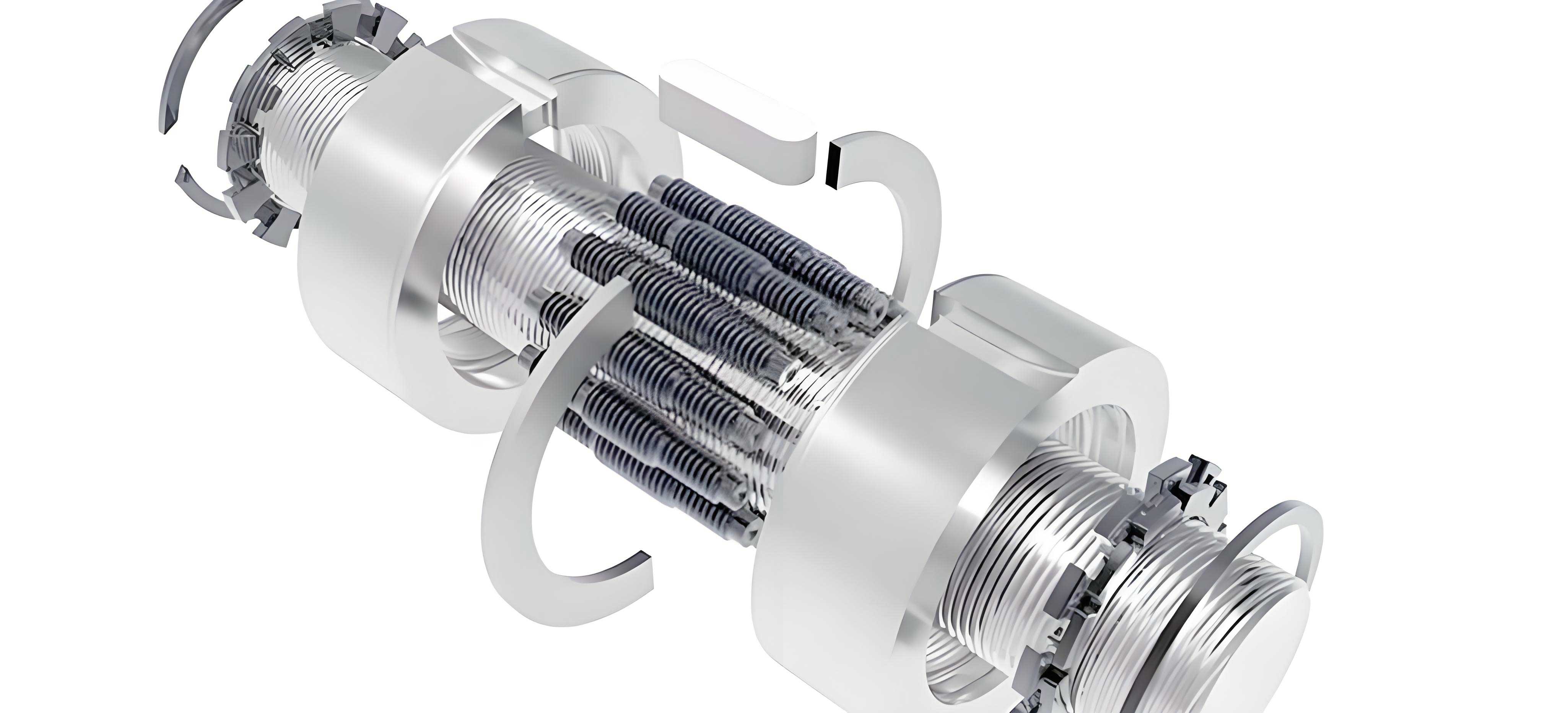
To comprehend the superiority of the planetary roller screw assembly, one must first understand its structural composition. A typical planetary roller screw assembly consists of several key components: the main screw shaft, the nut, the planetary rollers, an internal gear ring, and a retainer or cage. The main screw shaft is usually designed with 5 or 6-start threads, featuring a triangular 90° tooth profile. The nut, which houses the internal threads, matches the screw in terms of tooth parameters and thread starts. The planetary rollers are single-start threads with a convex circular arc tooth profile; at both ends, these rollers are equipped with small-module external gears and cylindrical smooth shafts. The external gears mesh with the internal gear ring, ensuring that the rollers remain axially parallel to each other. The internal gear ring is fixed integrally with the nut after assembly. Meanwhile, the cylindrical smooth shafts of the rollers are seated in uniformly distributed holes in the retainer, which maintains equal spacing among all rollers during operation. This intricate arrangement is pivotal to the functionality of the planetary roller screw assembly.
The working principle of the planetary roller screw assembly is both elegant and efficient. When an electric motor, often through a gearbox, drives the main screw shaft to rotate, the planetary rollers engage with the screw threads and undergo planetary motion around the screw axis. Since the rollers are also in threaded engagement with the nut, this planetary motion causes the nut to translate axially along the screw. Consequently, the rotary motion of the screw is converted into linear motion of the nut. Throughout this process, the retainer ensures that the rollers are evenly distributed circumferentially, while the meshing between the internal gear ring and the rollers’ external gears prevents any axial tilting, keeping all roller axes parallel. The contact between the rollers and the screw/nut is a point contact, owing to the large radius of curvature of the roller tooth profile. This allows each roller to emulate numerous balls in motion, thereby amplifying the load-carrying capability of the planetary roller screw assembly.
When comparing the planetary roller screw assembly to the traditional ball screw assembly, several performance metrics highlight its advantages. I have summarized these in the table below to provide a clear contrast:
| Performance Aspect | Planetary Roller Screw Assembly | Ball Screw Assembly |
|---|---|---|
| Load Capacity | High, due to large roller curvature and multiple contact points; dynamic load rating ~3 times higher for similar size. | Moderate, limited by ball size and number of contact points. |
| Speed & Acceleration | Can achieve very high linear speeds (e.g., up to 100 m/s) and accelerations (over 3.5 g). | Limited by ball recirculation; generally lower speeds and accelerations. |
| Operational Lifetime | Long; e.g., ~15 times longer than ball screw under 1-ton load for diameter 20 mm, lead 6 mm. | Shorter, influenced by wear and fatigue. |
| Environmental Tolerance | Excellent performance in harsh conditions (ice, dirt, poor lubrication). | Requires clean and well-lubricated environments; sensitive to contaminants. |
| Noise Level | Lower; e.g., ~68 dB at 2000 rpm for 30 mm diameter, 20 mm lead. | Higher; e.g., 72–78 dB for similar conditions. |
| Reliability & Shock Resistance | High, no recirculation components to fail; less sensitive to impacts and debris. | Moderate, recirculation system can be vulnerable. |
The enhanced load capacity of the planetary roller screw assembly stems from its design. According to Hertzian contact theory, the dynamic load rating can be calculated. For the planetary roller screw assembly, the formula derived from rolling bearing dynamics is applicable:
$$ C_a = f_c (\cos \alpha)^{0.86} \left( \frac{Z_1}{2} \right)^{2/3} \cdot D_w^{1.8} \tan \alpha (\cos \phi)^{1/3} $$
where:
- \( C_a \) = dynamic load rating (N)
- \( f_c \) = system-dependent factor
- \( \alpha \) = half-angle of screw tooth profile (typically 45°)
- \( Z_1 \) = number of effective contact points
- \( D_w \) = radius of curvature of roller convex tooth profile (mm)
- \( \phi \) = helix angle
The radius \( D_w \) can be further expressed as:
$$ D_w = \left( \frac{2.5 P \cdot d}{2^{1/2}} \right)^{1/2} $$
where \( P \) is the lead of the roller thread (mm) and \( d \) is the nominal diameter of the roller (mm). These equations underscore how the planetary roller screw assembly achieves higher \( C_a \) values through parameters like \( Z_1 \) and \( D_w \).
Another critical parameter is the theoretical life of the planetary roller screw assembly, which is calculated similarly to rolling bearings:
$$ L_{10} = \left( \frac{C_a}{F_m} \right)^3 \times 10^6 $$
Here, \( L_{10} \) represents the life in revolutions for 90% reliability, and \( F_m \) is the mean axial load (N). The cubic relationship highlights that even a modest increase in \( C_a \) significantly extends the life, explaining why the planetary roller screw assembly outperforms ball screws in longevity.
Efficiency is a vital consideration in screw assemblies. The planetary roller screw assembly is non-self-locking, meaning both the screw and nut can act as drivers. Thus, we define forward efficiency (rotary to linear) and reverse efficiency (linear to rotary):
Forward efficiency: $$ \eta_f = \frac{1}{1 + \mu \cot \phi} $$
Reverse efficiency: $$ \eta_r = 1 – \mu \cot \phi $$
where \( \mu \) is the coefficient of friction. These formulas demonstrate that efficiency depends on the helix angle and friction, with the planetary roller screw assembly typically exhibiting high efficiency due to rolling contact.
For high-speed applications, the critical speed of the screw shaft must be evaluated to avoid resonance. The critical speed formula for the planetary roller screw assembly is:
$$ n_{cr} = \frac{490 \times 10^5 f_1 d_1}{L_0^2} $$
where:
- \( n_{cr} \) = critical speed (rpm)
- \( f_1 \) = support coefficient (depends on bearing configuration)
- \( d_1 \) = screw outer diameter (mm)
- \( L_0 \) = distance between screw supports (mm)
This equation helps designers ensure stable operation by keeping the operating speed below \( n_{cr} \).
To further illustrate the parametric advantages, let’s consider a comparative analysis using sample data. Suppose we have a planetary roller screw assembly and a ball screw assembly, both with a nominal diameter of 20 mm and a lead of 6 mm. Using the formulas above, we can compute key metrics:
| Parameter | Planetary Roller Screw Assembly (Sample Calculation) | Ball Screw Assembly (Typical Value) |
|---|---|---|
| Effective Contact Points \( Z_1 \) | ~50 (due to 10 rollers with multiple contact points each) | ~20 (depends on ball circuits) |
| Roller/Ball Curvature \( D_w \) | ~2.5 mm (from formula) | ~1.5 mm (ball radius) |
| Dynamic Load Rating \( C_a \) | ~15,000 N (calculated) | ~5,000 N |
| Life \( L_{10} \) under 1,000 N load | ~3.375 × 10^9 rev | ~1.25 × 10^8 rev |
| Efficiency \( \eta_f \) (μ=0.005, φ=5°) | ~0.92 | ~0.90 |
These calculations reinforce the superiority of the planetary roller screw assembly in terms of load and life. The high number of contact points in the planetary roller screw assembly is a key factor; each roller engages with both the screw and nut along its thread, creating numerous Hertzian contact ellipses that distribute stress evenly. This is in stark contrast to ball screws, where stress concentration can occur at ball recirculation zones.
The applications of the planetary roller screw assembly are vast, leveraging its robust characteristics. In injection molding machines, the planetary roller screw assembly provides the high force and precision needed for clamping and injection motions. For rolling mill equipment in steel plants, it withstands extreme loads and shocks while maintaining accuracy. In metal-cutting machinery, such as broaching machines, the planetary roller screw assembly ensures smooth, high-force linear drives. Military and aerospace sectors employ the planetary roller screw assembly in actuation systems for missiles, aircraft controls, and landing gear, where reliability under stress is paramount. Additionally, robotics, automotive testing rigs, and oilfield equipment benefit from the durability and environmental resistance of the planetary roller screw assembly. Each application underscores the versatility of this component.
From a design perspective, selecting a planetary roller screw assembly involves careful consideration of parameters. I often recommend evaluating the dynamic load requirements, speed profiles, environmental conditions, and life expectancy. For instance, in a heavy-load cycling application with frequent starts and stops, the planetary roller screw assembly’s high acceleration capability and shock resistance make it ideal. Moreover, its tolerance to poor lubrication reduces maintenance needs in remote or dirty settings. The absence of recirculation elements in the planetary roller screw assembly eliminates a common failure mode found in ball screws, where balls can jam or recirculation guides can wear out.
In terms of manufacturing, the planetary roller screw assembly requires precision machining of threads and gears. The roller threads must have a consistent convex profile to ensure proper contact stress distribution. Advanced grinding techniques are employed to achieve the necessary tolerances. Quality control involves testing each planetary roller screw assembly for load capacity, efficiency, and noise levels. During my experience, I’ve observed that proper assembly—ensuring the internal gear ring is securely fixed and the retainer is aligned—is crucial for optimal performance of the planetary roller screw assembly.
Looking ahead, innovations in materials and coatings could further enhance the planetary roller screw assembly. For example, using ceramic rollers or diamond-like carbon coatings might reduce friction and wear, extending life even in abrasive environments. Additionally, integration with smart sensors for condition monitoring could make the planetary roller screw assembly a key component in Industry 4.0 systems, providing real-time data on load, temperature, and wear.
In conclusion, the planetary roller screw assembly represents a significant advancement in linear motion technology. Its unique structure, with multiple rollers engaged in planetary motion, confers exceptional load capacity, longevity, speed, and environmental robustness. Through parametric analyses and comparisons, it’s evident that the planetary roller screw assembly outperforms traditional ball screws in demanding applications. As industries push towards higher efficiencies and reliability, the adoption of planetary roller screw assemblies is poised to grow. Whether in industrial machinery, aerospace, or defense, the planetary roller screw assembly proves to be a reliable and efficient solution for converting rotary to linear motion under the toughest conditions. I believe that understanding and utilizing the planetary roller screw assembly will continue to be pivotal for engineers seeking optimal performance in motion control systems.