
In the realm of precision linear motion transmission, the planetary roller screw assembly stands out as a pivotal mechanical component, renowned for its high load capacity, rigidity, and accuracy. As an alternative to ball screws, this assembly converts rotational motion into linear motion through rolling contact, minimizing friction and enhancing efficiency. My investigation focuses on the frictional characteristics and transmission efficiency of the planetary roller screw assembly, which are critical for its performance in applications ranging from aerospace actuators to medical devices. In this work, I delve into the underlying mechanisms of friction, develop comprehensive models for frictional moment and efficiency, and analyze the influence of key operational and structural parameters. The goal is to provide a thorough understanding that aids in the optimal design of planetary roller screw assemblies for demanding engineering systems.
The planetary roller screw assembly typically consists of a central screw, a nut, multiple threaded rollers arranged planetarily, and associated gear elements for synchronization. This configuration allows for distributed load sharing and smooth motion transmission. Understanding its kinematics is essential for analyzing friction and efficiency. The screw rotates, driving the rollers to both rotate about their own axes and revolve around the screw axis, thereby translating the nut linearly. This motion involves complex contact dynamics at the screw-roller and roller-nut interfaces, where rolling, sliding, and spinning interactions occur. These interactions give rise to frictional losses that impact the overall performance of the planetary roller screw assembly.
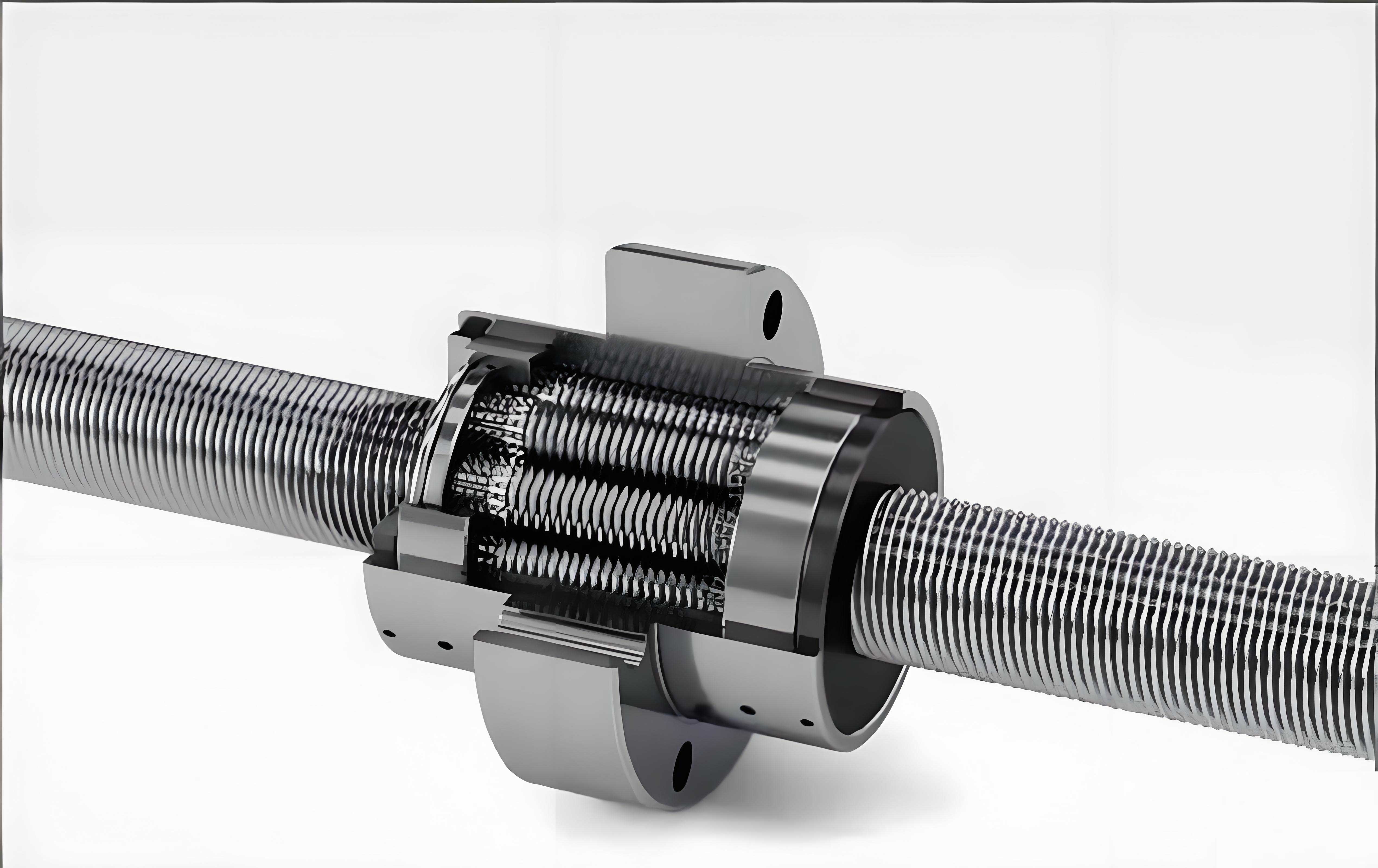
The frictional moment in a planetary roller screw assembly originates from multiple sources, primarily material elastic hysteresis, spinning sliding of the rollers, and viscous resistance of the lubricant. Based on Hertzian contact theory and the effective ball method, I calculate these components separately to quantify their contributions. For elastic hysteresis, the energy loss due to deformation recovery in the contact ellipses between the screw and rollers, and between the rollers and nut, is considered. The frictional moment from this source for the screw side, \( M_{fs} \), and nut side, \( M_{fn} \), can be expressed as:
$$ M_{fs} = N_0 \sum_{i=1}^{\tau} \frac{3}{8} \gamma B_s m_{bs} \left( \frac{3E’_s}{2\sum \rho_s} \right)^{1/2} N_i^{4/3}, $$
$$ M_{fn} = N_0 \sum_{i=1}^{\tau} \frac{3}{8} \gamma B_n m_{bn} \left( \frac{3E’_n}{2\sum \rho_n} \right)^{1/2} N_i^{4/3}, $$
where \( N_0 \) is the number of rollers, \( \tau \) is the number of thread teeth per roller, \( \gamma \) is the energy loss coefficient, \( B = 1/(2R) \) with \( R = d_r/(2\sin \beta) \) as the effective ball radius (\( d_r \) is the roller pitch diameter and \( \beta \) is the contact angle), \( m_b \) is the ellipse parameter, \( E’ \) is the equivalent elastic modulus, \( \sum \rho \) is the sum of curvatures, and \( N_i \) is the load on the i-th tooth. These parameters are derived from the geometry and material properties of the planetary roller screw assembly.
Spinning sliding occurs because the roller’s axis is constrained to be parallel to the screw axis, while the contact normal is inclined at angle \( \beta \). This leads to a spin component of the roller’s angular velocity about the contact normal, causing sliding friction. The resulting frictional moments on the screw side, \( M_{ks} \), and nut side, \( M_{kn} \), are given by integrating over the contact ellipses:
$$ M_{ks} = N_0 \cos \beta \sum_{i=1}^{\tau} \iint_{\Omega_{si}} f_h \frac{3N_i}{2\pi a_{si} b_{si}} \sigma_i p \, dx \, dy, $$
$$ M_{kn} = N_0 \cos \beta \sum_{i=1}^{\tau} \iint_{\Omega_{ni}} f_h \frac{3N_i}{2\pi a_{ni} b_{ni}} \upsilon_i p \, dx \, dy, $$
where \( f_h \) is the sliding friction coefficient, \( a \) and \( b \) are the semi-major and semi-minor axes of the contact ellipse, \( p = \sqrt{x^2 + y^2} \), \( \sigma_i = \sqrt{1 – x^2/a_{si}^2 – y^2/b_{si}^2} \), \( \upsilon_i = \sqrt{1 – x^2/a_{ni}^2 – y^2/b_{ni}^2} \), and the integration domains \( \Omega_{si} \) and \( \Omega_{ni} \) are defined by the ellipse boundaries. This spinning sliding is a dominant source of friction in the planetary roller screw assembly.
Lubricant viscous resistance arises from the shearing of lubricant films in the contact zones. Using the effective ball approach, the viscous rolling resistance force \( F_v \) on an equivalent ball is approximated as:
$$ F_v = 2.86 E’ R_x^2 \left( \frac{k^{0.348} \bar{U}^{0.66} P^{0.022} \bar{W}^{0.47}}{} \right), $$
where \( \bar{U} = \eta_0 U/(2E’R) \) is the dimensionless speed parameter (\( \eta_0 \) is the dynamic viscosity, \( U \) is the tangential velocity), \( R_x \) is the equivalent curvature radius in the rolling direction, \( P = \alpha E’ \) is the material parameter (\( \alpha \) is the pressure-viscosity coefficient), \( \bar{W} = P/(E’ R_x^2) \) is the load parameter, and \( k = R_y/R_x \) is the curvature ratio. For the screw side, \( R_{xs} = R(d_m – 2R\cos \beta)/d_m \), and for the nut side, \( R_{xn} = R(d_m + 2R\cos \beta)/d_m \), with \( d_m \) as the screw pitch diameter. The transverse equivalent curvature radii are \( R_{ys} = 2\kappa_s R/(2\kappa_s – 1) \) and \( R_{yn} = 2\kappa_n R/(2\kappa_n – 1) \), where \( \kappa_s \) and \( \kappa_n \) are curvature parameters for the screw and nut grooves, typically ranging from 0.515 to 0.54. The viscous frictional moments are then:
$$ M_{ls} = N_0 \sum_{j=1}^{\tau_0} F_{vsj} R_s, \quad M_{ln} = N_0 \sum_{j=1}^{\tau_0} F_{vnj} R_n, $$
where \( \tau_0 \) is the number of effective balls per roller, and \( R_s \), \( R_n \) are distances from contact points to the screw axis. The total frictional moment \( M \) in the planetary roller screw assembly is the sum of all components:
$$ M = M_{fs} + M_{ks} + M_{ls} + M_{fn} + M_{kn} + M_{ln}. $$
To analyze the effects of various parameters on the frictional moment, I consider a typical planetary roller screw assembly with the following specifications, which are used as a baseline for calculations:
| Parameter | Symbol | Value |
|---|---|---|
| Screw pitch diameter | \( d_m \) | 30 mm |
| Screw number of starts | – | 5 |
| Pitch | \( L_s \) | 2 mm |
| Helix angle | \( \lambda \) | 6.056° |
| Contact angle | \( \beta \) | 45° |
| Roller pitch diameter | \( d_r \) | 10 mm |
| Nut pitch diameter | \( D_n \) | 50 mm |
| Nut major diameter | – | 51.20 mm |
| Number of roller teeth engaged | \( \tau \) | 20 |
| Number of effective balls per roller | \( \tau_0 \) | 10 |
| Number of rollers | \( N_0 \) | 10 |
| Roller revolution diameter | – | 40 mm |
| Effective ball radius | \( R \) | 7.699 mm |
| Rolling friction coefficient | – | 0.005 |
| Sliding friction coefficient | \( f_h \) | 0.050 |
| Energy loss coefficient | \( \gamma \) | 0.007 |
| Elastic modulus | \( E \) | 210 GPa |
| Poisson’s ratio | \( \nu \) | 0.3 |
The influence of axial load on the frictional moment is significant. As the axial load increases, the frictional moment rises, primarily due to the spinning sliding component. For instance, at a screw speed of 1000 rpm and contact angle of 45°, the total frictional moment \( M \) shows a near-linear increase with axial load above 4000 N. This relationship underscores the importance of load management in the planetary roller screw assembly to minimize friction. The contributions from elastic hysteresis and lubricant viscosity are relatively minor compared to spinning sliding, which dominates the frictional behavior. This dominance is attributed to the constrained roller kinematics inherent in the planetary roller screw assembly design.
Contact angle \( \beta \) plays a crucial role in modulating friction. A larger contact angle reduces the spinning sliding component, thereby decreasing the total frictional moment. This effect is more pronounced at higher axial loads. For example, at an axial load of 10,000 N, increasing \( \beta \) from 25° to 55° can reduce \( M \) by over 50%. However, excessively large contact angles may compromise thread engagement and load distribution. Typically, a contact angle around 45° is recommended for balancing friction reduction and mechanical integrity in the planetary roller screw assembly.
Helix angle \( \lambda \) has minimal direct impact on the frictional moment, as it primarily affects the lead and linear speed. Variations in \( \lambda \) from 3° to 15° result in negligible changes in \( M \), as confirmed by calculations. Therefore, the helix angle in a planetary roller screw assembly should be selected based on kinematic requirements, such as desired linear velocity, rather than friction considerations.
The number of roller thread teeth \( \tau \) influences both load capacity and friction. Interestingly, increasing \( \tau \) tends to lower the total frictional moment, despite more contact points. This is because the load per tooth decreases, reducing the contact pressure and sliding friction. For instance, doubling \( \tau \) from 20 to 40 can reduce \( M \) by approximately 15% under high axial loads. However, more teeth increase the axial length of the nut and assembly, so a trade-off is necessary in designing the planetary roller screw assembly.
Transmission efficiency \( \eta \) is a key performance metric for the planetary roller screw assembly, defined as the ratio of output torque to input torque. The ideal output torque \( M’_s \) (without friction) for a given axial force \( F_a \) is:
$$ M’_s = F_a \cdot R_s \cdot \frac{L_s}{\pi d_m}, $$
where \( R_s \) is the effective radius, \( L_s \) is the screw lead, and \( d_m \) is the screw pitch diameter. The actual input torque includes the frictional moment \( M \), so the efficiency is:
$$ \eta = \frac{M’_s}{M’_s + M}. $$
Screw rotational speed \( \omega_s \) adversely affects efficiency. As \( \omega_s \) increases, the frictional moment rises due to heightened spinning sliding and viscous effects, leading to a decline in \( \eta \). For example, at an axial load of 1500 N, increasing \( \omega_s \) from 1000 rpm to 5000 rpm can drop \( \eta \) from about 0.85 to below 0.70. However, higher axial loads improve efficiency at the same speed, as the output torque grows linearly with load, outweighing the frictional increase. This highlights that the planetary roller screw assembly operates more efficiently under high-load, low-speed conditions.
Contact angle and helix angle also impact efficiency. A larger contact angle boosts \( \eta \) by reducing friction, as shown in Table 1, which summarizes efficiency values for different parameters at a screw speed of 2000 rpm. Similarly, a larger helix angle enhances efficiency by increasing the lead, which reduces the required input torque for a given linear displacement. For instance, at \( F_a = 3000 \) N and \( \omega_s = 2000 \) rpm, increasing \( \lambda \) from 6° to 12° can improve \( \eta \) from 0.82 to 0.88. These trends emphasize the importance of parameter optimization in the planetary roller screw assembly for efficiency gains.
| Axial Load \( F_a \) (N) | Contact Angle \( \beta = 35^\circ \) | Contact Angle \( \beta = 45^\circ \) | Contact Angle \( \beta = 55^\circ \) |
|---|---|---|---|
| 1500 | 0.72 | 0.78 | 0.81 |
| 3000 | 0.79 | 0.84 | 0.87 |
| 5000 | 0.84 | 0.88 | 0.90 |
| 8000 | 0.87 | 0.91 | 0.92 |
| 10000 | 0.88 | 0.92 | 0.93 |
The relationship between roller thread tooth count and efficiency is indirect. While more teeth reduce friction, they also alter the load distribution and may affect dynamic response. In practice, selecting \( \tau \) involves balancing efficiency, load capacity, and size constraints for the planetary roller screw assembly.
In summary, this study provides a detailed analysis of frictional moment and transmission efficiency in the planetary roller screw assembly. The frictional moment is predominantly caused by roller spinning sliding, with minor contributions from elastic hysteresis and lubricant viscosity. Axial load, contact angle, and roller tooth count significantly influence friction, while helix angle has little effect. For transmission efficiency, higher axial loads and larger contact or helix angles improve performance, whereas increased screw speed reduces it. These insights can guide the design and operation of planetary roller screw assemblies for optimal efficiency and minimal friction in advanced mechanical systems. Future work could explore thermal effects, dynamic loading, and advanced lubrication schemes to further enhance the performance of the planetary roller screw assembly.
To reinforce the findings, consider the following key equations and relationships for the planetary roller screw assembly. The total frictional moment model integrates multiple physics-based components, enabling precise prediction. The efficiency model links operational parameters to energy loss, providing a tool for system optimization. Throughout this analysis, the planetary roller screw assembly is treated as a complex tribological system where geometry, load, and motion interplay. By mastering these relationships, engineers can tailor the planetary roller screw assembly to specific applications, ensuring reliability and efficiency in demanding environments such as aerospace, robotics, and precision manufacturing. The continuous evolution of the planetary roller screw assembly technology will benefit from such foundational studies, driving innovations in linear motion transmission.