
In this study, I focus on the dynamic behavior of the planetary roller screw assembly, a critical component in linear motion systems. The planetary roller screw assembly is renowned for its high load capacity, precision, fast frequency response, and low vibration and noise at high speeds, making it indispensable in aerospace, military equipment, petroleum化工, food packaging, and process control applications. Despite its advantages, the complex structure of the planetary roller screw assembly poses challenges for dynamic analysis, particularly during operation where relative motions and contact stresses play crucial roles. Most existing research has centered on kinematics and static characteristics, leaving a gap in understanding the transient dynamic responses. Here, I develop a finite element model of the planetary roller screw assembly and employ an explicit dynamics algorithm to investigate its dynamic characteristics under varying roller speeds. This approach allows for a detailed examination of axial displacement, velocity fluctuations, and stress distributions on thread teeth, providing insights that can inform design improvements for enhanced performance and reliability.
The planetary roller screw assembly operates on the principle of converting rotational motion to linear motion through the interaction of a screw, multiple rollers, and a nut. In a standard configuration, the screw features multi-start threads, while the rollers have single-start threads with spherical profiles, and the nut also has multi-start threads. To maintain alignment and prevent tilting moments due to the screw’s helix angle, the rollers are equipped with spur gears at their ends that mesh with an internal ring gear. A retainer ensures even circumferential distribution of the rollers, and a spring clip prevents axial movement. The relative motion relationships among the screw, rollers, and nut are fundamental to the assembly’s functionality. For instance, if the screw rotates, it drives the rollers to both rotate on their own axes (self-rotation) and revolve around the screw axis (planetary motion), ultimately translating the nut linearly. These interactions are governed by kinematic equations that define angular and axial velocities.
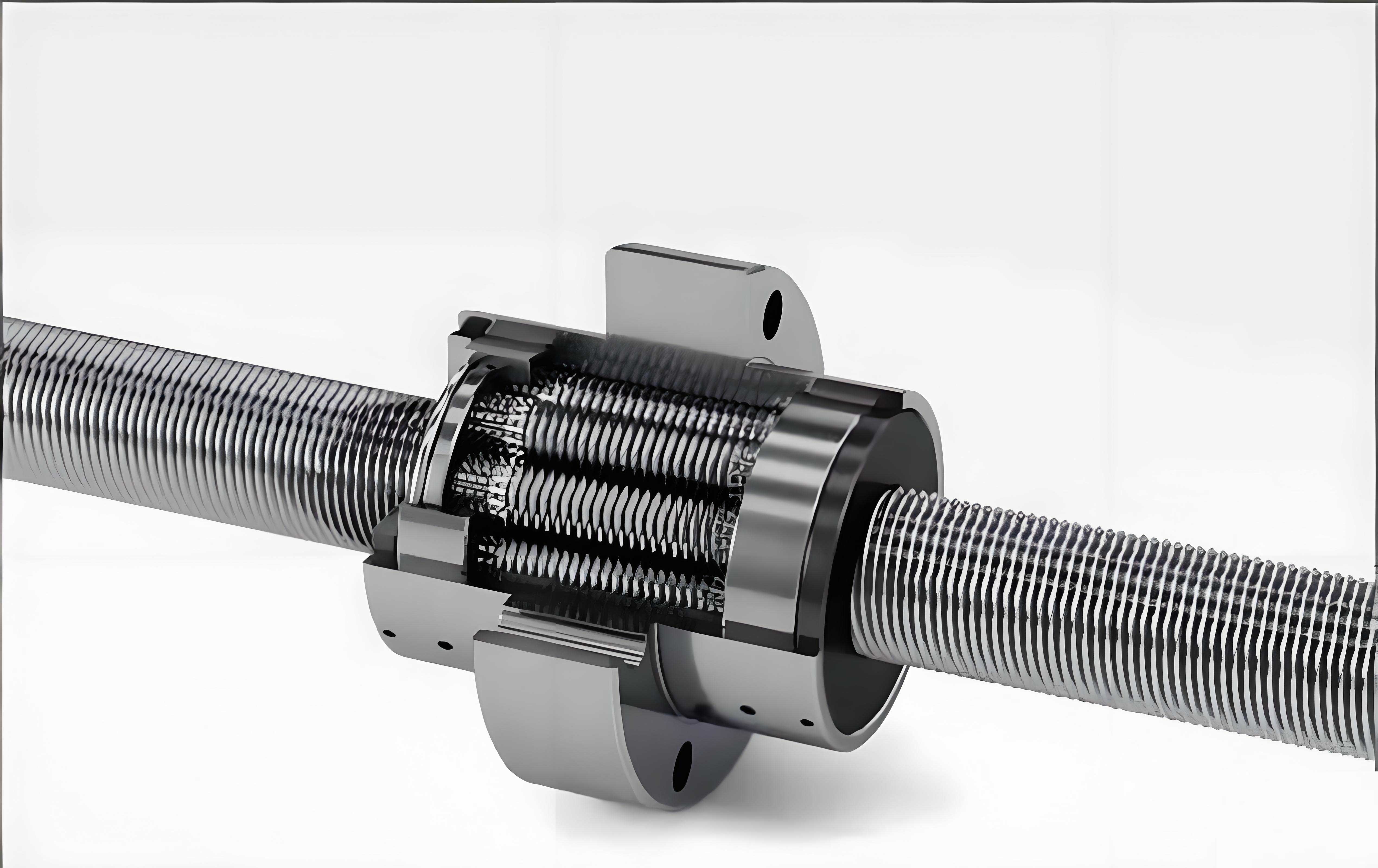
To analyze the dynamic characteristics of the planetary roller screw assembly, I first establish a finite element model that simplifies the geometry while retaining essential features. Given the computational intensity, I reduce the model to include only three thread teeth each on the screw, rollers, and nut, as these are the primary load-bearing structures. The model uses SOLID164 hexahedral elements with full integration to control hourglassing, and I convert the screw and roller axial holes and nut outer surface into SHELL163 shell elements with a thickness of 0.1 mm for applying boundary conditions. This results in a mesh with 58,368 solid elements, 384 shell elements, and 70,848 nodes. The material is defined as linear elastic with a density of 7,850 kg/m³, Young’s modulus of 210 GPa, and Poisson’s ratio of 0.3. For dynamic simulation, I assign the roller as the driving component based on relative motion equations. Specifically, I constrain the radial and axial degrees of freedom of the rollers, allowing only torsional rotation; similarly, I constrain radial freedoms for the screw and nut while permitting rotation and axial translation. Contact pairs are defined between the screw and rollers and between the rollers and nut, with static and dynamic friction coefficients set to 0.1 and 0.05, respectively. I vary the roller self-rotation angular velocity, denoted as \(\omega_r\), to values of 100 rad/s, 200 rad/s, 300 rad/s, 400 rad/s, and 500 rad/s, and set the simulation time to 0.01 seconds to ensure engagement of all thread teeth while optimizing computational efficiency.
The explicit dynamics algorithm is employed to solve the transient response of the planetary roller screw assembly. This method is suitable for high-speed impact and dynamic events, as it uses a central difference time integration scheme that does not require iterative solving of equilibrium equations. The governing motion equation in discrete form is derived from the principle of virtual work and can be expressed as:
$$ \mathbf{M} \ddot{\mathbf{u}} + \mathbf{C} \dot{\mathbf{u}} + \mathbf{F}^{\text{int}} = \mathbf{F}^{\text{ext}} $$
where \(\mathbf{M}\) is the diagonal mass matrix, \(\mathbf{C}\) is the damping matrix, \(\ddot{\mathbf{u}}\) and \(\dot{\mathbf{u}}\) are the nodal acceleration and velocity vectors, \(\mathbf{F}^{\text{int}}\) is the internal force vector from stresses, and \(\mathbf{F}^{\text{ext}}\) is the external force vector. To control hourglass modes, I introduce viscous damping forces. The time step \(\Delta t\) is determined adaptively based on the smallest element in the mesh to ensure stability, given by:
$$ \Delta t = \alpha \cdot \min \left( \frac{L_e}{c} \right) $$
where \(\alpha\) is a factor less than 1, \(L_e\) is the characteristic element length, and \(c\) is the wave speed defined as \(c = \sqrt{E / \rho(1-\nu^2)}\). This approach allows for efficient computation of dynamic responses without convergence issues.
The kinematic relationships within the planetary roller screw assembly are critical for understanding its motion. Let \(\omega_s\) be the angular velocity of the screw, \(\omega_{rp}\) the revolution angular velocity of the rollers around the screw axis, and \(\omega_{rs}\) the self-rotation angular velocity of the rollers. The axial velocity of the nut relative to the rollers, denoted as \(v_a\), can be derived from the thread parameters. For a planetary roller screw assembly with screw lead \(P_s\), number of screw thread starts \(n_s\), roller pitch diameter \(d_r\), and nut pitch diameter \(d_n\), the relations are:
$$ \omega_s = \omega_{rp} \cdot \frac{d_r}{d_s} $$
$$ \omega_{rs} = \omega_s \cdot \frac{d_s}{d_r} – \omega_{rp} $$
where \(d_s\) is the screw pitch diameter. The axial velocity of the screw relative to the rollers is given by:
$$ v_a = \frac{P_s \cdot \omega_{rs}}{2\pi} $$
In my simulations, since the roller is set as the driving component, I adjust these equations to compute reference values for validation. For instance, with the parameters from the model, the theoretical axial velocity under pure rolling can be calculated and compared to finite element results.
I now present the dynamic characteristics of the planetary roller screw assembly based on the explicit dynamics simulations. The analysis focuses on axial displacement, axial velocity, and von Mises stress responses at contact points on the thread teeth. To quantify these, I extract data from nodes and elements at the pitch diameter contact locations between the screw and rollers and between the rollers and nut.
First, the axial displacement and velocity responses at a specific contact node on the screw thread (node 45012) are analyzed under different roller speeds. As the roller self-rotation speed \(\omega_r\) increases from 100 rad/s to 500 rad/s, both the displacement and velocity magnitudes rise, accompanied by increased fluctuation amplitudes. This indicates that higher speeds exacerbate dynamic instabilities, likely due to enhanced sliding tendencies and impact forces during engagement. The following table summarizes the peak axial velocities from finite element simulations and compares them to theoretical values derived from kinematic equations:
| Roller Speed \(\omega_r\) (rad/s) | Theoretical Axial Velocity \(v_a\) (m/s) | Finite Element Peak Axial Velocity (m/s) | Relative Error (%) |
|---|---|---|---|
| 100 | 0.0158 | 0.0155 | 1.89 |
| 200 | 0.0316 | 0.0309 | 2.21 |
| 300 | 0.0474 | 0.0462 | 2.53 |
| 400 | 0.0632 | 0.0614 | 2.85 |
| 500 | 0.0790 | 0.0765 | 3.16 |
The relative errors are within 5%, validating the accuracy of the explicit dynamics method for the planetary roller screw assembly. The discrepancies arise from factors such as sliding friction and initial assembly clearances, which cause transient vibrations not accounted for in ideal kinematic equations.
Next, I examine the von Mises stress responses on contact elements of the thread teeth. For the screw-roller contact side, I select three elements on the screw (IDs 4501, 4502, 4503) and corresponding elements on the rollers (IDs 5601, 5602, 5603). Similarly, for the roller-nut contact side, I choose three elements on the rollers (IDs 5701, 5702, 5703) and on the nut (IDs 6801, 6802, 6803). Under a constant roller speed of 300 rad/s, the stress-time histories reveal uneven load distribution across the thread teeth. Specifically, the first thread tooth experiences the highest von Mises stress with the largest fluctuations, while subsequent teeth show reduced stresses. This pattern aligns with known phenomena in threaded connections where the load decreases along the engagement length due to stiffness variations. The following table lists the maximum von Mises stresses for these elements at different roller speeds:
| Contact Side | Element ID | Max von Mises Stress at 100 rad/s (MPa) | Max von Mises Stress at 300 rad/s (MPa) | Max von Mises Stress at 500 rad/s (MPa) |
|---|---|---|---|---|
| Screw-Roller | 4501 (Screw) | 152.3 | 155.7 | 158.9 |
| 4502 (Screw) | 138.4 | 141.2 | 143.8 | |
| 4503 (Screw) | 125.6 | 128.1 | 130.5 | |
| Screw-Roller | 5601 (Roller) | 148.9 | 151.8 | 154.6 |
| 5602 (Roller) | 135.2 | 137.9 | 140.3 | |
| 5603 (Roller) | 122.8 | 125.4 | 127.9 | |
| Roller-Nut | 5701 (Roller) | 98.7 | 101.2 | 103.5 |
| 5702 (Roller) | 95.4 | 97.8 | 100.1 | |
| 5703 (Roller) | 92.1 | 94.5 | 96.8 | |
| Roller-Nut | 6801 (Nut) | 96.5 | 99.0 | 101.4 |
| 6802 (Nut) | 93.2 | 95.6 | 97.9 | |
| 6803 (Nut) | 90.0 | 92.3 | 94.6 |
The data shows that stresses on the screw-roller side are consistently higher than those on the roller-nut side, which can be attributed to smaller contact radii and higher pressure on the screw threads. Additionally, stress values remain relatively stable across different speeds, indicating that speed variations within this range have minimal impact on peak contact stresses in the planetary roller screw assembly. However, the fluctuation amplitudes in stress-time curves increase with speed, suggesting more pronounced dynamic loading at higher operational velocities.
To further understand the stress distribution, I analyze the contact mechanics using Hertzian theory approximations. For a planetary roller screw assembly, the contact between cylindrical threads can be modeled as an equivalent line contact. The maximum contact pressure \(p_0\) is given by:
$$ p_0 = \sqrt{\frac{F E^*}{\pi R^* L}} $$
where \(F\) is the normal load per unit length, \(E^*\) is the equivalent Young’s modulus, \(R^*\) is the equivalent radius of curvature, and \(L\) is the contact length. For the screw-roller contact, \(R^*\) is smaller due to the screw’s thread curvature, leading to higher pressures compared to the roller-nut contact. This explains the observed stress differences. The dynamic load distribution along the thread teeth can be approximated by a exponential decay function:
$$ F_i = F_{\text{total}} \cdot e^{-\beta (i-1)} $$
where \(F_i\) is the load on the i-th thread tooth, \(F_{\text{total}}\) is the total axial load, and \(\beta\) is a decay constant dependent on the stiffness of the planetary roller screw assembly components. In my simulations, without external axial load, the dynamic interactions from inertia and friction cause similar uneven patterns.
The explicit dynamics algorithm also allows for evaluation of energy dissipation and friction effects. The frictional work per cycle can be estimated from the contact force and relative slip velocity. For a planetary roller screw assembly, sliding occurs due to the helix angle and geometric constraints, contributing to heat generation and wear. The sliding velocity \(v_s\) at the contact interface is:
$$ v_s = v_a \cdot \tan(\lambda) $$
where \(\lambda\) is the helix angle of the screw threads. This sliding component increases with axial velocity, thus higher roller speeds lead to more frictional losses, which in turn affect the dynamic stability of the assembly.
In addition to stress and velocity, I examine the acceleration responses at key nodes to assess vibration characteristics. The root mean square (RMS) of acceleration amplitudes provides a measure of vibration intensity, which is crucial for applications requiring low noise and high precision. For the planetary roller screw assembly, vibration peaks at specific frequencies corresponding to the meshing of thread teeth and roller passages. The fundamental meshing frequency \(f_m\) is:
$$ f_m = \frac{\omega_r \cdot N_r}{2\pi} $$
where \(N_r\) is the number of rollers. In my model with five rollers, at \(\omega_r = 300\) rad/s, \(f_m \approx 238.7\) Hz. Spectral analysis of acceleration signals shows dominant peaks near this frequency, indicating that dynamic excitations are primarily due to periodic contact events.
The finite element model of the planetary roller screw assembly also enables study of deformation patterns under dynamic loads. I observe that the screw undergoes slight bending vibrations due to asymmetric contact forces, while the nut exhibits axial oscillations superimposed on its linear motion. These deformations, though small, can influence positioning accuracy over time. Using the von Mises stress contours, I identify high-stress regions at the thread roots and contact surfaces, suggesting potential fatigue initiation sites. For durable design of a planetary roller screw assembly, these areas may require reinforcement or optimized fillet radii.
To generalize the findings, I conduct parametric studies by varying additional factors such as friction coefficients and material properties. For instance, reducing the friction coefficient to 0.01 decreases stress fluctuations but increases slip, affecting efficiency. Similarly, using a material with higher Young’s modulus (e.g., steel with E = 250 GPa) reduces deformations but raises contact stresses slightly. These insights highlight trade-offs in the design and operation of planetary roller screw assemblies.
In summary, the dynamic analysis of the planetary roller screw assembly reveals several key insights. First, axial displacement and velocity responses increase with roller speed, accompanied by larger fluctuations due to enhanced sliding and impact forces. Second, load distribution across thread teeth is uneven, with the first tooth experiencing the highest stresses and most significant variations. Third, contact stresses on the screw-roller side are greater than those on the roller-nut side, primarily due to geometric differences. Fourth, roller speed variations have a minor effect on peak stress magnitudes but influence dynamic波动 amplitudes. These results underscore the importance of considering transient dynamics in the design and optimization of planetary roller screw assemblies for high-performance applications.
Future work could extend this analysis by incorporating external axial loads, thermal effects, and wear progression to better simulate real-world operating conditions. Additionally, experimental validation using high-speed imaging and strain gauges would further confirm the numerical predictions. Despite the complexities, the explicit dynamics approach proves effective for capturing the intricate behaviors of the planetary roller screw assembly, offering a valuable tool for engineers seeking to enhance its reliability and efficiency in advanced mechanical systems.