
In the field of electromechanical actuation systems, the planetary roller screw assembly has emerged as a critical component due to its high thrust capacity, speed, precision, longevity, and compact design. Specifically, the inverted planetary roller screw assembly (IPRS) offers unique advantages, such as integration with motor rotors, making it ideal for applications with strict space and weight constraints, like aerospace and precision machinery. However, a significant challenge in the operation of these assemblies is the pitch circle mismatch between the roller thread and the roller gear, which arises from manufacturing tolerances and contact deformation under load. This mismatch leads to relative sliding and axial displacement between the roller and the screw, adversely affecting friction, transmission accuracy, and efficiency. In this study, I will conduct a comprehensive kinematic analysis of an inverted planetary roller screw assembly, focusing on the effects of pitch circle mismatch. I will develop models for slip angle, axial displacement, and slip velocity, and analyze how these factors influence the overall performance. The goal is to provide insights that can guide the design and optimization of planetary roller screw assemblies to minimize sliding and improve reliability.
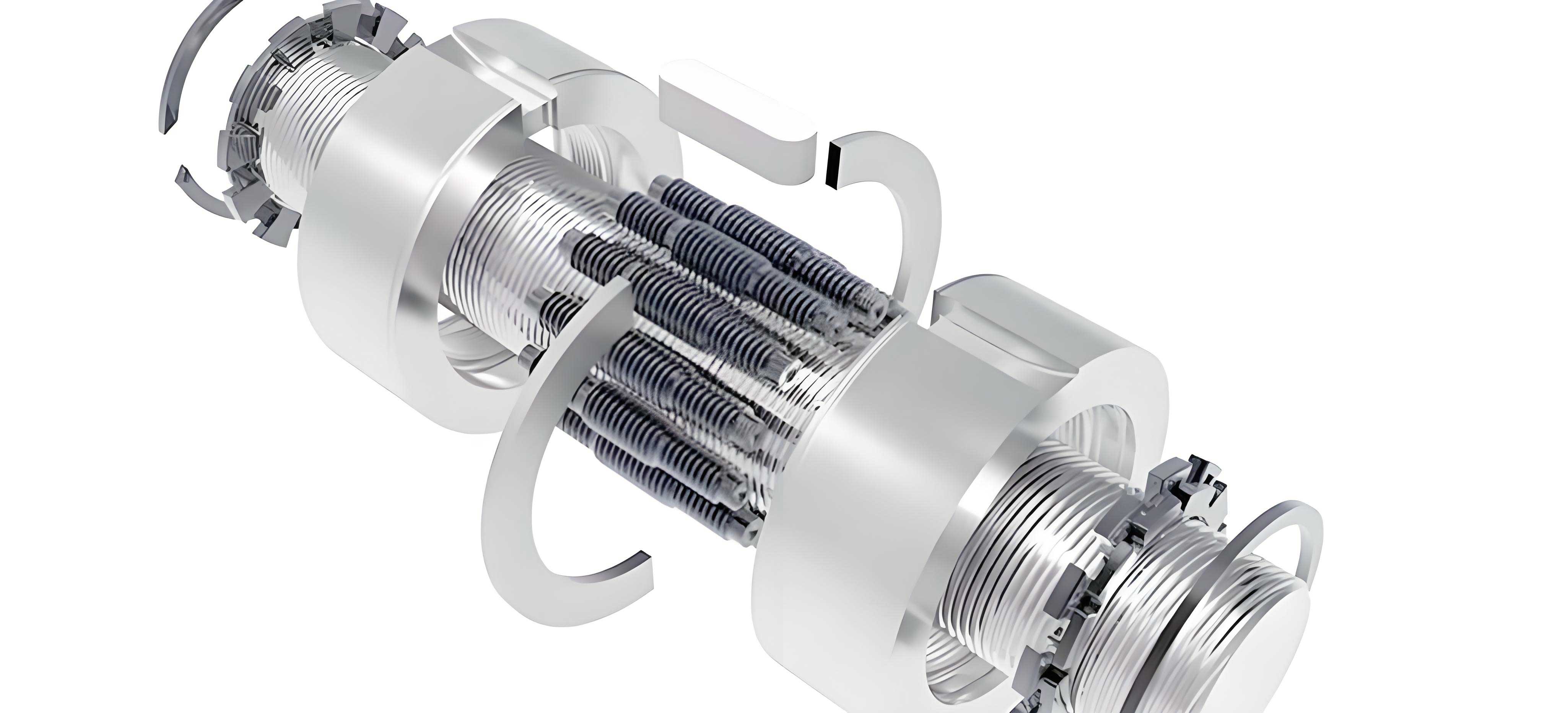
The inverted planetary roller screw assembly consists of several key components: a screw, a nut, multiple rollers, and a carrier. In this configuration, the nut serves as the driving element, converting rotational motion into planetary motion of the rollers through threaded engagement. The rollers, in turn, engage with the screw’s threads to produce linear motion of the screw. The rollers are designed with single-start threads, while the screw and nut have multi-start threads with equal lead numbers. This design ensures that the helix angles of the screw and rollers are identical, theoretically preventing relative axial displacement during pure rolling. Additionally, straight gears at the ends of the rollers and screw synchronize rotation and prevent tilting moments. The planetary roller screw assembly must adhere to specific geometric relationships for proper function. For instance, the pitch radii of the nut, screw, and roller threads satisfy: $$R_n = R_s + 2R_r$$ where \(R_n\), \(R_s\), and \(R_r\) are the pitch radii of the nut, screw, and roller threads, respectively. The number of starts on the screw and nut are equal, denoted as \(k\), and the gear ratio matches the pitch radius ratio: \(Z_s / Z_r = R_s / R_r = k\), with \(Z_s\) and \(Z_r\) being the tooth numbers of the screw and roller gears. The thread handedness is opposite between the screw and rollers to facilitate motion conversion.
Under operational loads, the planetary roller screw assembly experiences significant forces. When a load \(F\) is applied to the screw, normal forces \(F_n\) act at the threaded interfaces. These forces decompose into axial (\(F_a\)), tangential (\(F_t\)), and radial (\(F_r\)) components. The radial component \(F_r\) directs inward toward the roller axis, causing compressive deformation of the roller threads. This deformation results in a reduction of the effective pitch radius of the roller threads, leading to a mismatch with the pitch radius of the roller gears. I define the pitch circle mismatch as \(\Delta = G_r – R_r\), where \(G_r\) is the pitch radius of the roller gear. The normalized error is given by \(\varepsilon = \Delta / R_r\). This mismatch is central to the kinematic issues in the planetary roller screw assembly, as it introduces relative motion between components.
To analyze the kinematics of the inverted planetary roller screw assembly, I consider the motion when the nut rotates with an angular velocity \(\omega_n\) through an angle \(\theta_n\). The roller undergoes planetary motion, comprising revolution around the screw axis and rotation about its own axis. Let \(\theta_R\) be the revolution angle of the roller axis relative to the screw axis, and \(\theta_r\) be the rotation angle of the roller. From gear engagement, the relationship between \(\theta_r\) and \(\theta_R\) at the screw-roller side is: $$\theta_r = \frac{G_s + G_r}{G_r} \theta_R$$ where \(G_s\) is the pitch radius of the screw gear. Assuming no slip at the nut-roller interface initially, the kinematic condition gives: $$(\theta_n – \theta_R) R_n = (\theta_r – \theta_R) R_r$$ Substituting the expression for \(\theta_r\), I derive: $$\theta_R = \frac{G_r R_n}{G_s R_r + G_r R_n} \theta_n$$ Using the geometric relations \(R_s / R_r = G_s / G_r = k\) and \(R_n = R_s + 2R_r\), this simplifies to: $$\theta_R = \frac{R_n}{2(R_n – R_r)} \theta_n$$ However, due to pitch circle mismatch, pure rolling cannot be maintained, leading to slip.
The slip angle \(\theta_{\text{slip}}\) represents the relative sliding between the roller thread and screw thread due to the mismatch. When the roller rotates by \(\theta_r\), the pure rolling rotation of the roller thread relative to the screw is: $$\theta_R^H = \frac{R_r}{R_s + R_r} \theta_r$$ Similarly, the rotation due to gear engagement is: $$\theta_R^G = \frac{G_r}{G_s + G_r} \theta_r$$ The slip angle is the difference: $$\theta_{\text{slip}} = \theta_R^G – \theta_R^H$$ Substituting \(\theta_r\) from earlier, I obtain: $$\theta_{\text{slip}} = \left(1 – \frac{R_r}{G_r}\right) \theta_R$$ Expressing in terms of \(\theta_n\): $$\theta_{\text{slip}} = \left(1 – \frac{R_r}{G_r}\right) \frac{G_r R_n}{G_s R_r + G_r R_n} \theta_n$$ If no mismatch exists (\(\Delta = 0\), so \(R_r = G_r\)), then \(\theta_{\text{slip}} = 0\), indicating no slip. This slip angle directly influences the sliding velocity in the planetary roller screw assembly.
Next, I calculate the axial displacement of the roller relative to the screw, denoted \(\delta_{rs}\). This displacement arises from the slip component and consists of two parts: axial displacement due to pure sliding of the roller thread in the screw thread (\(\delta_1\)) and axial displacement due to pure spinning slip of the roller thread (\(\delta_2\)). For a slip angle \(\theta_{\text{slip}}\), these are: $$\delta_1 = \frac{\theta_{\text{slip}}}{2\pi} L_s, \quad \delta_2 = -\frac{\theta_{\text{slip}}}{2\pi} L_r$$ where \(L_s\) and \(L_r\) are the leads of the screw and roller, respectively. The leads are related to pitch radii and helix angles: \(L_s = 2\pi R_s \tan \alpha_s\), \(L_r = 2\pi R_r \tan \alpha_r\), and similarly for the nut. The helix angles satisfy \(\tan \alpha_s = n_s p / (2\pi R_s)\), with \(p\) as the pitch. Since the screw and roller have the same helix angle in design, \(L_s / R_s = L_r / R_r\). Thus, the total axial displacement is: $$\delta_{rs} = \delta_1 + \delta_2 = (L_s – L_r) \frac{\theta_{\text{slip}}}{2\pi}$$ Substituting expressions, I get: $$\delta_{rs} = \left(1 – \frac{R_r}{R_s}\right) \left(1 – \frac{R_r}{G_r}\right) \frac{G_r R_n}{G_s R_r + G_r R_n} \frac{\theta_n}{2\pi} L_n$$ where \(L_n\) is the nut lead. This shows that axial displacement occurs only if mismatch exists. In a planetary roller screw assembly, this displacement must be accommodated in design, such as by providing sufficient gear tooth width.
I also analyze the axial displacement of the roller relative to the nut, \(\delta_{rn}\). It comprises axial displacement from roller rotation and revolution: $$\delta_{rn} = \left(\frac{G_r R_n}{G_s R_r + G_r R_n} – 1\right) \left(1 + \frac{R_n}{R_s}\right) \frac{\theta_n}{2\pi} L_n$$ The axial displacement of the screw relative to the nut, \(\delta_{sn}\), is then: $$\delta_{sn} = \delta_{rn} – \delta_{rs}$$ After simplification, I find: $$\delta_{sn} = -\frac{\theta_n}{2\pi} L_n$$ This indicates that when the nut rotates one full revolution (\(\theta_n = 2\pi\)), the screw moves axially by \(L_n\), exactly the nut lead. Therefore, the pitch circle mismatch causes roller axial displacement but does not affect the overall transmission lead of the planetary roller screw assembly. This is a key insight for system design, as the functional output remains consistent despite internal sliding.
To quantify sliding effects, I derive the slip velocities. The circumferential slip velocity at the contact point between the roller and screw, \(v_{cp}\), is obtained from the total sliding arc length \(\gamma = (R_r + R_s) \theta_{\text{slip}}\). Differentiating with respect to time: $$v_{cp} = \frac{d\gamma}{dt} = \left(1 – \frac{R_r}{G_r}\right) \frac{G_r R_n (R_r + R_s)}{G_s R_r + G_r R_n} \omega_n$$ The axial slip velocity of the roller relative to the screw is: $$v_{rs} = \frac{d\delta_{rs}}{dt} = \left(1 – \frac{R_r}{R_s}\right) \left(1 – \frac{R_r}{G_r}\right) \frac{G_r R_n}{G_s R_r + G_r R_n} \frac{\omega_n}{2\pi} L_n$$ Similarly, the axial slip velocity of the roller relative to the nut is: $$v_{rn} = \frac{d\delta_{rn}}{dt} = \left(\frac{G_r R_n}{G_s R_r + G_r R_n} – 1\right) \left(1 + \frac{R_n}{R_s}\right) \frac{\omega_n}{2\pi} L_n$$ These velocities are critical for assessing friction and wear in the planetary roller screw assembly.
To generalize the analysis, I normalize the equations using the parameters \(\varepsilon\) (normalized error) and \(k = R_s / R_r\) (pitch radius ratio). Recall that \(R_n = R_s + 2R_r = kR_r + 2R_r = R_r(k+2)\), and from gear relations, \(G_s = k G_r\). Since \(\varepsilon = \Delta / R_r = (G_r – R_r)/R_r\), we have \(G_r = R_r(1+\varepsilon)\) and \(G_s = k R_r(1+\varepsilon)\). Substituting into the earlier equations, I obtain dimensionless forms:
| Quantity | Dimensionless Expression |
|---|---|
| Slip angle | $$\theta_{\text{slip}} = \frac{\varepsilon (k+2)}{(\varepsilon+2)(k+1)} \theta_n$$ |
| Axial displacement (roller relative to screw) | $$\frac{\delta_{rs}}{L_n} = \frac{\varepsilon (k-1)(k+2)}{k(\varepsilon+2)(k+1)} \frac{\theta_n}{2\pi}$$ |
| Total axial displacement over full travel | $$\delta_{\text{Total}} = \frac{\delta_{rs}^T}{\lambda} = \frac{\varepsilon (k-1)(k+2)}{k(\varepsilon+2)(k+1)}$$ where \(\lambda\) is total screw travel |
| Axial displacement (roller relative to nut) | $$\frac{\delta_{rn}}{L_n} = \frac{\varepsilon – k}{(k+1)(\varepsilon+2)} \frac{\theta_n}{2\pi}$$ |
| Circumferential slip velocity | $$\bar{v}_{cp} = \frac{v_{cp}}{\omega_n R_r} = \frac{\varepsilon (k+2)}{(\varepsilon+2)}$$ |
| Axial slip velocity (roller relative to screw) | $$\bar{v}_{rs} = \frac{v_{rs}}{\omega_n L_n} = \frac{\varepsilon (k-1)(k+2)}{2\pi k (k+1)(\varepsilon+2)}$$ |
| Axial slip velocity (roller relative to nut) | $$\bar{v}_{rn} = \frac{v_{rn}}{\omega_n L_n} = \frac{\varepsilon – k}{2\pi (k+1)(\varepsilon+2)}$$ |
These dimensionless expressions reveal the influence of \(\varepsilon\) and \(k\) on the kinematic behavior. For instance, when \(\varepsilon = 0\), \(\bar{v}_{rs} = 0\), but \(\bar{v}_{rn} = -1/[2\pi(k+1)]\), which is a constant negative value, indicating that slip always occurs at the nut-roller interface in a planetary roller screw assembly. This underscores the inevitability of sliding in that region, whereas the screw-roller side can be designed to minimize slip by reducing mismatch.
To illustrate the application of this model, I consider a practical example of an inverted planetary roller screw assembly with parameters: \(R_s = 20 \, \text{mm}\), \(R_r = 5 \, \text{mm}\), so \(k = 4\). Then \(R_n = 30 \, \text{mm}\), and the nut and screw have \(n_s = n_n = 4\) starts. I assume the normalized error \(\varepsilon\) ranges from \(-0.01\) to \(0.01\), representing typical manufacturing and deformation tolerances. Using the dimensionless formula for total axial displacement \(\delta_{\text{Total}}\), I compute values over this range. For instance, at \(\varepsilon = 0.001\), \(\delta_{\text{Total}} = \frac{0.001 \times (4-1) \times (4+2)}{4 \times (0.001+2) \times (4+1)} \approx \frac{0.001 \times 3 \times 6}{4 \times 2.001 \times 5} = \frac{0.018}{40.02} \approx 0.00045\). If the total screw travel \(\lambda = 2 \, \text{m}\), the axial displacement \(\delta_{rs}^T = 0.00045 \times 2000 \, \text{mm} = 0.9 \, \text{mm}\). This shows that even small mismatches can lead to measurable displacements, which must be accounted for in the design of a planetary roller screw assembly.
Furthermore, I evaluate slip velocities. For \(\varepsilon > 0\), the circumferential slip velocity \(\bar{v}_{cp}\) is positive and larger in magnitude than \(\bar{v}_{rs}\) for typical \(k\) values. For \(\varepsilon < 0\), the opposite holds. To reduce sliding friction and improve efficiency, it is beneficial to minimize \(\varepsilon\) at the screw-roller interface. In practice, the mismatch \(\Delta\) arises from contact deformation under load. Using Hertzian contact theory, the radial deformation of roller threads can be estimated. For an axial load of \(5 \, \text{kN}\), the deformation might be around \(4.5 \, \mu\text{m}\), giving \(\Delta = 4.5 \, \mu\text{m}\) and \(\varepsilon = \Delta / R_r = 4.5 \times 10^{-3} / 5 = 0.0009\). Plugging into the dimensionless expressions, I get \(\delta_{\text{Total}} \approx 0.0004\) and \(\bar{v}_{rs} \approx 2.86 \times 10^{-5}\), indicating very low slip velocity. However, for higher loads or larger tolerances, these values can increase significantly, affecting the planetary roller screw assembly’s performance.
The following table summarizes key kinematic parameters for different \(\varepsilon\) values with \(k=4\), assuming \(\omega_n = 100 \, \text{rpm}\) and \(L_n = 10 \, \text{mm}\) for illustration:
| \(\varepsilon\) | \(\theta_{\text{slip}} / \theta_n\) | \(\delta_{rs}^T / \lambda\) | \(\bar{v}_{cp}\) | \(\bar{v}_{rs} \times 10^5\) |
|---|---|---|---|---|
| -0.01 | -0.0033 | -0.0030 | -0.0198 | -2.38 |
| -0.005 | -0.0017 | -0.0015 | -0.0099 | -1.19 |
| 0 | 0 | 0 | 0 | 0 |
| 0.005 | 0.0017 | 0.0015 | 0.0099 | 1.19 |
| 0.01 | 0.0033 | 0.0030 | 0.0198 | 2.38 |
These results highlight the linear relationship between \(\varepsilon\) and the slip metrics near zero. The non-zero slip velocity at the nut-roller side, as given by \(\bar{v}_{rn}\), is constant at approximately \(-0.0318\) for \(k=4\), regardless of \(\varepsilon\). This constant slip emphasizes the need for robust lubrication and material selection at that interface in a planetary roller screw assembly.
In conclusion, my kinematic analysis of the inverted planetary roller screw assembly demonstrates that pitch circle mismatch, arising from errors and deformation, induces relative sliding and axial displacement. The derived models for slip angle, axial displacement, and slip velocity provide tools for quantifying these effects. Key findings include: (1) The axial displacement of the roller does not alter the overall system lead, ensuring functional consistency. (2) Slip is inevitable at the nut-roller interface due to geometric constraints, whereas the screw-roller side can be optimized by minimizing mismatch. (3) Dimensionless expressions simplify the analysis, showing dependence on normalized error and radius ratio. (4) Practical calculations for a sample planetary roller screw assembly reveal that even minor mismatches can lead to displacements requiring design accommodations. To enhance the performance of planetary roller screw assemblies, future work should focus on precision manufacturing, contact deformation compensation, and dynamic modeling under varying loads. This study lays a foundation for improving the reliability and efficiency of these critical actuation systems.
Throughout this analysis, I have emphasized the importance of considering pitch circle mismatch in the design and operation of planetary roller screw assemblies. By integrating these kinematic insights, engineers can better predict behavior, reduce unwanted sliding, and extend service life. The planetary roller screw assembly, in its inverted form, offers significant advantages for compact actuation, and addressing its inherent kinematic challenges is essential for advancing applications in aerospace, robotics, and beyond. Further research could explore thermal effects, lubrication dynamics, and advanced materials to further optimize the planetary roller screw assembly for high-performance environments.