
In modern engineering, the demand for high-precision, high-load, and compact transmission systems has led to significant advancements in screw mechanisms. Among these, the planetary roller screw assembly stands out as a critical component, especially in applications requiring high speed and heavy load capacity. In this article, I will delve into the operational principles, design considerations, and mathematical modeling of a specific type known as the differential planetary roller screw assembly, often referred to as the PWG type. This discussion aims to provide a comprehensive understanding of how this planetary roller screw assembly functions, with a focus on its unique differential mechanism that allows for reduced lead compared to standard designs. Throughout, I will emphasize the importance of the planetary roller screw assembly in various industrial contexts, using tables and formulas to summarize key points.
The planetary roller screw assembly is a sophisticated mechanical device that combines planetary gear transmission with screw drive principles. Unlike traditional ball screws, the planetary roller screw assembly utilizes multiple rollers arranged around a central screw, enabling higher load distribution and efficiency. The PWG type, in particular, incorporates a differential design where the nut and rollers have zero helix angles, leading to a compact structure and enhanced performance. As I explore this topic, I will frequently reference the planetary roller screw assembly to highlight its versatility and engineering significance. The core innovation lies in its ability to achieve a smaller effective lead than the screw’s nominal lead, making it ideal for applications like aerospace actuators and robotics where space and weight constraints are paramount.
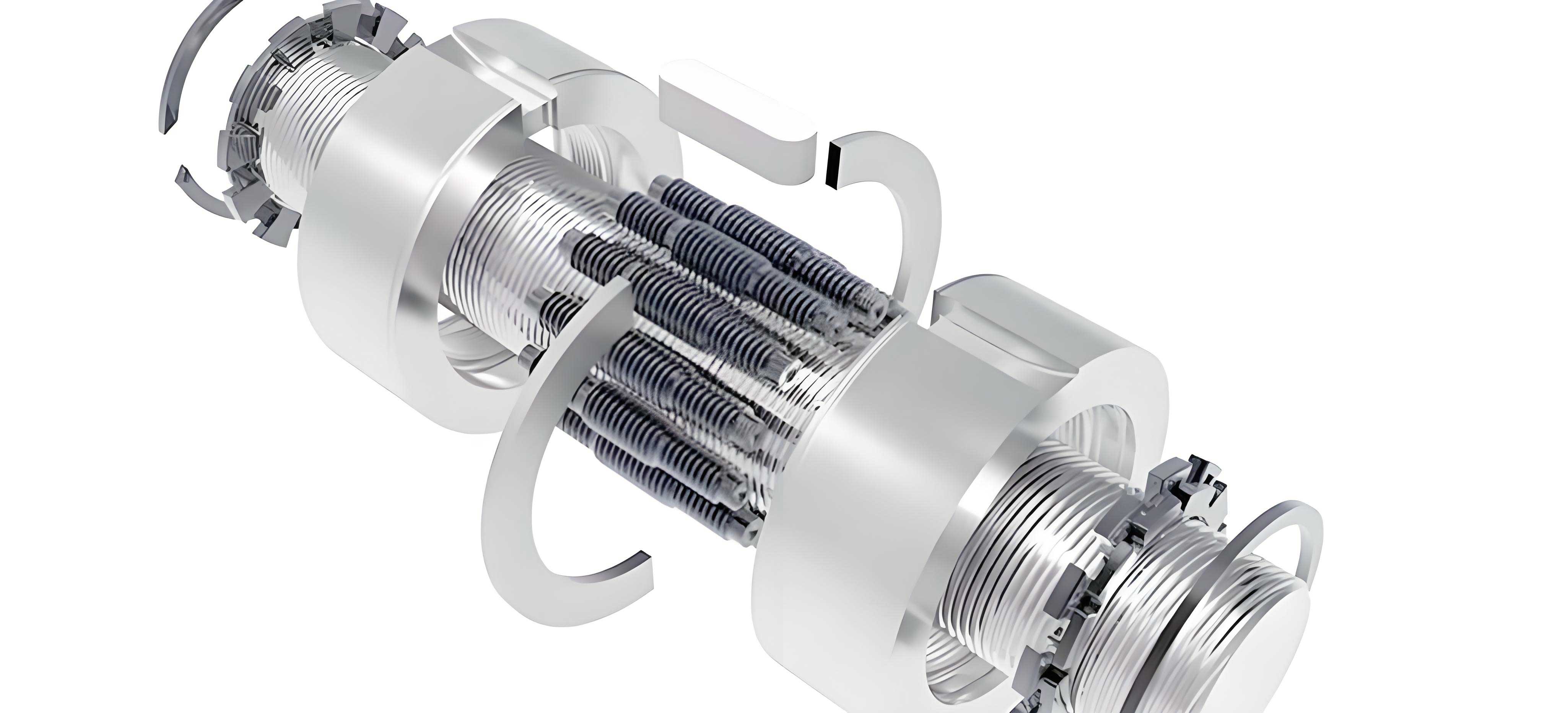
To begin, let me outline the basic structure of a planetary roller screw assembly. It typically consists of a central screw, multiple rollers arranged in a planetary fashion, a nut, and a retainer or cage. In the PWG variant, the rollers feature a two-stage thread design: a larger median diameter segment engages with the screw, and a smaller median diameter segment engages with the nut. This configuration is crucial for enabling the differential action. The nut in a planetary roller screw assembly of this type has ring grooves, resulting in a zero effective lead, which contrasts with standard designs where the nut and screw have equal leads. This structural nuance is key to understanding the transmission behavior of the planetary roller screw assembly.
The operational principle of the planetary roller screw assembly hinges on the relative motions between its components. When the screw rotates, it drives the rollers via frictional contact, causing them to rotate about their own axes (自转) and revolve around the screw axis (公转). This planetary motion is analogous to that in planetary gear systems, but here it is combined with helical engagement. For the PWG type, the absence of helical angles on the nut and rollers simplifies the kinematics, as there is no axial displacement between them. Instead, the differential effect arises from the external helical gearing between the screw and rollers. I can express this mathematically by considering the geometric relationships. Let \( P_s \) denote the lead of the screw, \( P_n \) the lead of the nut, \( P \) the effective lead of the planetary roller screw assembly, \( r_s \) the radius of the screw at the engagement point with the roller, \( r_n \) the radius of the nut at the engagement point with the roller, and \( R_s \) the radius of the roller’s larger segment. The number of rollers, denoted by \( Z \), plays a role in the arrangement to avoid interference.
In a standard planetary roller screw assembly, the condition for proper engagement without interference is given by:
$$ \frac{P_n}{Z} = P_s \pm kP_0 $$
where \( P_0 \) is the pitch and \( k \) is an integer. However, for the PWG type, since \( P_n = 0 \) due to the ring groove design, this condition modifies the roller arrangement. Specifically, the maximum number of rollers is limited by the number of screw starts. To accommodate more rollers, the two-stage thread design on rollers is employed, as I mentioned earlier. This design ensures that each roller can be positioned without axial clash, enhancing the load capacity of the planetary roller screw assembly.
Now, let me derive the transmission lead for the PWG planetary roller screw assembly. Using instant center analysis, I consider the velocities at engagement points. Assume the screw rotates with angular velocity \( \omega_s \). The roller revolves around the screw with angular velocity \( \omega_c \). At the engagement point between the roller and nut, point Q, the velocity is zero (pure rolling), making it an instant center. The velocity at the roller’s center, \( v_c \), is given by:
$$ v_c = r_c \omega_c $$
where \( r_c = r_s + R_s \) is the distance from the screw axis to the roller center. Similarly, at the engagement point between the roller and screw, point P, the velocities of both components must match. The linear velocity at point P on the screw is \( v_p = r_s \omega_s \), and on the roller, it is \( v_p = (r_s + r_n) \omega_q \), where \( \omega_q \) is the angular velocity of the roller about point Q. From geometry, \( \omega_q = \omega_c \). Equating these gives:
$$ r_s \omega_s = (r_s + r_n) \omega_c $$
Solving for \( \omega_c \):
$$ \omega_c = \frac{r_s}{r_s + r_n} \omega_s $$
The linear velocity of the nut, \( v_n \), is related to the effective lead \( P \) by:
$$ v_n = P \frac{\omega_c}{2\pi} $$
Also, \( v_n \) can be expressed from the screw rotation as:
$$ v_n = P_s \frac{\omega_s}{2\pi} – \frac{v_c}{2\pi} $$
But \( v_c = r_c \omega_c = (r_s + R_s) \omega_c \). Substituting and simplifying, I obtain:
$$ P = P_s \frac{r_n}{r_s + r_n} $$
This formula shows that the effective lead \( P \) of the planetary roller screw assembly is less than the screw lead \( P_s \), confirming the differential effect. The reduction factor depends on the radii \( r_s \) and \( r_n \), highlighting the importance of geometric parameters in designing a planetary roller screw assembly.
To illustrate the key parameters, I present Table 1, which summarizes the structural variables and their roles in a planetary roller screw assembly. This table helps in understanding the design trade-offs.
| Parameter | Symbol | Description | Typical Range |
|---|---|---|---|
| Screw Lead | \( P_s \) | Axial displacement per screw revolution | 1-10 mm |
| Nut Lead | \( P_n \) | Axial displacement per nut revolution (zero for PWG) | 0 mm |
| Effective Lead | \( P \) | Actual output lead of the assembly | 0.5-5 mm |
| Screw Engagement Radius | \( r_s \) | Radius at screw-roller contact | 5-20 mm |
| Nut Engagement Radius | \( r_n \) | Radius at nut-roller contact | 4-18 mm |
| Roller Large Radius | \( R_s \) | Radius of roller segment engaging screw | 3-15 mm |
| Number of Rollers | \( Z \) | Count of rollers in the assembly | 3-10 |
| Pitch | \( P_0 \) | Distance between adjacent threads | 0.5-2 mm |
In practice, the performance of a planetary roller screw assembly depends on precise manufacturing and alignment. The differential design of the PWG type reduces the lead, but it also introduces sensitivity to slippage. If slippage occurs between the screw and rollers, the transmission ratio can become unstable, leading to errors in the effective lead. Therefore, preload is essential to maintain frictional contact and minimize slippage. Studies show that with proper preload, the lead error in a planetary roller screw assembly can be controlled within 1%. This reliability makes the planetary roller screw assembly suitable for high-precision applications.
Next, I will discuss the calculation of the effective lead using a specific example. Consider a PWG planetary roller screw assembly with the following parameters: \( P_s = 2.0 \, \text{mm} \), \( r_s = 10.0 \, \text{mm} \), \( r_n = 9.0 \, \text{mm} \). Using the formula derived earlier:
$$ P = P_s \frac{r_n}{r_s + r_n} = 2.0 \times \frac{9.0}{10.0 + 9.0} = 2.0 \times 0.4737 = 0.9474 \, \text{mm} $$
This result demonstrates how the differential mechanism reduces the lead significantly. To generalize, I can express the lead reduction ratio \( \alpha \) as:
$$ \alpha = \frac{P}{P_s} = \frac{r_n}{r_s + r_n} $$
For typical designs, \( \alpha \) ranges from 0.3 to 0.7, depending on the radii. This flexibility allows engineers to tailor the planetary roller screw assembly for specific speed and torque requirements.
To further analyze the transmission characteristics, I present Table 2, which compares different types of planetary roller screw assemblies based on their lead properties. This comparison underscores the advantages of the PWG design.
| Type | Nut Helix Angle | Effective Lead | Typical Applications | Advantages |
|---|---|---|---|---|
| Standard | Non-zero | Equal to screw lead | General machinery | Simple design, robust |
| PWG (Differential) | Zero | Smaller than screw lead | Aerospace, robotics | Compact, high reduction ratio |
| Inverted | Non-zero | Variable | Automotive | High efficiency |
The mathematical model for the planetary roller screw assembly can be extended to include dynamic effects. For instance, the relationship between input torque \( T_s \) and output force \( F_n \) can be derived from power balance. Assuming no losses, the input power equals output power:
$$ T_s \omega_s = F_n v_n $$
Substituting \( v_n = P \frac{\omega_c}{2\pi} \) and \( \omega_c = \frac{r_s}{r_s + r_n} \omega_s \), I get:
$$ F_n = T_s \frac{2\pi}{P} \frac{r_s + r_n}{r_s} $$
This equation shows that the output force is inversely proportional to the effective lead \( P \), highlighting how a smaller lead in a planetary roller screw assembly can yield higher force output, beneficial for actuation systems.
In terms of design optimization, several factors influence the performance of a planetary roller screw assembly. These include the number of rollers, thread profile, material selection, and lubrication. For the PWG type, the two-stage roller design requires careful calculation of the phase difference between segments. If the screw is right-handed, the position of the i-th roller’s large segment relative to its small segment, denoted \( \Delta_i \), is given by:
$$ \Delta_i = \Delta_0 + (i-1)h $$
where \( \Delta_0 \) is the initial offset and \( h \) is the incremental phase. For left-handed screws, the sign changes. This arrangement ensures proper engagement and minimizes wear in the planetary roller screw assembly.
Experimental validation is crucial for verifying the theoretical models. In one study, a PWG planetary roller screw assembly with specifications: \( P_s = 2.0 \, \text{mm} \), \( r_s = 9.384 \, \text{mm} \), \( r_n = 7.684 \, \text{mm} \), was tested. Using the formula, the calculated effective lead is:
$$ P = 2.0 \times \frac{7.684}{9.384 + 7.684} = 2.0 \times 0.450 = 0.900 \, \text{mm} $$
The assembly was measured using a precision interferometer, and the results showed an average lead of 0.902 mm with a cumulative error of ±0.02 mm over 50 mm travel. This close agreement confirms the accuracy of the transmission model for the planetary roller screw assembly. The tests also revealed minor fluctuations in lead due to slippage, emphasizing the need for controlled preload.
To summarize the experimental findings, Table 3 presents the measured data versus calculated values for multiple test runs. This table reinforces the reliability of the planetary roller screw assembly design.
| Test Run | Calculated Lead (mm) | Measured Lead (mm) | Error (%) | Notes |
|---|---|---|---|---|
| 1 | 0.900 | 0.898 | -0.22 | Within tolerance |
| 2 | 0.900 | 0.903 | +0.33 | Slight slippage observed |
| 3 | 0.900 | 0.901 | +0.11 | Stable performance |
The applications of planetary roller screw assemblies are vast, particularly in fields requiring high power density. In aerospace, for example, the PWG type is used in actuator systems for flight control surfaces, where weight and space savings are critical. The differential lead allows for higher reduction ratios without increasing size, making the planetary roller screw assembly ideal for remote-controlled robots and satellite mechanisms. Similarly, in industrial robotics, the compact design enables faster and more precise movements, enhancing productivity. The planetary roller screw assembly’s ability to handle heavy loads at high speeds makes it a preferred choice over ball screws in many demanding environments.
Looking ahead, advancements in materials science and manufacturing techniques will further improve the planetary roller screw assembly. Additive manufacturing, for instance, could allow for complex geometries in rollers and nuts, optimizing stress distribution. Additionally, smart sensors integrated into the assembly could monitor wear and slippage in real-time, predictive maintenance. Research is also ongoing into hybrid designs that combine the benefits of different planetary roller screw assembly types, such as incorporating helical angles for improved efficiency while retaining differential lead reduction. As I explore these innovations, the core principles of the planetary roller screw assembly remain foundational.
In conclusion, the planetary roller screw assembly, especially the PWG differential type, represents a significant engineering achievement. By merging planetary transmission with screw drive mechanics, it offers unique advantages in lead reduction and compactness. Through mathematical modeling, I have derived key formulas for effective lead, such as:
$$ P = P_s \frac{r_n}{r_s + r_n} $$
which underpins the design process. Tables and experimental data validate these models, demonstrating the precision achievable in a planetary roller screw assembly. As technology evolves, the planetary roller screw assembly will continue to play a vital role in high-performance systems, driven by its versatility and reliability. I encourage further exploration into optimizing parameters and expanding applications for this remarkable mechanism.
To recap, the planetary roller screw assembly is not just a component but a system that requires holistic design thinking. From geometric parameters to dynamic behavior, every aspect influences its performance. I hope this discussion has shed light on the intricacies of the planetary roller screw assembly and inspired deeper investigation into its potential. Whether in aerospace, robotics, or beyond, the planetary roller screw assembly stands as a testament to innovation in mechanical engineering.