
The precise conversion of rotational motion to linear translation, and vice versa, is a fundamental requirement in advanced mechanical systems. Among the various solutions, the planetary roller screw assembly stands out as a premier electromechanical actuator, renowned for its exceptional load-bearing capacity, high positional accuracy, and compact power density. This mechanism is increasingly becoming the actuator of choice in demanding fields such as aerospace flight control, robotic joint actuation, and high-precision machine tools. The core of its operation lies in the synchronized meshing of threaded surfaces between a central screw, multiple planetary rollers, and an outer nut. However, this very meshing introduces a complex kinematic condition: the inevitable coexistence of rolling and sliding motions at the contact interfaces.
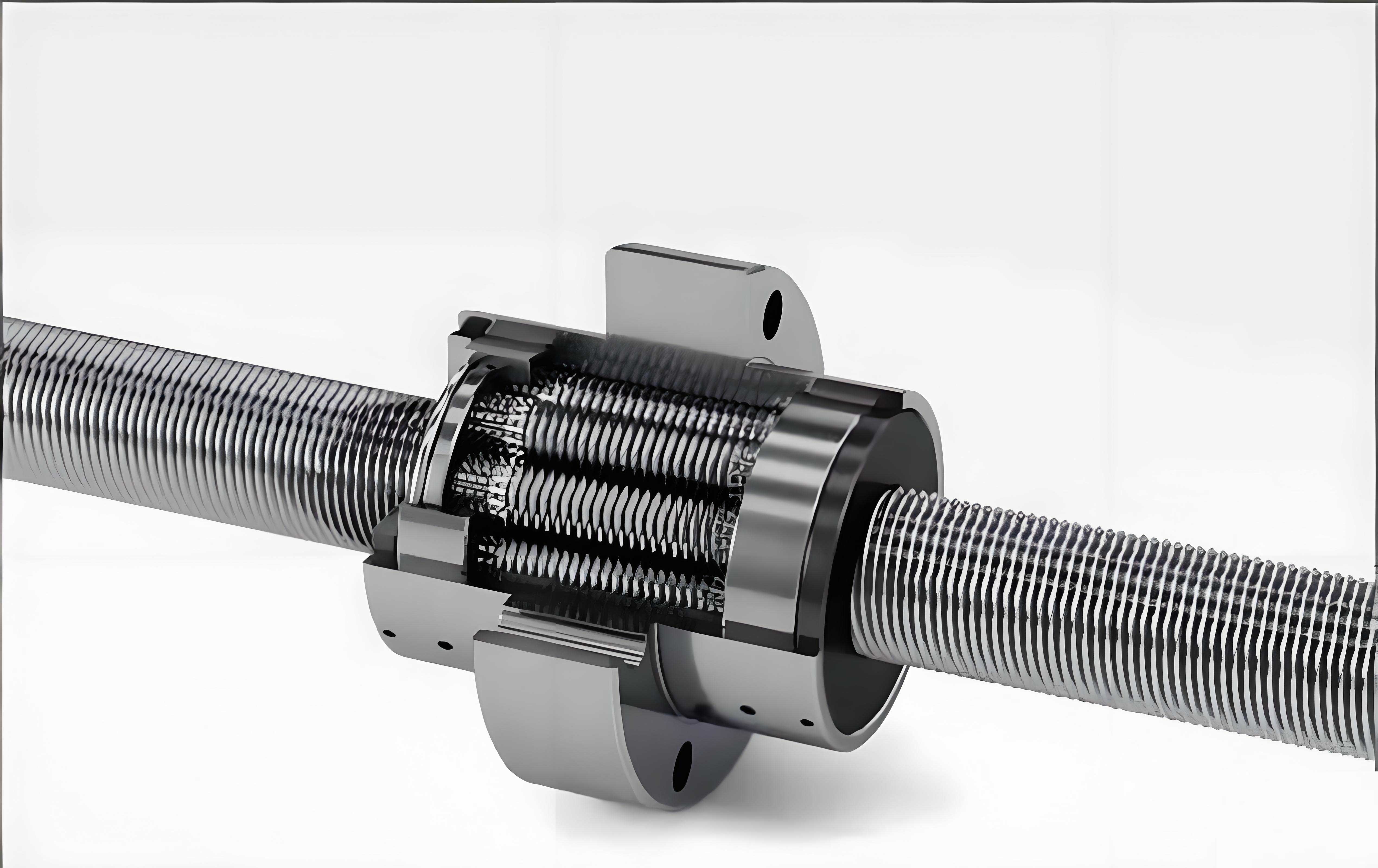
While rolling is the desired efficient motion, sliding introduces detrimental effects, including increased friction, accelerated wear, reduced transmission efficiency, and the potential for premature failure. Therefore, a profound understanding of the rolling-sliding coupling mechanism is not merely academic; it is essential for the optimal design, performance prediction, and longevity enhancement of the planetary roller screw assembly. This article, from a designer’s and analyst’s perspective, delves into the intricate mechanics governing this coupling, with particular emphasis on the often-overlooked influence of load-induced deformation. We will construct a comprehensive analytical model, validate it against experimental data, and quantitatively reveal how operational loads fundamentally alter the kinematic behavior within the assembly.
Load-Induced Contact State Analysis in the Planetary Roller Screw Assembly
Any kinematic or dynamic analysis of a planetary roller screw assembly must begin with a realistic assessment of its contact state under load. Under ideal, zero-load conditions, contact between the screw, rollers, and nut is assumed to be geometrically perfect. However, the application of an axial load, which is the primary function of the actuator, induces significant elastic deformations in the threaded teeth. These deformations redistribute contact forces, alter the effective contact geometry, and ultimately change the kinematic conditions. Ignoring this effect leads to an inaccurate, idealized model of the planetary roller screw assembly’s behavior.
The deformation under load can be categorized into two primary components: thread tooth bending/shearing deformation and Hertzian contact deformation at the interface. For the i-th roller and its j-th engaged thread tooth, the equivalent normal contact deformation $\delta^E_{n(i,j)}$, considering load distribution, can be related to the axial load $F_a$:
$$ \delta^E_{n(i,j)} = \frac{F_a L_r \sin \beta}{E A N n_t \cos \lambda} $$
where $L_r$ is the roller length, $\beta$ is the contact angle, $\lambda$ is the lead angle, $E$ is the elastic modulus, $A$ is the cross-sectional area, $N$ is the number of rollers, and $n_t$ is the number of active threads per roller.
Following Hertzian contact theory, the corresponding equivalent normal contact force $Q^E_{n(i,j)}$ is then:
$$
Q^E_{n(i,j)} = \left( \frac{\delta^E_{n(i,j)}}{K_{rn} + K_{rs}} \right)^{3/2}
$$
with the contact stiffness coefficient $K_{ri}$ for the screw (i=s) or nut (i=n) side given by:
$$
K_{ri} = \frac{K_{ei} \pi m_{ai}}{4} \left[ \frac{9 \sum \rho_i}{2} \left( \frac{1-\mu_r^2}{E_r} + \frac{1-\mu_i^2}{E_i} \right) \right]^{1/3}
$$
Here, $\mu$ and $E$ denote Poisson’s ratio and elastic modulus, $\sum \rho_i$ is the sum of principal curvatures, and $K_{e} \pi m_{a}$ is derived from the curvature difference function $F(\rho)$.
Static force equilibrium for the entire planetary roller screw assembly dictates that the sum of all contact force components must balance the external loads:
$$
\begin{aligned}
F_a – \sum_{i=1}^{N} \sum_{j=1}^{n_t} Q^E_{n(i,j)} \sin \beta \cos \lambda &= 0 \\
F_r – \sum_{i=1}^{N} \sum_{j=1}^{n_t} Q^E_{n(i,j)} \cos \beta \cos \phi_j &= 0
\end{aligned}
$$
The total axial deformation $\chi_{(i,j)}$ at a specific thread location results from the differential deformation between adjacent thread segments on both the screw and nut sides of the roller:
$$
\chi_{(i,j)} = \frac{1}{\sin \beta \cos \lambda} \left( \delta_{sr(i,j-1)} – \delta_{sr(i,j)} + \delta_{rn(i,j-1)} – \delta_{rn(i,j)} \right)
$$
This total deformation is accommodated by the axial compliance of the screw and nut threads themselves:
$$
\chi_{(i,j)} = \chi_{s(i,j)} + \chi_{n(i,j)} = \frac{F_{n(i,j)} p (A_s + A_n)}{2 E_s A_s A_n}
$$
An iterative relationship can be established to solve for the actual contact load distribution $Q_{n(i,j)}$ under the combined constraints of Hertzian contact, structural compliance, and force equilibrium. This provides the foundational load state for subsequent kinematic analysis. The thread tooth deformation itself, $\delta^a_i$, comprises four elements: bending ($\delta^1_i$), shear ($\delta^2_i$), tooth root inclination ($\delta^3_i$), and tooth root shear deformation ($\delta^4_i$).
| Parameter | Symbol | Screw Value | Roller Value |
|---|---|---|---|
| Pitch Diameter | $d$ | 24 mm | 8 mm |
| Lead Angle | $\lambda$ | 2.28° | 1.37° |
| Lead | $l$ | 3 mm | 0.6 mm |
| Thread Profile Angle | $\theta$ | 90° | 90° |
Kinematic Modeling of Rolling-Sliding Motion Incorporating Deformation
With the load-induced contact state established, we can now proceed to model the kinematics. The inherent kinematic mismatch due to differing lead angles between the screw and the rollers is the root cause of sliding. To analyze this, we define three key coordinate systems: the screw-fixed frame, the roller-fixed frame, and a carrier-fixed frame. The velocity of any contact point can be decomposed into components relative to these frames.
The geometric definition of the threaded surfaces is critical. Accounting for axial deformation $\delta^a$, the modified equations for the screw and roller thread surfaces become:
$$
\begin{aligned}
z_{ms} &= \frac{\gamma}{\cos \beta_s} \left( K – r_{Bs} \cos \alpha_n + \delta^a_R + \sqrt{r_{Bs}^2 – r_{ms}^2} \right) + \frac{\theta_{ms} l_s}{2\pi} \\
z_{mr} &= \frac{\gamma}{\cos \beta_r} \left[ K + \delta^a_R – (r_{mr} – r_{Tr}) \tan \alpha_n \right] + \frac{\theta_{mr} l_r}{2\pi}
\end{aligned}
$$
where $\gamma=\pm1$ indicates the top or bottom flank, $r$ is the radial coordinate, $\theta$ is the angular coordinate, $K$ is a constant based on pitch, and $h(r)$ is a function describing the thread profile.
Finding the contact point between the screw and roller surfaces is a geometric problem of two surfaces in tangency. The conditions are: (1) the position vectors from each body’s axis to the contact point differ by the center distance $d$, and (2) the unit normals at the contact point are collinear but opposite. These conditions yield a system of equations. From the position condition:
$$
\begin{bmatrix}
r_{ES} & 0 \\
0 & r_{ES}
\end{bmatrix}
\begin{bmatrix}
\cos \theta_{ES} \\
\sin \theta_{ES}
\end{bmatrix}
–
\begin{bmatrix}
r_{ER} & 0 \\
0 & r_{ER}
\end{bmatrix}
\begin{bmatrix}
\cos \theta_{ER} \\
\sin \theta_{ER}
\end{bmatrix}
=
\begin{bmatrix}
d \\
0
\end{bmatrix}
$$
From the normal vector condition, after manipulation, we derive two key functions $f_1$ and $f_2$ that must be solved iteratively for the contact radii $r_{ES}$ and $r_{ER}$:
$$
\begin{aligned}
f_1(r_{ES}, r_{ER}) &= \left( \frac{h’_1}{\cos \beta_s} \right)^2 + \left( \frac{l_s}{2\pi r_{ES}} \right)^2 – \left( \frac{h’_2}{\cos \beta_r} \right)^2 – \left( \frac{l_r}{2\pi r_{ER}} \right)^2 = 0 \\
f_2(r_{ES}, r_{ER}) &= \left( \frac{r_{ES} \gamma_1 h’_1}{d \cos \beta_s} – \frac{r_{ER} \gamma_2 h’_2}{d \cos \beta_r} \right)^2 + \left( \frac{l_s – l_r}{2\pi d} \right)^2 – \left[ \left( \frac{h’_1}{\cos \beta_s} \right)^2 + \left( \frac{l_s}{2\pi r_{ES}} \right)^2 \right] = 0
\end{aligned}
$$
Once the radii are known, the contact angles $\theta_{ER}$ and $\theta_{ES}$ can be directly calculated. The velocity of the contact point on the roller relative to the screw, which is the sliding velocity $\vec{v}_{slide}$, is found by subtracting the velocity of the point on the screw from the velocity of the coincident point on the roller, both expressed relative to the carrier frame:
$$
\vec{v}_{slide} = \vec{v}_{r/p}(E) – \vec{v}_{s/p}(E) = \begin{bmatrix}
(1-\epsilon-\lambda) r_{ES} \sin \theta_{ES} \\
-c\lambda + (\epsilon+\lambda-1) r_{ES} \cos \theta_{ES} \\
-\frac{l_s}{2\pi}
\end{bmatrix} \omega_{s/n}
$$
where $\lambda = \omega_{r/p} / \omega_{s/n}$, $\epsilon = \omega_{p/n} / \omega_{s/n}$, and $c$ is a geometric constant. Conversely, the velocity associated with the pure rolling component, which is the velocity of the screw surface point relative to the carrier, is:
$$
\vec{v}_{roll} = \vec{v}_{s/p}(E) = \begin{bmatrix}
(\epsilon – 1) r_{ES} \sin \theta_{ES} \\
(1 – \epsilon) r_{ES} \cos \theta_{ES} \\
\frac{l_s}{2\pi}
\end{bmatrix} \omega_{s/n}
$$
This model directly links the load-induced deformations (which alter $r_{ES}$, $r_{ER}$, $\theta_{ES}$, $\theta_{ER}$) to the fundamental rolling and sliding velocity components in the planetary roller screw assembly.
Experimental Validation of the Kinematic Model
To validate the proposed analytical model for the planetary roller screw assembly, a dedicated motion characteristic test platform was employed. The principle of the test hinges on independently measuring the input screw rotation and the resulting axial translation of the nut, which is kinematically locked to the rollers’ axial motion. The screw is driven by a servo motor at controlled speeds, while the nut assembly is constrained to linear motion. Key measurements include screw rotational speed (via an encoder), nut axial displacement (via a linear encoder), and ambient temperatures.
Tests were conducted at different input speeds (equivalent to nut translation speeds of 3, 5, and 7 mm/s). The measured screw speed over time showed stable operation during the constant velocity phase. The axial displacement of the nut was recorded linearly. The roller speed, a critical parameter for kinematic analysis, was derived indirectly. Since the rollers have no axial slip relative to the nut, their rotational speed $\omega_r$ is directly related to the nut’s axial velocity $v_a$ and their lead $l_r$: $\omega_r = 2\pi v_a / l_r$. This derived roller speed was calculated from the measured nut displacement data.
The experimental results were then compared with the predictions from the analytical model. The comparison focused on the magnitudes of the rolling and sliding velocity components. The results showed a high degree of consistency.
| Nut Speed (mm/s) | Rolling Velocity (Model) | Rolling Velocity (Experiment) | Deviation | Sliding Velocity (Model) | Sliding Velocity (Experiment) | Deviation |
|---|---|---|---|---|---|---|
| 3 | V_r1 | V_r1_exp | < 1.8% | V_s1 | V_s1_exp | < 1.5% |
| 5 | V_r2 | V_r2_exp | < 1.2% | V_s2 | V_s2_exp | < 1.2% |
| 7 | V_r3 | V_r3_exp | < 0.6% | V_s3 | V_s3_exp | < 0.9% |
The minor deviations confirm the accuracy of the kinematic model for the planetary roller screw assembly, providing confidence for its use in parametric studies.
Quantitative Impact of Load-Induced Deformation on Rolling-Sliding Behavior
Utilizing the validated model, we can now isolate and quantify the effect of axial load on the kinematic behavior. The analysis was performed for axial loads $F_a$ of 10 kN, 30 kN, and 50 kN. The primary effect of the load is to induce deformation $\delta^a$ in the threaded components, which in turn alters the effective contact radii $r_{ES}$ and $r_{ER}$.
The relationship is systematic: as the load increases, the deformation increases. For a given load, the deformation is not uniform across all engaged threads; it accumulates along the engagement length. Consequently, the contact radius on the roller side $r_{ER}$ tends to increase with thread number (and thus with cumulative deformation), while the contact radius on the screw side $r_{ES}$ decreases. This trend is markedly amplified under higher axial loads. For instance, at 50 kN, the variation in $r_{ER}$ and $r_{ES}$ across the threads is significantly more pronounced than at 10 kN.
This load-dependent shift in contact geometry directly impacts the rolling and sliding velocities. As the load (and associated deformation) increases, both velocity components change. Crucially, they do not change proportionally. The analysis reveals that the rolling velocity component $\vec{v}_{roll}$ experiences a relatively mild increase—on average, a rise of approximately 0.106% across the studied load range. In stark contrast, the sliding velocity component $\vec{v}_{slide}$ undergoes a dramatic surge, increasing by an average of 19.012% from the 10 kN to the 50 kN condition.
| Axial Load $F_a$ (kN) | Avg. Change in Rolling Velocity | Avg. Change in Sliding Velocity | Implied Sliding Ratio Increase |
|---|---|---|---|
| 10 | Baseline | Baseline | Baseline |
| 30 | + ~0.05% | + ~9.5% | Significant |
| 50 | + ~0.106% | + ~19.012% | Very Significant |
This disproportionate growth in sliding velocity under higher loads has profound implications for the performance of the planetary roller screw assembly. It directly translates to higher interfacial friction, greater heat generation, accelerated wear rates, and reduced mechanical efficiency. This insight underscores the critical importance of considering load-induced effects during the design phase. A planetary roller screw assembly designed solely based on unloaded geometry will perform sub-optimally under its intended operational loads, with degraded service life.
Conclusion and Perspectives
This investigation has systematically deconstructed the rolling-sliding coupling mechanism within a planetary roller screw assembly. By integrating a detailed analysis of load-induced contact deformation with precise kinematic modeling, we have developed a robust framework for predicting the true motion behavior under operational conditions. The experimental validation confirms the model’s accuracy, moving analysis beyond idealized assumptions.
The key finding is the quantified, disproportionate impact of axial load: while it slightly modifies the rolling motion, it drastically exacerbates the sliding motion. This revelation is critical. It explains why friction and wear in a planetary roller screw assembly are not simple linear functions of load or speed but are intensely coupled through this deformation-kinematic feedback loop.
From a practical standpoint, this work provides essential theoretical and data-driven support for advanced design strategies aimed at “increasing rolling and reducing sliding.” Future work can leverage this model to explore the efficacy of specialized thread profiles, lead angle optimizations, or material pairings specifically targeted at mitigating the detrimental load-induced sliding effect. Furthermore, this model serves as a foundational block for higher-fidelity dynamic models, thermal models, and lifetime prediction algorithms for the planetary roller screw assembly, ultimately contributing to more reliable and efficient high-performance actuation systems.