
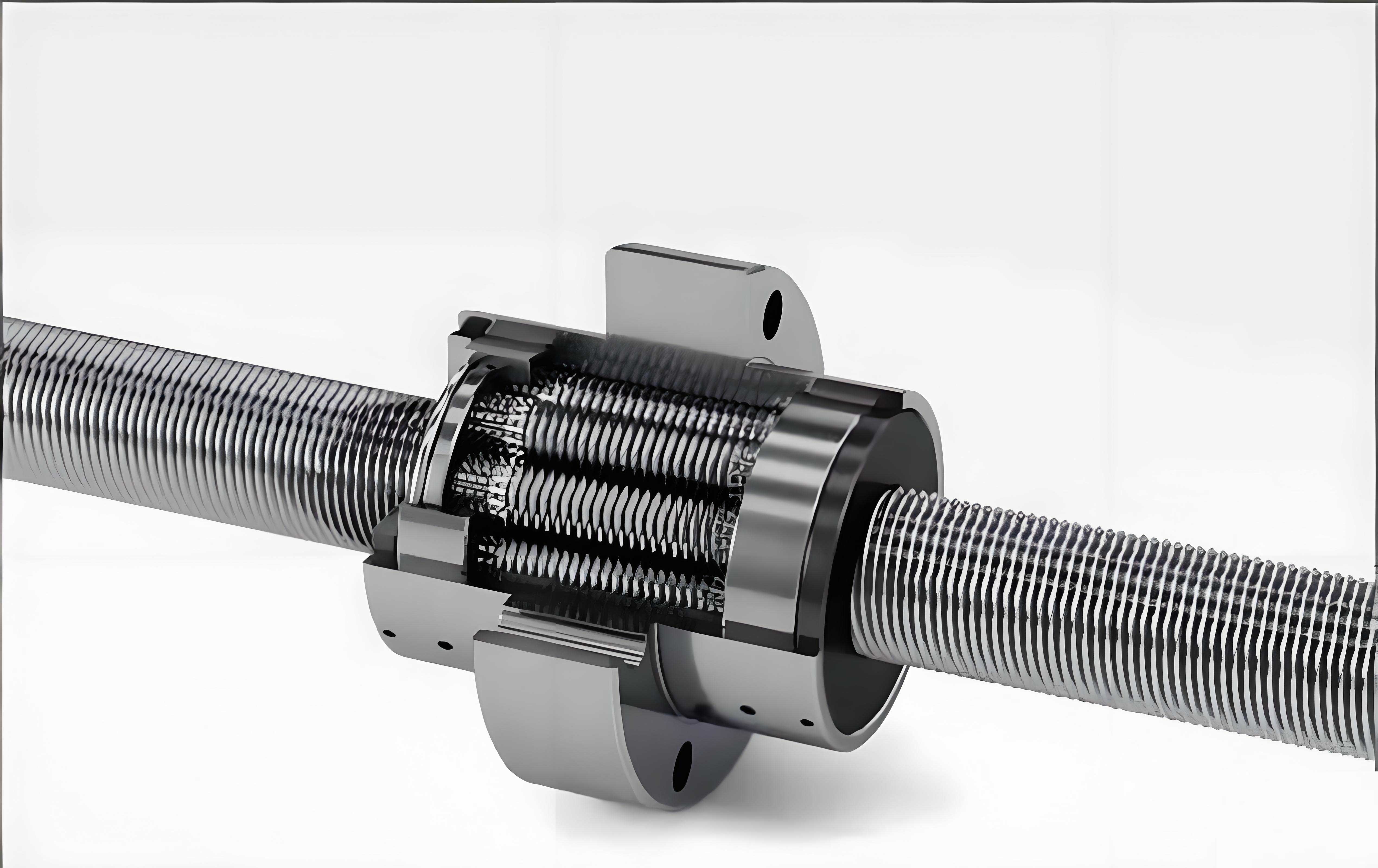
The development of high-performance actuation systems for aerospace, defense, and precision industrial applications demands components of exceptional reliability and longevity. Among these, the planetary roller screw assembly stands out for its superior load capacity, stiffness, and potential service life compared to traditional ball screw mechanisms. This assembly, consisting of a central screw, multiple threaded rollers distributed planetarily within a nut, and often a gear ring for synchronization, transforms rotary motion into high-force linear motion. Validating the predicted lifespan of a planetary roller screw assembly under realistic operational loads is a critical but challenging step in the product development cycle. This necessitates a dedicated life test bench capable of applying controlled, high-magnitude axial loads over millions of cycles without failure. As the test bench itself is subjected to these severe and repeated loading conditions, its structural integrity cannot be an afterthought. A failure in the test frame would lead to catastrophic losses, including damage to expensive prototypes, halted testing schedules, and significant safety risks.
This article details a comprehensive engineering project where I conducted a finite element analysis (FEA) on the critical structural components of a newly designed life test bench for planetary roller screw assembly evaluation. The primary objective was to ensure the bench’s reliability by identifying potential areas of high stress and fatigue risk before physical manufacturing and testing commenced. The analysis focused on static structural performance under the maximum intended operational load, providing a foundation for assessing safety factors and guiding potential design optimizations. The methodology, results, and insights presented here underscore the indispensable role of simulation in modern mechanical design, particularly for high-stakes testing equipment.
1. Introduction to the Life Test Bench and Its Design Challenges
The core function of the life test bench is to simulate the operational life of a planetary roller screw assembly by subjecting it to controlled axial loading while it is driven through its full stroke. The test article—the planetary roller screw assembly—is mounted horizontally. One end of the screw is fixed against rotation and axial translation, while the nut is connected to a driven carriage. A high-torque servo motor rotates the nut, causing the screw to extend or retract. The critical element is the load application: a hydraulic cylinder applies a persistent axial force (tension or compression) to the free end of the screw, opposing the motion and simulating the real-world working load.
The bench’s main structure, or “bed,” must serve several conflicting purposes: it must be massively stiff to minimize deflection under load (which would affect load measurement and alignment), it must provide precise and stable mounting surfaces for the test article, drive system, and load cylinder, and it must do so without being prohibitively heavy or costly. The most highly stressed regions are invariably the localized areas where these large external loads are introduced into the structure—specifically, the mounting interfaces for the hydraulic cylinder and the reaction force from the planetary roller screw assembly itself. These areas are prone to stress concentrations that, if overlooked, could initiate fatigue cracks over the millions of cycles typical of a life test. Therefore, a detailed finite element analysis targeting these zones was deemed essential.
2. Finite Element Analysis Methodology
I performed the structural analysis using a commercial FEA software package integrated within a 3D CAD environment. This integration streamlined the process from geometry preparation to result visualization. The overall approach followed a standard linear static analysis workflow, which is appropriate for evaluating peak stresses under a worst-case static load scenario as a precursor to fatigue life estimation.
2.1 Geometry Preparation and Simplification
The first step involved importing the full 3D CAD model of the test bench bed. To reduce computational complexity without sacrificing result accuracy in the regions of interest, I judiciously simplified the model. Small non-structural features such as fillets, chamfers, lightening holes, and minor bolt holes were suppressed. Crucially, I employed the concept of “part simplification” to isolate the critical load introduction zones. Instead of analyzing the entire, complex bed structure, I extracted sub-assemblies representing the hydraulic cylinder mounting block and the main bearing support housing. This allowed for a more focused mesh refinement and detailed study of stress patterns in these critical locations. The assumption here is that these local stresses are not significantly influenced by the distant boundaries of the full structure, provided reasonable boundary conditions are applied.
2.2 Material Properties
The primary structural material selected for the test bed is a high-strength low-alloy steel, analogous to grades like Q355 or A572. Its key properties for linear elastic analysis are its Young’s Modulus (E), Poisson’s Ratio (ν), and Yield Strength (σy). For the analysis, I used the following values, which are representative of such materials:
| Property | Symbol | Value | Unit |
|---|---|---|---|
| Young’s Modulus | E | 210 | GPa |
| Poisson’s Ratio | ν | 0.3 | – |
| Yield Strength | σy | 355 | MPa |
| Density | ρ | 7850 | kg/m³ |
These properties are entered into the FEA software to define the linear elastic material model. The von Mises yield criterion is used for result evaluation, where the equivalent stress (σv) is calculated from the principal stresses (σ1, σ2, σ3):
$$ \sigma_{v} = \sqrt{\frac{(\sigma_{1} – \sigma_{2})^{2} + (\sigma_{2} – \sigma_{3})^{2} + (\sigma_{3} – \sigma_{1})^{2}}{2}} $$
A safety factor (SF) is then simply defined as the ratio of yield strength to the maximum von Mises stress observed: SF = σy / σv_max.
2.3 Meshing Strategy
Accurate results in FEA are heavily dependent on mesh quality. For the 3D solid components of the mounting blocks, I selected a second-order (quadratic) tetrahedral element type. These elements, such as SOLID186 in some software libraries, have mid-side nodes that allow them to model complex geometries effectively and capture stress gradients more accurately than their first-order counterparts. They are well-suited for the irregular shapes resulting from the geometry simplification.
I applied a mesh control strategy, specifying a finer global mesh size for the overall part and applying local mesh refinements in areas where high stress gradients were anticipated: around bolt holes, sharp internal corners, and the load-bearing faces. A mesh convergence study was performed on a representative section to ensure that the reported maximum stresses did not change significantly with further mesh refinement, indicating that the solution was numerically stable.
| Component | Element Type | Global Size | Local Refinement Size | Number of Nodes | Number of Elements |
|---|---|---|---|---|---|
| Cylinder Mount | Quadratic Tetrahedron | 8 mm | 2 mm (at holes) | ~285,000 | ~185,000 |
| Bearing Housing | Quadratic Tetrahedron | 10 mm | 3 mm (at interfaces) | ~220,000 | ~140,000 |
2.4 Loads and Boundary Conditions
Defining realistic loads and constraints is the most critical step in setting up a meaningful FEA. The goal was to simulate the state of the component when the test bench is applying the maximum rated load to the planetary roller screw assembly.
For the Hydraulic Cylinder Mounting Block:
The block is bolted to the main bed frame. Therefore, I fixed all degrees of freedom on the bottom surface of the block, simulating a rigid connection to the much stiffer main bed. The load from the hydraulic cylinder is applied as a distributed pressure over the four bolt circle areas on the front face where the cylinder flange attaches. The total force (Fcyl) corresponds to the maximum output of the cylinder, which for this design is 350 kN. The pressure (P) on each bolt circle area (Acircle) is calculated as P = (Fcyl/4) / Acircle.
For the Main Bearing Support Housing:
This housing supports the reaction force from the planetary roller screw assembly. The screw’s fixed end bears against a large thrust bearing housed within this support. I modeled this condition by applying a “remote force.” This feature allows you to apply a force at a point in space and distribute its moment and force effects to a selected face via a rigid beam connection, simulating the action through a stiff bearing. The force magnitude is equal and opposite to the cylinder force (350 kN), applied along the central axis. The housing’s base, where it bolts to the bed, was assigned a fixed constraint.
| Analysis Case | Component | Boundary Condition | Load Application | Load Magnitude |
|---|---|---|---|---|
| Static Max Load | Cylinder Mount | Fixed Base | Distributed Pressure on 4 bolt circles | 350 kN (total) |
| Static Max Load | Bearing Housing | Fixed Base | Remote Force along central axis | 350 kN |
3. Analysis Results and Structural Evaluation
Solving the linear static models produced detailed contour plots of stress, displacement, and strain. The von Mises stress plot is the primary tool for assessing yielding risk.
3.1 Hydraulic Cylinder Mounting Block
The stress distribution in the cylinder mount revealed clear patterns. The highest stresses were not found on the loaded front face itself, which was in compression, but in regions of geometric discontinuity behind it. Specifically, significant stress concentrations arose at the sharp re-entrant corners where the bolt circle bosses met the main back plate of the mount. This is a classic location for stress risers. The maximum von Mises stress (σv_max) recorded in this area was approximately 118 MPa.
$$ SF_{mount} = \frac{\sigma_{y}}{\sigma_{v\_max}} = \frac{355 \text{ MPa}}{118 \text{ MPa}} \approx 3.0 $$
A safety factor of 3.0 under the maximum static load is generally considered very robust for a steel structure in a controlled environment, indicating a low risk of static yield. However, for fatigue life, the focus must be on the magnitude of the stress fluctuation (Δσ) at these concentration points during cyclic loading. While the mean stress is high, the alternating stress component will also be significant, necessitating a separate fatigue analysis using these local stresses as input.
3.2 Main Bearing Support Housing
The bearing housing analysis showed a different stress pattern. The highest stresses were concentrated around the bolt holes on the mounting flange and at the transition fillet between the heavy cylindrical housing and the base flange. The remote force application created a bending moment on the housing, leading to tensile stresses on one side of the bolt holes and compressive on the other. The peak von Mises stress here was slightly higher, at around 165 MPa.
$$ SF_{housing} = \frac{355 \text{ MPa}}{165 \text{ MPa}} \approx 2.15 $$
A safety factor of 2.15 is still acceptable for static strength but highlights this area as more critical than the cylinder mount. The stress concentration factor (Kt) at the bolt holes, calculated by comparing the peak local stress to the nominal bearing stress, was found to be in the range of 2.5-3. This is a direct callout for design attention.
| Component | Max. Von Mises Stress (MPa) | Material Yield (MPa) | Static Safety Factor | Critical Location | Primary Load Type |
|---|---|---|---|---|---|
| Hydraulic Cylinder Mount | 118 | 355 | 3.01 | Re-entrant corners at bolt bosses | Direct Compression/Bending |
| Main Bearing Housing | 165 | 355 | 2.15 | Bolt hole edges & base fillet | Bending from Remote Force |
3.3 Discussion and Design Implications
The FEA results provided actionable insights. While both components were confirmed to be safe against static yielding, the identified stress concentrations are potential initiators for fatigue cracks. Based on these results, I proposed specific design modifications prior to manufacturing:
- Increased Fillet Radii: For both the re-entrant corners on the cylinder mount and the base fillet on the bearing housing, the fillet radii were substantially increased. This is the most effective way to reduce the geometric stress concentration factor (Kt). The relationship between stress concentration and fillet radius (r) and adjacent thickness (d) is often expressed empirically; increasing r/d reduces Kt significantly.
- Local Reinforcement: Around the high-stress bolt holes on the bearing housing flange, adding localized thickening or “pads” can reduce the nominal bearing stress and improve load distribution.
- Material Upgrade Consideration: For the bearing housing, given its lower safety factor and critical role, I evaluated the impact of using a material with a higher yield strength (e.g., 500 MPa). A quick recalculation showed this could elevate the static SF above 3.0, providing a greater margin for fatigue and unforeseen overloads.
These iterative design changes, guided by FEA, transition the structure from one that is merely “strong enough” to one that is robustly designed for its demanding cyclic duty.
4. Extending the Analysis: The Planetary Roller Screw Assembly Interface
While the test bed structure is primary, the interaction between the bed and the test article—the planetary roller screw assembly—is also crucial. Misalignment or point loading at the mounting interfaces can induce parasitic moments into the screw, drastically altering its internal load distribution and fatigue life, invalidating the test. Therefore, as an extension of this work, I performed a contact analysis on the interface between the screw’s fixed-end bearing housing and the custom fixture that holds the screw.
This analysis aimed to verify that under the 350 kN load, the contact pressure at the interface remained uniform and within acceptable limits for the fixture material. A nonlinear static analysis with frictional contact was set up. The results confirmed that with a sufficiently large and flat mating surface and properly torqued bolts, the contact pressure distribution was nearly uniform, with edge effects being minimal. This ensures that the load is transferred axially into the planetary roller screw assembly as intended, without introducing significant bending. The maximum contact pressure (pmax) can be approximated for a simplified case using the formula for pressure under a rigid annulus:
$$ p_{max} \approx \frac{F}{A} \left(1 + \frac{e \cdot r}{I} \cdot k\right) $$
where F is the axial force, A is the contact area, e is the eccentricity, r is the radius, I is the area moment of inertia, and k is a factor accounting for stiffness. The FEA results provided a more accurate, non-uniform distribution that validated the design of the fixture.
5. Limitations of the Linear Static Analysis and Future Work
It is vital to acknowledge the limitations of the presented linear static analysis. This approach provides an excellent baseline for strength evaluation but does not directly predict fatigue life or account for all real-world complexities.
- Fatigue Life Prediction: The logical next step is a fatigue analysis. Using the local stress results (σmax, σmin) from the static analysis as input into a fatigue life model (e.g., Stress-Life approach using modified Goodman or Gerber criteria) would provide an estimate of the test bench’s own lifecycle. The equation for the modified Goodman line is:
$$ \frac{\sigma_{a}}{S_{e}} + \frac{\sigma_{m}}{S_{ut}} = \frac{1}{n} $$
where σa is the stress amplitude, σm is the mean stress, Se is the corrected endurance limit of the material, Sut is the ultimate tensile strength, and n is the design factor. Applying this to the stress concentrations found would quantify the risk.
- Nonlinear Effects: The analysis assumed linear material behavior (no plasticity) and small deformations. It also simplified bolt connections with fixed constraints or remote forces. A more advanced model would include pretension in the bolts and frictional contact between mating parts, which could redistribute stresses.
- Dynamic and Thermal Effects: The life test involves constant motion. While inertial forces are small compared to the 350 kN load, a transient dynamic analysis could capture vibratory responses. Furthermore, continuous operation of the planetary roller screw assembly and the drive motor may generate heat, potentially causing thermal expansion and induced stresses not considered here.
Future work will involve conducting a detailed fatigue analysis based on these static results and potentially creating a more sophisticated nonlinear model of the complete test bench assembly to study load paths and interactions more holistically.
6. Conclusion
Through a detailed finite element analysis focused on the critical load-bearing components of a life test bench for planetary roller screw assembly evaluation, I have successfully verified the structural integrity of the design under maximum static operational loads. The analysis identified specific locations of stress concentration at the hydraulic cylinder mount and main bearing housing, calculating static safety factors of 3.0 and 2.15, respectively. These factors confirm a low risk of yielding but importantly highlight areas requiring design attention to mitigate fatigue risk.
The practical outcomes of this work are threefold. First, it provides a high degree of confidence in the test bench’s mechanical reliability before committing to costly manufacturing. Second, it offers a clear roadmap for design optimization, such as increasing fillet radii and considering material upgrades, to enhance durability. Third, it establishes a validated simulation framework that can be reused for future iterations or for analyzing test benches for different sizes of planetary roller screw assembly.
This project underscores a fundamental principle in modern engineering: simulation is not a substitute for physical testing, but a powerful partner. By rigorously analyzing the test equipment itself, we ensure that the subsequent life test data for the planetary roller screw assembly is credible, the process is safe, and the development of these high-performance actuation systems can proceed with greater efficiency and reduced risk. The methodologies of geometry simplification, targeted meshing, and careful application of loads and boundary conditions, as demonstrated here, are directly applicable to a wide range of structural validation challenges in heavy-duty mechanical design.