
The design and optimization of a planetary roller screw assembly present a complex multi-disciplinary challenge, requiring the harmonious integration of geometric constraints, static strength, and dynamic performance. A poorly matched set of parameters can lead to excessive backlash, premature failure, or inefficiently large and heavy assemblies. In this article, I will detail a comprehensive parameter optimization model for the planetary roller screw assembly, utilizing the Crow Search Algorithm (CSA) to navigate the intricate design space. The goal is to achieve a compact, strong, and precise design by simultaneously optimizing the thread pair and gear pair parameters.
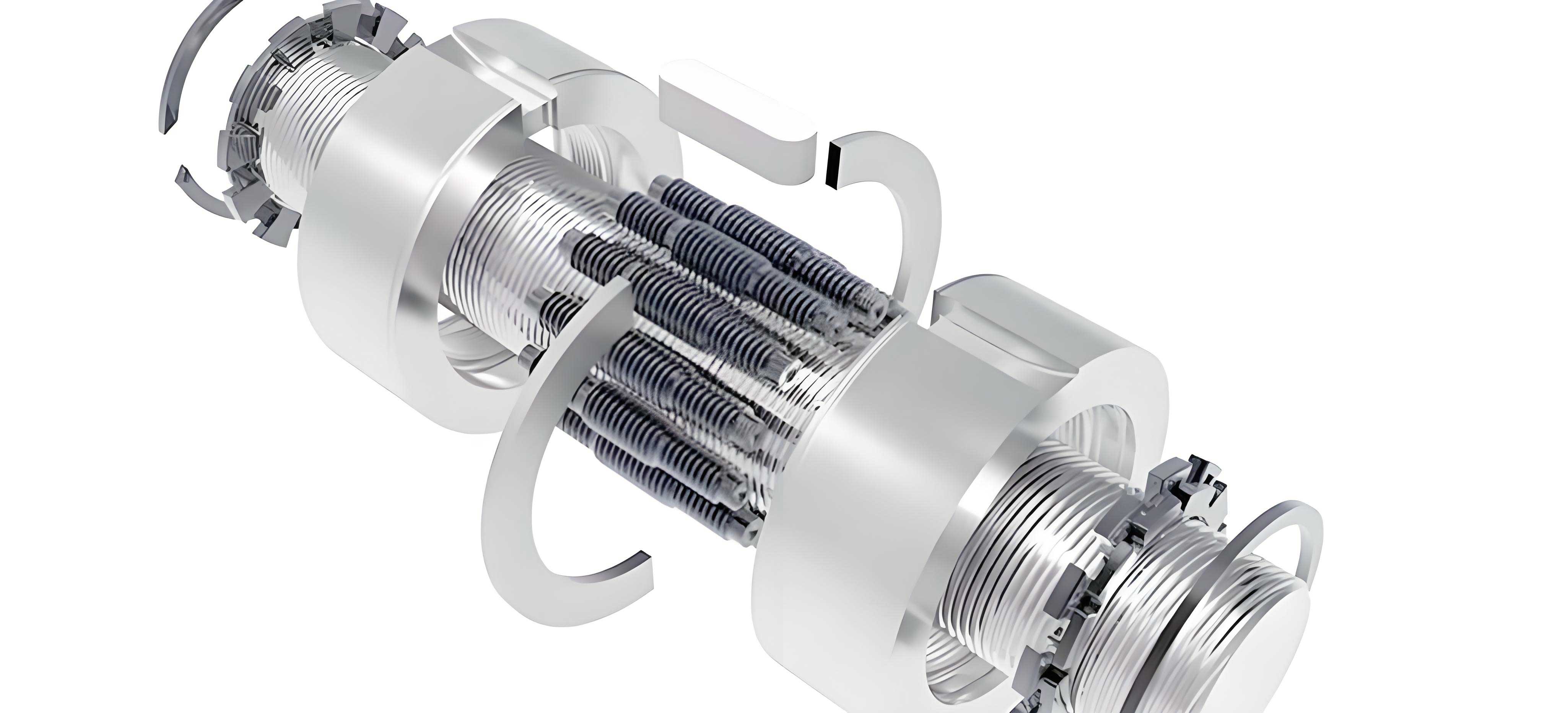
The core of the planetary roller screw assembly consists of a central screw, multiple planetary rollers arranged around it, and an outer nut. The rollers threadably engage with both the screw and the nut. To maintain synchronization, the ends of the rollers are geared and mesh with an internal gear ring fixed inside the nut. This unique architecture is what grants the planetary roller screw assembly its high load capacity, rigidity, and precision compared to conventional ball screws.
1. Geometric and Kinematic Foundation
The fundamental geometric relationships within a planetary roller screw assembly are derived from its kinematic operation. For proper motion transfer without jamming, the threads of the screw, rollers, and nut must have the same hand and an identical pitch.
$$ P_s = P_r = P_n = P $$
Furthermore, the screw and nut typically have the same number of thread starts, while the rollers are single-start. This ensures a constant transmission ratio and prevents relative axial displacement between the rollers and the nut. The number of starts on the screw is fundamentally linked to the pitch diameters:
$$ n_s = n_n = \frac{d_s}{d_r} + 2 $$
where \( d_s \) and \( d_r \) are the pitch diameters of the screw and roller, respectively. Consequently, the nut’s pitch diameter is:
$$ d_n = d_s + 2d_r = n_s d_r $$
The lead angles for each component are then given by:
$$ \tan \lambda_s = \frac{n_s P}{\pi d_s}, \quad \tan \lambda_r = \frac{P}{\pi d_r}, \quad \tan \lambda_n = \frac{n_n P}{\pi d_n} $$
From the above equations, it directly follows that \( \lambda_n = \lambda_r \), a crucial kinematic condition.
2. Mathematical Modeling of Thread Meshing and Backlash Elimination
To achieve high precision, the planetary roller screw assembly must be designed for near-zero or controlled backlash. This requires a precise mathematical model of the contacting helical surfaces. The thread profiles are typically defined as follows: the screw and nut have trapezoidal (straight-flanked) profiles, while the roller profile is circular (gothic arch). The relevant profile parameters are summarized in the table below.
| Parameter | Symbol (Screw) | Symbol (Roller) | Symbol (Nut) | Description |
|---|---|---|---|---|
| Total Tooth Height | \( a_s \) | \( a_r \) | \( a_n \) | Full radial height of the thread tooth. |
| Tooth Base Height | \( b_s \) | \( b_r \) | \( b_n \) | Radial distance from pitch diameter to tooth root. |
| Tooth Thickness | \( c_s \) | \( c_r \) | \( c_n \) | Chord length at the pitch diameter. |
| Thread Angle | \( \beta_s \) | \( \beta_r \) | \( \beta_n \) | Half-angle of the thread profile. |
| Profile Radius | – | \( r_{tr} \) | – | Radius of the circular roller thread profile: \( r_{tr} = \frac{d_r}{2 \cos \beta_r} \). |
The helical surface of each component is generated by sweeping its 2D profile along a helix. A point \( Q \) on such a surface can be described in a global coordinate system. For the screw with a straight-flank profile, the surface equation is:
$$
\begin{cases}
x_s = r_s \cos \theta_s \\
y_s = r_s \sin \theta_s \\
z_s = \zeta_s \left[ -\tan\beta_s (r_s – b_s) + \frac{c_s}{2} \right] + \frac{\theta_s l_s}{2\pi}
\end{cases}
$$
where \( \zeta_s = \pm 1 \) selects the upper or lower flank, \( r_s \) is the radial coordinate, \( \theta_s \) is the angular parameter, and \( l_s = n_s P \) is the lead.
For the roller with a circular profile, the surface equation becomes:
$$
\begin{cases}
x_r = r_r \cos \theta_r \\
y_r = r_r \sin \theta_r \\
z_r = \zeta_r \left[ \sqrt{ r_{tr}^2 – (r_r + r_r^0 – b_r)^2 } + b_r – r_r^0 \right] + \frac{\theta_r l_r}{2\pi}
\end{cases}
$$
where \( r_r^0 \) is the nominal roller radius. The nut’s surface equation is analogous to the screw’s. The unit normal vector \( \mathbf{n} \) at any point on these surfaces is critical for contact analysis. For the screw, it is derived as:
$$ \mathbf{n}_s = \begin{bmatrix} \tan \lambda_s \sin \theta_s + \zeta_s \tan \beta_s \cos \theta_s \\ \zeta_s \tan \beta_s \sin \theta_s – \tan \lambda_s \cos \theta_s \\ 1 \end{bmatrix} $$
Similar expressions can be derived for the roller \( (\mathbf{n}_r) \) and nut \( (\mathbf{n}_n) \). The condition for tangential contact between two surfaces (e.g., screw and roller) is the collinearity of their unit normal vectors at the contact point: \( \mathbf{n}_s = \mathbf{n}_r \). This condition, combined with the coordinate transformation relating the two surfaces, yields a system of nonlinear equations that define the meshing point coordinates \( (r_{sr}, \theta_{sr}) \) on the screw and \( (r_{rs}, \theta_{rs}) \) on the roller.
The axial backlash \( \delta_{sr} \) between the screw and roller is the difference in their axial coordinates at these meshing points:
$$ \delta_{sr} = z_s(r_{sr}, \theta_{sr}) – z_r(r_{rs}, \theta_{rs}) $$
An identical procedure establishes the meshing and backlash \( \delta_{nr} \) between the nut and roller. By setting \( \delta_{sr} = 0 \) and \( \delta_{nr} = 0 \), and solving the complete system of meshing equations, one can determine the required thread tooth thicknesses \( c_s, c_r, c_n \) that yield zero axial backlash for a given set of pitch diameters and profile angles. This is the cornerstone for precision design of the planetary roller screw assembly.
3. Design of the Synchronizing Gear Pair
The gear pair at the roller ends and the internal ring gear is essential for synchronizing the planetary motion in the planetary roller screw assembly. Its design is constrained by the already determined roller dimensions. The number of teeth on the roller gear is approximately determined by its pitch diameter and a chosen module \( m \):
$$ z_r = \text{int}\left( \frac{d_r}{m} \right) $$
The number of teeth on the internal ring gear is determined by the transmission ratio, which must match the thread start relationship to prevent kinematic interference:
$$ z_g = n_n \cdot z_r $$
Often, the major diameter of the roller gear differs from the roller’s thread major diameter, necessitating profile shifting (addendum modification). The shift coefficients \( x_r \) (roller) and \( x_g \) (ring gear) are calculated to provide standard clearance and contact ratio while satisfying the center distance constraint imposed by the planetary roller screw assembly geometry. Typically, \( x_g = -x_r \).
4. Static Load Distribution and Strength Constraints
A successful planetary roller screw assembly design must withstand the operational loads. The analysis begins with a static force balance on a single roller, assuming load is equally distributed among all \( N \) rollers. The key forces are the normal contact forces from the screw (\( \mathbf{F}_{ts} \)) and nut (\( \mathbf{F}_{tn} \)), and the gear mesh forces from the internal ring gear (\( \mathbf{F}_g \)). The axial component of the nut-roller contact force for one roller is:
$$ F_{nz} = \frac{F_a}{N} $$
where \( F_a \) is the total external axial load on the nut. The magnitude of the normal contact force is related to this axial component through the geometry of the contact. For example, at the nut-roller interface:
$$ F_{tn} = \frac{F_{nz}}{|\mathbf{n}_n \cdot \mathbf{k}|} $$
where \( \mathbf{k} \) is the unit vector in the axial direction. This normal force is used for strength verification. Primary strength constraints for the planetary roller screw assembly include:
- Thread Shear & Bending: The thread teeth are checked for shear and bending stress. For a component (screw, roller, or nut) with tooth thickness \( c_o \), total height \( a_o \), and load per engaged thread \( F_{to}/e \) (where \( e \) is the number of engaged threads), the stresses are:
$$ \tau_o = \frac{F_{to}}{2 e a_o \tan \beta_o}, \quad \sigma_o = \frac{3 F_{to}}{e a_o^2 \tan \beta_o} $$
These must be below the material’s allowable shear and bending strength.
- Gear Tooth Bending & Contact: The roller end gear teeth are checked using standard AGMA/ISO equations for bending stress \( \sigma_F \) and contact stress \( \sigma_H \).
$$ \sigma_F = \frac{K F_g}{b m} Y_{Fa} Y_{Sa} Y_{\epsilon}, \quad \sigma_H = \sqrt{ \frac{K F_g}{b d_r} \frac{u \pm 1}{u} } Z_H Z_E Z_{\epsilon} $$
where \( b \) is the effective face width, \( K \) is the load factor, and \( Y \) and \( Z \) are geometry and material factors.
- Nut Housing Tensile Stress: The nut body is checked for tensile/hoop stress due to the axial load:
$$ \sigma_{nut} = \frac{4 F_a}{\pi (d_{no}^2 – d_n^2)} $$
where \( d_{no} \) is the nut outer diameter.
- Structural & Interference Constraints: The number of rollers \( N \) is limited by the need to prevent physical interference between adjacent rollers. The angular spacing \( \alpha = 2\pi / N \) must satisfy:
$$ \frac{d_s + d_r}{2} \sin\left(\frac{\alpha}{2}\right) \ge (r_r^0 + a_r – b_r) $$
5. Multi-Objective Optimization Model and Crow Search Algorithm
The design problem for the planetary roller screw assembly is formalized as a constrained multi-objective optimization. The goal is to minimize the overall size and mass, which directly correlates with minimizing key dimensions.
Design Variables: The vector of design variables includes parameters that define the scale and configuration of the planetary roller screw assembly:
$$ \mathbf{X} = [d_s, n_s, P, m, B, d_{ng}, e]^T $$
where \( B \) is gear width and \( d_{ng} \) is a radial distance defining the nut outer diameter.
Objective Function: A composite objective function is formulated to minimize size:
$$ \text{Minimize: } f(\mathbf{X}) = d_s \cdot d_{no}(\mathbf{X}) \cdot (eP + 2B) $$
Minimizing \( f(\mathbf{X}) \) directly promotes smaller screw diameter, nut diameter, and overall assembly length.
Constraints: All the strength and geometric conditions derived earlier form the constraint set \( g_j(\mathbf{X}) \le 0 \).
To solve this complex, non-linear, and potentially non-convex optimization problem, the Crow Search Algorithm (CSA) is employed. CSA is a metaheuristic inspired by the intelligent hiding and stealing behavior of crows. Its advantages include simplicity, few tuning parameters, and effective exploration/exploitation balance. The algorithm process for the planetary roller screw assembly optimization is:
- Initialization: A flock of \( N_{crows} \) “crows” (candidate solutions \( \mathbf{X}_i \)) is randomly initialized within the defined variable bounds.
- Fitness Evaluation: For each crow, the corresponding planetary roller screw assembly geometry is calculated (roller diameter, nut diameter, thread thickness for zero backlash, gear parameters). The static forces are computed, and all constraints \( g_j \) are checked. If any constraint is violated, a penalty is applied to the objective \( f(\mathbf{X}) \).
- Position Update (Flight): Each crow \( i \) randomly follows another crow \( j \) to discover its hidden “food” (better solution). A new position is generated:
$$ \mathbf{X}_i^{new} = \mathbf{X}_i^{old} + r_i \cdot fl \cdot (\mathbf{X}_j^{old} – \mathbf{X}_i^{old}) $$
where \( r_i \) is a random number [0,1], and \( fl \) is the flight length. If crow \( j \) becomes “aware” (with probability \( AP \)), it deceives crow \( i \) by moving to a random location.
- Feasibility Check & Memory Update: The new position is evaluated. If it is feasible and has a better fitness value than the one stored in the crow’s memory, the memory is updated. Otherwise, the crow remains in its old position.
- Iteration: Steps 2-4 repeat until a maximum number of iterations is reached. The best solution found in the flock’s memory is the optimized planetary roller screw assembly design.
6. Optimization Results and Comparative Analysis
To validate the proposed model, the CSA-based optimization was executed for three different axial load cases. The material was set as GCr15 bearing steel. The results, including key derived parameters, were compared with dimensions from a reputable commercial planetary roller screw assembly product manual. The comparative data is presented below.
| Structural Parameter | Case 1: Fa = 51,000 N | Case 2: Fa = 102,100 N | Case 3: Fa = 221,600 N | |||
|---|---|---|---|---|---|---|
| Proposed Model | Commercial | Proposed Model | Commercial | Proposed Model | Commercial | |
| Screw Pitch Diameter, \( d_s \) (mm) | 15 | 15 | 20 | 19.5 | 29 | 30 |
| Roller Pitch Diameter, \( d_r \) (mm) | 5 | 5 | 6.67 | 6.5 | 9.67 | 10 |
| Nut Pitch Diameter, \( d_n \) (mm) | 25 | 25 | 33.34 | 32.5 | 48.34 | 50 |
| Thread Pitch, \( P \) (mm) | 0.4 | 0.4 | 0.6 | 0.4 | 1.0 | 0.8 |
| Screw Thread Starts, \( n_s \) | 5 | 5 | 5 | 5 | 5 | 5 |
| Nut Outer Diameter, \( d_{no} \) (mm) | 31.42 | 26 | 39.20 | 42 | 56.41 | 62 |
| Roller Tooth Thickness, \( c_r \) (mm) | 0.216 | – | 0.304 | – | 0.484 | – |
| Internal Gear Teeth, \( z_g \) | 20 | – | 26 | – | 38 | – |
| Gear Module, \( m \) (mm) | 0.25 | – | 0.25 | – | 0.25 | – |
The results demonstrate strong agreement between the optimized parameters and the commercial specifications for the core pitch diameters and number of starts, validating the geometric and load-bearing logic of the model. Differences in the selected pitch and the precise nut outer diameter highlight the multi-objective nature of the problem; the commercial catalog may prioritize standardization across a pitch series, while the optimization model strictly minimizes dimensions subject to strength. A significant added value of the proposed model is the determination of critical but often unspecified parameters, such as the precise thread tooth thicknesses required for zero backlash and the complete gear pair design (module, teeth numbers, shift coefficients). This provides a fully-defined, strength-verified, and precision-oriented blueprint for the planetary roller screw assembly.
7. Conclusion
In this article, I have presented a holistic methodology for the optimal design of a planetary roller screw assembly. The approach integrates a precise geometric model for helical thread meshing—enabling the calculation of zero-backlash tooth thicknesses—with a static load distribution model for strength verification. This foundation supports a formal multi-objective optimization framework aimed at minimizing the assembly’s overall size. The Crow Search Algorithm proves to be an effective tool for navigating this complex design space, handling multiple continuous and discrete variables alongside non-linear constraints. The validation against commercial products confirms that the model yields sensible and competitive designs for the planetary roller screw assembly, while also providing a more complete set of manufacturing parameters. This model serves as a powerful tool for developing high-performance, compact, and reliable planetary roller screw assembly units tailored to specific load requirements.