
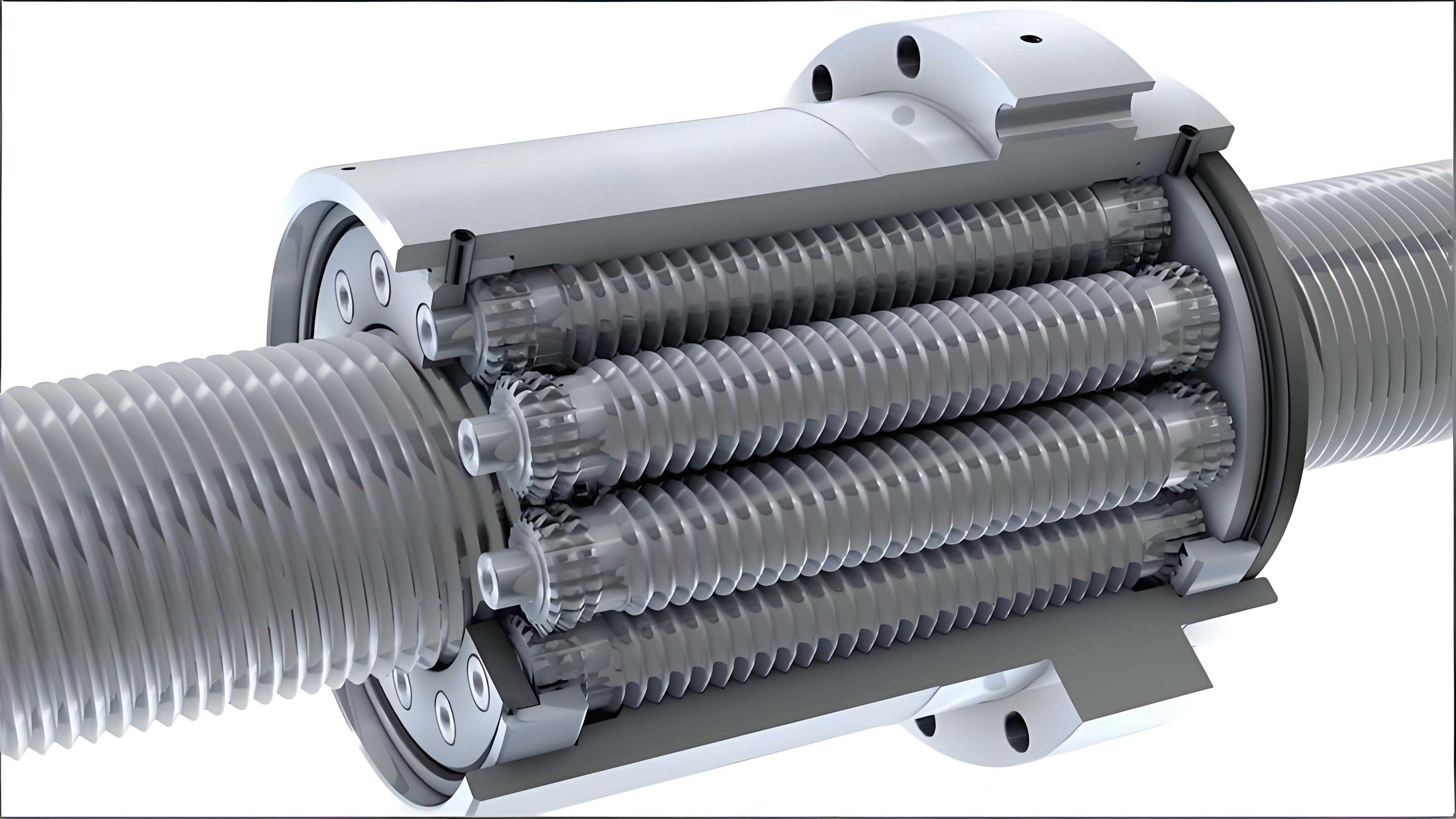
In precision motion control systems, the transmission performance is critically dependent on the kinematic accuracy and load distribution within the actuating mechanism. Among these mechanisms, the planetary roller screw assembly stands out for its superior load capacity, high rigidity, and long operational life. The core functionality of a planetary roller screw assembly stems from the intricate meshing of multiple helical thread surfaces between the screw, the planetary rollers, and the nut. A fundamental characteristic governing this meshing behavior, and consequently the overall performance, is the clearance present between these conjugated surfaces. This clearance, often referred to as backlash or meshing clearance, directly impacts positioning accuracy, stiffness, vibration, and noise generation. Traditionally, analysis of the planetary roller screw assembly has often focused on axial clearance. However, in real-world applications, the components within a planetary roller screw assembly are subject to multi-dimensional loading and potential misalignments. Therefore, the meshing characteristics and clearances in the radial and circumferential directions are equally significant. A comprehensive understanding of meshing clearance in all three directions—axial, radial, and circumferential—is essential for optimizing the design, predicting performance under various operating conditions, and ensuring the reliability of the planetary roller screw assembly. This study delves into establishing a precise mathematical model to determine the meshing points and quantify the clearance in a planetary roller screw assembly along these three primary directions, providing a foundational tool for advanced design and analysis.
Structural Configuration and Coordinate Systems
The standard design of a planetary roller screw assembly, which is the focus of this analysis, comprises several key components: a central screw, multiple planetary rollers distributed around it, an outer nut, an internal gear ring, a roller retainer (cage), and related securing elements. The screw and the nut feature multi-start trapezoidal threads, while each planetary roller has a single-start thread, typically with a circular arc profile for improved contact stress distribution. All threads share the same pitch and hand (e.g., right-handed). The planetary rollers are held in a specific spatial arrangement by the cage. Their ends are geared, meshing with the stationary internal gear ring mounted inside the nut. This gear meshing ensures that as the screw rotates, the rollers undergo a compounded planetary motion: they revolve around the screw’s axis (revolution) while simultaneously rotating about their own axes (rotation). This specific kinematic constraint allows the nut to translate axially without relative rotation. The geometric model begins by defining coordinate systems for each component to mathematically describe their helical surfaces.
We establish a component coordinate system $O_i$-$x_i y_i z_i$ for each part, where the subscript $i = s, r, n$ denotes the screw, roller, and nut, respectively. The $z_i$-axis aligns with the component’s axis of symmetry. A separate profile coordinate system $O’_i$-$u_i v_i w_i$ is defined for the thread tooth cross-section. The relationship between a point on the thread profile and its location in the component’s 3D helical surface is given by a homogeneous transformation. The global assembly coordinate system $O$-$xyz$ is fixed, with the screw and nut coordinate systems aligned or simply related to it. The roller’s coordinate system is positioned relative to the global system based on its center distance from the screw axis. The initial angular position of the thread start on each component, denoted by $\theta_{0i}$, is crucial for defining the phase relationship in the assembled planetary roller screw assembly. For an assembly with $n_s$ screw starts and $n_n$ nut starts, a common phase relationship is $\theta_{0n} = \theta_{0s} – \pi / n_n$. The roller’s initial angle depends on its assembly position and the screw’s starts: $\theta_{0r} = \theta_{0s} + (1 – n_s)\phi_r$, where $\phi_r$ is the roller’s revolution angle.
Mathematical Model of Helical Surfaces
The thread surface of each component in a planetary roller screw assembly is a helicoid, generated by sweeping a 2D tooth profile along a helical path. Defining the profile accurately is the first step. Common profiles include trapezoidal for the screw and nut, and a circular arc for the roller. The following parameters are used: nominal radius $r_{mi}$, distance from root to pitch radius $a_i$, thread tooth thickness $b_i$, thread flank angle $\beta_i$, and full tooth height $h_i$. For the roller with an arc profile, the radius of the circular arc $r_{tr}$ is related to its nominal radius and flank angle: $r_{tr} = r_{mr} / \sin(\beta_r/2)$.
In the profile coordinate system $O’_i$-$u_i v_i w_i$ (where $v_i=0$), the profile curves can be expressed. For the screw (trapezoidal, external thread), the coordinates are:
$$
\begin{cases}
u_s = u’_s \\
v_s = 0 \\
w_s = \zeta_s \left[ -\tan\left(\dfrac{\beta_s}{2}\right) (u’_s – a_s) + \dfrac{b_s}{2} \right]
\end{cases}
$$
For the roller (circular arc, external thread):
$$
\begin{cases}
u_r = u’_r \\
v_r = 0 \\
w_r = \zeta_r \left[ \sqrt{ r_{tr}^2 – \left[u’_r + (r_{mr} – a_r)\right]^2 } + \dfrac{b_r}{2} – r_{tr}\cos\left(\dfrac{\beta_r}{2}\right) \right]
\end{cases}
$$
For the nut (trapezoidal, internal thread):
$$
\begin{cases}
u_n = u’_n \\
v_n = 0 \\
w_n = \zeta_n \left[ \tan\left(\dfrac{\beta_n}{2}\right) (u’_n – a_n) + \dfrac{b_n}{2} \right]
\end{cases}
$$
Here, the parameter $\zeta_i$ takes the value $+1$ for the upper flank (one side of the tooth) and $-1$ for the lower flank. The variable $u’_i$ effectively represents the radial coordinate in the profile system, ranging from the root to the crest.
The transformation from the profile system to the component’s 3D coordinate system involves a rotation by an angle $\theta_i$ (the helical parameter) and a simultaneous translation along the axis. The transformation matrix $\mathbf{H}$ is:
$$
\mathbf{H} =
\begin{bmatrix}
\cos(\theta_i + \theta_{0i}) & -\sin(\theta_i + \theta_{0i}) & 0 & r_{fi}\cos(\theta_i + \theta_{0i}) \\
\sin(\theta_i + \theta_{0i}) & \cos(\theta_i + \theta_{0i}) & 0 & r_{fi}\sin(\theta_i + \theta_{0i}) \\
0 & 0 & 1 & r_{fi} \theta_i \tan\lambda_i \\
0 & 0 & 0 & 1
\end{bmatrix}
$$
where $r_{fi} = r_{mi} – a_i$ is the root radius, and $\lambda_i$ is the lead angle at the root radius, given by $\tan \lambda_i = L_i / (2\pi r_{fi})$, with $L_i = n_i p$ being the lead and $p$ the pitch. Applying this transformation, the parametric equations for the helical surfaces in the component coordinate systems are obtained. Subsequently, applying the assembly phase relationships, we get the global coordinates for points on each surface in the planetary roller screw assembly. For the screw:
$$
\begin{cases}
x_s = r_s \cos(\theta_s + \theta_{0s}) \\
y_s = r_s \sin(\theta_s + \theta_{0s}) \\
z_s = \zeta_s \left[ -\tan\left(\dfrac{\beta_s}{2}\right) (r_s – r_{ms}) + \dfrac{b_s}{2} \right] + r_{fs}\theta_s \tan\lambda_s
\end{cases}
$$
For the roller in the global frame:
$$
\begin{cases}
x_r = r_r \cos(\theta_r + \theta_{0s} + (1-n_s)\phi_r) + (r_{mr}+r_{ms})\cos(\theta_{0s} + \phi_r) \\
y_r = r_r \sin(\theta_r + \theta_{0s} + (1-n_s)\phi_r) + (r_{mr}+r_{ms})\sin(\theta_{0s} + \phi_r) \\
z_r = \zeta_r \left[ \sqrt{ r_{tr}^2 – r_r^2 } + \dfrac{b_r}{2} – r_{tr}\cos\left(\dfrac{\beta_r}{2}\right) \right] + r_{fr}\theta_r \tan\lambda_r
\end{cases}
$$
For the nut:
$$
\begin{cases}
x_n = r_n \cos\left( \theta_n + \theta_{0s} – \dfrac{\pi}{n_n} \right) \\
y_n = r_n \sin\left( \theta_n + \theta_{0s} – \dfrac{\pi}{n_n} \right) \\
z_n = \zeta_n \left[ \tan\left(\dfrac{\beta_n}{2}\right) (r_n – r_{mn}) + \dfrac{b_n}{2} \right] + r_{fn}\theta_n \tan\lambda_n
\end{cases}
$$
Here, $r_s$, $r_r$, $r_n$ are the radial parameters equivalent to $u’_i + r_{fi}$ from the profile definitions, representing the radial distance of a point on the surface from the component’s own axis.
General Theory for Meshing Clearance Determination
The meshing clearance between two surfaces in a planetary roller screw assembly is defined as the minimal relative displacement required along a specified direction to bring the surfaces into contact (tangency). Consider two general surfaces $\Lambda_1$ and $\Lambda_2$ in space. Let $\mathbf{n}_1$ and $\mathbf{n}_2$ be their unit normal vectors at points $Q_1$ and $Q_2$, respectively. Let $\mathbf{n}_{12}$ be the specified direction of relative motion (e.g., axial, radial). The condition for these points to be potential contact points after a translation $\tau$ along $\mathbf{n}_{12}$ is that the surface normals at these points are parallel (collinear), and the vector connecting $Q_1$ and $Q_2$ is parallel to the motion direction. This can be expressed as:
$$
\mathbf{n}_1 = \mu \mathbf{n}_2
$$
$$
\overrightarrow{Q_1 Q_2} = \tau \mathbf{n}_{12}
$$
where $\mu$ is a scalar (typically $\pm 1$), and $\tau$ is the clearance (positive if surfaces are separated, zero if in contact, negative if interfering). The coordinates of $Q_1$ and $Q_2$ are given by their respective surface equations. Solving these equations simultaneously for the parameters defining $Q_1$ and $Q_2$ yields the meshing points and the clearance $\tau = |\overrightarrow{Q_1 Q_2}|$ along $\mathbf{n}_{12}$.
To apply this, we need the normal vector to the helical surfaces. The normal vector $\mathbf{n}_i = [n^x_i, n^y_i, n^z_i]^T$ at any point on the surface defined by parameters $(r_i, \theta_i)$ is obtained from the cross product of the partial derivative vectors. For the general helical surface form used for the planetary roller screw assembly components, the normal vector (non-unit) can be derived as:
$$
\mathbf{n}_i =
\begin{bmatrix}
r_{fi} \tan\lambda_i \sin(\theta_i+\theta_{0i}) + \varepsilon_i \zeta_i r_i \tan(\beta_i/2) \cos(\theta_i+\theta_{0i}) \\[6pt]
\varepsilon_i \zeta_i r_i \tan(\beta_i/2) \sin(\theta_i+\theta_{0i}) – r_{fi} \tan\lambda_i \cos(\theta_i+\theta_{0i}) \\[6pt]
r_i
\end{bmatrix}
$$
where $\varepsilon_i = +1$ for an external thread (screw, roller) and $\varepsilon_i = -1$ for an internal thread (nut). This expression is fundamental for applying the meshing condition.
Meshing Clearance in Specific Directions for Planetary Roller Screw Assembly
We now apply the general meshing theory to the three specific directions in a planetary roller screw assembly: axial, radial, and circumferential. Clearance is evaluated for both the screw-roller pair and the nut-roller pair.
Axial Clearance
Axial clearance is the relative displacement along the Z-axis ($\mathbf{n}_{12} = [0, 0, 1]$). For the screw-roller pair, we consider contact between the upper flank of the screw ($\zeta_s=+1$) and the lower flank of the roller ($\zeta_r=-1$), and vice versa. The meshing condition (normals collinear and connecting vector axial) leads to the following system for the first case ($\zeta_s=+1, \zeta_r=-1$):
$$
\frac{n^x_s}{n^z_s} = \frac{n^x_r}{n^z_r}, \quad \frac{n^y_s}{n^z_s} = \frac{n^y_r}{n^z_r}, \quad x_s – x_r = 0, \quad y_s – y_r = 0
$$
Solving these four equations yields the meshing point coordinates: screw side $(r_{as1}, \theta^a_{s1})$ and roller side $(r_{ars1}, \theta^a_{rs1})$. The axial gap for this flank pair is then $\delta^a_{sr1} = z_s(r_{as1}, \theta^a_{s1}) – z_r(r_{ars1}, \theta^a_{rs1})$. Repeating the process for the opposite flanks ($\zeta_s=-1, \zeta_r=+1$) gives $\delta^a_{sr2}$. The total axial backlash between the screw and roller is the sum: $\delta^a_{sr} = \delta^a_{sr1} + \delta^a_{sr2}$. A similar procedure is applied to the nut-roller pair, noting that the nut is an internal thread ($\varepsilon_n=-1$). The condition for nut-roller axial meshing is:
$$
\frac{n^x_n}{n^z_n} = \frac{n^x_r}{n^z_r}, \quad \frac{n^y_n}{n^z_n} = \frac{n^y_r}{n^z_r}, \quad x_n – x_r = 0, \quad y_n – y_r = 0
$$
Solving for the two flank combinations gives $\delta^a_{nr1}$ and $\delta^a_{nr2}$, and the total axial clearance is $\delta^a_{nr} = \delta^a_{nr1} + \delta^a_{nr2}$.
Radial Clearance
Radial clearance involves displacement along the line connecting the screw and roller centers. For a roller at revolution angle $\phi_r$, the radial direction vector from the screw to the roller is $\mathbf{n}_{12} = [\cos(\theta_{0s}+\phi_r), \sin(\theta_{0s}+\phi_r), 0]$. For the screw-roller pair, the meshing conditions become:
$$
\frac{n^x_s}{n^z_s} = \frac{n^x_r}{n^z_r}, \quad \frac{n^y_s}{n^z_s} = \frac{n^y_r}{n^z_r}, \quad y_s – y_r = \sin(\theta_{0s}+\phi_r) \tau, \quad z_s – z_r = 0
$$
The last condition ensures the connecting vector has no axial component, making it purely radial. Solving gives the radial meshing points and the clearance $\delta^r_{sr}$ as the magnitude of the radial displacement $\tau$. The expression for the radial clearance can be derived from the difference in x-coordinates (or y-coordinates) projected onto the radial direction. For the screw-roller pair:
$$
\delta^r_{sr} = \left| r_{rs} \cos(\theta^r_{rs} + \theta_{0s} + (1-n_s)\phi_r) + (r_{mr}+r_{ms})\cos(\theta_{0s}+\phi_r) – r_s \cos(\theta^r_s + \theta_{0s}) \right|
$$
for the specific solved points. The process for the nut-roller radial clearance is analogous, using the condition $y_n – y_r = \sin(\theta_{0s}+\phi_r) \tau$ and $z_n – z_r = 0$.
Circumferential Clearance
Circumferential clearance (or torsional backlash) is the relative rotation angle about the screw/nut axis required to bring surfaces into contact. This is modeled by introducing an additional rotation $\delta^t$ to one component’s coordinate. For the screw-roller pair, we consider the surfaces in direct positional contact ($x, y, z$ equal) but with the condition of collinear normals. This leads to the system:
$$
\frac{n^x_s}{n^z_s} = \frac{n^x_r}{n^z_r}, \quad \frac{n^y_s}{n^z_s} = \frac{n^y_r}{n^z_r}, \quad x_s – x_r = 0, \quad y_s – y_r = 0, \quad z_s – z_r = 0
$$
This is a system of five equations. However, the angular parameter for one component effectively incorporates the clearance rotation. Solving for the two flank pairs gives rotational clearances $\delta^t_{sr1}$ and $\delta^t_{sr2}$, with total circumferential clearance $\delta^t_{sr} = \delta^t_{sr1} + \delta^t_{sr2}$ (in radians). The same approach with $x_n, y_n, z_n$ gives the nut-roller circumferential clearance $\delta^t_{nr}$.
Analysis of Results and Parametric Study
Using the derived models, the meshing points and clearances can be computed for a given planetary roller screw assembly design. A reference design with parameters listed in Table 1 is analyzed.
| Parameter | Screw | Roller | Nut |
|---|---|---|---|
| Nominal Radius (mm) | 7.5 | 2.5 | 12.5 |
| Number of Starts | 5 | 1 | 5 |
| Pitch, p (mm) | 2 | 2 | 2 |
| Tooth Thickness, b (mm) | 0.8 | 0.8 | 0.8 |
| Root Height, a (mm) | 0.275 | 0.275 | 0.275 |
| Flank Angle, β (deg) | 90 | 90 | 90 |
The computed meshing points and clearances for the reference design are summarized in Table 2. Key observations can be made. For the screw-roller pair, the meshing points in all three directions deviate from the nominal pitch radius. For the nut-roller pair, the roller-side meshing point consistently lies at its nominal pitch radius, while the nut-side point varies. The clearance values differ significantly between directions and pairs, highlighting the multi-dimensional nature of the play within a planetary roller screw assembly.
| Parameter | Axial | Radial | Circumferential |
|---|---|---|---|
| Screw-Roller Pair | |||
| Screw Meshing Radius (mm) | 7.586 | 7.494 | 7.586 |
| Screw Meshing Angle (rad) | 0.082 | 0.083 | 0.141 |
| Roller Meshing Radius (mm) | 2.517 | 2.518 | 2.517 |
| Roller Meshing Angle (rad) | 2.893 | 2.891 | 2.893 |
| Clearance (mm or rad) | 0.187 mm | 0.092 mm | 0.118 rad |
| Nut-Roller Pair | |||
| Nut Meshing Radius (mm) | 12.500 | 12.700 | 12.500 |
| Nut Meshing Angle (rad) | 0 | 0 | 0.503 |
| Roller Meshing Radius (mm) | 2.500 | 2.500 | 2.500 |
| Roller Meshing Angle (rad) | 0 | 0.003 | 0 |
| Clearance (mm or rad) | 0.400 mm | 0.200 mm | 0.250 rad |
The influence of key design parameters—pitch ($p$), flank angle ($\beta$), and tooth thickness ($b$)—on the three-directional clearances in a planetary roller screw assembly is critically important for designers. The following parametric studies reveal distinct trends.
Effect of Pitch
Varying the pitch (while keeping leads proportional for multi-start components) affects clearances as shown in the analysis. Increasing the pitch generally increases the axial and radial clearances for the screw-roller pair. For the nut-roller pair, the axial and radial clearances may first increase and then decrease or show a linear increase, depending on the specific geometry. Interestingly, the circumferential clearance for the screw-roller pair decreases with increasing pitch, while the nut-roller circumferential clearance often remains relatively constant. This inverse relationship highlights a design trade-off: a smaller pitch reduces axial/radial play but increases torsional backlash in the screw-roller interface. The optimal pitch for a planetary roller screw assembly must be chosen based on the dominant stiffness and accuracy requirements of the application.
Effect of Flank Angle
The flank angle $\beta$ primarily influences the slope of the thread flanks. Analysis shows that increasing the flank angle tends to increase the axial and circumferential clearances on the screw-roller side. The radial clearance on the screw-roller side may increase initially and then saturate for angles beyond 90°. For the nut-roller pair, the radial clearance decreases with increasing flank angle, while the axial and circumferential clearances often remain unaffected. This asymmetric effect underscores that the flank angle is a powerful parameter for selectively adjusting clearances in specific directions within a planetary roller screw assembly, but it cannot simultaneously minimize all clearances.
Effect of Tooth Thickness
The tooth thickness $b_i$ is the most straightforward parameter influencing clearance. Increasing the tooth thickness on the screw, roller, and nut directly reduces the space between opposing flanks. The modeling results confirm that increasing tooth thickness consistently reduces the meshing clearance in all three directions for both the screw-roller and nut-roller interfaces. This makes increasing tooth thickness the most effective single-parameter adjustment for minimizing overall backlash in a planetary roller screw assembly. However, practical limits exist: excessive tooth thickness can lead to interference during assembly or reduce the root strength of the thread. Therefore, tooth thickness should be maximized within manufacturing and strength constraints to achieve minimal, yet functional, clearance in the planetary roller screw assembly.
Conclusions
This study presents a comprehensive analytical framework for determining the meshing clearance in a planetary roller screw assembly along the axial, radial, and circumferential directions. By establishing precise mathematical models of the helical thread surfaces and applying spatial gearing conditions, the exact meshing point locations and the corresponding clearances can be calculated. The key findings are:
- The meshing points within a planetary roller screw assembly are not fixed at the nominal pitch diameters and vary depending on the direction of relative motion considered. For the screw-roller interface, meshing occurs off the pitch cylinder in all directions. For the nut-roller interface, the roller meshes at its pitch radius, but the nut contact point shifts.
- Design parameters have distinct and sometimes opposing effects on clearances in different directions. Pitch reduction decreases axial/radial clearance but increases circumferential clearance for the screw-roller pair. Increasing the flank angle can increase screw-roller axial and circumferential clearances while potentially reducing nut-roller radial clearance.
- Among the studied parameters, increasing the thread tooth thickness is the only modification that consistently and simultaneously reduces meshing clearance in all three directions (axial, radial, circumferential) for both the screw-roller and nut-roller interfaces in a planetary roller screw assembly. This provides a clear guideline for designers seeking to minimize overall backlash.
The models developed herein provide valuable tools for the design and analysis of high-performance planetary roller screw assemblies, enabling the prediction and control of multi-dimensional meshing characteristics that are crucial for precision, stiffness, and dynamic response.