
In the pursuit of high-precision mechanical processing, the evolution from sliding screw assemblies to rolling contact mechanisms has marked a significant advancement. Among these, the planetary roller screw assembly stands out as a superior solution for applications demanding compact design, high load capacity, stiffness, and longevity. This article delves into the fundamental principles, motion characteristics, and geometric relationships of the planetary roller screw assembly, providing a comprehensive analysis that guides parameter selection for optimal performance.
The planetary roller screw assembly operates on the principle of converting rotary motion into linear motion through a system of rolling elements, thereby replacing sliding friction with rolling friction. This transition not only enhances efficiency but also addresses limitations found in other assemblies, such as ball screws. Specifically, while ball screws offer high transmission efficiency and predictable load capacity, they suffer from shorter lifespan, limited load capacity especially at small leads, and reduced stiffness. In contrast, the planetary roller screw assembly features rollers with larger effective contact radii, enabling substantial load capacity—approximately 20 times that of ball screws at leads as small as 1 to 2 mm—along with improved reliability, vibration damping, noise reduction, and ease of disassembly. These attributes make the planetary roller screw assembly indispensable in scenarios where space constraints, high speeds, and robust performance are critical.
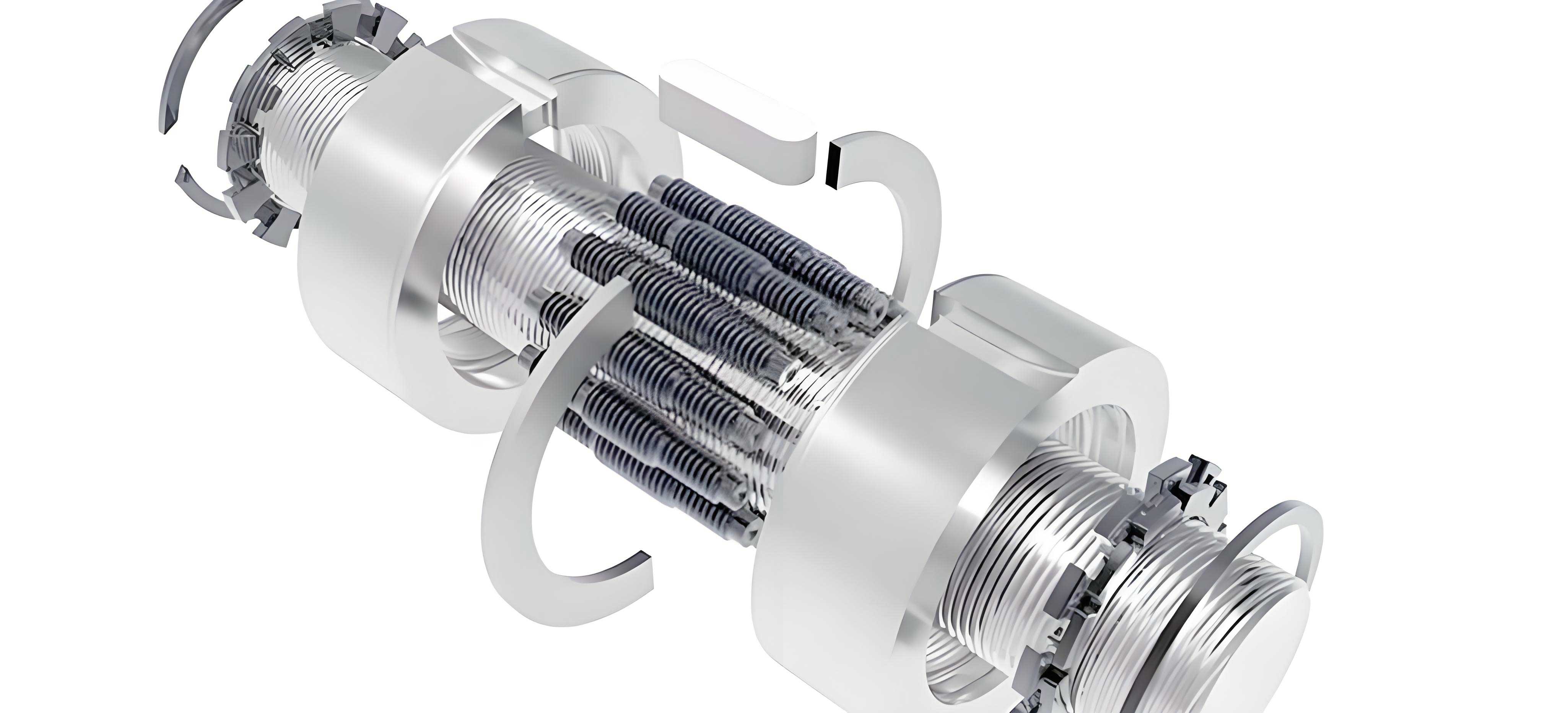
The core structure of a planetary roller screw assembly consists of three primary components: the screw, the rollers, and the nut. The screw typically features a multi-start, 90-degree triangular thread profile, while the nut mirrors this thread type and number of starts. The rollers, which are single-start elements, have a double-circular arc thread profile with a radius R, ensuring point contact with both the screw and nut. At each end of the rollers, external gears are mounted, engaging with internal ring gears fixed at the ends of the nut. This gear arrangement ensures synchronized motion among the rollers, maintaining parallelism with the screw axis and minimizing slippage. Additionally, a guide ring spaces the rollers uniformly to prevent inter-roller friction and improve load distribution. Understanding this configuration is essential for analyzing the motion dynamics and parameter selection in a planetary roller screw assembly.
The motion characteristics of the planetary roller screw assembly are derived from the interactions between the screw, rollers, and nut. Consider a scenario where the screw rotates while the nut is stationary. Let $$d_s$$, $$d_r$$, and $$d_n$$ represent the diameters of the screw, roller, and nut at their contact points, respectively. The pitch of the threads is denoted as $$s$$. The angular velocity of the screw is $$\omega$$, the angular velocity of the roller about its own axis (self-rotation) is $$\dot{\omega}_r$$, and the angular velocity of the roller revolving around the screw axis (orbital motion) is $$\omega’$$. The mean diameter for orbital motion is $$d_m = d_s + d_r$$. The relationship between these angular velocities can be expressed as:
$$ \omega’ \frac{d_m}{2} = \omega \frac{d_s}{4} $$
Solving for $$\omega’$$ yields:
$$ \omega’ = \frac{\omega d_s}{2 d_m} = \frac{\omega d_s}{2(d_s + d_r)} = \frac{\omega \kappa}{2(\kappa + 1)} $$
where $$\kappa = d_s / d_r$$. The self-rotation of the roller is governed by:
$$ \dot{\omega}_r \frac{d_r}{2} = \omega’ \frac{d_n}{2} $$
Combining these equations, we obtain:
$$ \dot{\omega}_r = \frac{\omega \kappa (\kappa + 2)}{2(\kappa + 1)} $$
These fundamental equations describe the kinematic behavior of the planetary roller screw assembly. To ensure smooth operation without relative axial movement between the nut and rollers, specific conditions must be met. When the screw completes one revolution, the axial displacement of the roller relative to the nut, $$H_1$$, is given by:
$$ H_1 = \frac{\omega’}{\omega} n_n s \mp \frac{\dot{\omega}_r}{\omega} s $$
Here, $$n_n$$ is the number of starts on the nut, and the upper sign corresponds to identical helix directions for the nut and roller, while the lower sign indicates opposite directions. Substituting the expressions for $$\omega’$$ and $$\dot{\omega}_r$$:
$$ H_1 = \frac{\kappa s}{2} \left[ \frac{n_n}{(\kappa + 1)} \mp \frac{(\kappa + 2)}{(\kappa + 1)} \right] $$
For zero relative displacement ($$H_1 = 0$$), we derive:
$$ n_n = \pm (\kappa + 2) $$
Since $$n_n$$ and $$\kappa$$ are positive integers, the negative sign is discarded, implying that the nut and roller must have the same helix direction. Thus:
$$ n_n = \kappa + 2 = \frac{d_n}{d_r} $$
Similarly, the axial displacement of the roller relative to the screw per screw revolution, $$H_2$$, is:
$$ H_2 = \frac{\dot{\omega}_r}{\omega} s \mp \frac{\omega’ n_s s}{\omega} \pm n_s s $$
where $$n_s$$ is the number of starts on the screw. This leads to:
$$ H_2 = \frac{(\kappa + 2)}{2(\kappa + 1)} (\kappa \mp n_s) s $$
To prevent slippage between the screw and roller, $$H_2$$ must be constant, which requires:
$$ \frac{\dot{\omega}_r}{\omega} s \mp \frac{\omega’ n_s s}{\omega} = 0 $$
Solving this condition gives:
$$ n_s = \pm (\kappa + 2) $$
Again, considering practical integer values, the screw and roller share the same helix direction, so:
$$ n_s = \kappa + 2 = \frac{d_n}{d_r} $$
Consequently, the screw, nut, and rollers all possess identical helix directions, and their numbers of starts are equal:
$$ n_n = n_s = \kappa + 2 = \frac{d_n}{d_r} $$
This uniformity simplifies the design and ensures consistent motion in the planetary roller screw assembly. The arrangement of rollers is also crucial; the angular spacing between adjacent rollers, $$\theta$$, must allow proper engagement with the screw and nut threads. The condition for installation is:
$$ \frac{\theta}{2\pi} n_n s – \frac{\theta}{2\pi} n_s s = E s $$
where $$E$$ is an integer. Given $$n_n = n_s$$, this reduces to $$E = 0$$, meaning $$\theta$$ can be任意 chosen. Therefore, the number of rollers is limited only by spatial constraints, allowing for flexibility in maximizing load capacity through multiple rollers.
The load distribution in a planetary roller screw assembly under axial force is complex but can be modeled to optimize strength and durability. When an axial load $$F$$ is applied, it is distributed across the $$f$$ thread engagements. The force distribution equations for each thread contact point $$N$$ (from 1 to $$f$$) are:
$$ \frac{F_N^{2/3}}{\sin \Theta_0} + k_2 F_N = \frac{F_{N-1}^{2/3}}{\sin \Theta_0} + k_2 F_{N-1} – k_1 \left( \sum_{i=N}^{f} F_i \right) \sin \Theta_0 $$
Here, $$\Theta_0$$ is the contact angle (typically 45°), and $$k_1$$ and $$k_2$$ are constants related to material properties and geometry. The friction forces generated at these contacts, $$f_N = \mu F_N$$ (with $$\mu$$ as the coefficient of friction), drive the planetary motion of the rollers. This analysis highlights the importance of precise parameter selection to ensure even load sharing and minimize wear in the planetary roller screw assembly.
Selecting appropriate design parameters is pivotal for the performance of a planetary roller screw assembly. The following sections outline key parameters and their calculations, emphasizing the gear teeth numbers for the rollers and internal rings.
| Parameter | Symbol | Formula or Guideline |
|---|---|---|
| Screw Diameter | $$d_s$$ | Chosen based on load and space requirements |
| Screw Thread Profile | — | 90° triangular, multi-start ($$n_s$$), right-hand helix |
| Roller Diameter | $$d_r$$ | Derived from $$\kappa = d_s / d_r$$; typically optimized for contact stress |
| Roller Thread Profile | — | Double-circular arc with radius $$R = d_r / (2 \sin 45°)$$, single-start, right-hand helix |
| Nut Diameter | $$d_n$$ | $$d_n = n_n d_r$$, with $$n_n = \kappa + 2$$ |
| Nut Thread Profile | — | 90° triangular, multi-start ($$n_n$$), right-hand helix |
| Pitch | $$s$$ | Selected based on lead and speed requirements; common values range from 1 to 10 mm |
| Number of Rollers | $$N_r$$ | Approximately $$\pi d_m / d_r$$, adjusted for installation; maximum limited by $$d_m = d_s + d_r$$ |
| Contact Angle | $$\Theta_0$$ | Typically 45° to balance axial and radial forces |
For the gear mechanism, the external gears on the roller ends and the internal ring gears must be designed to maintain kinematic consistency. The transmission model involves the screw (component 1), roller gear (2), internal ring gear (3), and auxiliary gears (4 and 5) in a planetary setup. Let the angular velocity of the carrier (guide ring) be $$\omega_H$$. From the gear train analysis, we equate the carrier velocities from different paths to ensure no relative motion:
$$ \frac{\omega_H}{\omega} = \frac{d_s}{d_n + d_s} = \frac{d_s Z_r}{d_r Z_n + d_s Z_r} $$
where $$Z_r$$ is the number of teeth on the roller gear, and $$Z_n$$ is the number of teeth on the internal ring gear. Simplifying yields:
$$ d_r Z_n = d_n Z_r $$
Substituting $$d_n = (\kappa + 2) d_r$$, we obtain:
$$ Z_n = (\kappa + 2) Z_r $$
This equation is critical for determining the gear teeth numbers in the planetary roller screw assembly. For instance, if the module $$m$$ is selected, then $$Z_r$$ can be chosen based on geometric constraints, and $$Z_n$$ is computed accordingly. This ensures proper meshing and synchronization, preventing skewing and ensuring smooth operation of the planetary roller screw assembly.
To further elucidate the parameter relationships, consider the following derived formulas that summarize the motion and geometric constraints:
$$ \kappa = \frac{d_s}{d_r} $$
$$ n_s = n_n = \kappa + 2 $$
$$ d_n = n_n d_r = (\kappa + 2) d_r $$
$$ d_m = d_s + d_r = (\kappa + 1) d_r $$
$$ \omega’ = \frac{\omega \kappa}{2(\kappa + 1)} $$
$$ \dot{\omega}_r = \frac{\omega \kappa (\kappa + 2)}{2(\kappa + 1)} $$
$$ Z_n = (\kappa + 2) Z_r $$
These equations form the backbone of the design process for a planetary roller screw assembly. Practical implementation involves iteratively selecting parameters like $$d_s$$, $$s$$, and $$N_r$$ to meet specific load, speed, and stiffness requirements. For example, a higher number of rollers increases load capacity but may complicate assembly. Similarly, a smaller pitch enhances precision but reduces linear speed per screw revolution. The planetary roller screw assembly offers flexibility in tuning these parameters for diverse applications, from aerospace actuators to industrial robotics.
The advantages of the planetary roller screw assembly extend beyond high load capacity and stiffness. Its rolling contact mechanism reduces heat generation and wear, contributing to longer service life compared to ball screws. Additionally, the planetary arrangement distributes loads evenly among rollers, minimizing stress concentrations and enhancing reliability. Noise and vibration levels are lower due to the smooth rolling action, making it suitable for precision machinery. The ability to separate the nut and screw easily facilitates maintenance and repair, further boosting its appeal in critical systems.
In conclusion, the planetary roller screw assembly represents a sophisticated solution for high-performance linear motion systems. Through detailed analysis of its motion characteristics, we have derived essential equations governing angular velocities, displacements, and geometric relationships. Parameter selection, particularly for gear teeth numbers, is streamlined using the formulas provided. By adhering to these guidelines, designers can optimize the planetary roller screw assembly for a wide range of demanding applications, ensuring efficiency, durability, and precision. Future research may explore advanced materials, lubrication techniques, and dynamic modeling to further enhance the capabilities of the planetary roller screw assembly.
To summarize key insights, the table below contrasts the planetary roller screw assembly with ball screw assemblies, highlighting its superior attributes:
| Aspect | Planetary Roller Screw Assembly | Ball Screw Assembly |
|---|---|---|
| Load Capacity | High (≈20× ball screw at small leads) | Moderate, limited by ball diameter |
| Lifespan | Long due to rolling contact and even load distribution | Shorter, prone to wear and fatigue |
| Stiffness | High, with larger contact areas | Lower, especially under dynamic loads |
| Noise and Vibration | Low, smooth operation | Higher, especially at high speeds |
| Maintenance | Easy disassembly and reassembly | More complex, often requiring replacement |
| Suitability for Small Leads | Excellent, maintains high performance | Poor, load capacity drops significantly |
Ultimately, the planetary roller screw assembly is a versatile and robust technology that continues to evolve. Its motion characteristics, such as the synchronized planetary motion of rollers, ensure precise linear actuation. Parameter selection, guided by the derived equations, allows for customized designs that meet specific operational needs. As industries push for greater precision and reliability, the planetary roller screw assembly will undoubtedly play a pivotal role in advancing mechanical systems. Embracing these principles enables engineers to harness the full potential of the planetary roller screw assembly, driving innovation in fields ranging from manufacturing to renewable energy.