
The pursuit of high-performance linear actuation systems has driven significant innovation in screw mechanisms. Among these, the Planetary Roller Screw Assembly (PRSA) stands out for its superior load capacity, high stiffness, longevity, and resilience in harsh environments compared to traditional ball screws. This article focuses on a specific configuration known as the Inverted Planetary Roller Screw Assembly, characterized by its long nut and short screw design. This configuration is particularly advantageous for electromechanical integration, as the long nut can be readily designed as a motor rotor. While standard and recirculating planetary roller screw assemblies have been studied, the inverted variant merits detailed examination. This work presents a comprehensive analysis of its working principle, kinematic relationships, parameter selection criteria, and dynamic behavior through multi-body simulation.
The core components of an Inverted Planetary Roller Screw Assembly are the nut, a set of planetary rollers, and the screw. The nut features a multi-start internal thread, typically with a triangular profile (e.g., 90° included angle). The screw possesses an external thread with the same lead, number of starts, and profile as the nut. The planetary rollers are single-start threaded components, but their thread flanks are profiled with a circular arc to establish point contact with both the nut and the screw, reducing friction. A key feature is the inclusion of spur gears at both ends of each roller and on the screw. These gears mesh to ensure the roller axis remains parallel to the screw axis, preventing skewing moments induced by the helix angle and enforcing pure rolling motion at the roller-screw interface. The rollers are housed in a cage that maintains their circumferential spacing, and the entire assembly is often secured axially within the screw.
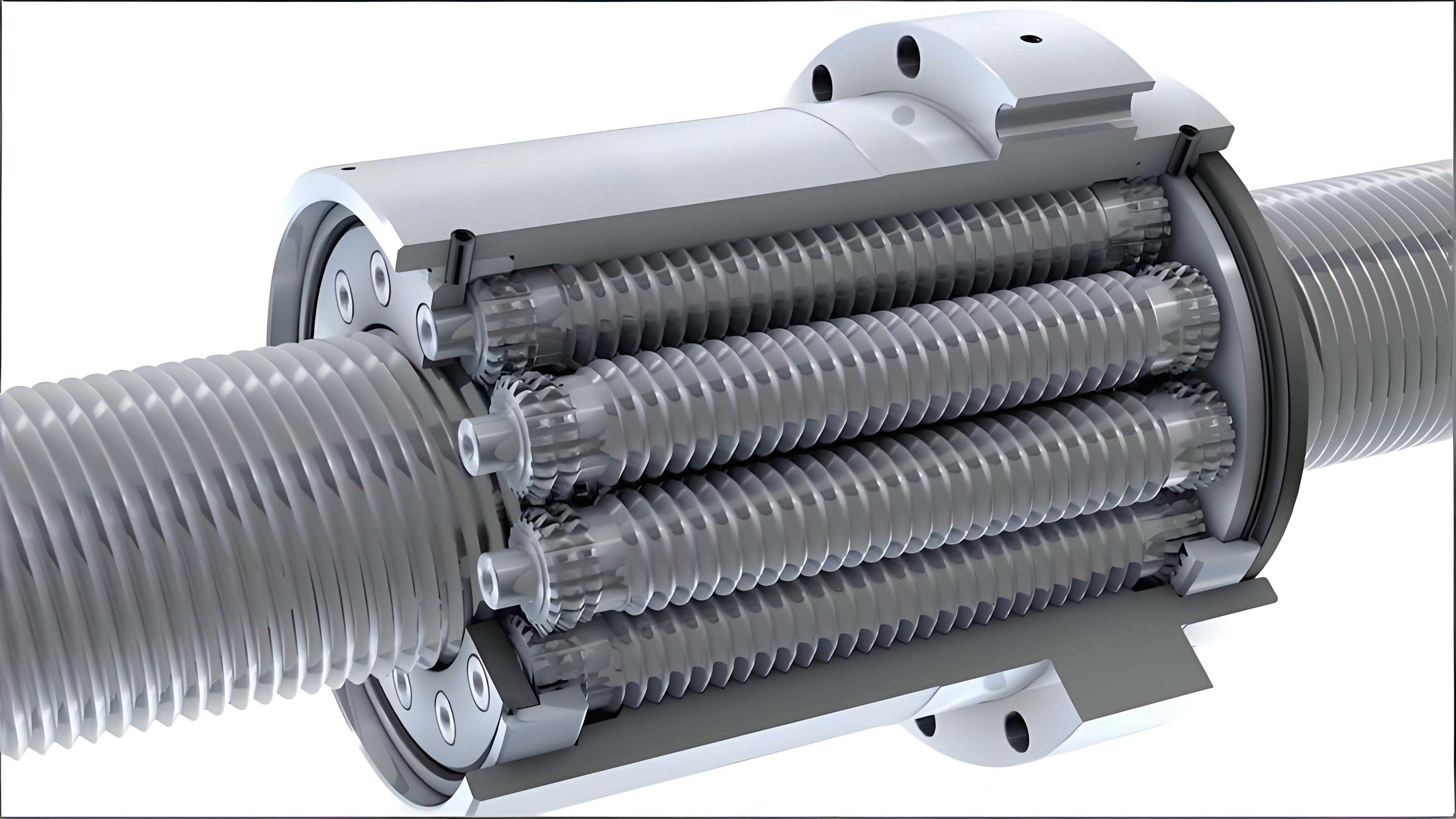
The fundamental kinematic principle of the planetary roller screw assembly involves constrained motion: the nut rotates but is fixed axially, the screw translates linearly but is prevented from rotating, and the rollers undergo both rotation about their own axes (spin) and revolution around the screw axis (orbit). To derive the precise kinematic relationships, we analyze the geometry and motion constraints. Let us define the pitch diameters as $d_n$ (nut), $d_r$ (roller), and $d_s$ (screw). The lead is denoted by $s$, and the number of thread starts for the nut and screw are $n_n$ and $n_s$, respectively (the roller has $n_r=1$). The angular velocities are $\omega_n$ (nut rotation), $\omega_r$ (roller spin), and $\omega_c$ (roller orbit or cage rotation).
At the roller-screw contact point, pure rolling is enforced by the gear pair. This implies the instantaneous center of rotation for the roller relative to the screw is at the contact point. From the velocity geometry, the relationship between the orbital speed and the nut speed is derived as:
$$
\omega_c = \frac{d_n}{2(d_s + d_r)} \omega_n = \frac{d_n}{2d_r(1 + k)} \omega_n
$$
where $k = d_s / d_r$. The pure rolling condition also relates the angular displacement of the roller spin ($\phi_r$) to its orbital displacement ($\phi_c$): the arc length rolled on the roller equals the arc length traversed on the screw. This yields:
$$
\frac{\phi_r}{\phi_c} = \frac{d_s}{d_r} = k
$$
Since $\omega_r / \omega_c = \phi_r / \phi_c$, we combine the equations to find the roller spin velocity:
$$
\omega_r = \frac{k (k+2)}{2(k+1)} \omega_n
$$
A critical design step is determining the hand relationship and the number of starts among the components. We analyze the relative axial displacement $L_1$ of a roller relative to the screw over one nut revolution. This displacement has two components: one from the roller’s spin ($L_{1r}$) and one from its orbit ($L_{1c}$), which is equal and opposite to the axial displacement the screw would have if it rotated through the orbital angle. The expressions are:
$$
L_{1r} = \frac{\phi_r}{2\pi} s, \quad L_{1c} = \mp n_s \frac{\phi_c}{2\pi} s
$$
The sign depends on the hand relationship (upper: same hand, lower: opposite hand). For the roller to have no net axial slip relative to the screw—a requirement for the mechanism—we must have $L_1 = L_{1r} + L_{1c} = 0$. This condition forces the selection of the lower sign, indicating the screw and roller threads must be of opposite hand. Substituting the ratio $\phi_r/\phi_c = k$ leads to the requirement for the screw’s number of starts:
$$
n_s = k = \frac{d_s}{d_r}
$$
Next, we analyze the contact between the nut and the roller. The relative motion here can include a sliding component. The relative axial displacement $L_2$ of the roller with respect to the nut also has two components. Following a similar derivation and enforcing a condition to avoid erratic axial slip (which would cause velocity fluctuations), we find that the kinematic equations balance only if the nut and roller threads are also of opposite hand. This leads to the condition:
$$
n_n = k = \frac{d_s}{d_r}
$$
Consequently, the axial displacement of the screw (which equals $L_2$) per one revolution of the nut is:
$$
L_2 = n_n \cdot s
$$
Therefore, the linear velocity of the screw is:
$$
v_s = \frac{\omega_n}{2\pi} n_n s = \frac{\omega_n}{2\pi} n_s s
$$
Based on this kinematic analysis, we can summarize the fundamental parameter selection rules for a functional Inverted Planetary Roller Screw Assembly in the following table:
| Parameter | Rule/Relationship | Rationale |
|---|---|---|
| Pitch Diameters | $d_n = d_s + 2d_r$ | Geometric assembly constraint. |
| Number of Thread Starts | $n_n = n_s = k = d_s/d_r$; $n_r=1$ | Derived from no-slip kinematic conditions at both contacts. |
| Hand of Threads | Nut & Roller: Opposite; Screw & Roller: Opposite. | Required for kinematic consistency and force transmission. |
| Roller Gear Teeth | $z_s / z_r \approx k$, where $z$ is number of teeth. | Gear pitch diameters match thread pitch diameters to maintain alignment. |
| Roller Gear Design | Gear addendum diameter $\leq$ Roller thread major diameter. | Ensures the nut can be assembled over the roller gears. |
To validate the derived kinematics and investigate the dynamic forces within the planetary roller screw assembly, a detailed multi-body dynamics simulation was conducted. A three-dimensional solid model was created with the following key parameters:
| Component | Lead, $s$ (mm) | Starts, $n$ | Hand | Pitch Diameter, $d$ (mm) |
|---|---|---|---|---|
| Roller | 3 | 1 | Right | 5.095 |
| Screw | 3 | 4 ($=k$) | Left | 20.379 |
| Nut | 3 | 4 ($=k$) | Left | 30.569 ($=d_s+2d_r$) |
The model, incorporating five planetary rollers, was imported into ADAMS software. Realistic joints were applied: a revolute joint for the nut, a translational joint for the screw, revolute joints between rollers and their cage (for spin), and a cylindrical joint for the cage (allowing orbit and axial translation). Contact forces between the nut-roller and roller-screw pairs were modeled using the Impact function, with parameters (stiffness, damping, exponent) set for steel-on-steel contact, including Coulomb friction. A constant rotational velocity of $\omega_n = 157.08 \, \text{rad/s}$ (9000 deg/s) was applied to the nut. An external axial load $F_{ext}$ opposing the screw’s motion was applied at the screw’s center of mass to simulate operational conditions.
The simulation provided time-history data for velocities and forces. The roller’s total angular velocity ($\omega’_r$) measured in the global frame is the sum of its spin ($\omega_r$) and orbital ($\omega_c$) components. The simulation outputs were processed to extract these values. The screw’s linear velocity $v_s$ and displacement were also recorded. For a simulation run with $F_{ext} = 25 \, \text{kN}$, the mean results are compared to theoretical predictions below:
| Parameter | Simulation Mean Value | Theoretical Value | Relative Error |
|---|---|---|---|
| Roller Spin, $\omega_r$ (rad/s) | 358.48 | 376.99 | 4.91% |
| Roller Orbit, $\omega_c$ (rad/s) | 89.74 | 94.25 | 4.79% |
| Screw Velocity, $v_s$ (mm/s) | 298.92 | 300.00 | 0.36% |
| Screw Disp. per Rev, $L_2$ (mm) | 11.88 | 12.00 | 1.00% |
The close agreement, particularly for the primary output ($v_s$ and $L_2$), validates the kinematic model and the simulation methodology. Minor discrepancies in angular velocities are attributed to micro-slip at contacts, numerical integration, and the influence of modeled clearances and friction, which are not accounted for in the ideal kinematic theory.
A significant advantage of dynamic simulation is the ability to probe internal contact forces, which are critical for stress analysis and fatigue life prediction. The contact forces at the nut-roller and roller-screw interfaces were analyzed under varying external loads. The following table summarizes the mean contact force per roller pair for different external loads $F_{ext}$:
| External Load, $F_{ext}$ (kN) | Mean Nut-Roller Force (kN) | Mean Roller-Screw Force (kN) | Force Ratio (Nut-Roller / Roller-Screw) |
|---|---|---|---|
| 5 | 1.95 | 1.82 | ~1.07 |
| 15 | 6.09 | 5.61 | ~1.09 |
| 25 | 10.52 | 9.58 | ~1.10 |
The contact forces scale approximately linearly with the external load, as expected. However, the force at the nut-roller interface is consistently 7-10% higher than the force at the roller-screw interface for this specific geometry. This asymmetry arises from the kinematic and geometric differences between the two contact points. The nut and roller have different helix angles due to their different diameters, influencing the normal force required to produce the same axial load component. Furthermore, the condition at the roller-screw interface is enforced as pure rolling by the gears, while the nut-roller interface has a compounded rolling and sliding motion. These factors, combined with frictional effects and the specific load distribution among the multiple rollers, lead to the observed disparity in contact forces. The contact forces also exhibit dynamic fluctuations around their mean values, caused by the discrete engagement of thread teeth, clearance effects, and the inherent dynamics of the multi-contact system.
In conclusion, this work provides a thorough exposition of the Inverted Planetary Roller Screw Assembly. The kinematic analysis rigorously establishes the essential design rules governing thread hand, number of starts, and geometric ratios, which are fundamental for any successful design of this planetary roller screw assembly variant. The multi-body dynamics simulation serves as a powerful virtual prototyping tool, not only validating the kinematic predictions but also revealing important dynamic characteristics that are difficult to obtain analytically. The simulation confirms the velocity relationships and, crucially, provides quantitative data on the internal contact forces under load. The finding that the nut-roller contact force is systematically higher than the roller-screw force is critical for designers, indicating which interface may be more prone to wear or failure and should be the focus of material and heat treatment selection. This integrated analytical and simulation methodology forms a robust foundation for the design, optimization, and reliability assessment of high-performance Inverted Planetary Roller Screw Assemblies for demanding linear actuation applications.