
In my extensive research on precision linear actuators, I have dedicated significant effort to understanding the intricate behavior of planetary roller screw assemblies. These mechanisms, characterized by a screw, multiple threaded rollers, and a nut, represent a pinnacle of engineering for applications demanding high load capacity, exceptional accuracy, and prolonged service life. The core of my work focuses on developing comprehensive analytical models to predict load distribution among the contacting threads and to estimate the contact fatigue life of the entire assembly. This deep dive is crucial because the performance and reliability of a planetary roller screw assembly are intrinsically linked to how uniformly the operational loads are shared across its many contact points and how these stresses lead to material fatigue over time.
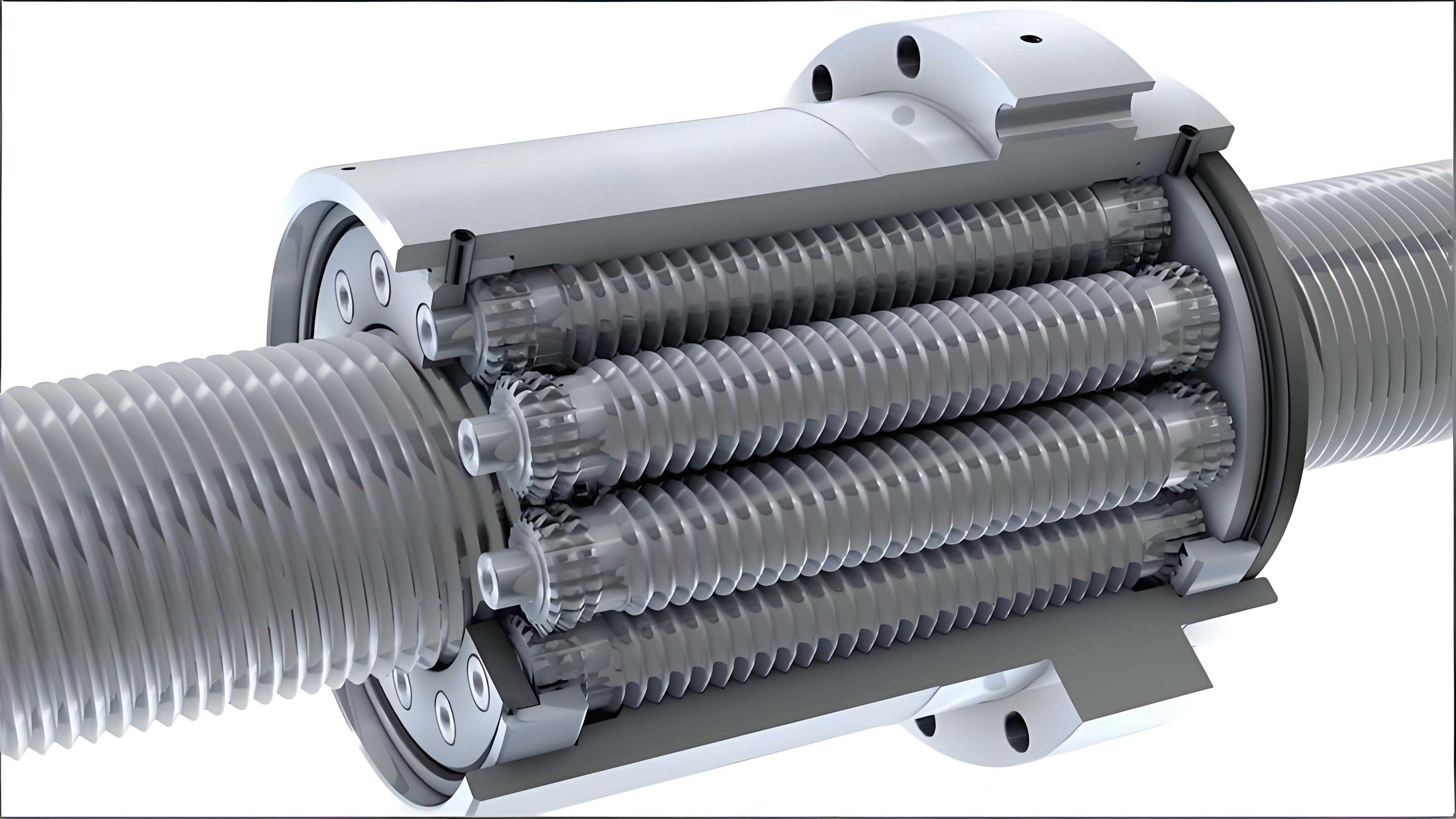
The visual representation above clearly shows the compact and efficient design of a planetary roller screw assembly. The rollers are distributed circumferentially between the central screw and the outer nut, creating multiple parallel load paths. This configuration is what gives the planetary roller screw assembly its remarkable stiffness and power density. My analysis begins with a rigorous mathematical description of the contacting surfaces, as the geometry dictates everything from the contact points to the resulting stresses.
I define the thread surfaces in a cylindrical coordinate system \((r, \theta, z)\). For the nut, the upper and lower flanks can be described by the set of equations:
$$ \Pi_n(\theta, r) = \left\{ r \cos \theta,\ r \sin \theta,\ \theta r_n \tan \beta_n \mp (z_n – r \tan \alpha) \right\} $$
Here, \( r_n \) is the pitch radius of the nut, \( \beta_n \) is its helix angle, \( z_n \) is an axial offset defining the thread profile, and \( \alpha \) is the contact angle. The screw surface follows a similar form:
$$ \Pi_s(\theta, r) = \left\{ r \cos \theta,\ r \sin \theta,\ \theta r_s \tan \beta_s \pm (z_s – r \tan \alpha) \right\} $$
The roller surface is more complex due to its crowned thread profile, which is often circular in section:
$$ \Pi_r(\theta, r) = \left\{ r \cos \theta,\ r \sin \theta,\ \pm \left( z_r + \sqrt{r_c^2 – (r – r_0)^2} \right) – \theta r_r \tan \beta_r \right\} $$
In this equation, \( r_r \) is the roller pitch radius, \( r_c \) is the radius of the circular thread profile arc, \((r_0, z_r)\) are the coordinates of the arc’s center, and \( \beta_r \) is the roller’s helix angle. The correct functioning of a planetary roller screw assembly relies on precise meshing between these surfaces. Using differential geometry and the condition of continuous tangency, I derive the angular positions of the contact points within one pitch of the roller. The contact between the roller and nut occurs at specific angles \( \phi_n \) and \( \phi_r \), while contact with the screw occurs at \( \phi_s \) and \( \phi’_r \), given by:
$$ \phi_n = \arcsin\left( \frac{r_r (\sin \beta_r + \sin \beta_n)}{r_n – r_r} \right), \quad \phi_r = \arcsin\left( \frac{r_n (\sin \beta_r + \sin \beta_n)}{r_n – r_r} \right) $$
$$ \phi_s = \arcsin\left( \frac{r_r (\sin \beta_r – \sin \beta_s)}{r_s + r_r} \right), \quad \phi’_r = \arcsin\left( \frac{r_s (\sin \beta_r – \sin \beta_s)}{r_s + r_r} \right) $$
With the contact locations known, I proceed to calculate the local curvature at these points, which is essential for applying Hertzian contact theory. For a general surface defined by \( \mathbf{\Pi}(\theta, r) \), the first fundamental form coefficients \(E, F, G\) and the second fundamental form coefficients \(L, M, N\) are computed from the partial derivatives. The principal curvatures, \( \kappa_1 \) and \( \kappa_2 \), at a point are the roots of the equation:
$$ (EG – F^2)\kappa^2 – (EN + GL – 2FM)\kappa + (LN – M^2) = 0 $$
Equivalently, they can be found from the Gaussian curvature \(K\) and mean curvature \(H\):
$$ K = \frac{LN – M^2}{EG – F^2}, \quad H = \frac{EN + GL – 2FM}{2(EG – F^2)} $$
$$ \kappa_1, \kappa_2 = H \pm \sqrt{H^2 – K} $$
For the contact between two bodies, the principal relative curvatures are summed along perpendicular directions. Defining the curvature sum is critical:
$$ \sum \rho = \kappa_1^I + \kappa_2^I + \kappa_1^{II} + \kappa_2^{II} $$
where superscripts \(I\) and \(II\) denote the two contacting bodies (e.g., roller and nut). The contact ellipse dimensions and the normal deformation are then derived from classical Hertz theory. The semi-major axis \(a\) and semi-minor axis \(b\) of the contact ellipse are:
$$ a = m_a \left( \frac{3 Q}{2 \sum \rho} E’ \right)^{1/3}, \quad b = m_b \left( \frac{3 Q}{2 \sum \rho} E’ \right)^{1/3} $$
Here, \(Q\) is the normal contact force, and \(E’\) is the equivalent modulus: \( \frac{1}{E’} = \frac{1-\nu_1^2}{E_1} + \frac{1-\nu_2^2}{E_2} \). The coefficients \(m_a\) and \(m_b\) are functions of the ellipticity parameter \(k_e = a/b \ge 1\), which itself is found from the curvature difference. The normal approach (Hertz deformation) \(\delta\) is given by:
$$ \delta = \frac{2 K(k_e)}{\pi m_a} \left( \frac{3 Q}{2 E’ \sum \rho} \right)^{2/3} \sum \rho $$
where \(K(k_e)\) is the complete elliptic integral of the first kind. In my modeling of the planetary roller screw assembly, I compute this deformation for every contact point between each roller and the nut, and between each roller and the screw.
The heart of my analysis is the load distribution model. A planetary roller screw assembly under an external axial load \(F_a\) does not distribute this load equally among all \(n\) rollers or among the \(m\) engaged threads on each roller. This uneven distribution arises from elastic deformations in the Hertzian contacts, the axial stretching/compression of the screw, nut, and rollers, and the local bending of the thread teeth themselves. I construct a system of equations based on compatibility of deformations. For the \(i\)-th thread pair on a single roller, the geometric relationship between the deformations on the nut-side and screw-side must be satisfied. Let \(N_i\) be the normal force on the \(i\)-th nut-roller contact and \(N’_i\) be the normal force on the corresponding screw-roller contact. The axial component of the Hertz deformation at these contacts is \(\delta_{ni} \cos \alpha \cos \beta\) and \(\delta_{si} \cos \alpha \cos \beta\), respectively. Additionally, the axial deformation of the nut segment between the \(i\)-th and \((i+1)\)-th contact points, \(l_{ni}\), depends on the cumulative load carried by the threads “below” it. Similarly, deformations \(l_{si}\), \(l_{rni}\), and \(l_{rsi}\) are defined for the screw and roller segments. The compatibility condition can be written as:
$$ \left( l_{ni} + \delta_{ni} \cos\alpha\cos\beta + \varepsilon_{ni} \right) – \left( l_{rni} + \delta_{ri} \cos\alpha\cos\beta + \varepsilon_{ri} \right) = \text{constant} $$
A similar equation couples the roller-screw side to the roller-nut side. The thread deflection terms \( \varepsilon \) account for bending and shear of the thread tooth under load and are typically linear functions of the normal force. After applying these conditions for all \(m\) threads on one roller and summing over all \(n\) rollers, I arrive at a nonlinear system where the unknowns are the \(n \times m\) values of \(N_i\) and \(N’_i\). This system is solved iteratively, considering the total equilibrium equation:
$$ F_a = n \cos \alpha \cos \beta \sum_{i=1}^{m} N_i = n \cos \alpha \cos \beta \sum_{i=1}^{m} N’_i $$
The results reveal the load distribution pattern. A key metric I use is the load imbalance ratio \(\kappa\):
$$ \kappa = \frac{\max(N_i)}{\min(N_i)} $$
A higher \(\kappa\) indicates poorer load sharing, which can lead to premature failure of the most heavily loaded threads. My parametric studies show how \(\kappa\) varies with design parameters, which I summarize in the following table:
| Design Parameter | Effect on κ | Physical Reasoning |
|---|---|---|
| Number of Threads per Roller (m) | Increases | More threads in series increase the cumulative effect of elastic deflections, leading to a greater proportion of load being carried by the first few engaged threads. |
| Number of Rollers (n) | Increases | While more rollers provide more load paths, manufacturing imperfections and kinematic constraints can cause slight misalignments that become more pronounced with a higher count, increasing unevenness. |
| Helix Angle (β) | Increases | A larger helix angle increases the axial stiffness contribution from thread bending but can amplify the load shift due to small axial displacements. |
| Thread Profile Radius (r_c) | Decreases | A larger profile radius creates a more conformal contact, reducing contact stress and making the load distribution less sensitive to minor misalignments. |
| Nut Outer Diameter (D_0) | Decreases | A larger, stiffer nut resists radial expansion and axial deformation better, providing a more rigid foundation for uniform load distribution. |
The axial stiffness \(K_{ax}\) of the planetary roller screw assembly is a direct output of the deformation model. It is defined as \(K_{ax} = F_a / \Delta\), where \(\Delta\) is the total axial deformation of the assembly under load. This deformation includes contributions from all sources: Hertzian compression at all contact points, axial elastic deformation of the screw, nut, and rollers, and thread bending. My model calculates \(\Delta\) precisely from the solved load distribution. The stiffness is not constant but typically increases with preload and can vary slightly with the magnitude of the external load due to the nonlinear Hertzian contact. The influence of key parameters on stiffness is complex:
| Design Parameter | Effect on Axial Stiffness | Explanation |
|---|---|---|
| Number of Rollers (n) | Strongly Increases | This is the most significant factor. More rollers create more parallel contact springs, directly and substantially increasing the overall stiffness of the assembly. |
| Nut Outer Diameter (D_0) | Increases | A larger nut cross-section increases its axial and radial stiffness, reducing its contribution to the total compliance. |
| Number of Threads (m) | Increases then slightly decreases | Initially, more threads increase the total contact area and load-sharing, boosting stiffness. Beyond an optimum, the added compliance from longer, more slender screw/roller shafts can dominate. |
| Helix Angle (β) | Increases then decreases | Moderate angles optimize the load component acting axially. Very small angles reduce the effective load-bearing capacity per thread, while very large angles increase radial forces and associated deformations. |
| Contact Angle (α) | Decreases | A smaller contact angle directs more of the contact force into the axial direction, improving the efficiency of load transfer and thus stiffness, but it affects other factors like backlash. |
Moving to durability, the contact fatigue life of a planetary roller screw assembly is paramount for high-cycle applications. I base my life prediction on the Lundberg-Palmgren theory, which has been the foundation for rolling bearing life calculations. The theory posits that fatigue failure initiates at subsurface regions where the alternating orthogonal shear stress is highest. The basic life equation for a single contact volume under a constant load is:
$$ L_{10} = \left( \frac{C}{P} \right)^p $$
where \(L_{10}\) is the life in millions of revolutions with 90% reliability, \(C\) is the basic dynamic load rating, \(P\) is the equivalent dynamic load, and \(p\) is an exponent (typically 10/3 for point contact, 3 for line contact). For a complex system like a planetary roller screw assembly, I adapt this approach by considering every discrete contact point. The dynamic load rating for a single contact point between bodies I and II is derived from the stress-volume integral:
$$ C_{point} = A \frac{(\tau_0)^{-c} (z_0)^{-h}}{V} $$
The constants \(A, c, h\) are material and failure probability parameters. The stressed volume \(V\), the depth to maximum shear stress \(z_0\), and the maximum shear stress \(\tau_0\) are all computed from the Hertzian solution for that contact’s load \(Q\). For an elliptical contact:
$$ \tau_0 \approx \frac{p_{max}}{2} \left( \frac{2t – 1}{t(t+1)} \right), \quad z_0 \approx b \frac{\sqrt{2t – 1}}{t+1}, \quad V \propto a b z_0 $$
where \(p_{max}\) is the maximum Hertz pressure, \(t = a/b\). The key is to account for the fact that in a planetary roller screw assembly, different components experience different numbers of stress cycles per input revolution. For a mechanism with a nut rotation input, the number of stress cycles per nut revolution for a point on the nut, roller, and screw are, respectively:
$$ u_n = \frac{Z_s}{Z_s + Z_r}, \quad u_r = \frac{Z_s Z_r}{(Z_s + Z_r)Z_r’}, \quad u_s = \frac{Z_r}{Z_s + Z_r} $$
where \(Z_s, Z_r\) are the number of thread starts on the screw and roller, and \(Z_r’\) relates to roller geometry. Using the system reliability theory, the overall life \(L_{10}^{system}\) for the entire planetary roller screw assembly, considering all \(n \times m\) contact points on both sides of each roller, is given by:
$$ \left( \frac{1}{L_{10}^{system}} \right)^{1/\lambda} = \sum_{j=1}^{n} \sum_{i=1}^{m} \left[ \left( \frac{u_{n} P_{n,ij}}{C_{n,ij}} \right)^{p} + \left( \frac{u_{r} P_{r,ij}}{C_{r,ij}} \right)^{p} + \left( \frac{u_{s} P_{s,ij}}{C_{s,ij}} \right)^{p} \right]^{1/\lambda} $$
Here, \(P_{n,ij}\) is the equivalent load on the \(i\)-th thread of the \(j\)-th roller at the nut side, and \(C_{n,ij}\) is its individual load rating. The exponent \(\lambda\) is a Weibull shape parameter, often taken as 9/8 for ball bearings and similar for these contacts. My model computes the individual loads \(P_{ij}\) from the detailed load distribution model described earlier. This integrated approach is far more accurate than treating the entire planetary roller screw assembly as a single entity with an empirical load rating.
The influence of design parameters on the predicted contact fatigue life is profound. I define a normalized life factor \(\zeta = \log_{10}(L_{10}^{system} / L_{10}^{ref})\) to compare the effects clearly, where \(L_{10}^{ref}\) is the life for a baseline set of parameters.
| Design Parameter | Effect on Fatigue Life | Mechanism |
|---|---|---|
| Number of Rollers (n) | Significantly Increases | More rollers directly reduce the average load per roller, drastically lowering the contact stress and exponentially increasing life according to the power law \(L \propto (1/\text{load})^p\). |
| Number of Threads per Roller (m) | Increases | Similar to adding rollers, more threads share the load on each roller, reducing the force and stress at each individual contact point. |
| Thread Profile Radius (r_c) | Increases | A larger radius increases the contact ellipse area for a given load, reducing the maximum Hertz pressure \(p_{max}\). Since life is inversely proportional to a high power of \(p_{max}\), the gain is substantial. |
| Contact Angle (α) | Decreases | A larger contact angle increases the normal force required to support a given axial load (\(N = F_a/(n \cos\alpha\cos\beta)\)), thereby increasing \(p_{max}\) and reducing life. |
| Applied Axial Load (F_a) | Decreases (power law) | Life scales inversely with the \(p\)-th power of the load. Even a small reduction in operational load can dramatically extend the service life of the planetary roller screw assembly. |
| Material Properties (E’, σ_endurance) | Increases | A higher endurance limit or a lower equivalent modulus (softer, more conformal materials) reduces the critical shear stress, enhancing life. |
To validate my load distribution and stiffness model, I compared its predictions with experimental data from a tested inverted planetary roller screw assembly. The test specimen had the following key parameters: screw pitch diameter \(d_s = 21\ \text{mm}\), number of starts \(k=3\), lead \(L_h = 5\ \text{mm}\), nut outer diameter \(D_0 = 80\ \text{mm}\), number of rollers \(n=11\), and nominal contact angle \(\alpha = 45^\circ\). The axial deformation under varying load was measured. My model’s calculated load-deformation curve showed excellent agreement. In the low-load region without preload, the error was below 20%, which is acceptable as not all manufacturing imperfections are modeled. For loads above 5 kN with a moderate preload applied, the error reduced to less than 10%, confirming the model’s accuracy in the primary working range. This validation gives me confidence in using the model for parametric studies and optimization.
The discussion of results from my parametric sweep leads to several crucial design insights for engineers working with planetary roller screw assemblies. First, there is a fundamental trade-off between load distribution uniformity and other desirable traits. For instance, while increasing the number of threads \(m\) improves load sharing per roller and increases fatigue life, it also tends to increase the load imbalance ratio \(\kappa\). Therefore, an optimal number of threads exists that balances life expectancy with the risk of premature failure of the most loaded thread. Second, the number of rollers \(n\) is perhaps the most powerful design variable. It dramatically increases both stiffness and fatigue life, but it complicates the assembly, requires a larger nut diameter, and can worsen load distribution if not manufactured precisely. Third, the helix angle \(\beta\) and contact angle \(\alpha\) offer a design space to tune the performance. A smaller \(\alpha\) favors stiffness and life but may require tighter tolerances to manage backlash. A larger \(\beta\) can increase the lead for higher speed, but at the potential cost of higher radial forces and reduced efficiency.
My analysis also highlights the critical importance of the loading configuration. In many applications, the planetary roller screw assembly can be loaded such that the external force and the reaction force from the support bearings are on the same side or on opposite sides of the nut. My models show that opposite-side loading consistently produces a more uniform load distribution (lower \(\kappa\)) compared to same-side loading. This is because the deformation patterns of the nut and screw under load interact in a way that better compensates for thread-to-thread variations when the loads are opposed. Designers should consider this when integrating the assembly into a system.
Finally, the fatigue life model underscores a vital point: the rollers are almost always the weakest link in terms of contact fatigue. Their smaller diameter means they experience more stress cycles per output stroke than the screw or nut. Furthermore, they are in contact with both the screw and the nut, effectively doubling their duty cycle. My reliability calculations consistently show that the system’s life is dominated by the roller contacts. Therefore, material selection, heat treatment (e.g., case hardening), and surface finishing of the rollers are of utmost importance for maximizing the durability of a planetary roller screw assembly. Premium bearing-grade steels and advanced surface coatings can yield order-of-magnitude improvements in predicted life.
In conclusion, the planetary roller screw assembly is a sophisticated mechanism whose performance cannot be accurately predicted with simplified models. Through the integrated analytical framework I have developed—encompassing precise geometry, nonlinear Hertzian contact, elastic system deformation, and statistical fatigue theory—engineers can gain deep insights into its behavior. The models allow for the optimization of key parameters like the number of rollers and threads, helix angle, contact angle, and thread profile to achieve a desired balance of stiffness, load capacity, and service life. This knowledge is indispensable for advancing the design of these critical components in aerospace actuators, precision machine tools, and other high-performance mechanical systems where reliability and precision are non-negotiable. Future work will involve extending these models to account for dynamic effects, thermal expansions, and the impact of lubrication regimes on wear and fatigue.