
The pursuit of high-performance motion control and actuation in demanding applications such as aerospace, robotics, and precision machine tools has consistently driven the development of advanced mechanical power transmission systems. Among these, the planetary roller screw assembly stands out due to its superior load-carrying capacity, high stiffness, exceptional durability, and reliable operation under extreme conditions. This mechanism elegantly converts rotary motion into linear thrust (or vice-versa) through the meshing of threaded surfaces between a central screw, multiple planetary rollers, and a surrounding nut. The load is distributed across several contact lines on the rollers, theoretically offering significant advantages over traditional ball screws. However, a critical challenge that impedes the full realization of this potential is the non-uniform distribution of load among the individual threads in the engaged zone.
In practical operation, the first few engaged threads near the load application point tend to bear a disproportionately high share of the total axial force. This concentration of stress accelerates wear, promotes premature fatigue failure, and ultimately limits the service life and reliability of the entire planetary roller screw assembly. This phenomenon is analogous to the well-documented load distribution problem in power screw threads, but it is compounded in the planetary roller screw assembly by the presence of multiple, spatially complex contact paths and the interactions between several components. Addressing this load maldistribution is therefore paramount for enhancing performance.
This article, based on my analysis and modeling, delves into the methodology of thread tooth modification as a strategic solution to homogenize load sharing. Using finite element analysis as the primary investigative tool, I explore the impact of targeted geometrical alterations—specifically on the roller threads and the screw threads—on the contact stress and force distribution within a planetary roller screw assembly. The core objective is to demonstrate how deliberate, minimal changes to the tooth profile can compensate for elastic deformations under load, thereby promoting a more uniform stress state and unlocking higher performance ceilings for this critical mechanism.
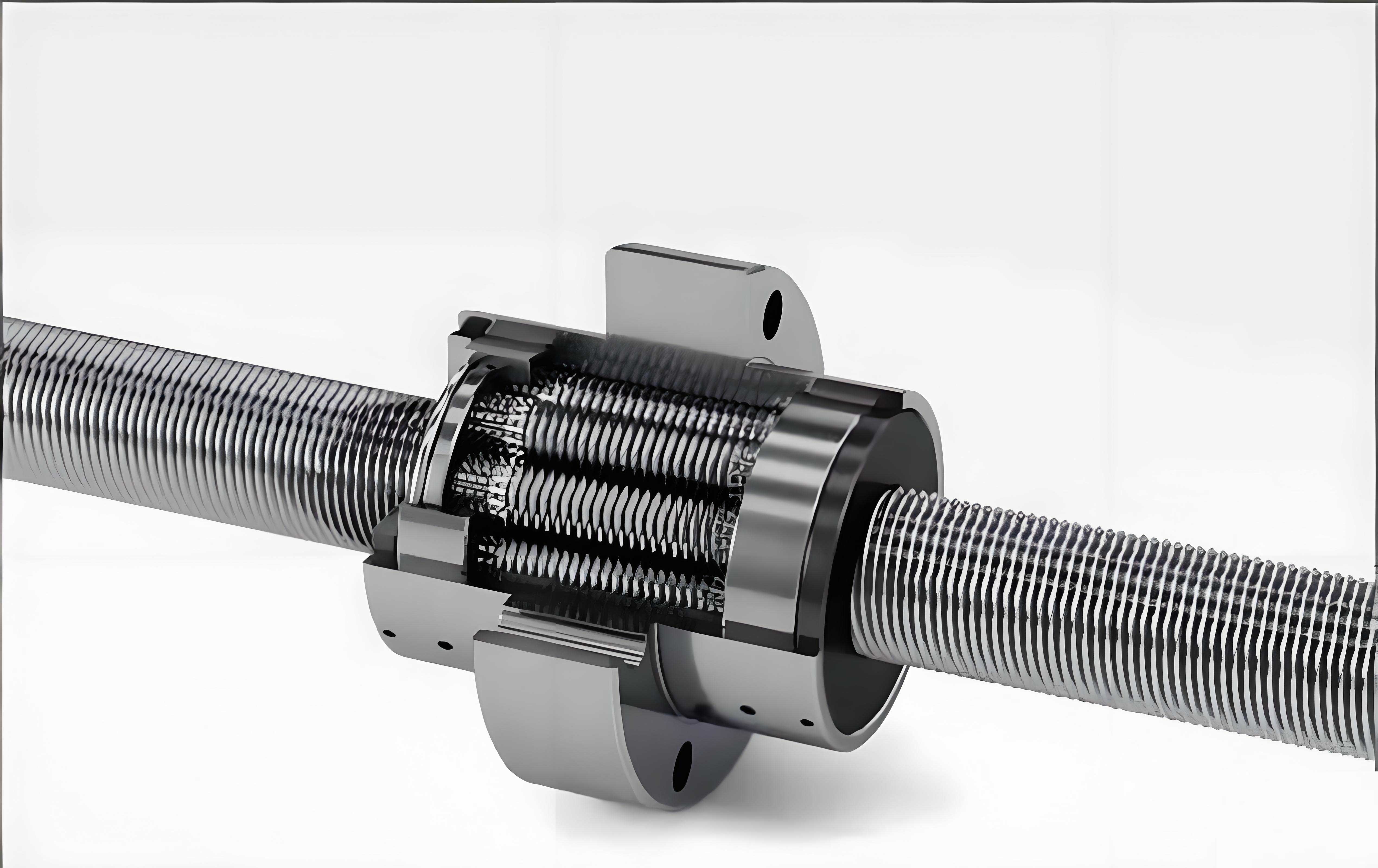
The fundamental operation of a planetary roller screw assembly relies on precise threaded engagement. A central screw, typically with a multi-start thread, is in simultaneous contact with several identical planetary rollers, which themselves engage with an internally threaded nut. The rollers are housed in a carrier that prevents axial movement but allows rotation, causing them to orbit the screw as they spin. The kinematic relationship dictates the linear travel per revolution. The contact forces at the screw-roller and nut-roller interfaces are three-dimensional. For analytical purposes, the normal contact force at any thread flank can be resolved into three orthogonal components: axial (Fa), tangential (Ft), and radial (Fr). The relationships are derived from the geometry of the thread, defined by the helix angle (α) and the normal pressure angle (φ).
If $F_n$ represents the normal contact force at the thread interface, its components can be expressed as:
$$F_a = F_n \cos \phi \cos \alpha$$
$$F_t = F_n \cos \phi \sin \alpha$$
$$F_r = F_n \sin \phi$$
The summation of the axial components $F_a$ from all active contact points across all rollers must equilibrate the external axial load applied to the planetary roller screw assembly. It is the uneven sharing of this total $F_a$ among individual threads that is the central issue.
To accurately model the complex, non-linear contact behavior within a planetary roller screw assembly, I employ Finite Element Analysis (FEA). Given the periodic symmetry of a system with Z rollers, a 1/Z sector model is sufficient for load distribution analysis, significantly reducing computational cost without sacrificing accuracy. The model includes only the critical threaded engagement regions of the screw, one representative roller, and the corresponding segment of the nut. The material is typically modeled as linear-elastic (e.g., GCr15 bearing steel with E = 212 GPa, ν = 0.29).
Contact pairs are defined between the screw-roller and nut-roller threaded surfaces with a frictional coefficient (e.g., 0.15). A fine, localized mesh is generated at and around the contact zones to capture stress gradients accurately. Boundary conditions are applied to replicate the operational state: the nut is fixed, the screw is constrained to allow only axial translation, and the roller’s axial displacement is coupled to the screw’s while allowing rotation. A substantial axial load (e.g., 5000 N) is applied to the free end of the screw. Solving this model reveals the stark reality of load concentration. The results consistently show that the first engaged thread on the loaded side carries the highest force, with the load decaying exponentially along the engagement length. This pattern is observed on both the screw-roller and nut-roller sides, though the severity often differs.
| Thread Position (From Load) | Screw-Roller Load (N) | Nut-Roller Load (N) | Load Share (%) |
|---|---|---|
| 1 | 631 | 576 | ~21% | ~19% |
| 2 | 580 | 552 | ~19% | ~18% |
| 3 | 535 | 530 | ~18% | ~18% |
| 4 | 495 | 510 | ~17% | ~17% |
| 5 | 460 | 492 | ~15% | ~16% |
| … Last | 439 | 468 | ~15% | ~16% |
The principle behind thread modification is proactive compensation. Under load, components elastically deform. The cumulative axial deformation of the screw and nut causes the “effective” pitch of their threads to differ slightly from that of the rigid roller, leading to the observed load concentration on the first threads. Modification intentionally alters the tooth profile to create a controlled “gap” or “lead error” in the unloaded state. When load is applied and deformation occurs, this pre-engineered gap closes progressively from one end of the engagement zone to the other, ideally bringing all threads into contact simultaneously and sharing the load equally.
I investigated two primary modification strategies for the planetary roller screw assembly, each targeting a different component.
Method 1: Roller Thread Profile Modification (Linear Thickness Variation)
This method keeps the basic arc profile of the roller thread intact but linearly varies the thickness of each thread half-tooth along the roller’s axis. For the screw-roller interface, the half-tooth thickness is increased linearly from the free end towards the loaded end. Conversely, for the nut-roller interface, the thickness is decreased linearly from the free end towards the fixed (loaded) end. The maximum modification amount, δ_roller, is the total change in tooth thickness over the engagement length.
The effect is to create a tapered gap. Before loading, only a few threads are in full contact. Under load, axial compression of the screw and nut effectively “shortens” them relative to the roller, gradually taking up the slack in the modified profile and engaging more threads. The optimal δ_roller is on the order of the total axial elastic deformation of the mating parts under nominal load. My parametric FEA studies evaluated δ_roller from 0.002 mm to 0.016 mm.
| Modification δ_roller (mm) | Max Thread Load (N) | Min Thread Load (N) | Std. Deviation (N) | Max Contact Stress (MPa) |
|---|---|---|---|---|
| 0 (Unmodified) | 631 | 439 | 59.6 | 2421 |
| 0.002 | 597 | 458 | 42.8 | 2439 |
| 0.004 | 575 | 472 | 30.5 | 2352 |
| 0.006 | 543 | 480 | 21.7 | 2303 |
| 0.008 | 564 | 474 | 25.8 | 2350 |
| 0.010 | 593 | 458 | 38.0 | 2340 |
The data clearly indicates an optimum. At δ_roller = 0.006 mm, the standard deviation of the thread loads is minimized, indicating the most uniform distribution. The maximum load drops by nearly 14%, and the peak contact stress is also reduced. Beyond this optimum, over-modification occurs, causing the load to peak at the opposite end of the engagement zone, reintroducing maldistribution. A similar analysis for the nut-roller interface revealed an even more sensitive response, with an optimal δ_roller of 0.004 mm, due to the higher relative stiffness of the nut structure.
Method 2: Screw Thread Lead Modification (Tapered Tooth Height)
This approach directly modifies the screw, the component often found to have the more severe load concentration. The engaged portion of the screw is given a slight linear taper, meaning the thread tooth height is progressively reduced from the loaded end to the free end. The modification amount, δ_screw, is the maximum reduction in tooth height. The intent is to make the screw threads at the loaded end more compliant (effectively “softer”) so they deform more easily under load, allowing subsequent threads to share the burden.
My FEA results for this method showed a different trend. For small modifications (δ_screw < 0.025 mm), the effect on load distribution was negligible. Significant improvement required larger modifications, but this came with a critical trade-off.
| Modification δ_screw (mm) | Max Thread Load (N) | Min Thread Load (N) | Std. Deviation (N) | Max Contact Stress (MPa) |
|---|---|---|---|---|
| 0 (Unmodified) | 631 | 439 | 62.9 | 2047* |
| 0.015 | 620 | 436 | 59.6 | 3506 |
| 0.025 | 593 | 453 | 46.5 | 3632 |
| 0.035 | 463 | 474 | 14.2 | 4122 |
| 0.040 | 517 | 474 | 15.1 | 4715 |
While a δ_screw of 0.035 mm achieved excellent load uniformity (lowest standard deviation) and a dramatic reduction in maximum load, the peak contact stress increased alarmingly—by over 100% compared to the unmodified nut-roller interface stress. This creates a paradox: the load is shared better, but the most stressed point is subjected to a significantly higher Hertzian pressure, which could accelerate surface fatigue (pitting) and defeat the purpose of extending the life of the planetary roller screw assembly.
Comparing the two methods yields decisive insights for designing a high-performance planetary roller screw assembly. Roller modification (Method 1) proves to be the superior strategy. It effectively reduces both the maximum thread load and the maximum contact stress when the optimal modification amount is applied. The modification is applied to the component (the roller) that is typically easier to manufacture and replace than the screw or nut. Its effect is predictable, with a clear optimum that aligns with the system’s elastic deformation.
Screw lead modification (Method 2), while capable of excellent load equalization, does so at the expense of drastically increased contact stress for the required modification depths. This makes it a less desirable solution for high-cycle fatigue life, which is often the primary design driver for a planetary roller screw assembly. The sharp increase in stress is likely due to the reduced contact area on the heavily modified, tapered flanks of the screw threads.
The sensitivity of the nut-roller interface to smaller modification amounts highlights the importance of considering the relative stiffness of all components in the system. The stiffer the surrounding structure (the nut), the less deformation it undergoes, and thus a smaller compensatory modification on the roller is needed to achieve balance. A comprehensive design optimization for a planetary roller screw assembly would therefore involve calculating the individual axial compliances of the screw and nut under load to guide the selection of the optimal roller modification profile, potentially applying different modification amounts for the screw-side and nut-side flanks of the roller threads.
In conclusion, thread tooth modification is a powerful and necessary design tool for maximizing the performance of a planetary roller screw assembly. The non-uniform load distribution inherent in unmodified designs is a major limiting factor for load capacity and longevity. Through detailed finite element analysis, I have demonstrated that targeted linear modification of the roller thread profile is an effective method to homogenize load sharing. This approach successfully lowers both the peak load on individual threads and the associated contact stress, directly contributing to enhanced fatigue life and reliability. The planetary roller screw assembly, when optimized through such precision engineering of its threaded interfaces, can fully deliver on its promise as a robust, high-capacity, and durable solution for the most demanding linear motion applications. Future work should integrate this modification strategy with full system stiffness models and advanced manufacturing techniques to enable the production of next-generation planetary roller screw assemblies with predictable, optimized performance characteristics.