
In the realm of precision power transmission, the cycloidal drive stands out for its high torque capacity, compact design, and excellent overload protection. Traditional single-tooth difference cycloidal drives, where the number of pin teeth exceeds the number of cycloid gear teeth by one, face significant challenges at low reduction ratios (typically i≤17). These challenges include a reduced number of simultaneously engaged teeth, leading to heightened contact stresses, potential pin bending failures, and tooth surface scoring. To overcome these limitations, the two-tooth difference cycloidal drive has been developed and widely adopted. In this configuration, the pin tooth count exceeds the cycloid gear tooth count by two, which improves load distribution, increases the simultaneous contact ratio, and enhances the overall torque transmission capability, particularly in low-ratio applications. This article delves into the mechanical analysis of this robust drive system, with a focused examination on a critical component: the pin stock. I will present a detailed methodology for calculating the bending strength and stiffness of the pin stock in a two-tooth difference cycloidal drive, based on an accurate force analysis that accounts for realistic tooth profile modifications.
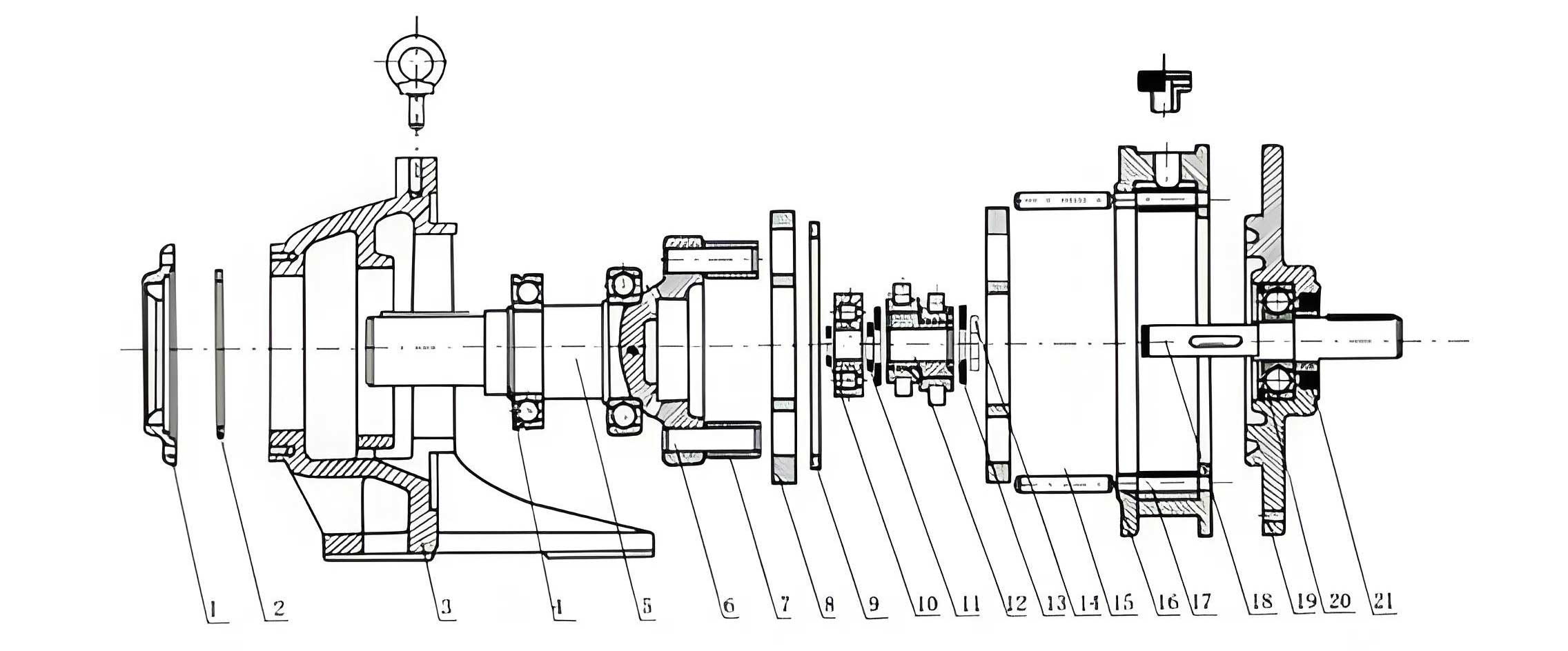
The operational principle of a cycloidal drive relies on the meshing between a lobed cycloid disc and a ring of cylindrical pins. The unique motion generates high reduction ratios in a single stage. The performance and longevity of any cycloidal drive are intrinsically linked to the health of its pins, or pin stocks. These components transmit force from the cycloid disc to the housing and are subjected to cyclic bending loads. Failure due to excessive bending stress or deflection can lead to catastrophic drive failure. Therefore, a precise understanding of the loads acting on each pin and a rigorous method for verifying its structural integrity are paramount in the design process. This is especially true for the two-tooth difference variant, where the load-sharing characteristics and tooth engagement pattern differ from the conventional single-tooth design.
The foundation for any strength calculation is an accurate force analysis. For a two-tooth difference cycloidal drive, the force analysis is complicated by the standard practice of profile modification applied to the cycloid gear tooth flank. Modifications, such as equidistant modification (effectively reducing the pin circle radius) and profile shift modification (effectively increasing the pin radius), are applied to optimize backlash, ensure proper lubrication, and prevent edge-loading at the tooth tips. However, these modifications create initial clearances between the cycloid gear and the pins when the drive is unloaded. Under load, these clearances must be closed by elastic deformation before a pin can carry any load. Consequently, the number of pins actually sharing the load at any given moment and the magnitude of force on each pin are dynamic and depend on the precise geometry and the applied torque. A simplified analysis that ignores these clearances or uses approximations derived from single-tooth difference drives can lead to significant errors in predicting the maximum pin load. I will describe an analytical method that accurately computes these initial clearances throughout the entire engagement cycle, leading to a force distribution model that closely aligns with engineering reality.
Tooth Profile Generation in Two-Tooth Difference Cycloidal Drives
The tooth profile of a two-tooth difference cycloid gear is not a simple, standard cycloidal curve. It is generated from the intersection of two sets of single-tooth difference cycloid curves that are phase-shifted by half of the angular pitch. Let us define the fundamental parameters. For a single-tooth difference drive, let \(z_c\) be the number of teeth on the cycloid gear and \(z_p = z_c + 1\) be the number of pin teeth. The theoretical tooth profile of the cycloid gear is a shortened epicycloid, derived from a rolling circle of radius \(r’_p\) rolling on a fixed base circle of radius \(r’_c\).
For the two-tooth difference drive, the pin tooth count is \(z_2 = z_c + 2\). The generation process can be visualized as follows. On the rolling circle circumference, points are marked at intervals corresponding to half of the circular pitch \(t/2\) of the single-tooth difference gear. When this rolling circle rotates around the base circle, these points generate two families of complete epicycloids that are out of phase by \(360^\circ / (2z_c)\). The tooth profile for the two-tooth difference gear is formed by the non-complete, shortened epicycloid segments where these two families intersect, effectively creating a tooth with a theoretical tip. The equidistant curve to this theoretical profile, offset by the pin radius \(r_{rp}\), gives the actual working profile of the cycloid gear that meshes with the cylindrical pins. This generation method results in a tooth with a pointed tip, which is undesirable due to stress concentration and noise generation. Therefore, tip relief in the form of the aforementioned modifications is universally applied, blunting the tip and creating the necessary running clearances. This modified geometry is the starting point for all subsequent force and strength analyses in a practical cycloidal drive.
Precise Force Analysis for Modified Tooth Profiles
The core of predicting pin stock loads lies in determining the force transmitted through each meshing pin. For a modified two-tooth difference cycloid gear, under no load, only one pin is in theoretical contact at any given position of the input eccentric shaft. All other pins have a small separation, or initial clearance \(\Delta Q_i\), from the cycloid gear flank. When torque is applied, the system deforms. A pin will begin to carry load only when the total elastic deformation in the direction of the common normal at that pin’s location exceeds its initial clearance \(\Delta Q_i\). The force on that pin is then proportional to this excess deformation.
The critical step is the accurate computation of \(\Delta Q_i\) for every pin \(i\) relative to a presumed initial contact point \(K\). Previous simplified methods assumed the initial contact always occurs at the point of maximum force arm, which is not generally true for the entire rotation. My analytical method calculates the clearance for any arbitrary initial contact position.
Let Curve 1 represent the theoretical, unmodified tooth profile of the cycloid gear (no profile shift or equidistant modification). Its parametric equations in the coordinate system fixed to the gear center are:
$$ x_1 = (r_p – r_{rp} S_i^{-1/2}) \sin[(1 – i_h)\phi_i] + \frac{a}{r_p}(r_p – z_p r_{rp} S_i^{-1/2}) \sin(i_h \phi_i) $$
$$ y_1 = (r_p – r_{rp} S_i^{-1/2}) \cos[(1 – i_h)\phi_i] – \frac{a}{r_p}(r_p – z_p r_{rp} S_i^{-1/2}) \cos(i_h \phi_i) $$
where:
\(r_p\) is the pin circle radius,
\(r_{rp}\) is the pin radius,
\(a\) is the eccentricity,
\(i_h = z_p / z_c\) is the transmission ratio parameter for the generating mechanism,
\(S_i = 1 + K_1^2 – 2K_1 \cos \phi_i\),
\(K_1 = a z_p / r_p\) is the shortening coefficient,
\(\phi_i\) is the generating angle parameter for point \(i\) on the profile.
Let Curve 2 represent the actual, modified tooth profile. Its equations are:
$$ x_2 = (r’_p – r’_{rp} S_{2i}^{-1/2}) \sin[(1 – i_h)\phi’_i] + \frac{a}{r’_p}(r’_p – z_p r’_{rp} S_{2i}^{-1/2}) \sin(i_h \phi’_i) $$
$$ y_2 = (r’_p – r’_{rp} S_{2i}^{-1/2}) \cos[(1 – i_h)\phi’_i] – \frac{a}{r’_p}(r’_p – z_p r’_{rp} S_{2i}^{-1/2}) \cos(i_h \phi’_i) $$
where:
\(r’_p = r_p – \Delta r_p\) (profile shift modification, effectively increasing pin radius),
\(r’_{rp} = r_{rp} + \Delta r_{rp}\) (equidistant modification, effectively reducing pin circle radius),
\(S_{2i} = 1 + K’_1^2 – 2K’_1 \cos \phi’_i\),
\(K’_1 = a z_p / r’_p\).
Assume the initial contact under load occurs at a specific pin located at point \(K\) on Curve 1, with parameter \(\phi_K\). For the actual gear (Curve 2) to contact this point, it must rotate relative to its theoretical position. This relative rotation angle \(\beta_K\) is found by solving for the point on Curve 2 that has the same radial distance from the center as point \(K\) and then calculating the angular difference. The coordinates of point \(K\), \((x_K, y_K)\), are obtained from Curve 1’s equations with \(\phi_i = \phi_K\). Its radial distance is \(R_K = \sqrt{x_K^2 + y_K^2}\). We need to find the parameter \(\phi’_M\) for a point \(M\) on Curve 2 such that its coordinates \((x_M, y_M)\) satisfy \(R_K = \sqrt{x_M^2 + y_M^2}\). This involves solving a system of non-linear equations. Once \(\phi’_M\) is determined, the coordinates \((x_M, y_M)\) are known, and the relative rotation angle \(\beta_K\) can be computed as:
$$ \beta_K = \arcsin\left( \frac{\sqrt{(x_M – x_K)^2 + (y_M – y_K)^2}}{2 R_K} \right) $$
This angle \(\beta_K\) is significant as it relates to the backlash or lost motion in the cycloidal drive.
Now, imagine rotating the actual profile (Curve 2) by this angle \(\beta_K\) counterclockwise to form Curve 2′, which now contacts point \(K\). The equation for Curve 2′ is:
$$ x’_2 = x_2 \cos \beta_K + y_2 \sin \beta_K $$
$$ y’_2 = y_2 \cos \beta_K – x_2 \sin \beta_K $$
For any other pin \(i\) located at point \((x_i, y_i)\) on Curve 1 (with parameter \(\phi_i\), where \(\phi_i – \phi_K\) is an integer multiple of \(2\pi/z_2\)), we can compute the initial clearance \(\Delta Q_i\). This clearance is the shortest distance, along the common normal direction, from point \((x_i, y_i)\) to Curve 2′. The common normal at point \((x_i, y_i)\) for the theoretical profile (which is the same as for its equidistant curve) is found by differentiating the base shortened epicycloid (setting \(r_{rp}=0\) in Curve 1 equations). The direction vector components are:
$$ \frac{dx_i}{d\phi_i} = r_p (1 – i_h) \cos[(1 – i_h)\phi_i] + a i_h \cos(i_h \phi_i) $$
$$ \frac{dy_i}{d\phi_i} = -r_p (1 – i_h) \sin[(1 – i_h)\phi_i] + a i_h \sin(i_h \phi_i) $$
The slope of the normal line passing through \((x_i, y_i)\) is \(-\frac{dx_i}{dy_i}\). The intersection point \(T\) \((x_{Ti}, y_{Ti})\) between this normal line and Curve 2′ is found by solving the line equation and the parametric equations of Curve 2′ simultaneously. The initial clearance is then the Euclidean distance:
$$ \Delta Q_i = \sqrt{(x_{Ti} – x_i)^2 + (y_{Ti} – y_i)^2} $$
This calculation must be performed for all pin positions within a half-pitch range of the initial contact point \(K\) to ensure a valid contact condition (all \(\Delta Q_i \geq 0\) and only one intersection per tooth space). By varying the assumed initial contact point \(\phi_K\) over one angular pitch (\(2\pi/z_2\)), we can map the initial clearance distribution for the entire engagement cycle.
Calculation of Contact Forces and Maximum Pin Load
With the initial clearances known, we proceed to calculate the contact forces under a transmitted output torque \(M_v\). Considering a typical design with two cycloid discs phased 180° apart for balance, we assume each disc carries approximately 55% of the total torque to account for slight load unevenness. Therefore, the torque per disc is \(0.55M_v\). Let the pins from number \(m\) to \(n\) be the set that are potentially in contact for a given initial contact point \(K\). The deformation at the initial contact pin \(K\), denoted \(E_K\), consists of the contact deformation \(W_K\) and the bending deformation of the pin itself \(J_K\) at that location, both in the direction of the common normal. These deformations are functions of the contact force \(F_K\).
The force equilibrium condition and the proportionality between force and net deformation (deformation minus initial clearance) yield the following equation for \(F_K\):
$$ F_K = \frac{0.55 M_v}{\sum_{i=m}^{n} \left( \frac{L_i}{L_K} – \frac{\Delta Q_i}{E_K} \right) L_i } $$
where \(L_i = a z_c S_i^{-1/2}\) is the force arm (distance from the gear center to the line of action) for pin \(i\), and \(L_K\) is the force arm for the initial contact pin. The term \(\left( \frac{L_i}{L_K} – \frac{\Delta Q_i}{E_K} \right)\) represents the relative force contribution factor for pin \(i\), accounting for both geometric advantage and the clearance it must overcome.
The deformations \(W_K\) and \(J_K\) are calculated using Hertzian contact theory and beam bending formulas, respectively. For the contact deformation between the cycloid gear (steel) and the pin (steel):
$$ W_K = \frac{2(1-\nu^2)}{\pi E} F_K \left( \frac{2}{3} + \ln \frac{4 \rho_{Ti}}{b} \right) \quad \text{(simplified for cylinder-on-plane approximation)} $$
where \(\nu\) is Poisson’s ratio, \(E\) is Young’s modulus, \(\rho_{Ti}\) is the relative curvature radius at the contact point, and \(b\) is the half-width of the contact area. More precise formulas specific to cycloidal gear geometry are used in practice. The pin bending deformation \(J_K\) at the point of load application for a simply supported beam (for a two-support pin design) will be detailed in the next section.
Since \(E_K = W_K + J_K\) is a function of \(F_K\), and \(F_K\) is a function of \(E_K\), an iterative numerical solution is required. Using an algorithm like the Newton-Raphson method or a simple fixed-point iteration, we solve for \(F_K\) and \(E_K\). However, the force \(F_K\) at the initial contact point is not necessarily the maximum force on any pin during the meshing cycle. The force on any other pin \(i\) is:
$$ F_i = F_K \frac{(E_i – \Delta Q_i)}{E_K} $$
where \(E_i = E_K (L_i / L_K)\). The maximum contact force \(F_{max}\) is found by evaluating \(F_i\) for all pins \(i\) and all possible initial contact positions \(\phi_K\) within one pitch:
$$ F_{max} = \max_{\phi_K, i} \left( F_K \frac{(E_i – \Delta Q_i)}{E_K} \right) $$
Similarly, the maximum contact stress \(\sigma_{Hmax}\), which is critical for pitting resistance, is calculated using the Hertzian contact stress formula for cylindrical surfaces:
$$ \sigma_{Hmax} = \max_{\phi_K, i} \left( 0.418 \sqrt{ \frac{E_d F_K (E_i – \Delta Q_i)}{B_b \rho_{Ti} E_K} } \right) $$
where \(E_d\) is the combined modulus of elasticity, \(B_b\) is the effective face width of the cycloid gear, and \(\rho_{Ti}\) is the comprehensive radius of curvature at the contact point for pin \(i\).
Bending Strength and Stiffness Calculation for the Pin Stock
The pin stock, a cylindrical pin upon which the needle bearing sleeve (pin gear) often rotates, is subjected to the contact force \(F_{max}\) as a transverse load. According to Newton’s third law, the force on the pin is equal and opposite to the force exerted by the cycloid gear. Excessive bending stress can lead to fatigue fracture, while excessive deflection (characterized by the slope at the support) can cause the pin to bind in its housing or disrupt the proper rotation of the needle bearing sleeve, leading to wear and failure. Therefore, both strength and stiffness must be verified.
Two common support configurations are used depending on the pin circle diameter \(d_p\). For \(d_p < 390 \text{ mm}\), a two-support design is typical. For larger diameters, a three-support design is used to reduce span and deflection. The following analysis focuses on the two-support design, which is common in many compact cycloidal drive units.
The calculation model assumes the pin is a simply supported beam of diameter \(d_{sp}\) and span \(L\). The contact force from the cycloid gear is distributed over the face width \(B_b\). For conservatism and simplicity, it is common to model the load as a concentrated force acting at the midpoint of the span, or as a uniformly distributed load over a portion of the span. A more realistic model assumes the load is uniformly distributed over half the gear face width centered on the midpoint. The formulas for maximum bending stress \(\sigma_F\) and the slope (angle) \(\theta\) at the support are as follows.
For a pin with a uniformly distributed load \(w = F_{max} / (B_b/2)\) over a length of \(B_b/2\) at the center of the span \(L\), the maximum bending moment occurs at the center. The maximum bending stress is:
$$ \sigma_F = \frac{M_{max} \cdot c}{I} = \frac{ \left[ \frac{w (B_b/2)}{2} \left( L – \frac{B_b}{2} \right) \right] \cdot (d_{sp}/2) }{\frac{\pi d_{sp}^4}{64}} = \frac{1.411 F_{max} L}{d_{sp}^3} $$
The factor 1.411 consolidates the constants from the specific load distribution. This stress must be less than the allowable bending stress for the pin material \(\sigma_{FP}\):
$$ \sigma_F = \frac{1.411 F_{max} L}{d_{sp}^3} \leq \sigma_{FP} \quad \text{(MPa)} $$
The slope at the support, which is critical for ensuring free rotation of the needle sleeve, is given by:
$$ \theta = \frac{4.44 \times 10^{-6} F_{max} L^2}{d_{sp}^4} \leq \theta_p \quad \text{(radians)} $$
The constant \(4.44 \times 10^{-6}\) has units to yield radians when force is in Newtons, length in mm, and accounts for the load distribution and material properties (assuming steel with \(E = 2.06 \times 10^5 \text{ MPa}\)).
Where:
\(F_{max}\) is the maximum contact force on the pin (in N),
\(L\) is the span between supports (in mm). Typically, \(L \approx 3.5 B_b\) for a two-support design,
\(d_{sp}\) is the pin stock diameter (in mm),
\(\sigma_{FP}\) is the allowable bending stress for the pin material. For high-carbon chromium bearing steel like GCr15 (AISI 52100), \(\sigma_{FP}\) can be in the range of 150 to 200 MPa, depending on heat treatment and safety factors,
\(\theta_p\) is the allowable slope at the support. To ensure proper functioning of the needle bearing, \(\theta_p\) is typically very small, in the range of 0.001 to 0.003 radians.
These formulas provide a direct link between the complex meshing forces derived earlier and the structural assessment of a key component. The accuracy of the \(F_{max}\) calculation directly influences the reliability of the pin stock design.
Computational Example and Results
To illustrate the application of this methodology, I consider a specific two-tooth difference cycloidal drive model with the following parameters, similar to the example in the source material: Output torque \(M_v = 240 \text{ N·m}\), Pin circle radius \(r_p = 110 \text{ mm}\), Pin radius \(r_{rp} = 8.5 \text{ mm}\), Eccentricity \(a = 5 \text{ mm}\), Reduction ratio \(i = 11.5\), Cycloid gear tooth count \(z_c = 9\), Pin tooth count \(z_2 = 11\). The profile modifications are: Equidistant modification \(\Delta r_{rp} = -0.35 \text{ mm}\) (reducing pin circle), Profile shift modification \(\Delta r_p = 0.50 \text{ mm}\) (increasing effective pin radius). The pin stock has a diameter \(d_{sp} = 8.5 \text{ mm}\), and the effective gear width \(B_b = 12 \text{ mm}\), leading to an approximate support span \(L = 3.5 \times 12 = 42 \text{ mm}\).
Implementing the analytical procedure described—calculating initial clearances for various assumed initial contact points, solving the force equilibrium iteratively, and determining the maximum forces—yields the following results. The table below summarizes the findings for four different initial contact positions (\(\phi_K\)) to demonstrate the variation in load distribution. The analysis identifies which pin numbers are in force-transmitting contact for each case.
| Initial Contact Point \(\phi_K\) (degrees) | Pins in Contact | Max Pin Force \(F_{max}\) (N) | Bending Stress \(\sigma_F\) (MPa) | Support Slope \(\theta\) (rad) |
|---|---|---|---|---|
| 48.80 | Pins 3 to 6 | 1469 | 68.47 | 0.0013 |
| 55.37 | Pins 3 to 6 | 1531 | 89.86 | 0.0016 |
| 58.70 | Pins 3 to 5 | 1367 | 80.23 | 0.0014 |
| 62.71 | Pins 3 to 6 | 2207 | 129.54 | 0.0023 |
This table clearly shows that the initial contact position significantly influences the load dynamics within the cycloidal drive. The maximum pin force varies from 1367 N to 2207 N. Consequently, the calculated bending stress in the pin stock ranges from 68.47 MPa to 129.54 MPa, and the slope at the support varies from 0.0013 rad to 0.0023 rad. Comparing these results with the allowable limits for GCr15 steel (\(\sigma_{FP} = 150-200 \text{ MPa}\)) and the typical allowable slope (\(\theta_p = 0.001-0.003 \text{ rad}\)), we can conclude that for this specific drive design, the pin stock is adequately sized. The maximum calculated stress of 129.54 MPa is well within the material’s strength, and the maximum slope of 0.0023 rad is within the acceptable range for ensuring smooth operation of the needle bearings. This example validates the engineering soundness of the design and, more importantly, highlights the necessity of the precise force analysis method. Using an average or approximated maximum force could lead to either an over-designed (costly) or under-designed (risky) pin stock.
Discussion and Implications for Cycloidal Drive Design
The methodology presented establishes a robust framework for analyzing two-tooth difference cycloidal drives. The accurate computation of initial clearances is the linchpin, transforming a static gear mesh assumption into a dynamic load-sharing model that mirrors real-world behavior. This approach has several important implications for the design and optimization of cycloidal drives.
First, it allows designers to confidently predict the true load on the most critically stressed pin. This is essential for performing reliable fatigue life calculations for the pin stock and the cycloid gear teeth. Second, the calculation of the relative rotation angle \(\beta_K\) provides direct insight into the kinematic backlash of the drive, a key performance parameter for applications requiring high positional accuracy. Third, by incorporating the effects of specific profile modifications (\(\Delta r_{rp}\) and \(\Delta r_p\)), the method enables the evaluation of how different modification strategies affect load distribution, maximum stress, and backlash. This is a powerful tool for design optimization; one can potentially adjust modifications to achieve a more uniform load distribution among pins, thereby increasing the drive’s overall torque capacity or life.
The force analysis also feeds into other critical analyses, such as the calculation of contact stresses on the cycloid gear flank (for pitting resistance) and the analysis of the output mechanism (e.g., rollers and pins in the output flange). The principles, while detailed for a two-tooth difference drive, are adaptable with appropriate adjustments to single-tooth difference or other multi-tooth difference cycloidal drives. The core idea of calculating clearances due to modification and solving for force equilibrium based on deformation remains universally applicable.
From a practical standpoint, implementing this analysis requires computational tools. The solution of the non-linear equations for initial clearance and the iterative force calculation are best performed using software, whether a custom-written program, a sophisticated spreadsheet, or integration into CAD/CAE systems. This computational aspect is a natural step in the modern design process for high-performance mechanical components like those found in advanced cycloidal drives.
Conclusion
In this comprehensive analysis, I have detailed a precise analytical method for determining the bending strength and stiffness of pin stocks in two-tooth difference cycloidal drives. The process begins with a geometrically accurate calculation of the initial clearances between a modified cycloid gear tooth profile and the pin teeth, accounting for the variable initial contact point. This leads to a force distribution model that solves for contact forces based on elastic deformations, providing a realistic picture of load sharing among the pins. The maximum pin force derived from this model is then used in standard beam bending formulas to evaluate the pin stock’s bending stress and deflection at the supports.
The results from a computational example demonstrate the method’s effectiveness and its sensitivity to operating conditions. The calculated stresses and deflections fell within acceptable limits for a typical drive, validating the design. More importantly, the method provides a level of accuracy superior to simplified approximations, enabling more reliable and potentially more efficient designs. As cycloidal drives continue to be favored in robotics, aerospace, and high-precision industrial machinery for their compactness and high torque-to-weight ratio, such rigorous analytical techniques become increasingly valuable. They ensure that these drives are not only functional but also durable and reliable, maximizing the benefits of the ingenious cycloidal principle. Future work could integrate this mechanical analysis with thermal and lubrication models, or explore its application to novel cycloidal drive variants with further optimized tooth profiles, continuing to push the boundaries of this versatile power transmission technology.