
In my extensive experience with industrial machinery, I have often relied on cycloidal drives for their compact design, high reduction ratios, and lightweight construction. These advantages make cycloidal drives a popular choice in transmission systems across various sectors, including cement production, mining, and material handling. However, through practical application and maintenance, I have encountered several design, manufacturing, and operational shortcomings that can hinder their reliability. This article delves into these issues, proposes improvements, and explores technical aspects to optimize cycloidal drive performance, all from a first-hand perspective. I will emphasize the term “cycloidal drive” throughout to underscore its relevance, and incorporate tables and formulas to summarize key points, aiming for a comprehensive discussion exceeding 8000 tokens.
The fundamental operation of a cycloidal drive hinges on the meshing of a cycloidal disc (or rotor) with a stationary ring of pins. This interaction converts eccentric motion into rotational output with high torque multiplication. The reduction ratio, a critical parameter, can be expressed mathematically. For a standard cycloidal drive, the ratio is given by:
$$ i = \frac{N_p}{N_p – N_c} $$
where \( N_p \) is the number of pins in the ring (针轮齿数) and \( N_c \) is the number of lobes on the cycloidal disc (摆线轮齿数). This formula highlights the drive’s ability to achieve large reduction ratios in a single stage, often exceeding 100:1, which is a standout feature compared to traditional gear systems. To visualize the internal arrangement, consider the following diagram, which shows a typical cycloidal gearbox assembly.
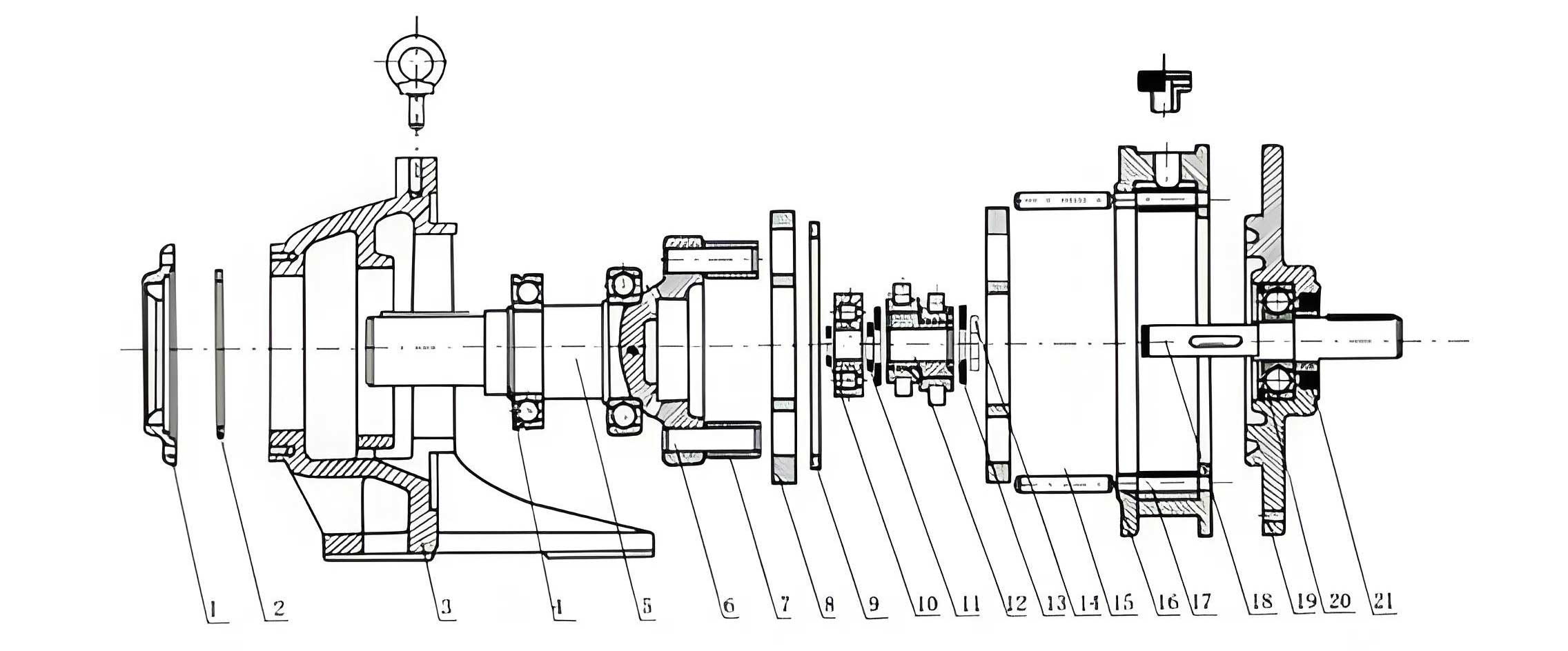
The compactness stems from this unique kinematic principle, but it also introduces stress concentrations that, if not properly addressed, lead to failures. Below is a table comparing cycloidal drives with conventional cylindrical gear reducers, based on my observations.
| Feature | Cycloidal Drive | Cylindrical Gear Reducer |
|---|---|---|
| Reduction Ratio Range | High (up to 200:1 in single stage) | Moderate (typically up to 10:1 per stage) |
| Size and Weight | Compact and light | Larger and heavier |
| Backlash | Low | Higher, depending on precision |
| Component Interchangeability | Poor across manufacturers | Good due to standardized parts |
| Cost of Spares | Relatively high | Moderate to low |
| Common Failure Points | Flange fractures, housing cracks | Gear tooth wear, bearing failures |
Despite the benefits, the cycloidal drive presents several challenges in real-world use. One major issue is the lack of standardization. Numerous manufacturers produce cycloidal drives with varying models, dimensions, and components that are not interchangeable. This non-uniformity complicates spare parts procurement, especially for continuous operations like cement plants, where a cycloidal drive failure can disrupt entire production lines, affecting output, quality, and efficiency. In contrast, cylindrical gear reducers, with established national standards, offer better part interchangeability, simplifying repairs and ratio adjustments—often just by swapping a gear shaft or adjusting belt drives.
Another critical problem is the design weakness in the motor connection flange. For high-power cycloidal drives (e.g., those transmitting 55 kW, 75 kW, or 90 kW), the flange, typically cast iron, is too slender. Combined with vibration from larger motors, this leads to oil leaks, cracks, and eventual fracture. I have witnessed several cycloidal drives gradually developing vibrations, leaks, and then catastrophic flange failures, necessitating replacement with cylindrical reducers or extensive reinforcement. The stress on the flange can be approximated by:
$$ \sigma = \frac{M \cdot c}{I} $$
where \( \sigma \) is the bending stress, \( M \) is the bending moment from motor weight and dynamic loads, \( c \) is the distance from the neutral axis, and \( I \) is the area moment of inertia. In many cycloidal drive flanges, \( I \) is insufficient, causing \( \sigma \) to exceed material limits.
Furthermore, the housing of cycloidal drives is often inadequately robust. In applications like apron feeders, where blockages occur, the cycloidal drive housing—particularly the foot mounts and mid-sections—has been pulled apart or broken, even when shear pins in couplings remain intact. This housing is costly to replace and repair. The failure typically arises from excessive torsional loads, which can be modeled as:
$$ \tau = \frac{T \cdot r}{J} $$
with \( \tau \) being shear stress, \( T \) the torque, \( r \) the radius, and \( J \) the polar moment of inertia. Low \( J \) in housing designs exacerbates this issue.
Lubrication is another area of concern. Many cycloidal drive manuals recommend using low-viscosity mechanical oils (e.g., 68 or 100 cSt), which lack extreme pressure (EP), anti-wear, and anti-rust additives. This leads to accelerated bearing and internal component wear, rising operating temperatures over months, and increased oil leakage due to low viscosity. The temperature rise \( \Delta T \) can be related to frictional losses:
$$ \Delta T \propto \mu \cdot P \cdot v $$
where \( \mu \) is the friction coefficient, \( P \) the load, and \( v \) the sliding velocity. Without proper additives, \( \mu \) increases, elevating \( \Delta T \).
To address these cycloidal drive shortcomings, I have implemented several measures. For high-power units prone to vibration and flange failure, reinforcement is key. The method involves three steps: first, connecting the upper lifting eye bolts of the cycloidal drive and motor with a steel rod; second, supporting the motor mid-section with a rigid steel bracket; and third, placing wooden or steel pads under the motor. This triad approach significantly stabilizes the assembly, preventing flange fractures. Ideally, future cycloidal drive designs should incorporate a vertical-horizontal motor configuration with direct foundation support. The reinforcement effectively increases the system’s stiffness, reducing dynamic deflection \( \delta \):
$$ \delta = \frac{F}{k} $$
where \( F \) is the force and \( k \) the stiffness constant, which is enhanced by the added supports.
Regarding lubrication, I have adopted two improvements for cycloidal drives. One is adding imported Omega or SB耐磨 additives to standard mechanical oil (68 or 100 cSt), which lowers operating temperatures by 5–10°C or even 15°C by enhancing EP properties. The other is directly substituting with medium-load EP industrial gear oils, such as ISO VG 150, which reduce leakage and wear. I recommend manufacturers update manuals to specify EP gear oils for cycloidal drives. The improvement in film strength can be expressed via the specific film thickness \( \lambda \):
$$ \lambda = \frac{h_{\text{min}}}{\sqrt{R_q^2 + R_q^2}} $$
where \( h_{\text{min}} \) is the minimum lubricant film thickness, enhanced by EP additives, and \( R_q \) surface roughness.
Standardization is crucial. I urge manufacturers to unify cycloidal drive models and components, enabling interchangeability. This would minimize downtime from failures. A proposed standard could include dimensions for key parts like flanges, housings, and pins. Below is a table summarizing suggested improvements for cycloidal drives.
| Issue | Solution | Technical Benefit |
|---|---|---|
| Weak Flange | Reinforce with connecting rods and supports; redesign for thicker castings or steel | Reduces bending stress \( \sigma \) by increasing \( I \) |
| Fragile Housing | Strengthen foot mounts and mid-sections; use ductile iron or reinforced designs | Increases polar moment \( J \), lowering shear stress \( \tau \) |
| Inadequate Lubrication | Switch to EP industrial gear oils (e.g., ISO VG 150) with additives | Boosts film strength, reduces \( \mu \) and \( \Delta T \) |
| Non-Uniform Parts | Establish industry-wide standards for dimensions and tolerances | Enhances interchangeability, cuts spare part lead time |
| High Spare Cost | Optimize manufacturing processes and standardize to economies of scale | Lowers overall lifecycle cost |
From a practical standpoint, in our facility, approximately 70% of cycloidal drive systems have been replaced by motor-cylindrical gear reducer arrangements due to recurrent issues. For remaining cycloidal drives, we maintain backup units and implement the above measures to ensure long-term, safe, and stable operation. This experience underscores the need for design recalculation. For instance, the housing and flange strengths should be re-evaluated using finite element analysis (FEA) to account for dynamic loads. The safety factor \( n \) should satisfy:
$$ n = \frac{\sigma_{\text{yield}}}{\sigma_{\text{working}}} \geq 2.5 \text{ for cast iron} $$
in cycloidal drive components.
In conclusion, while cycloidal drives offer unmatched compactness and high reduction ratios, their reliability in heavy-duty applications is compromised by design flaws, lubrication inadequacies, and lack of standardization. Through reinforcement techniques, lubrication upgrades, and advocacy for industry standards, the performance of cycloidal drives can be significantly improved. I encourage design departments to re-calculate strengths and promote uniformity, ensuring that the cycloidal drive realizes its full potential as a robust transmission solution. The continued evolution of cycloidal drive technology hinges on addressing these practical challenges, paving the way for wider adoption and reduced maintenance headaches in industrial settings.