
In modern mechanical transmission systems, hyperbolic gears, often referred to as hypoid gears, play a critical role due to their ability to transmit motion between non-intersecting and non-parallel axes with high efficiency and smooth operation. The complex tooth surface geometry of hyperbolic gears directly influences their dynamic performance, noise levels, and lifespan. Traditional manufacturing methods for hyperbolic gears, such as those using dedicated Gleason machines, rely on intricate tooling systems, swing frames, and specialized fixtures, leading to lengthy setup times, limited machining efficiency, and constraints in processing large-sized gears. With the rapid advancement of numerical control (NC) technology, there is a growing opportunity to explore innovative machining approaches that leverage the flexibility, precision, and high-speed capabilities of modern CNC machining centers. This article delves into the feasibility and implementation of form milling for hyperbolic gears using finger-type milling cutters on vertical machining centers, presenting a comprehensive study from theoretical modeling to practical experimentation.
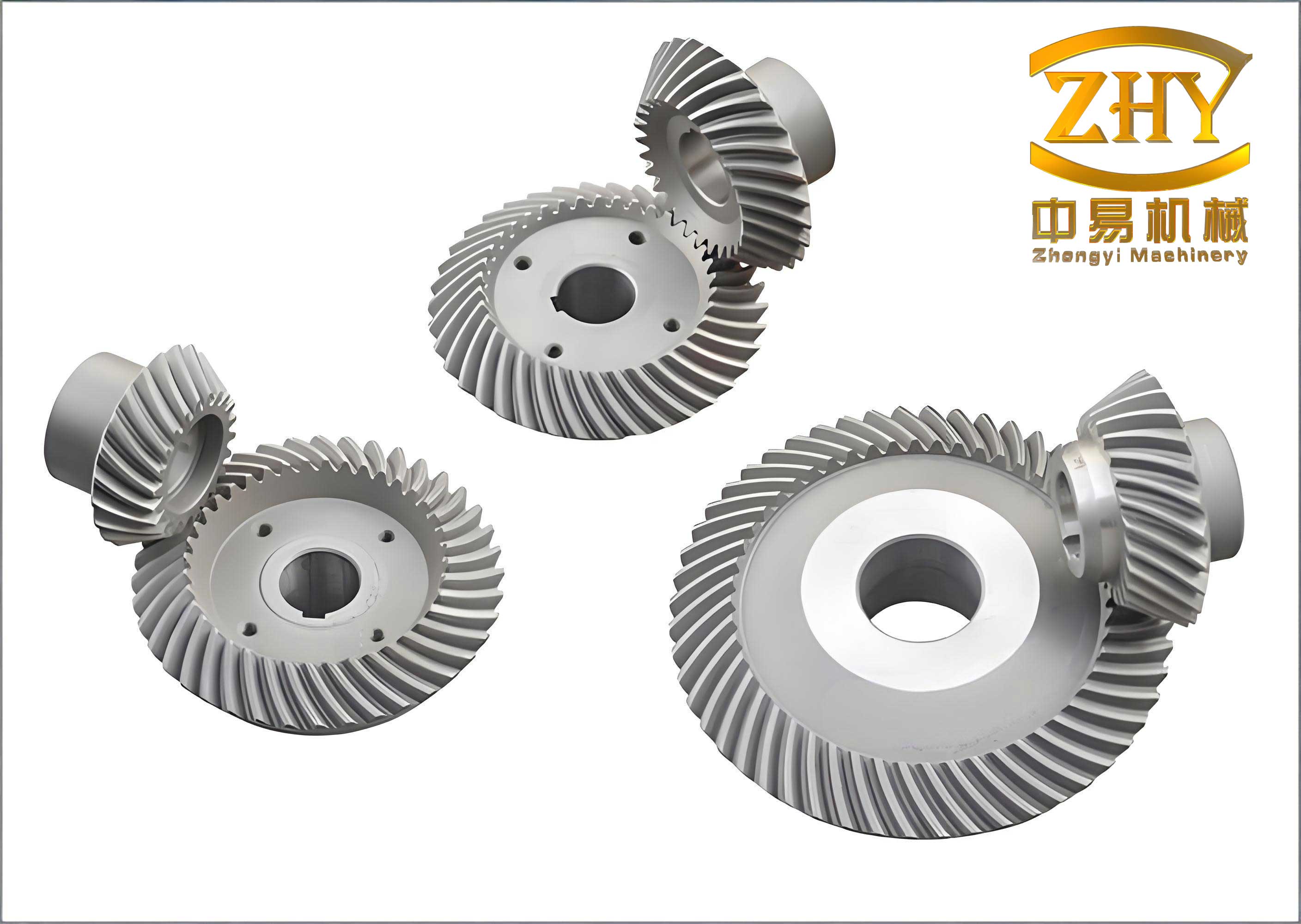
The application of hyperbolic gears spans across automotive differentials, industrial machinery, and aerospace systems, where their unique offset design allows for compact and robust power transmission. However, the manufacturing of hyperbolic gears has long been dominated by specialized gear-cutting machines that employ generating methods with complex kinematic chains. These methods, while effective, often suffer from high equipment costs, rigid process constraints, and challenges in adapting to custom or large-scale production. In contrast, NC-based machining offers a paradigm shift by enabling multi-axis control, programmable tool paths, and integration with computer-aided design (CAD) and manufacturing (CAM) systems. This research investigates whether the form milling technique, commonly used for simpler gear profiles, can be adapted for hyperbolic gears, particularly the Formate-type large gear where the tooth profile is straight in the normal section. By utilizing a finger-type end mill to simulate the cutting action of a traditional cutter head, we aim to achieve high-quality tooth surfaces with reduced setup time and enhanced process flexibility. The core of this work lies in establishing a mathematical model for the form milling process, determining machine adjustment parameters, generating NC codes, and validating through simulation and physical machining trials.
The feasibility of form milling for hyperbolic gears hinges on two main aspects: the kinematic compatibility and the practical implementation. Kinematically, the Formate method for hyperbolic gears produces a tooth surface that is conjugate to a straight-sided basic rack, meaning the normal tooth profile is linear. This characteristic allows the use of a finger-type cutter whose profile closely matches the desired tooth space. During machining, the relative motion between the cutter and the gear blank must replicate the path of the virtual generating gear. In NC machining, this can be achieved through coordinated linear and rotary axes movements. Specifically, the workpiece is mounted on a NC rotary table (or indexer), while the finger-type cutter performs interpolated arcs and linear feeds to carve out the tooth slots. The tool’s geometry is designed based on the gear’s tooth space dimensions, and its orientation is adjusted to account for the gear’s root angle and offset. Practically, the selection of appropriate cutting tools, machine tools, and fixtures is crucial. For machining hyperbolic gears made of alloy steels, carbide finger-type end mills are recommended due to their hardness and wear resistance. The tool’s diameter and length should be optimized to minimize overhang and enhance rigidity, reducing vibrations and ensuring surface finish. A vertical machining center with at least four axes (three linear and one rotary) is required, such as models from Cincinnati or similar manufacturers, which provide sufficient stiffness, thermal stability, and precision. The fixture, typically a NC dividing head, must securely hold the gear blank with the root cone plane oriented horizontally, and its design should prioritize compactness to avoid deflection during cutting.
To formalize the form milling process, a mathematical model is established to derive the machine adjustment parameters. Consider a coordinate system attached to the machining center, as shown in the schematic below. Let \( Oxyz \) be the machine coordinate system, where the origin \( O \) is the projection of the gear blank’s reference point onto the horizontal plane. The gear blank is fixed to a rotary table with its axis aligned to simulate the root cone angle. The finger-type cutter, representing the virtual cutter head, moves relative to the blank to generate the tooth surface. The key parameters include the horizontal tool setting \( H_m \), vertical tool setting \( V_m \), root angle \( \delta_{m2} \), and axial workpiece setting \( O_2O_m \). These are derived from the basic gear geometry and cutter geometry.
The fundamental equations for the tool settings are based on the geometry of the hyperbolic gears and the form milling principle. For a given point \( M \) on the tooth surface, the coordinates in the machine system can be expressed as:
$$ x_m = V_m \sin(\beta_m) + \Delta, $$
$$ y_m = H_m \cos(\beta_m) – OO_m, $$
where \( \beta_m \) is the spiral angle at point \( M \), and \( \Delta \) accounts for pressure angle corrections. The horizontal and vertical tool settings are given by:
$$ H_m = R_{02} \cos(\beta_{f2}) \cos(\beta_m) – r \sin(\beta_m) – \Delta_h \tan(\delta_{m2}), $$
$$ V_m = R_{02} \cos(\beta_{f2}) \sin(\beta_m) + r \cos(\beta_m), $$
where \( R_{02} \) is the pitch cone distance of the generating gear, \( r \) is the cutter radius compensation, \( \beta_{f2} \) is the nominal spiral angle, and \( \Delta_h \) is a correction factor for pressure angle mismatch. The root angle \( \delta_{m2} \) is determined from the gear design, typically based on the tooth width and offset. The axial setting \( O_2O_m \) is the distance from the gear blank’s reference point to the root cone apex, and its projection in the machine coordinates is:
$$ OO_m = O_2O_m \cos(\delta_{m2}), $$
$$ O_2O = O_2O_m \sin(\delta_{m2}). $$
The center of the interpolated arc path, which simulates the cutter head motion, has coordinates \( (x_{Oc}, y_{Oc}) \) in the \( Oxy \) plane:
$$ x_{Oc} = \pm V_m, $$
$$ y_{Oc} = H_m – OO_m, $$
with the sign depending on the hand of the hyperbolic gear (right-hand or left-hand). The arc’s radius is equal to the nominal cutter head radius \( r_c \). The start and end points of the arc, denoted \( A \) and \( B \), are calculated based on the tooth space width and the gear’s face width \( b_2 \). For instance, if the tooth slot is symmetric, the coordinates can be derived using trigonometric relations involving the arc center and the gear geometry.
To illustrate, consider a hyperbolic gear pair with the following basic parameters. These parameters are essential for calculating the adjustment settings and for NC programming.
| Parameter | Pinion | Gear (Large Wheel) |
|---|---|---|
| Number of Teeth | 9 | 41 |
| Offset Distance (mm) | 31.7 | |
| Shaft Angle | 90° | |
| Face Width (mm) | 33 | 33 |
| Nominal Spiral Angle | 50° | 50° |
| Mean Pressure Angle | 19° | 19° |
| Pitch Diameter (mm) | ~202.25 | ~202.25 |
| Cutter Head Diameter (mm) | 190.5 | |
| Contraction Type | Standard Contraction | |
| Hand of Spiral | Left | Right |
Using these parameters, the adjustment values are computed through the mathematical model. For the large hyperbolic gear, the calculated settings might be: \( H_m = 28.4956 \) mm, \( V_m = 86.6184 \) mm, \( \delta_{m2} = 68.8306^\circ \), \( O_2O_m = 54.6028 \) mm, arc center coordinates \( (x_{Oc}, y_{Oc}) = (86.6184, 8.7704) \) mm, and arc points \( A \) and \( B \) with coordinates \( (-2.229, 43.1093) \) mm and \( (42.0322, 92.9473) \) mm, respectively. These values are critical for setting up the machine and for generating the tool path.
The generation of NC code for form milling hyperbolic gears involves translating the mathematical model into a series of G-codes and M-codes that control the machining center’s axes. The process typically includes: (1) initial positioning of the tool and workpiece, (2) execution of arc interpolation for tooth slot milling, (3) linear retraction for tool clearance, (4) indexing of the rotary table for the next tooth, and (5) repetition until all teeth are machined. Advanced CAM software can automate this process, but understanding the underlying principles is key for optimization. The NC program must account for tool geometry, cutting parameters, and machine dynamics. For instance, the feed rate \( F \), spindle speed \( S \), and depth of cut \( D \) are optimized based on material properties and tool life considerations. The tool path strategy for form milling hyperbolic gears often employs peripheral side milling, where the cutter’s side teeth engage the workpiece to generate the tooth flank. This requires precise control of radial and axial immersion to avoid tool deflection and ensure surface accuracy.
Optimization of milling parameters is crucial for achieving high efficiency and quality in hyperbolic gears production. The following table summarizes key cutting parameters and their typical ranges for form milling alloy steel hyperbolic gears with carbide tools.
| Parameter | Symbol | Typical Range | Influence on Process |
|---|---|---|---|
| Spindle Speed | \( S \) | 1000–3000 rpm | Affects cutting speed, tool wear, surface finish |
| Feed per Tooth | \( f_z \) | 0.05–0.2 mm/tooth | Determines material removal rate, forces |
| Axial Depth of Cut | \( a_p \) | 1–5 mm | Impacts tool load, stability, and cycle time |
| Radial Depth of Cut | \( a_e \) | 0.5–2 mm | Influences tool engagement, heat generation |
| Cutting Speed | \( v_c \) | 50–150 m/min | Related to tool material and workpiece hardness |
The relationship between these parameters can be expressed using standard milling formulas. For example, the cutting speed \( v_c \) is given by:
$$ v_c = \frac{\pi D S}{1000}, $$
where \( D \) is the cutter diameter in mm. The feed rate \( F \) in mm/min is:
$$ F = f_z \cdot Z \cdot S, $$
with \( Z \) being the number of teeth on the cutter. For finger-type end mills, \( Z \) is typically 2 or 4. The material removal rate \( Q \) (in cm³/min) is approximated by:
$$ Q = a_p \cdot a_e \cdot F. $$
These formulas help in selecting parameters that balance productivity and tool life. Additionally, for hyperbolic gears, the tool path involves circular interpolation, which requires precise control of the center point and radius. In G-code, this might look like:
G02 Xx_end Yy_end Ii Jj Ff ; Clockwise arc interpolation
where \( (x_end, y_end) \) are the arc endpoint coordinates, and \( (i, j) \) are the incremental distances from the start point to the center. The indexing motion is handled by the rotary axis (e.g., C-axis), with commands like:
G00 Cangle ; Rapid positioning to new angular position
To validate the mathematical model and NC code, a simulation study is conducted using CAD/CAM software. The gear blank model is imported, and the tool path is simulated to visualize the material removal process. This helps in detecting potential collisions, verifying tooth geometry, and estimating machining time. For the hyperbolic gears with parameters listed earlier, the simulation shows that the tooth slots are correctly formed with straight profiles in the normal section, confirming the feasibility of form milling. The simulation also allows for optimization of tool paths to minimize air cuts and reduce cycle time. Following simulation, physical machining trials are performed on a vertical machining center. A gear blank of alloy steel is mounted on a NC dividing head, and the finger-type cutter is installed. The NC program generated from the model is executed, and the resulting gear teeth are inspected for dimensional accuracy and surface finish. Measurements might include tooth thickness, profile deviation, and surface roughness, which can be compared to design specifications.
The results from both simulation and physical trials demonstrate that form milling is a viable method for manufacturing hyperbolic gears. The tooth surfaces exhibit good geometrical conformity, and the process achieves higher efficiency compared to traditional methods due to reduced setup times and faster machining cycles. However, challenges remain, such as tool wear management for hard materials and the need for high rigidity in fixtures to maintain precision over multiple teeth. Future work could explore adaptive control systems that adjust cutting parameters in real-time based on sensor feedback, further enhancing the quality of hyperbolic gears. Additionally, the integration of this approach with additive manufacturing for gear blanks or hybrid machining could open new avenues for custom hyperbolic gears production.
In conclusion, the NC form milling of hyperbolic gears presents a significant advancement in gear manufacturing technology. By leveraging the flexibility of machining centers and precise mathematical modeling, this method offers advantages such as reduced dependency on dedicated gear-cutting machines, capability to produce large-sized hyperbolic gears, and improved surface quality. The key to success lies in accurate determination of adjustment parameters, optimization of cutting conditions, and robust NC programming. As industries demand more efficient and customized transmission solutions, the adoption of such innovative techniques will likely grow, contributing to the evolution of hyperbolic gears design and production. This research underscores the potential of integrating traditional gear theory with modern NC machining, paving the way for more agile and cost-effective manufacturing of complex gear types like hyperbolic gears.
To further elaborate on the mathematical foundations, the geometry of hyperbolic gears involves complex three-dimensional surfaces. The tooth surface equation can be derived based on the generating principle. For a Formate hyperbolic gear, the surface is defined by the family of tool surfaces during the generating motion. In parametric form, the coordinates of a point on the tooth surface in the gear coordinate system \( O_2x_2y_2z_2 \) are given by:
$$ \mathbf{r}_2(u, \theta) = \mathbf{M}_{2g}( \theta ) \cdot \mathbf{r}_g(u), $$
where \( \mathbf{r}_g(u) \) is the tool surface parameterized by \( u \), \( \theta \) is the generating motion parameter, and \( \mathbf{M}_{2g}(\theta) \) is the transformation matrix from the tool coordinate system to the gear system. For a straight-sided tool, \( \mathbf{r}_g(u) \) might be a line segment, and the transformation involves rotations and translations corresponding to the machine settings. This equation highlights the non-linear nature of hyperbolic gears surfaces, which necessitates precise control in machining.
Another aspect is the contact pattern analysis for hyperbolic gears, which is crucial for performance. The form milling process aims to produce a tooth surface that will mesh correctly with its conjugate pinion. The contact pattern under load can be simulated using elastic contact mechanics models, such as the Hertzian contact theory. The pressure distribution \( p(x,y) \) at the contact interface can be approximated by:
$$ p(x,y) = \frac{3F}{2\pi ab} \sqrt{1 – \left(\frac{x}{a}\right)^2 – \left(\frac{y}{b}\right)^2}, $$
where \( F \) is the normal load, and \( a \) and \( b \) are the semi-axes of the contact ellipse. For hyperbolic gears, the contact ellipse is oriented diagonally across the tooth flank due to the offset and spiral angle. Ensuring that the machined surface geometry aligns with the theoretical contact pattern is essential for optimal performance, and form milling can achieve this through accurate tool path generation.
In terms of process economics, the adoption of NC form milling for hyperbolic gears can lead to cost savings in medium-to-low volume production. Traditional dedicated machines have high capital and maintenance costs, whereas machining centers are more versatile and widely available. The table below compares key aspects of traditional Gleason machining versus NC form milling for hyperbolic gears.
| Aspect | Traditional Gleason Machining | NC Form Milling |
|---|---|---|
| Setup Time | Long (hours) | Short (minutes to hours) |
| Tooling Cost | High (specialized cutter heads) | Moderate (standard finger-type mills) |
| Flexibility | Low (dedicated to gear types) | High (programmable for various gears) |
| Maximum Gear Size | Limited by machine envelope | Can handle larger blanks with custom fixtures |
| Surface Finish | Excellent with proper setup | Good to excellent with optimization |
| Production Rate | Moderate | High for batch production |
This comparison underscores the potential benefits of NC form milling, especially for prototyping or small batches of hyperbolic gears. Moreover, the ability to integrate this process with in-line inspection using touch probes on machining centers can further enhance quality control, allowing for real-time adjustments and reduced scrap rates.
From a materials perspective, hyperbolic gears are often made from case-hardened steels such as AISI 8620 or similar alloys to withstand high contact stresses. The form milling process must account for the material’s hardness and machinability. Post-machining heat treatment might be required to achieve the desired surface hardness, but the form milling can be done either before or after hardening, depending on the tool material and process parameters. For hardened gears, grinding is typically used for finishing, but form milling with cubic boron nitride (CBN) tools could be explored as an alternative for hard machining of hyperbolic gears.
In summary, the research on NC form milling of hyperbolic gears demonstrates a promising alternative to conventional manufacturing methods. By combining precise mathematical modeling, advanced NC programming, and modern machining center capabilities, this approach can produce high-quality hyperbolic gears with greater efficiency and flexibility. The iterative process of simulation and physical validation ensures that the method is robust and practical for industrial applications. As technology continues to evolve, further refinements in tool design, real-time monitoring, and adaptive control will likely expand the applicability of form milling to even more complex gear geometries, solidifying its role in the future of gear manufacturing for hyperbolic gears and beyond.