
As a researcher deeply involved in the field of gear design and transmission technology, I have spent considerable time studying the intricate geometry and performance of hypoid bevel gears. These gears are essential components in modern machinery, particularly in automotive drivetrains, aerospace systems, and heavy industrial equipment, where they enable efficient power transmission between non-intersecting shafts. The design of hypoid bevel gear pairs is a complex endeavor due to their three-dimensional geometry, which involves numerous interdependent parameters such as pitch cone angles, spiral angles, offset distances, and tooth profile modifications. This complexity is further compounded by the need to align design with manufacturing processes, as cutting adjustments directly influence meshing quality and overall performance. In this article, I will delve into the current research status, methodologies, and future prospects for geometric parameters design of hypoid bevel gears, drawing from extensive literature and my own experiences. I aim to provide a comprehensive overview, enriched with mathematical formulations and comparative tables, to shed light on advancements and challenges in this critical area of mechanical engineering.
The geometric design of hypoid bevel gears has traditionally been dominated by the Gleason system, which relies on empirical calculation cards with over 150 steps. This method, while foundational, is tailored for manual computation and often leads to inaccuracies due to iterative approximations. Key limitations include significant node shift errors, inaccuracies in pinion spiral angle calculations, and deviations in cutter radius determination. For instance, the basic pitch cone parameters in Gleason’s approach are derived from simplified spatial relationships, but the iterative nature can obscure underlying geometric principles. To illustrate, consider the fundamental equations for pitch cone geometry in a hypoid bevel gear pair with shaft angle $$ \Sigma $$, offset $$ E $$, and gear ratio $$ i = \frac{z_2}{z_1} $$, where $$ z_1 $$ and $$ z_2 $$ are the tooth numbers of the pinion and gear, respectively. The traditional Gleason method approximates pitch cone angles $$ \delta_1 $$ and $$ \delta_2 $$ using:
$$ \tan \delta_1 \approx \frac{\sin \Sigma}{i + \cos \Sigma} $$
$$ \tan \delta_2 \approx \frac{\sin \Sigma}{1 + i \cos \Sigma} $$
However, these formulas assume zero offset and do not fully account for the hypoid bevel gear’s unique geometry, leading to the need for correction factors and iterative refinements. The manual process often results in design inefficiencies, prompting researchers to seek more robust and accurate methodologies.
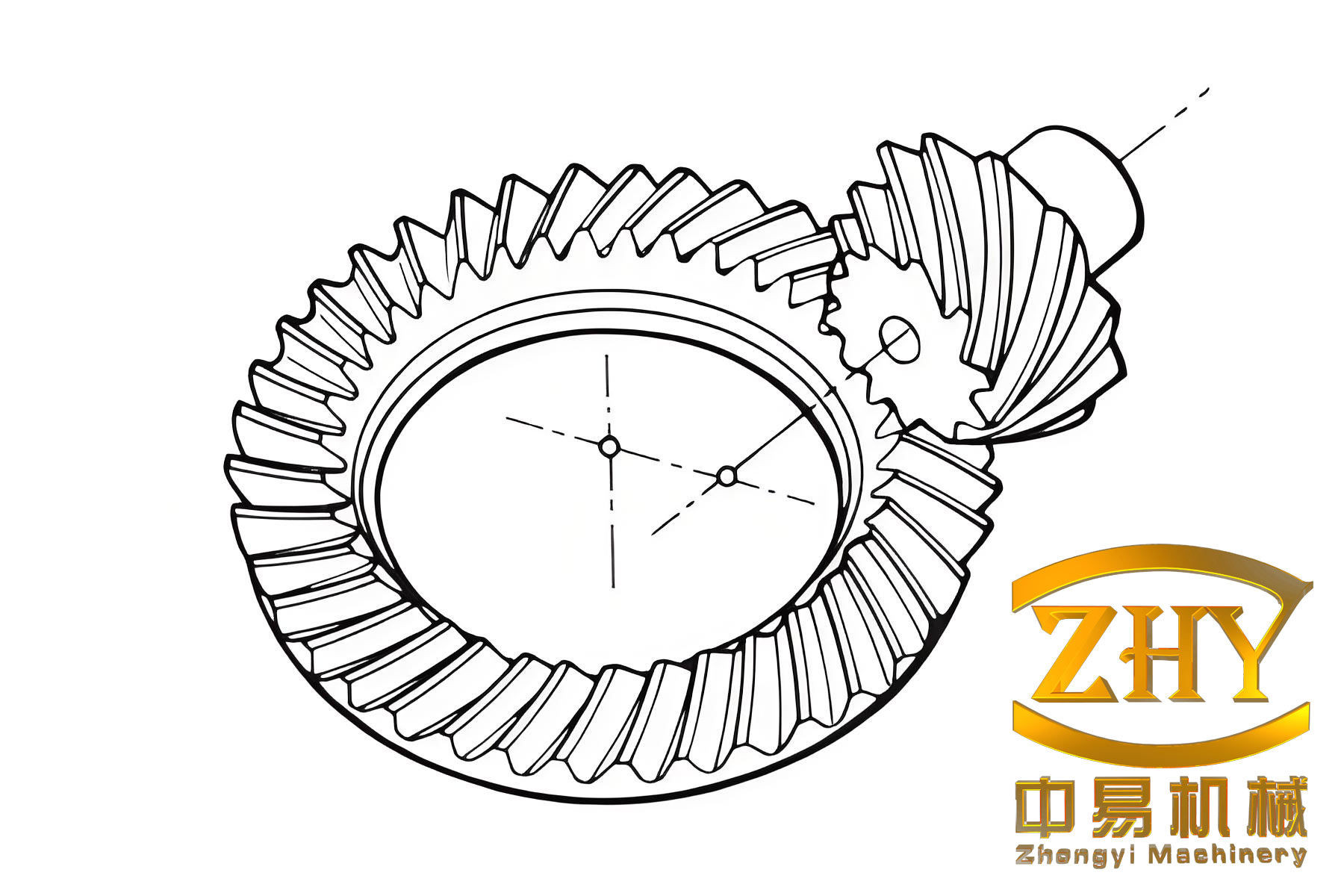
Recent advancements have shifted focus toward analytical and optimization-based approaches for hypoid bevel gear design. One significant development is the concept of non-zero modification, which allows independent selection of addendum shift coefficients beyond traditional height modifications. This flexibility enables designers to optimize hypoid bevel gear pairs for specific performance criteria, such as reduced noise and increased load capacity. The mathematical basis involves modifying tooth thickness and space width using shift coefficients $$ x_1 $$ and $$ x_2 $$ for the pinion and gear, respectively. For a hypoid bevel gear with normal module $$ m_n $$, the modified addendum $$ h_a $$ and dedendum $$ h_f $$ can be expressed as:
$$ h_a = (1 + x) m_n + \Delta h $$
$$ h_f = (1.25 – x) m_n + \Delta h $$
where $$ \Delta h $$ accounts for the hypoid bevel gear’s offset and spiral angle effects. This approach has been shown to improve meshing symmetry and contact patterns, particularly in high-torque applications. Another innovative method involves precise calculation of pitch cone parameters using extended epicycloidal geometry. Researchers have derived formulas that ensure bilateral meshing symmetry for hypoid bevel gears, even under non-standard shaft angles. For example, the pitch cone angles can be recalculated using vector analysis, leading to more accurate results. Consider the position vectors of points on the pitch cones; by applying coordinate transformations, we can establish the relationship:
$$ \mathbf{R}_1 = \begin{bmatrix} R_{p1} \cos \theta_1 \\ R_{p1} \sin \theta_1 \\ 0 \end{bmatrix}, \quad \mathbf{R}_2 = \begin{bmatrix} R_{p2} \cos \theta_2 + E \\ R_{p2} \sin \theta_2 \\ 0 \end{bmatrix} $$
where $$ R_{p1} $$ and $$ R_{p2} $$ are pitch radii, and $$ \theta_1, \theta_2 $$ are angular parameters. The tangency condition yields equations that can be solved numerically for hypoid bevel gear geometries.
To systematically compare various design methodologies for hypoid bevel gears, I have compiled a table summarizing key approaches, their features, advantages, and limitations. This table highlights the evolution from traditional empirical methods to modern computational techniques.
| Design Methodology | Key Principles | Advantages | Disadvantages | Applicability to Hypoid Bevel Gears |
|---|---|---|---|---|
| Traditional Gleason System | Empirical charts, iterative manual calculations | Industry-standard, widely documented | Error-prone, time-consuming, limited accuracy | Foundational but increasingly supplemented |
| Non-Zero Modification | Flexible addendum shift coefficients | Enhanced meshing performance, noise reduction | Requires advanced software, complex parameter tuning | Highly effective for optimized hypoid bevel gear pairs |
| Analytical Geometry | Pure mathematical derivation using vector and coordinate systems | High precision, better understanding of geometry | May oversimplify manufacturing constraints | Suitable for research and custom hypoid bevel gear designs |
| Optimization-Based Design | Multi-objective functions (e.g., minimize noise, volume) | Balanced performance, tailored solutions | Computationally intensive, requires robust algorithms | Ideal for advanced hypoid bevel gear applications in automotive and aerospace |
| Virtual Pitch Cone Methods | Adjustment of pitch cone location to improve strength | Increased durability, reduced stress concentrations | Alters traditional geometry, may complicate manufacturing | Useful for high-load hypoid bevel gear systems |
Further refining geometric parameters, researchers have developed new computational models that address specific shortcomings. For instance, some studies introduce additional variables and constraints to ensure the pitch cone node remains at the midpoint of the face width, a critical aspect for even load distribution in hypoid bevel gears. This involves solving a system of equations with constraints such as equal initial and actual pitch cone angles. Consider the optimization problem: minimize the objective function $$ F(\mathbf{x}) $$, where $$ \mathbf{x} = [\delta_1, \delta_2, \beta, E]^T $$ represents design variables. The constraints include:
$$ g_1(\mathbf{x}) = R_{p1} \sin \delta_1 + R_{p2} \sin \delta_2 – E = 0 $$
$$ g_2(\mathbf{x}) = \beta – \beta_0 = 0 $$
$$ g_3(\mathbf{x}) = \delta_2 – \delta_{2,initial} = 0 $$
where $$ \beta_0 $$ is the target spiral angle, and $$ \delta_{2,initial} $$ is the initial gear pitch cone angle. Solving this via numerical methods like Newton-Raphson or gradient-based optimization yields precise geometric parameters for hypoid bevel gears. Another approach focuses on modifying the pitch cone itself to enhance strength and longevity. By shifting the gear pitch cone outside the face cone, designers can increase the pinion root thickness and reduce contact pressures. The revised pitch cone parameters are derived from geometric relationships, such as:
$$ R_{p2,new} = R_{p2} + \Delta R $$
$$ \delta_{2,new} = \arctan\left( \frac{R_{p2,new} \sin \delta_{2}}{R_{p2,new} \cos \delta_{2} – \Delta E} \right) $$
where $$ \Delta R $$ and $$ \Delta E $$ are adjustments based on design goals. This method has proven effective in improving the fatigue life of hypoid bevel gears under cyclic loading.
In addition to these methodologies, the integration of manufacturing considerations into geometric design is crucial for hypoid bevel gears. The cutting process, whether using HFT (Hyperbolic Facet Tooth) or traditional face-milling, directly influences tooth profile accuracy and meshing behavior. Therefore, modern design frameworks often couple geometric parameters with machine-tool settings. For example, the relationship between cutter radius $$ R_c $$ and tooth curvature can be expressed as:
$$ R_c = \frac{R_p \cos \beta}{\cos \alpha} $$
where $$ \alpha $$ is the pressure angle. Deviations in $$ R_c $$ due to design approximations can lead to tooth undercutting or excessive contact stress in hypoid bevel gears. To address this, some researchers propose iterative correction loops that adjust geometric parameters based on simulated cutting outcomes. This holistic approach ensures that hypoid bevel gear designs are not only theoretically sound but also manufacturable with high precision.
Looking toward the future, I envision several promising directions for geometric parameters design of hypoid bevel gears. First, there is a need to simplify the design process by deriving more intuitive mathematical expressions that reduce reliance on iterative computations. Current methods, while accurate, often involve complex equations that can be barriers for practicing engineers. By leveraging symbolic computation and geometric algebra, we could develop closed-form solutions for key parameters like spiral angle and offset distance. For instance, using quaternion or dual-number representations of spatial rotations might streamline the derivation of pitch cone equations for hypoid bevel gears. Second, a comprehensive design framework incorporating weighted multi-objective optimization should be established. This framework would allow designers to balance competing criteria such as noise, volume, mass, efficiency, and strength through adjustable weighting coefficients. Mathematically, this can be formulated as:
$$ \min_{\mathbf{x}} \left( w_1 \cdot N(\mathbf{x}) + w_2 \cdot V(\mathbf{x}) + w_3 \cdot S(\mathbf{x}) \right) $$
subject to $$ h_j(\mathbf{x}) = 0 $$ and $$ g_k(\mathbf{x}) \leq 0 $$, where $$ N $$, $$ V $$, and $$ S $$ represent noise, volume, and stress functions, respectively, and $$ w_i $$ are weights. Such a framework would enable customized hypoid bevel gear designs for diverse applications, from electric vehicles to wind turbines. Third, greater integration with advanced manufacturing technologies, such as additive manufacturing (3D printing) and digital twins, could revolutionize hypoid bevel gear production. By designing geometry that leverages additive manufacturing’s freedom, we could create lightweight, topology-optimized hypoid bevel gears with internal cooling channels or graded materials. Additionally, real-time simulation using digital twins would allow virtual testing of geometric parameters under dynamic loads, reducing prototyping costs and time.
To further elucidate the geometric relationships, I present a table of key formulas used in hypoid bevel gear design. These equations are foundational for calculating dimensions and performance metrics.
| Parameter | Symbol | Formula | Description |
|---|---|---|---|
| Pitch Diameter | $$ D_p $$ | $$ D_p = m_t z $$ | Based on transverse module $$ m_t $$ and tooth number $$ z $$ |
| Spiral Angle | $$ \beta $$ | $$ \beta = \arcsin\left( \frac{E}{R_p} \right) $$ | Relates offset $$ E $$ to pitch radius $$ R_p $$ |
| Offset Distance | $$ E $$ | $$ E = R_{p1} \sin \delta_1 + R_{p2} \sin \delta_2 $$ | Derived from pitch cone geometry |
| Pitch Cone Angle | $$ \delta $$ | $$ \delta = \arctan\left( \frac{D_p}{2L} \right) $$ | Where $$ L $$ is cone distance |
| Tooth Thickness | $$ s $$ | $$ s = \frac{\pi m_n}{2} + 2 x m_n \tan \alpha_n $$ | Including non-zero modification coefficient $$ x $$ |
| Contact Ratio | $$ \epsilon $$ | $$ \epsilon = \frac{\sqrt{R_{a1}^2 – R_{b1}^2} + \sqrt{R_{a2}^2 – R_{b2}^2} – E \sin \alpha}{p_{bt}} $$ | Ensures smooth meshing in hypoid bevel gears |
Another area ripe for exploration is the application of machine learning and artificial intelligence to hypoid bevel gear design. By training models on historical design data and performance outcomes, AI could predict optimal geometric parameters for new applications, reducing trial-and-error. For example, neural networks could approximate the relationship between input variables (e.g., torque, speed, space constraints) and output geometric parameters for hypoid bevel gears. This data-driven approach complements traditional analytical methods and could accelerate the design cycle. Furthermore, sustainability considerations are becoming increasingly important; designing hypoid bevel gears with minimal material usage and energy losses through geometric optimization aligns with global environmental goals. This might involve parametric studies to minimize power losses due to friction, which can be modeled as:
$$ P_{loss} = \mu \cdot F_n \cdot v \cdot f(\beta, \alpha) $$
where $$ \mu $$ is friction coefficient, $$ F_n $$ is normal force, $$ v $$ is sliding velocity, and $$ f $$ is a function of spiral and pressure angles. Optimizing geometric parameters to reduce $$ P_{loss} $$ would enhance the efficiency of hypoid bevel gear systems.
In conclusion, the design of geometric parameters for hypoid bevel gears has evolved from empirical, manual methods to sophisticated computational and optimization-based approaches. The ongoing research highlights the importance of accuracy, manufacturability, and performance integration. As a researcher, I believe that future advancements will hinge on interdisciplinary collaboration, leveraging tools from mathematics, computer science, and materials engineering to overcome existing challenges. By continuing to refine geometric design methodologies, we can develop hypoid bevel gears that meet the demanding requirements of modern industries, contributing to more efficient and reliable mechanical systems worldwide. The journey toward perfecting hypoid bevel gear design is complex, but with persistent innovation, it holds great promise for technological progress.