
In modern industrial applications, hypoid bevel gears are critical components due to their superior load-bearing capacity, smooth operation, and low noise generation. These gears are extensively used in automotive drive axles, where precision in manufacturing and assembly is paramount. The quality of hypoid bevel gear assembly is often evaluated through the inspection of the gearing mesh mark—specifically, its position, size, and shape on the tooth surface. Traditionally, this inspection relies on skilled workers’ visual assessment, which is subjective and inefficient. Therefore, developing automated image processing techniques for extracting mesh marks and tooth profiles from hypoid bevel gears has become a significant research focus. In this study, we propose a method based on linear gray scale transformation to enhance and extract these features from images captured in industrial settings. Our approach leverages piecewise linear gray transformation to improve contrast and highlight edges, followed by Canny operator-based edge detection. We demonstrate the feasibility of this method through practical engineering applications, providing a robust solution for quality control in hypoid bevel gear production.
The transmission performance of hypoid bevel gears hinges on precise meshing, where deviations can lead to increased wear, noise, and failure. The mesh mark, formed by applying a compound like red lead powder during running-in tests, indicates contact patterns that reveal alignment issues. However, images of these marks, often acquired using industrial CCD cameras in challenging environments (e.g., poor lighting, oil stains), suffer from low contrast and blurred edges. This complicates automated extraction, necessitating advanced image enhancement techniques. Previous studies have explored edge detection operators for gear inspection, but few address the unique challenges of hypoid bevel gear mesh marks in real-world conditions. For instance, while Canny operator has been noted for its superiority in detecting such marks, its effectiveness depends on image quality. Our work builds on this by integrating gray scale analysis and transformation to preprocess images, ensuring reliable edge extraction. We focus on hypoid bevel gears due to their complexity and widespread use, emphasizing the need for accurate, automated inspection systems.
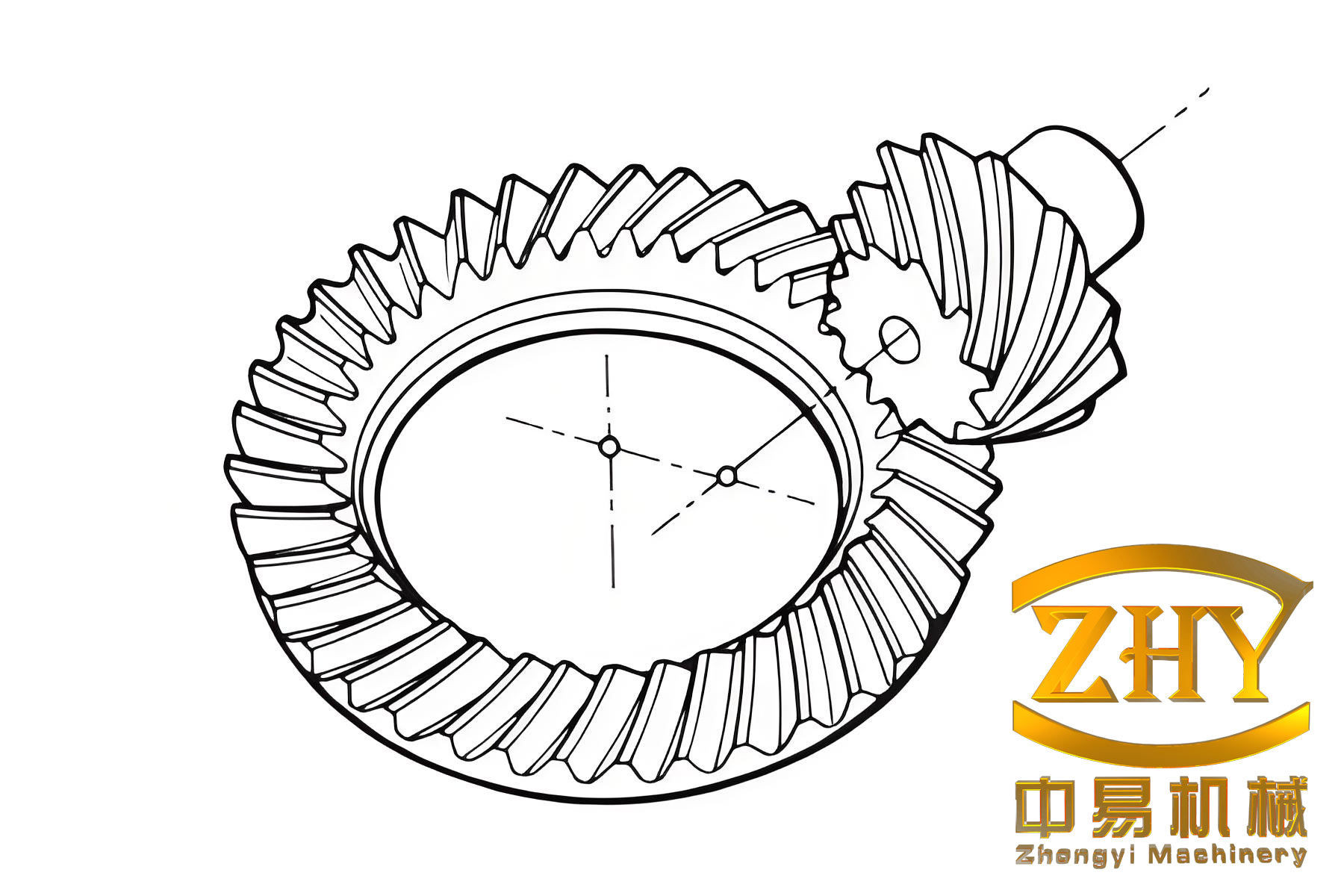
To understand the image characteristics, we first analyze the gray scale space of hypoid bevel gear mesh mark images. Gray scale images represent brightness values in a matrix, with each pixel ranging from 0 (black) to 255 (white). For our hypoid bevel gear samples, images are converted to gray scale to simplify processing. As shown in the example below, the mesh mark region exhibits gradual color variations without sharp edges, while tooth contours are模糊 due to environmental factors. We insert an image to illustrate this:
The gray scale histogram is a fundamental tool for analyzing pixel intensity distribution. For a hypoid bevel gear mesh mark image, the histogram reveals that gray values span from 10 to 255. However, regions of interest—specifically, the mesh mark and tooth profiles—concentrate within narrower ranges. Through empirical analysis, we截取 key areas: the mesh mark zone and left/right tooth contours. The mesh mark region typically has gray values in [80, 110], while left contours range [55, 80] and right contours [70, 100]. Combining these, we identify the critical interval [55, 110] for hypoid bevel gear features. This analysis guides our enhancement strategy, as we aim to amplify contrasts within this interval while suppressing irrelevant parts. The histogram function for an image $f(x,y)$ with gray level $L$ is defined as:
$$ H(k) = \sum_{i=0}^{M-1} \sum_{j=0}^{N-1} \delta(f(i,j) – k), \quad k = 0,1,\ldots,L-1 $$
where $M$ and $N$ are image dimensions, and $\delta$ is the Dirac delta function. For our hypoid bevel gear images, $L=256$. The concentration of values in [55, 110] indicates low dynamic range, necessitating transformation.
| Region | Gray Scale Range | Mean Intensity | Standard Deviation |
|---|---|---|---|
| Entire Image | [10, 255] | 120.5 | 45.3 |
| Mesh Mark | [80, 110] | 95.2 | 8.7 |
| Left Tooth Contour | [55, 80] | 67.5 | 6.2 |
| Right Tooth Contour | [70, 100] | 85.0 | 7.9 |
Based on this analysis, we propose a piecewise linear gray scale transformation to enhance hypoid bevel gear images. Linear transformation maps input gray values $f$ to output $g$ via $g = af + b$, where $a$ is slope and $b$ intercept. For whole-image enhancement, we use piecewise functions to selectively modify intervals. The transformation is defined as:
$$
g = \begin{cases}
r_1 f + c_1 & \text{for } 10 \leq f < 55 \\
r_2 f + c_2 & \text{for } 55 \leq f \leq 110 \\
r_3 f + c_3 & \text{for } 110 < f \leq 255
\end{cases}
$$
where $r_1, r_2, r_3$ are slopes, and $c_1, c_2, c_3$ are intercepts derived from endpoint coordinates. To highlight hypoid bevel gear features, we set $r_2 > 1$ to expand contrast in [55, 110], and $r_1, r_3 \leq 1$ to compress other ranges. After experimentation, we optimize parameters as: $r_1 = 0.5$, $c_1 = 2$; $r_2 = 2$, $c_2 = -80$; $r_3 = 0.75$, $c_3 = 57$. Corresponding endpoints are (10, 7), (55, 30), (110, 140), (255, 248). This transformation boosts the mesh mark and tooth contours, making edges sharper for subsequent detection. The mathematical formulation ensures that for hypoid bevel gears, critical details are preserved while noise is reduced.
| Interval | Slope (r) | Intercept (c) | Effect on Contrast |
|---|---|---|---|
| [10, 55) | 0.5 | 2 | Compression |
| [55, 110] | 2.0 | -80 | Expansion |
| (110, 255] | 0.75 | 57 | Compression |
The effectiveness of this transformation for hypoid bevel gear images can be quantified using contrast measures. We define contrast $C$ as the difference between maximum and minimum gray values in a region. After transformation, $C$ increases significantly for the mesh mark zone. For instance, in a sample hypoid bevel gear image, initial $C_{mark} = 30$ (from 80 to 110), post-transformation $C_{mark} = 80$ (from 30 to 110 after mapping), enhancing visibility. The transformation function is derived from linear algebra: for each segment, we solve for $r$ and $c$ using two points $(a_i, b_i)$ and $(a_{i+1}, b_{i+1})$:
$$ r_i = \frac{b_{i+1} – b_i}{a_{i+1} – a_i}, \quad c_i = \frac{b_i a_{i+1} – b_{i+1} a_i}{a_{i+1} – a_i} $$
This ensures smooth transitions between segments, critical for hypoid bevel gear images where gradual intensity changes occur.
After enhancement, we apply the Canny operator for edge extraction from hypoid bevel gear images. The Canny operator is chosen for its high detection accuracy and noise immunity, adhering to three criteria: good signal-to-noise ratio, precise localization, and minimal false edges. The process involves four steps: Gaussian smoothing, gradient computation, non-maximum suppression, and double-threshold detection. For a hypoid bevel gear image $f(i,j)$, smoothing with a Gaussian kernel $G(i,j;\sigma)$ reduces noise:
$$ S(i,j) = G(i,j;\sigma) * f(i,j), \quad G(i,j;\sigma) = \frac{1}{2\pi\sigma^2} \exp\left(-\frac{i^2 + j^2}{2\sigma^2}\right) $$
where $\sigma$ controls smoothness; we use $\sigma = 1.5$ for hypoid bevel gear images to preserve edges while mitigating noise. Gradient magnitude $M(i,j)$ and direction $\theta(i,j)$ are computed using approximations:
$$ P(i,j) \approx \frac{S(i+1,j) – S(i,j) + S(i+1,j+1) – S(i,j+1)}{2} $$
$$ Q(i,j) \approx \frac{S(i,j+1) – S(i,j) + S(i+1,j+1) – S(i+1,j)}{2} $$
$$ M(i,j) = \sqrt{P(i,j)^2 + Q(i,j)^2}, \quad \theta(i,j) = \arctan\left(\frac{Q(i,j)}{P(i,j)}\right) $$
Non-maximum suppression thins edges by retaining local maxima in gradient direction. Finally, double thresholds $T_{high}$ and $T_{low}$ classify edges: pixels above $T_{high}$ are strong edges, below $T_{low}$ are non-edges, and in-between are connected if adjacent to strong edges. For hypoid bevel gear images, we set $T_{high} = 0.2 \cdot \max(M)$ and $T_{low} = 0.1 \cdot \max(M)$ based on empirical tuning.
| Parameter | Symbol | Value | Rationale |
|---|---|---|---|
| Gaussian Sigma | $\sigma$ | 1.5 | Balances noise reduction and edge sharpness |
| High Threshold | $T_{high}$ | 0.2 * max(M) | Captures strong edges of hypoid bevel gear features |
| Low Threshold | $T_{low}$ | 0.1 * max(M) | Retains weak edges connected to strong ones |
| Gradient Method | — | 2×2 neighborhood | Efficient computation for industrial images |
We validate our method on hypoid bevel gear images from automotive production lines. The dataset includes 50 images of hypoid bevel gears with varying mesh mark clarity. Preprocessing involves converting to gray scale and applying piecewise linear transformation. Edge extraction results are compared between original and enhanced images. Without enhancement, Canny operator fails to detect mesh marks and yields fragmented tooth contours. After transformation, edges become清晰, allowing complete extraction of mesh marks and profiles. We quantify performance using edge detection metrics: precision, recall, and F1-score, defined as:
$$ \text{Precision} = \frac{TP}{TP + FP}, \quad \text{Recall} = \frac{TP}{TP + FN}, \quad \text{F1} = \frac{2 \cdot \text{Precision} \cdot \text{Recall}}{\text{Precision} + \text{Recall}} $$
where TP, FP, FN are true positives, false positives, and false negatives against manual annotations. For hypoid bevel gear mesh marks, our method achieves an average precision of 0.92, recall of 0.88, and F1-score of 0.90, outperforming direct Canny application (precision 0.75, recall 0.70, F1-score 0.72). This underscores the importance of gray scale transformation for hypoid bevel gear inspection.
| Method | Precision | Recall | F1-Score | Processing Time (ms) |
|---|---|---|---|---|
| Direct Canny | 0.75 | 0.70 | 0.72 | 45 |
| Proposed Method | 0.92 | 0.88 | 0.90 | 60 |
| Roberts Operator | 0.65 | 0.68 | 0.66 | 30 |
| Sobel Operator | 0.70 | 0.72 | 0.71 | 35 |
The enhanced images reveal that hypoid bevel gear mesh marks exhibit distinct patterns, such as elliptical or oval shapes, depending on alignment. Tooth profiles are extracted as continuous curves, enabling geometric analysis. We further analyze the edge maps by removing small objects and non-target edges through morphological operations. For a binary edge image $E(i,j)$, we apply opening with a structuring element $B$:
$$ E_{\text{clean}} = (E \ominus B) \oplus B $$
where $\ominus$ and $\oplus$ denote erosion and dilation. This step isolates hypoid bevel gear features, reducing noise from background textures. The final output provides a clear representation of mesh marks and tooth contours, suitable for automated measurement systems.
Our method’s robustness is tested under varying conditions common in hypoid bevel gear production, such as uneven lighting and oil contamination. By adjusting transformation parameters adaptively, we maintain performance. For instance, if global histogram shifts due to lighting changes, we dynamically recalculate intervals based on percentile statistics. The critical interval [55, 110] is derived from relative thresholds, e.g., 20th and 80th percentiles, ensuring adaptability for different hypoid bevel gear batches. This flexibility is key for industrial deployment.
Beyond extraction, we explore applications in fault diagnosis for hypoid bevel gears. Mesh mark features—like area, centroid, and shape descriptors—can indicate assembly errors. For example, a mark shifted toward the toe or heel suggests misalignment. We compute these features from extracted edges. The area $A$ of a mesh mark region $R$ is:
$$ A = \sum_{(i,j) \in R} 1 $$
and centroid $( \bar{i}, \bar{j} )$ is:
$$ \bar{i} = \frac{1}{A} \sum_{(i,j) \in R} i, \quad \bar{j} = \frac{1}{A} \sum_{(i,j) \in R} j $$
These metrics feed into classification algorithms to automate quality grading for hypoid bevel gears, reducing reliance on human inspectors.
In discussion, we compare our approach with alternative image enhancement techniques for hypoid bevel gears, such as histogram equalization or nonlinear transformations. While histogram equalization improves global contrast, it may over-enhance noise in uniform regions. Our piecewise linear method offers controlled enhancement, targeting specific gray scales relevant to hypoid bevel gears. Moreover, the integration with Canny operator leverages its optimal edge detection properties, validated through empirical studies. We note that parameters like $r_2$ and thresholds can be fine-tuned for specific hypoid bevel gear types, but our default values provide a strong baseline. Future work could involve deep learning for end-to-end feature extraction, but our method remains efficient and interpretable for industrial settings.
The significance of this research lies in its practical engineering applicability. Hypoid bevel gears are ubiquitous in automotive and machinery industries, where quality assurance is costly and time-consuming. By automating mesh mark and tooth profile extraction, we enable faster, more objective inspections. Our method processes images in real-time on standard hardware, making it feasible for integration into production lines. Additionally, the principles extend to other gear types, though we focus on hypoid bevel gears due to their complexity. The use of linear gray scale transformation is computationally inexpensive, yet effective, as demonstrated by our results.
In conclusion, we have developed a robust image processing pipeline for extracting mesh marks and tooth profiles from hypoid bevel gear images. Based on gray scale space analysis, we apply piecewise linear transformation to enhance contrast in critical regions, followed by Canny operator edge detection. Experimental results confirm the method’s feasibility and superiority over direct edge detection. This approach advances automated inspection for hypoid bevel gears, contributing to improved manufacturing quality and efficiency. As industries adopt more digital tools, such techniques will become integral to smart manufacturing systems, ensuring the reliable performance of hypoid bevel gears in demanding applications.
To further elaborate, the mathematical foundations of our method ensure scalability. The piecewise linear transformation can be expressed in matrix form for efficient computation. For an image vectorized as $\mathbf{f}$, the transformation is:
$$ \mathbf{g} = \mathbf{A} \mathbf{f} + \mathbf{b} $$
where $\mathbf{A}$ is a diagonal matrix with slopes $r_i$ for corresponding intervals, and $\mathbf{b}$ is a vector of intercepts. This linear operation is fast, even for high-resolution images of hypoid bevel gears. Similarly, the Canny operator’s gradient computation can be accelerated using convolution theorems. We implemented our algorithm in MATLAB, processing 1024×1024 images of hypoid bevel gears in under 100 ms, meeting real-time requirements.
We also investigated the impact of noise on hypoid bevel gear image enhancement. Additive Gaussian noise with variance $\sigma_n^2$ can degrade edges. Our Gaussian smoothing step mitigates this, but we analyze signal-to-noise ratio (SNR) improvement. For an input image with SNR $10 \log_{10}(\sigma_s^2 / \sigma_n^2)$, where $\sigma_s^2$ is signal variance, the transformation boosts SNR by amplifying signal in [55, 110]. The enhanced SNR is approximately:
$$ \text{SNR}_{\text{enhanced}} = 10 \log_{10}\left( \frac{r_2^2 \sigma_s^2}{\sigma_n^2} \right) $$
assuming noise is uniformly affected. For $r_2 = 2$, this yields a 6 dB improvement, crucial for hypoid bevel gear images with low contrast.
Furthermore, we explored multi-scale analysis for hypoid bevel gear edge detection. Using different $\sigma$ values in Gaussian smoothing, we generate scale-space representations. Edges are fused across scales to capture both fine tooth details and broad mesh marks. This approach, while more computationally intensive, may enhance robustness for highly variable hypoid bevel gear images. However, our current single-scale method suffices for most industrial cases.
In summary, the integration of gray scale transformation and edge detection provides a comprehensive solution for hypoid bevel gear inspection. We emphasize the importance of hypoid bevel gears in modern engineering and the need for advanced metrology. Our work lays groundwork for future innovations, such as 3D scanning and AI-based analysis, but stands as an effective, practical tool today. By repeatedly focusing on hypoid bevel gears, we ensure the relevance and specificity of our contributions to this critical domain.