
The transmission of power and motion between non-parallel, non-intersecting axes is a fundamental requirement in modern machinery, from automotive drivetrains to heavy industrial equipment. Among the various solutions, the hypoid bevel gear stands out due to its unique geometry and superior performance characteristics. A hypoid bevel gear pair is essentially a sophisticated evolution of the spiral bevel gear, distinguished by a deliberate offset between the axes of the pinion (the smaller gear) and the ring gear (the larger gear). This offset, while a seemingly simple geometric modification, introduces profound implications for the gear’s design, manufacturing, and application.
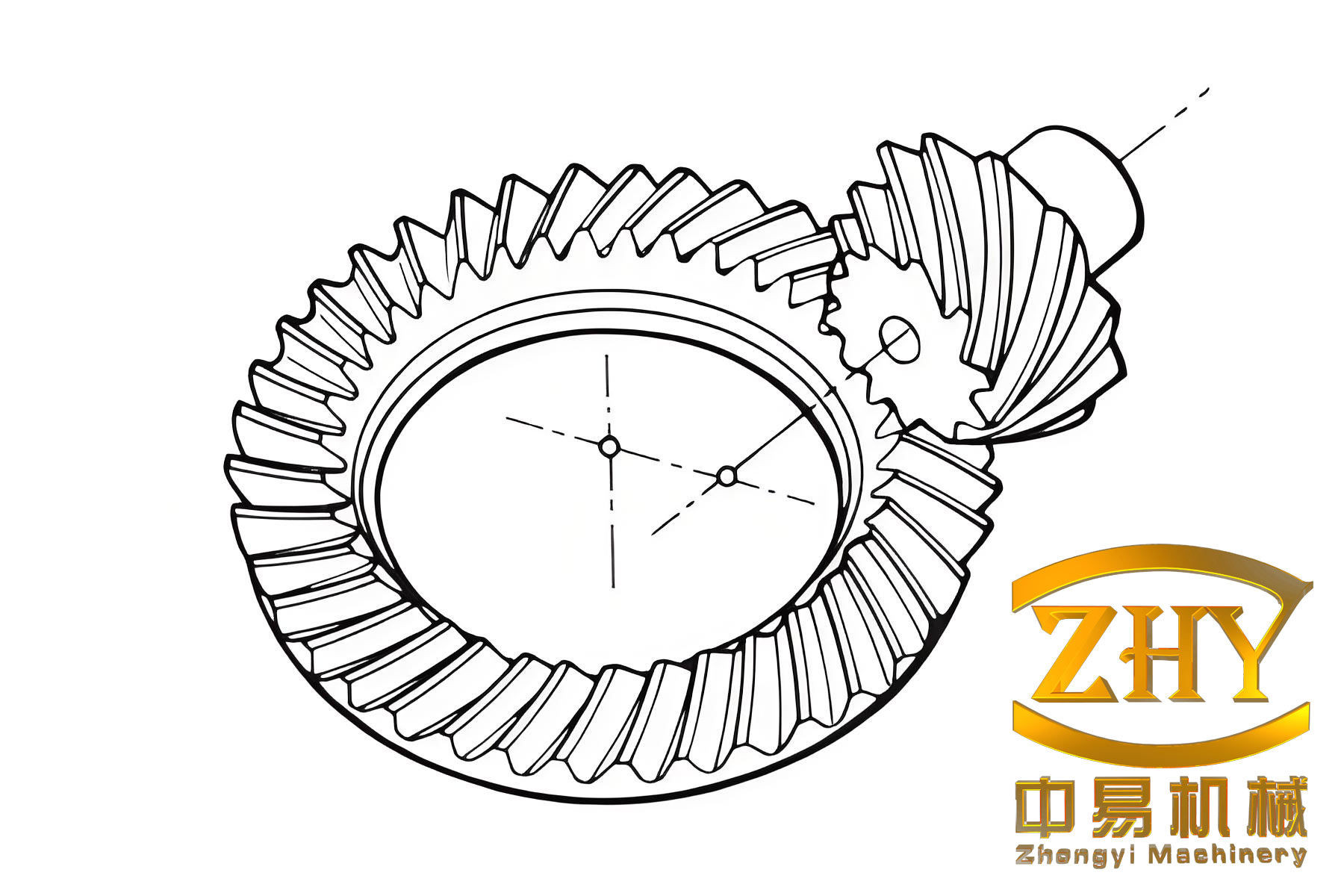
The core advantages of the hypoid bevel gear stem directly from this axis offset. Compared to standard spiral bevel gears, they offer greater design freedom for lowering the center of gravity in vehicles, thereby enhancing stability. The pinion in a hypoid bevel gear set typically has a larger spiral angle than the ring gear, which increases the contact ratio, leading to smoother, quieter operation suitable for high-speed applications. Furthermore, the pinion can have a larger diameter and stronger teeth for a given ratio and ring gear size, significantly boosting load capacity and rigidity. These attributes make the hypoid bevel gear indispensable in demanding applications like automotive rear axles. However, this complexity comes at a cost. The tooth surfaces of a hypoid bevel gear pinion are asymmetrical, making their design and manufacture vastly more complicated than symmetrical gears. Additionally, the meshing action involves a high degree of sliding, which, while beneficial for smoothness, generates significant interfacial pressure requiring specialized lubrication and careful control of the contact pattern to prevent wear and pitting failures.
The manufacturing of hypoid bevel gears is thus a field that balances achieving exceptional mechanical performance with managing considerable geometric complexity. The journey from a raw blank to a finished, high-precision hypoid bevel gear involves sophisticated processes, broadly categorized into traditional machining (subtractive manufacturing) and advanced chipless forming (net-shape or near-net-shape manufacturing).
Fundamental Geometry and Design of Hypoid Bevel Gears
The design of a hypoid bevel gear set is governed by a complex set of interrelated parameters. The foundational formula relates the pitch diameters of the ring gear ($d_{g}$) and the pinion ($d_{p}$), the shaft angle ($\Sigma$), and the offset distance ($E$) – the defining feature. A simplified kinematic relationship can be expressed as:
$$ \tan \gamma_p = \frac{\sin \Sigma}{\frac{d_g}{d_p} + \cos \Sigma} \quad \text{and} \quad \tan \gamma_g = \frac{\sin \Sigma}{\frac{d_p}{d_g} + \cos \Sigma} $$
Where $\gamma_p$ and $\gamma_g$ are the pitch cone angles of the pinion and gear, respectively. The introduction of the offset $E$ modifies these basic relationships and necessitates specialized calculation methods, often based on the Gleason system, to define the non-conjugate, localized tooth contact. Key design parameters are summarized below:
| Parameter | Symbol | Description & Influence |
|---|---|---|
| Axis Offset | $E$ | The perpendicular distance between shaft axes. Enables design flexibility, lowers center of gravity, and increases pinion strength. |
| Shaft Angle | $\Sigma$ | Typically 90° in most applications. The angle between the input and output shafts. |
| Spiral Angle | $\beta$ | Angle of the tooth trace. Hypoid pinions have a larger $\beta$ than the mating gear, improving overlap ratio and smoothness. |
| Face Width | $F$ | Length of the tooth along the pitch cone. Affects load distribution and bending strength. |
| Mean Normal Module | $m_n$ | Defines tooth size at the mean cone distance. While $m_n$ is equal for pinion and gear, their transverse modules differ due to the offset. |
Traditional Machining: The Art of Cutting Hypoid Bevel Gears
For decades, the primary method for producing hypoid bevel gears has been precision machining, specifically the face-milling process perfected by manufacturers like Gleason. This method relies on the principle of generating the tooth surface through a relative rolling motion between the workpiece and a cutting tool (cutter head).
The process is inherently asymmetric: the ring gear (larger member) is usually cut first, often using a form-cutting or semi-completing method for efficiency, especially at higher ratios. The pinion is then cut in a dedicated process where its tooth flanks are generated to mate correctly with the finished ring gear, a method known as “single-side” or “duplex” cutting. The cutter head, equipped with multiple indexed cutting blades, spins at high speed while the workpiece rolls in timed coordination with it, tracing out the complex curvilinear tooth form of the hypoid bevel gear. Advanced machine tools (e.g., Gleason Phoenix series) integrate multiple axes of motion (tilt, swivel, modified roll) to introduce controlled mismatches (ease-off) into the tooth surfaces, ensuring a localized contact pattern that can tolerate small misalignments in operation.
The machining sequence for a hypoid bevel gear pinion is particularly intricate, often involving separate roughing and finishing passes for the convex and concave flanks of each tooth. Key process parameters include machine settings (cradle angle, sliding base, tilt), cutter head design (blade profile, diameter, point radius), and cutting conditions (speed, feed, coolant). A significant challenge is managing the high sliding contact inherent to hypoid bevel gear operation, which requires subsequent heat treatment (case hardening) and often a final lapping or grinding process to perfect the micro-geometry of the tooth surface, reduce noise, and ensure optimal contact pattern location and size.
Chipless Forming: The Frontier of Precision Forging for Hypoid Bevel Gears
While machining dominates, precision forging represents a revolutionary alternative for manufacturing hypoid bevel gears. This chipless forming process aims to plastically deform a metal blank into a near-net-shape gear, either eliminating subsequent cutting operations entirely or leaving only a minimal finishing allowance. The advantages are compelling: continuous grain flow that follows the tooth contour, dramatically improving fatigue strength (both bending and contact); significant material savings; high production rates suitable for mass production; and excellent repeatability.
The state of research and application, however, is asymmetrical. Precision forging of ring gears (the larger member) is relatively mature and has been implemented industrially for spiral and hypoid bevel gears. The real technical frontier lies in forging the pinion. The severe asymmetry of the hypoid bevel gear pinion tooth flanks, combined with its typically smaller size and deeper tooth cavities, makes metal flow control and complete die filling exceptionally challenging without inducing defects like folds or laps, and without requiring prohibitively high forming forces.
Critical Research Challenges in Hypoid Bevel Gear Forging
Advancing the precision forging of hypoid bevel gears, especially pinions, requires focused research in several interconnected areas:
| Research Area | Key Challenges & Objectives |
|---|---|
| Process & Die Optimization | Designing optimal preform (blank) geometry to ensure uniform, complete die filling with minimal force. Developing robust multi-stage forging sequences (e.g., preform → rough forge → finish). Optimizing complex, segmented die structures for forging asymmetric hypoid bevel gear teeth. |
| Part Ejection (Demolding) | Designing dies with complex core-pulling mechanisms or tapers to enable the release of the forged hypoid bevel gear, particularly the pinion with its undercut and asymmetric teeth, without damaging the part or the tooling. |
| Forming Process Analysis | Understanding the precise metal flow, strain/stress distribution, and temperature evolution during forging. Identifying potential defect formation mechanisms. This is where numerical simulation becomes indispensable. |
| Material & Tribology | Selecting forgeable alloys and developing effective high-temperature lubricants and coatings to reduce friction, lower forming loads, prevent die soldering, and extend tool life. |
The Indispensable Role of Numerical Simulation
The complexity of forging a hypoid bevel gear renders traditional analytical methods and costly, time-consuming trial-and-error experiments inadequate. Three-dimensional Finite Element Method (3D FEM) simulation has emerged as the cornerstone of modern process development. Software platforms like DEFORM, Simufact.forming, and QForm allow engineers to create a virtual model of the entire forging process.
The simulation begins by defining the initial billet and the 3D CAD models of the dies, incorporating the exact tooth geometry of the hypoid bevel gear. The software then solves the fundamental equations of plasticity, heat transfer, and friction iteratively over small time increments. The governing equation for rigid-plastic or viscoplastic material flow is often based on the variational principle:
$$ \Phi = \int_V \bar{\sigma} \dot{\bar{\epsilon}} dV + \int_{S_f} \tau_f \Delta v dS – \int_{S_F} F_i v_i dS $$
Where $\Phi$ is the energy functional, $\bar{\sigma}$ is the effective stress, $\dot{\bar{\epsilon}}$ is the effective strain rate, $\tau_f$ is the frictional stress, and the integrals represent work done by internal deformation, surface friction, and external forces, respectively.
Through simulation, engineers can visualize material flow in real-time, predict the formation of folds or underfills, analyze die stress to prevent fatigue failure, and optimize key parameters like billet temperature, die temperature, forging speed, and lubrication. The load-stroke curve, a critical output, helps in selecting appropriate press capacity.
$$
\text{Forging Load} = f(\text{Flow Stress}, \text{Contact Area}, \text{Friction}, \text{Strain Rate})
$$
The flow stress $\sigma_f$ is itself a function of strain $\epsilon$, strain rate $\dot{\epsilon}$, and temperature $T$, often modeled by constitutive equations like:
$$ \sigma_f = K \epsilon^n \dot{\epsilon}^m e^{\beta T} $$
where $K$, $n$, $m$, and $\beta$ are material constants.
Emerging Trends and Hybrid Processes
The future of hypoid bevel gear forming lies not in a single process, but in intelligent combinations and technological integration:
- CAD/CAE/CAM Integration: Creating a seamless digital thread from gear design (CAD), through forging simulation and die stress analysis (CAE), to the CNC machining of the forging dies (CAM). This闭环 is essential for rapid development of robust processes for complex hypoid bevel gears.
- Advanced Forging Techniques: Processes like orbital forging (also known as rotary forging or spin forging) apply incremental, localized pressure. This can drastically reduce the forming force required to produce a hypoid bevel gear, making it feasible for larger components or higher-strength materials. The process is described by a rocking die motion with an inclination angle $\gamma$:
$$ F_{\text{orbital}} \approx \frac{\pi \sigma_y d^2}{4} \left( \frac{s}{d} + \frac{\mu}{\sqrt{3}} \right) \cdot \sin \gamma $$
where $F_{\text{orbital}}$ is the instantaneous forging force, $\sigma_y$ is the yield stress, $d$ is the workpiece diameter, $s$ is the feed per revolution, and $\mu$ is the friction coefficient. - Hybrid Manufacturing Routes: Combining the strengths of forming and machining offers a pragmatic path. Examples include:
- Forging + Precision Cutting: A near-net-shape hypoid bevel gear is forged, followed by a final hard-finishing operation (e.g., grinding or skiving) to achieve the highest possible accuracy and surface finish.
- Forging + Cold Calibration: A hot-forged gear is subjected to a final cold forging or sizing operation to improve dimensional accuracy and surface quality.
- Forging + Peening/Lapping: Forging provides the macro-geometry and strength, while subsequent surface treatments enhance fatigue performance and noise characteristics.
The optimal hybrid route depends on the required quality, volume, and cost targets for the final hypoid bevel gear component.
| Manufacturing Route | Typical Sequence | Key Advantages | Ideal Application Scope |
|---|---|---|---|
| Traditional Machining | Soft Cutting → Heat Treatment → Hard Finishing (Grind/Lap) | Extreme precision, flexibility for prototypes & low volume, established technology. | Low-to-medium volume, high-precision applications, prototypes. |
| Full Precision Forging | Billet Heating → Precision Forging → Cleaning → Shot Peening | Superior mechanical properties, high material yield, very high production rate. | High-volume production of ring gears; pinion forging is an R&D frontier. |
| Hybrid Forging+Finishing | Precision Forging → Soft Machining (non-tooth) → Heat Treat → Hard Finishing (teeth only) | Balances strength of forging with precision of machining, cost-effective for quality parts. | Medium-to-high volume production where performance and cost are critical. |
Conclusion
The manufacturing landscape for hypoid bevel gears is one of dynamic evolution. Traditional multi-axis cutting remains the benchmark for ultimate flexibility and precision, capable of producing the highly asymmetric tooth forms of the hypoid bevel gear pinion to exacting standards. However, the drive for enhanced performance, material efficiency, and production economics is steadily pushing the boundary towards advanced chipless forming techniques. Precision forging, empowered by sophisticated numerical simulation and innovative process variants like orbital forging, holds immense promise for realizing the full strength potential of these critical components. The greatest gains will likely come from hybridized approaches that strategically combine the bulk-forming efficiency of forging with the precision-finishing capability of machining. As research continues to overcome the challenges associated with forging the complex pinion, the adoption of net-shape and near-net-shape manufacturing for hypoid bevel gears will accelerate, leading to stronger, more durable, and more efficient power transmission systems across the automotive, aerospace, and heavy machinery industries. The journey of the hypoid bevel gear, from a blank to a finished component, encapsulates the ongoing pursuit of manufacturing excellence—a blend of time-honored craftsmanship and cutting-edge technological innovation.