
In this article, I will delve into the advanced methodology of active tooth surface design for hypoid bevel gears, a critical component in modern automotive and industrial applications. Hypoid bevel gears are renowned for their high load-carrying capacity, smooth operation, and low noise, making them indispensable in vehicle axles, especially for cars, trucks, and buses. The active design approach allows engineers to pre-control meshing performance by tailoring tooth surfaces to meet specific functional requirements, such as predefined transmission error curves and contact patterns. This proactive design philosophy is essential for optimizing gear performance, reducing vibrations, and enhancing durability. I will explore the theoretical foundations, mathematical formulations, and practical implementations of this technique, emphasizing the use of duplex cutting methods for cycloidal tooth profiles. Throughout this discussion, the term ‘hypoid bevel gears’ will be frequently highlighted to underscore its relevance. The core of this method lies in modifying the pinion tooth surface based on conjugate generation from the gear, followed by optimization to achieve desired meshing characteristics. I will present detailed formulas, tables, and a case study to illustrate the process, ensuring a comprehensive understanding of active design for hypoid bevel gears.
The active design of hypoid bevel gears begins with setting predefined meshing performance criteria. Two key aspects are controlled: the transmission error curve and the contact pattern. The transmission error, a primary source of vibration and noise, is often designed as a parabolic function to absorb linear errors induced by misalignments. For hypoid bevel gears, this curve is expressed as a function of the pinion rotation angle. Let $$\phi_1$$ denote the pinion angle, and $$\Delta\phi_2(\phi_1)$$ represent the transmission error. The parabolic form is given by:
$$\Delta\phi_2(\phi_1) = -\delta_{TE} \frac{z_1^2}{\pi^2} (\phi_1 – \phi_1^{(0)})^2$$
Here, $$\delta_{TE}$$ is the transmission error at the meshing transition point, $$z_1$$ is the number of pinion teeth, and $$\phi_1^{(0)}$$ is the initial pinion angle. This curve ensures smooth engagement and disengagement for hypoid bevel gears. The contact pattern, on the other hand, is predefined on the gear tooth surface projection to control lubrication and load distribution. For hypoid bevel gears, the contact path is often designed as a straight line to minimize sensitivity to installation errors. The orientation angle $$\eta$$ and the instantaneous contact ellipse semi-major axis length $$a$$ are specified to position the contact area optimally, typically between 40% to 60% of the face width. These predefined conditions guide the entire active design process for hypoid bevel gears.
To achieve active design for hypoid bevel gears, I start with the theoretical tooth surfaces generated from initial machining parameters. For a left-handed pinion cut via the duplex method, the tooth surface is derived using coordinate transformations and cutting tool geometry. Let $$S_t$$ be the tool coordinate system, and $$r_t(u)$$ represent the cutting edge equation, where $$u$$ is a tool parameter. The pinion theoretical tooth surface $$r_L$$ and its normal vector $$n_L$$ are obtained through a series of transformations involving machine settings such as tool inclination $$i$$, tool rotation $$j$$, and cradle rotation $$\phi_c$$. The transformation matrix $$M_{1t}$$ maps the tool coordinates to the pinion coordinates, resulting in:
$$r_L(\zeta, u, \beta, \phi_1) = M_{1t} r_t(u)$$
$$n_L(\zeta, u, \beta, \phi_1) = \frac{\partial r_L}{\partial u} \times \frac{\partial r_L}{\partial \beta} \bigg/ \left\| \frac{\partial r_L}{\partial u} \times \frac{\partial r_L}{\partial \beta} \right\|$$
Here, $$\zeta$$ denotes the machining parameters, including tool geometry and machine settings, and $$\beta$$ is the cutter rotation angle. The meshing equation $$f_L(u, \beta, \phi_1) = n_L \cdot v_1^{(t1)} = 0$$ must be satisfied, where $$v_1^{(t1)}$$ is the relative velocity. Similarly, the gear theoretical tooth surface $$r_2$$ is derived, whether generated or formed. For hypoid bevel gears, this forms the basis for conjugate analysis.
Next, I generate the pinion conjugate tooth surface by using the gear theoretical tooth surface as a generating tool. This involves setting up meshing coordinate systems and applying the kinematic relationship between the gear and pinion. The conjugate surface $$r_g$$ is obtained through transformation matrix $$M_{12}$$, which accounts for shaft angle $$\Sigma$$, offset distance $$V$$, and gear positions. The equation is:
$$r_g(u, \beta, \phi_1) = M_{12} r_2(u, \beta)$$
with the meshing condition $$f_{g2}(u, \beta, \phi_g) = n_g \cdot v_g^{(2g)} = 0$$. This conjugate surface ensures line contact with the gear but lacks adjustability. To introduce point contact and meet predefined conditions for hypoid bevel gears, I modify this conjugate surface along the contact path and contact line directions.
The target pinion tooth surface is derived by first adjusting the kinematic relationship to incorporate the predefined transmission error curve. Replacing the ideal motion with $$\phi_2 = \phi_2^{(0)} + \frac{z_1}{z_2}(\phi_1 – \phi_1^{(0)}) + \Delta\phi_2(\phi_1)$$ yields a new surface $$\Sigma_t$$ that satisfies $$\Delta\phi_2(\phi_1)$$. Then, I apply modifications along the contact line direction using parabolic curves to control the contact ellipse. Two parabolas are used: one within the contact region and another outside to remove additional material. The normal modification $$\delta_y$$ is given by:
$$\delta_y = \begin{cases} -\frac{\delta}{a^2} x^2, & -\frac{l}{2} \leq x \leq \frac{l}{2} \\ -\left(\frac{\delta}{a^2} + a’\right) x^2 + Y, & x < -\frac{l}{2} \text{ or } x > \frac{l}{2} \end{cases}$$
where $$\delta$$ is the elastic deformation, $$a’$$ controls outside modification, and $$Y = a’ l^2 / 4$$. Discretizing the surface into grid points, the target tooth surface $$r_1$$ and its normal $$n_1$$ are computed. The deviation between the pinion theoretical surface and the target surface is calculated as $$\delta_{1L}(k) = [r_1(k) – r_L(k)] \cdot n_L(k)$$ for each grid point $$k$$. This deviation guides the optimization process for hypoid bevel gears.
To achieve the target tooth surface for hypoid bevel gears, I formulate an optimization problem that adjusts the pinion machining parameters. Since hypoid bevel gears are cut using the duplex method, both sides (concave and convex) are affected simultaneously. The optimization aims to minimize the sum of squared normal deviations between the pinion tooth surface and the target surface on both sides. Let $$\Delta\zeta$$ represent the adjustments to machining parameters, including tool settings and higher-order roll ratio coefficients. The roll ratio is expressed as a third-order polynomial: $$\phi_{c2}(\phi_1) = \frac{1}{R_a} \phi_1 + C_1 \phi_1^2 + C_2 \phi_1^3$$, where $$C_1$$ and $$C_2$$ are coefficients. The objective function is:
$$\min f(\Delta\zeta) = w f_X + (1-w) f_V$$
where $$f_X = \sum_{k=1}^q \delta_{Xk}^2(\mu_X, \beta_X, \phi_X, \Delta\zeta)$$ for the convex side, $$f_V = \sum_{k=1}^q \delta_{Vk}^2(\mu_V, \beta_V, \phi_V, \Delta\zeta)$$ for the concave side, and $$w$$ is a weight coefficient between 0 and 1. The constraints are $$\Delta\zeta \in [\chi_1, \chi_2]$$, typically set to [-1, 1]. This nonlinear optimization problem is solved using the Sequential Quadratic Programming (SQP) algorithm, which efficiently handles the complex relationships in hypoid bevel gears design. The weight $$w$$ allows designers to prioritize one side based on operational requirements, such as forward or reverse driving conditions.
To validate the active design method for hypoid bevel gears, I present a numerical example based on a high-speed axle gear pair. The basic parameters, machine settings, cutter details, and preset conditions are summarized in tables below. This example illustrates the practical application of the methodology to hypoid bevel gears.
| Parameter | Gear (Convex) | Pinion (Concave) |
|---|---|---|
| Shaft Angle (°) | 90 | 90 |
| Offset Distance (mm) | 22 | 22 |
| Normal Module at Reference (mm) | 3.251 | 3.251 |
| Number of Teeth | 39 | 9 |
| Face Width (mm) | 31 | 31 |
| Pitch Angle (°) | 72.026 | 17.325 |
| Spiral Angle at Reference (°) | 49.997 | 34.046 |
| Pitch Radius at Reference (mm) | 76.5 | 22.756 |
| Machine Setting | Gear | Pinion |
|---|---|---|
| Tool Inclination (°) | 0 | 20.787 |
| Tool Rotation (°) | 0 | -162.669 |
| Cutter Distance (mm) | 101.196 | 100.468 |
| Initial Cradle Angle (°) | -56.541 | 74.368 |
| Vertical Wheel Distance (mm) | 0 | 21.709 |
| Wheel Correction (mm) | 0.0024 | 0.903 |
| Bed Correction (mm) | 0 | 9.182 |
| Machine Root Angle (°) | 72.026 | -0.531 |
| Roll Ratio | 0 | 4.555 |
| Cutter Parameter | Gear Concave | Gear Convex | Pinion Concave | Pinion Convex |
|---|---|---|---|---|
| Number of Blade Groups | 17 | 17 | 17 | 17 |
| Blade Radius (mm) | 88.024 | 87.578 | 87.697 | 87.951 |
| Tool Pressure Angle (°) | -23.61 | 17.516 | -23.007 | 18.059 |
| Blade Direction Angle (°) | 19.822 | 19.927 | -19.839 | -19.899 |
| Edge Arc Radius (mm) | 98,441 | 99,342 | 443.88 | 445.93 |
| Generating Gear Teeth | 40.999 | 40.999 | 40.999 | 40.999 |
| Preset Parameter | Drive Side | Coast Side |
|---|---|---|
| Transmission Error at Transition (arcsec) | 18 | 20 |
| Contact Path Orientation Angle (°) | 140 | 40 |
| Contact Ellipse Semi-Major Axis (mm) | 4 | 4 |
| Parabola Parameter a’ | 0 | 0.1 |
The initial theoretical tooth surfaces for hypoid bevel gears are generated using these parameters. After applying the active design process, the pinion target surface is derived, and deviations are computed. The optimization is performed with different weight coefficients $$w$$ to balance both sides. The resulting machining parameter adjustments for $$w=0.5$$ are shown below:
| Parameter Adjustment | Concave Side | Convex Side |
|---|---|---|
| Blade Radius (mm) | 0.0448 | 0.0482 |
| Tool Pressure Angle (°) | 0.0547 | 0.0534 |
| Blade Direction Angle (°) | – | – |
| Edge Arc Radius (mm) | -0.0004 | -0.0001 |
| Tool Inclination (°) | -0.0194 | -0.0194 |
| Tool Rotation (°) | -0.004 | -0.004 |
| Cutter Distance (mm) | -0.0798 | -0.0798 |
| Initial Cradle Angle (°) | 0.0232 | 0.0232 |
| Vertical Wheel Distance (mm) | 0.0781 | 0.0781 |
| Wheel Correction (mm) | 0.0113 | 0.0113 |
| Bed Correction (mm) | 0.0041 | 0.0041 |
| Machine Root Angle (°) | -0.0303 | -0.0303 |
| Roll Ratio Coefficient C1 | 0.0005 | 0.0005 |
| Roll Ratio Coefficient C2 | 0.0003 | 0.0003 |
The effectiveness of the active design for hypoid bevel gears is evaluated through Tooth Contact Analysis (TCA). After optimization, the maximum normal deviations between the pinion tooth surface and the target surface are -4.7 μm for the convex side and -4.67 μm for the concave side, indicating close approximation. The transmission error at the transition point is 19.2 arcsec for the drive side and 20.8 arcsec for the coast side, deviating by only 6.67% and 4% from the preset values, respectively. The contact path deviations are within 0.275 mm for the convex side and 0.177 mm for the concave side, and the contact patterns are well-distributed without distortion. These results confirm that the active design method successfully achieves the predefined meshing performance for hypoid bevel gears.
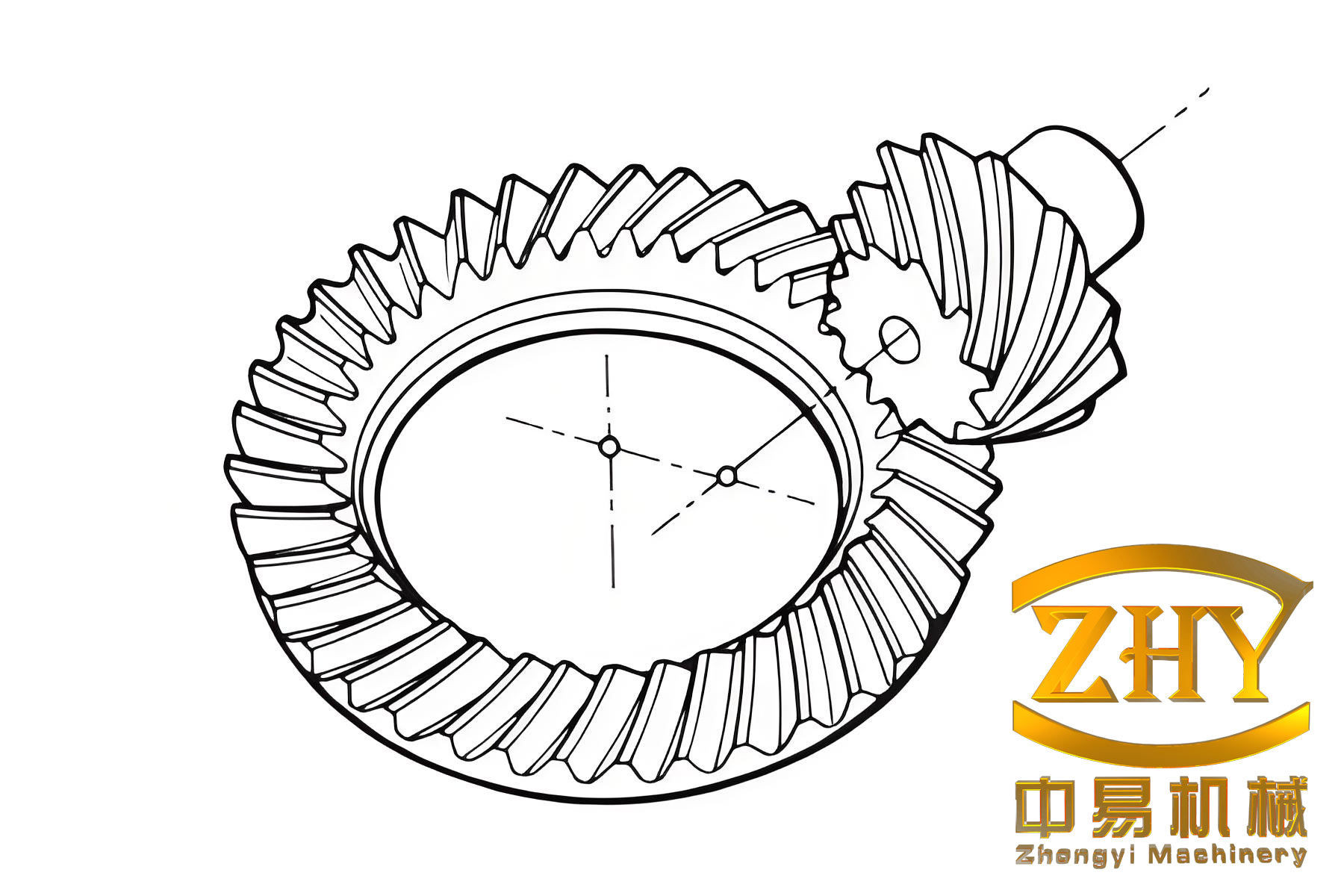
The active design methodology for hypoid bevel gears offers a robust framework for pre-controlling meshing characteristics. By deriving a target pinion tooth surface through conjugate generation and bidirectional modification, and then optimizing machining parameters via SQP, designers can achieve desired transmission error curves and contact patterns. This approach is particularly beneficial for hypoid bevel gears used in demanding applications like vehicle axles, where performance and reliability are paramount. The use of weight coefficients allows flexibility in prioritizing sides based on operational needs, such as forward or reverse driving. Future research could extend this method to incorporate higher-order transmission error designs for further refinement. In summary, active design empowers engineers to tailor hypoid bevel gears for optimal performance, reducing noise and enhancing durability through precise tooth surface engineering.