
The pursuit of superior performance and economic efficiency in automotive driveline components drives continuous research and development. Among these, hypoid bevel gears hold a critical position in rear and four-wheel-drive axles. Their unique geometry, characterized by offset and crossed axes, offers distinct advantages: compactness, high load-carrying capacity, smooth operation, and reduced noise. However, the traditional design process for hypoid bevel gears often relies heavily on empirical knowledge and iterative adjustments to select key geometric parameters. This approach, while functional, may not yield the most cost-effective or performance-optimal design. Specifically, achieving a large gear ratio, a common requirement, can lead to bulky gear sets, increasing material costs and weight. Furthermore, acoustic performance, directly linked to passenger comfort, is not always explicitly optimized during the initial design phase.
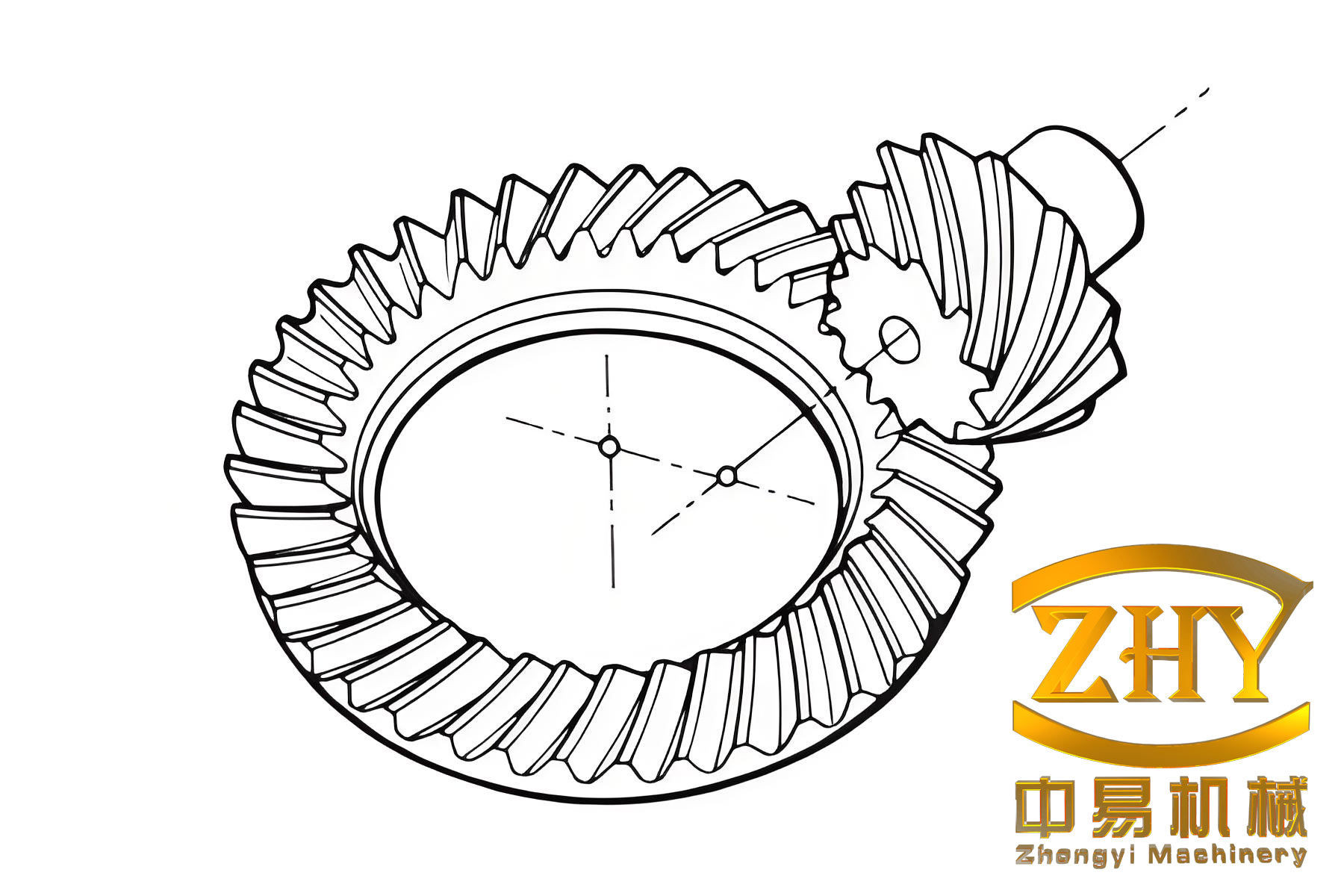
To address these challenges, this article presents a systematic, automated optimization framework. The core objective is to simultaneously minimize two conflicting goals: the overall volume of the gear pair (directly influencing manufacturing cost and weight) and the noise generated during meshing (impacting vehicle refinement and comfort). We formulate this as a constrained multi-objective optimization problem and employ an advanced genetic algorithm, NSGA-II, to find the best possible trade-off solutions. This methodology moves beyond traditional trial-and-error, providing designers with a Pareto-optimal set of designs from which the most suitable can be selected based on specific application priorities.
1. Problem Formulation and Mathematical Model
The design of hypoid bevel gears involves a complex interplay of geometric parameters that influence strength, efficiency, size, and noise. To cast this into an optimization problem, we must first define the decision variables, the objective functions to be minimized, and the practical constraints that ensure a feasible and reliable gear set.
1.1 Definition of Design Variables
After a thorough analysis of the governing equations for volume and meshing dynamics, and assuming a fixed gear ratio \( i \), five primary independent parameters are identified as the most influential. These form our design vector \( \mathbf{X} \):
$$
\mathbf{X} = [z_1, \quad d_{e2}, \quad b_2, \quad E, \quad \beta_2]^T
$$
Where:
- \( z_1 \): Number of teeth on the pinion.
- \( d_{e2} \): Outer pitch diameter of the gear.
- \( b_2 \): Face width of the gear.
- \( E \): Offset distance (the perpendicular distance between the pinion and gear axes).
- \( \beta_2 \): Spiral angle at the reference point (mid-face) of the gear.
The corresponding parameters for the pinion (\( d_{e1}, b_1, \beta_1, \delta_1 \)) and the gear’s pitch angle (\( \delta_2 \)) are derived from these variables and the fixed gear ratio using standard hypoid bevel gear geometric relationships.
1.2 Development of Objective Functions
We target two primary improvements: cost reduction through material savings and comfort enhancement through noise reduction.
Objective 1: Minimize Gear Pair Volume. A simplified yet effective model for the total volume \( V_{total} \) of a hypoid bevel gear pair approximates each member as a conical frustum. The combined volume is given by:
$$
\min F_1(\mathbf{X}) = V_1 + V_2 = \frac{\pi}{4} \left[ b_1 \left( d_{e1}^2 – 2 d_{e1} b_1 \sin \delta_1 + \frac{4}{3} b_1^2 \sin^2 \delta_1 \right) \cos \delta_1 \right] + \frac{\pi}{4} \left[ b_2 \left( d_{e2}^2 – 2 d_{e2} b_2 \sin \delta_2 + \frac{4}{3} b_2^2 \sin^2 \delta_2 \right) \cos \delta_2 \right]
$$
Minimizing \( F_1(\mathbf{X}) \) directly contributes to reducing material usage, weight, and inertia, leading to lower production costs and potentially improved vehicle efficiency.
Objective 2: Minimize Meshing Noise. Gear noise is strongly correlated with the smoothness of torque transmission, which is governed by the transverse contact ratio \( \varepsilon_{\alpha} \). Research indicates that the excitation force and consequent noise are minimized when the total contact ratio approaches an optimal value, often close to 2. This ensures at least two tooth pairs are in contact nearly all the time, providing a very smooth load transfer. Therefore, we formulate the second objective to drive the calculated contact ratio \( \varepsilon_F \) towards this ideal value:
$$
\min F_2(\mathbf{X}) = | 2 – \varepsilon_F |
$$
Where the total contact ratio \( \varepsilon_F \) for hypoid bevel gears can be approximated by a function involving the mean spiral angle \( \beta \), the mean cone distance \( A_0 \), and the outer transverse module \( m_t \). A typical formulation is:
$$
\varepsilon_F = (k_2 \tan \beta – \frac{k_3^2}{3} \tan^3 \beta) \frac{A_0}{\pi m_t}
$$
Here, \( k_2 \) and \( k_3 \) are coefficients related to the gear geometry and cutter head geometry. Minimizing \( F_2(\mathbf{X}) \) aims to achieve the quietest possible meshing condition for the given design space.
1.3 Establishment of Constraint Functions
A practical gear design must satisfy a multitude of mechanical, geometric, and manufacturing constraints. The following are incorporated as inequality constraints \( g_j(\mathbf{X}) \leq 0 \) or \( g_j(\mathbf{X}) \geq 0 \).
| Constraint Category | Mathematical Expression | Physical Justification |
|---|---|---|
| Tooth Count | \( 5 \leq z_1 \leq 12 \) \( z_2 \geq 30 \) \( 40 \leq z_1 + z_2 \leq 60 \) |
Avoids undercutting on pinion, ensures smooth motion transfer, and maintains optimal kinematic conditions. |
| Offset Limit | \( 0.1 \, d_{e2} \leq E \leq 0.2 \, d_{e2} \) | Prevents excessive sliding velocities (reduces wear/scuffing risk) and avoids potential tooth root undercutting. |
| Face Width | \( 4 m_t \leq b_2 \leq 10 m_t \) | Ensures sufficient load capacity and overlap ratio without causing significant load concentration at the ends of the teeth. |
| Spiral Angle | \( 30^\circ \leq \beta_m \leq 50^\circ \) | Balances smooth meshing (higher angle) with manageable axial thrust forces (lower angle). |
| Contact Strength | \( S_H \geq S_{Hmin} \) | Ensures the calculated contact stress safety factor meets or exceeds the minimum allowable value, preventing surface fatigue (pitting). |
| Bending Strength | \( S_F \geq S_{Fmin} \) | Ensures the calculated tooth root bending stress safety factor meets or exceeds the minimum allowable value, preventing tooth breakage. |
The strength safety factors \( S_H \) and \( S_F \) are calculated using standardized procedures (e.g., AGMA, ISO standards) which incorporate the gear geometry, material properties, and applied loading conditions.
2. Multi-Objective Optimization via the NSGA-II Algorithm
Our problem, defined as \( \min \, [F_1(\mathbf{X}), F_2(\mathbf{X})] \) subject to constraints \( g_j(\mathbf{X}) \), is a classic multi-objective optimization problem (MOOP). Unlike single-objective problems, MOOPs rarely have a single solution that minimizes all objectives simultaneously due to inherent conflicts (e.g., a very compact gear may be noisier). Instead, the solution is a set of Pareto-optimal points.
Pareto Optimality: A design point \( \mathbf{X}^* \) is Pareto-optimal if no other feasible point exists that improves one objective without worsening at least one other objective. The set of all Pareto-optimal points forms the Pareto front in the objective function space.
To find this front, we employ the Non-dominated Sorting Genetic Algorithm II (NSGA-II), a powerful and widely-used evolutionary algorithm renowned for its efficiency and ability to maintain a diverse spread of solutions along the Pareto front.
2.1 Core Mechanisms of NSGA-II
NSGA-II improves upon its predecessor through three key features:
1. Fast Non-dominated Sorting: The algorithm ranks the population into successive fronts based on Pareto dominance. Front 1 contains all non-dominated individuals in the current population. Front 2 contains individuals dominated only by those in Front 1, and so on. This ranking is used as the primary measure of fitness.
2. Crowding Distance Assignment: To maintain diversity, NSGA-II calculates a crowding distance for each individual within a front. This metric estimates the density of solutions surrounding a particular point. A larger crowding distance is preferable, indicating the individual is in a less crowded region of the objective space.
3. Elitist Selection with Crowding Comparison: The selection operator for creating the next generation uses a crowded-comparison operator \( \prec_n \). Between two individuals with different non-domination ranks, the one with the better (lower) rank is preferred. If they share the same rank, the one with the larger crowding distance is preferred. This ensures that selection pressure favors both non-dominance and diversity.
The algorithm’s flow can be summarized as follows:
- Initialization: Generate a random initial parent population \( P_t \) of size \( N \).
- Evaluation & Ranking: Evaluate objectives and constraints for \( P_t \). Perform fast non-dominated sort and calculate crowding distance.
- Main Loop: While termination criteria (e.g., max generations) not met:
- Selection: Create an offspring population \( Q_t \) from \( P_t \) using binary tournament selection based on the crowded-comparison operator.
- Variation: Apply crossover (e.g., SBX) and mutation (e.g., polynomial) operators to \( Q_t \).
- Combined Population: Form \( R_t = P_t \cup Q_t \) (size \( 2N \)).
- Elite Selection: Sort \( R_t \) using non-domination and crowding distance. Select the best \( N \) individuals to form the new parent population \( P_{t+1} \).
- Output: The final population \( P_{final} \) represents an approximation of the true Pareto front.
2.2 Implementation via MATLAB’s gamultiobj
For practical implementation, we utilize MATLAB’s built-in function gamultiobj, which is based on a controlled, elitist genetic algorithm (a variant of NSGA-II). The function is called with the following structure:
[x_opt, fval_opt] = gamultiobj(@ObjectiveFunction, n_vars, A, b, Aeq, beq, lb, ub, @ConstraintFunction, options);
We configure the algorithm with the following key options to balance convergence and diversity:
- PopulationSize: 150
- MaxGenerations: 1000
- ParetoFraction: 0.7 (Limits the fraction of individuals on the Pareto front in the final population, helping control elitism).
- FunctionTolerance: A small value (e.g., \(10^{-4}\)) for convergence.
The objective and constraint functions are provided as separate MATLAB function files (.m files) that encapsulate the complete mathematical model for the hypoid bevel gears.
3. Case Study: Optimization of an Automotive Hypoid Gear Set
To demonstrate the effectiveness of the proposed methodology, we apply it to a typical automotive rear axle hypoid bevel gear design problem.
3.1 Baseline Design Parameters
The initial, empirically designed gear pair has the following fixed and variable parameters, serving as our baseline for comparison:
| Parameter | Symbol | Value |
|---|---|---|
| Gear Ratio | \( i \) | 4.1 |
| Pinion Teeth | \( z_1 \) | 10 |
| Gear Outer Pitch Diameter | \( d_{e2} \) | 200.00 mm |
| Gear Face Width | \( b_2 \) | 30.00 mm |
| Offset | \( E \) | 20.00 mm |
| Gear Mid Spiral Angle | \( \beta_2 \) | 37.14° |
For this baseline, the calculated objective functions are:
- Gear Pair Volume, \( V_{baseline} = 2.8324 \times 10^5 \, \text{mm}^3 \)
- Contact Ratio, \( \varepsilon_{F_{baseline}} = 2.1552 \)
- Noise Objective, \( F_2 = |2 – 2.1552| = 0.1552 \)
3.2 Optimization Results and Pareto Front Analysis
Executing the gamultiobj solver with the defined model yields a set of Pareto-optimal solutions. The Pareto front, plotted in the objective space (\(F_1\) vs. \(F_2\)), is shown conceptually below. Each point represents a viable, non-dominated design for the hypoid bevel gears.
The front exhibits the classic trade-off characteristic: designs on the left region have very low volume (good for cost) but a higher noise objective value (potentially louder). Conversely, designs on the right region have a noise objective very close to zero (quieter) but at the expense of increased volume. There is no single “best” point; the optimal choice depends on the designer’s weighting of cost versus acoustic performance.
For this case study, we prioritize a balanced improvement over the baseline. We select a solution from the region where the noise objective \(F_2\) is approximately 0.05, indicating a contact ratio (\(\varepsilon_F\)) of about 1.95, which is closer to the theoretical optimum of 2 than the baseline, while still offering significant volume reduction.
| Design Parameter / Objective | Symbol | Baseline (Traditional) Design | Optimized Design (Selected Point) | Change |
|---|---|---|---|---|
| Pinion Teeth | \( z_1 \) | 10 | 10 | 0% |
| Gear Outer Pitch Diameter | \( d_{e2} \) | 200.00 mm | 196.99 mm | -1.5% |
| Offset | \( E \) | 20.00 mm | 19.72 mm | -1.4% |
| Gear Face Width | \( b_2 \) | 30.00 mm | 26.13 mm | -12.9% |
| Gear Mid Spiral Angle | \( \beta_2 \) | 37.14° | 38.51° | +1.37° |
| Gear Pair Volume | \( V_{total} \) | 2.8324 × 105 mm3 | 2.4725 × 105 mm3 | -12.7% |
| Contact Ratio | \( \varepsilon_{F} \) | 2.1552 | 1.9532 | -0.2020 |
| Noise Objective | \( F_2 = |2-\varepsilon_F| \) | 0.1552 | 0.0468 | -69.8% |
3.3 Discussion of Optimized Design
The results in Table 3 clearly demonstrate the advantages of the multi-objective optimization approach for hypoid bevel gears.
1. Significant Volume Reduction (12.7%): The optimizer successfully identified a more compact geometry. This was achieved primarily through a reduction in the gear face width (\(b_2\)) and a slight decrease in the gear’s outer diameter (\(d_{e2}\)), while the offset (\(E\)) was adjusted proportionally. This reduction translates directly into material savings and lower weight.
2. Improved Acoustic Performance: The noise objective function \(F_2\) was reduced by nearly 70%. The contact ratio moved from 2.1552 to 1.9532, much closer to the theoretically optimal value of 2.0 for minimal excitation. This change was facilitated by a slight increase in the mean spiral angle (\(\beta_2\)), which generally increases the overlap of teeth. The simultaneous reduction in face width, which would normally decrease the contact ratio, was compensated for by this spiral angle adjustment and the other geometric changes, showcasing the algorithm’s ability to navigate complex trade-offs.
3. Satisfaction of All Constraints: The selected optimized design, like all points on the Pareto front, fully satisfies all specified geometric, strength, and manufacturing constraints (tooth count limits, offset ratio, face width ratio, spiral angle range, and minimum safety factors for contact and bending). This guarantees the design is not only optimal but also practical and reliable.
4. The Value of the Pareto Front: The key outcome is not a single design but the entire Pareto front. In a real-world engineering context, different vehicle programs have different priorities. A cost-sensitive economy car might select a design from the low-volume end of the front, accepting slightly higher noise. A luxury vehicle would likely choose a design from the low-noise end. The optimization framework provides this full spectrum of optimal choices, empowering informed decision-making.
4. Conclusion
This article has presented a comprehensive methodology for the multi-objective optimal design of hypoid bevel gears, focusing on minimizing both physical volume and meshing noise. By formulating a detailed mathematical model that incorporates essential geometric relationships, strength criteria, and acoustic performance metrics, we transformed the design problem into a constrained multi-objective optimization framework.
The application of the NSGA-II genetic algorithm, implemented via MATLAB’s gamultiobj function, proved highly effective in solving this complex problem. The algorithm efficiently explored the design space and generated a Pareto-optimal front, revealing the inherent trade-off between compactness and quiet operation.
The case study validated the approach, showing that compared to a traditional empirical design, the optimized hypoid bevel gear pair achieved a 12.7% reduction in volume and a 69.8% reduction in the noise objective value. This demonstrates clear potential for reducing manufacturing costs and improving vehicle NVH (Noise, Vibration, and Harshness) characteristics.
This systematic, automated approach offers a significant advancement over traditional trial-and-error methods. It enhances design efficiency, reduces development time and cost, and provides designers with a set of quantifiably superior alternatives. The framework is also adaptable; the objective functions and constraints can be modified to prioritize other aspects like maximizing efficiency, durability, or minimizing weight, making it a versatile tool for the advanced development of automotive and other high-performance hypoid bevel gear transmissions. Future work may involve integrating more detailed finite element analysis for stress and thermal validation, or incorporating manufacturing cost models directly into the optimization objectives.