
In the field of automotive engineering, the dynamic behavior of gear transmission systems, particularly in drive axles, is a critical factor influencing noise, vibration, and harshness (NVH) performance. Among various gear types, hyperbolic gears—often referred to as hypoid gears—are widely used in automotive drive axles due to their ability to transmit power between non-intersecting axes with high efficiency and compact design. The time-varying mesh stiffness of these hyperbolic gears is a fundamental parameter in dynamic system modeling, as it directly affects gear vibration excitations and acoustic emissions. However, calculating this stiffness for hyperbolic gears poses significant challenges due to their complex geometry and varying contact conditions during meshing. Traditional methods for spur or helical gears are insufficient, necessitating advanced computational approaches. In this article, I present a comprehensive finite element method (FEM)-based methodology for determining the time-varying mesh stiffness of hyperbolic gears, validated through comparison with established models and applied to real-world automotive scenarios. The approach integrates geometric modeling, quasi-static finite element analysis, and post-processing techniques to capture the stiffness variations under different operational loads, providing insights for dynamic system optimization.
The primary excitation source in gear systems is the transmission error, which generates vibrational energy that propagates through connected components and radiates as noise. For hyperbolic gears in automotive drive axles, prior research has focused on gear geometry optimization, static contact analysis, and stress evaluation, but these efforts often overlook the dynamic interactions essential for noise prediction. Dynamic models of gear systems require accurate inputs of stiffness, damping, and inertial properties, with mesh stiffness being particularly complex for hyperbolic gears due to the continuous change in contact point location and force direction during rotation. Unlike spur gears, where mesh stiffness can be approximated using analytical formulas, hyperbolic gears exhibit three-dimensional contact patterns that vary with gear position and load, making stiffness calculation more intricate. Existing studies have employed simplified approximations, such as constant values combined with trigonometric series, or specialized software like Calyx, but details remain scarce, and widespread tools like ABAQUS or ANSYS are underutilized for this purpose. This article addresses this gap by detailing a complete workflow using MATLAB, CATIA, and ABAQUS to compute time-varying mesh stiffness, enabling direct application in dynamic simulations without simplifying assumptions.
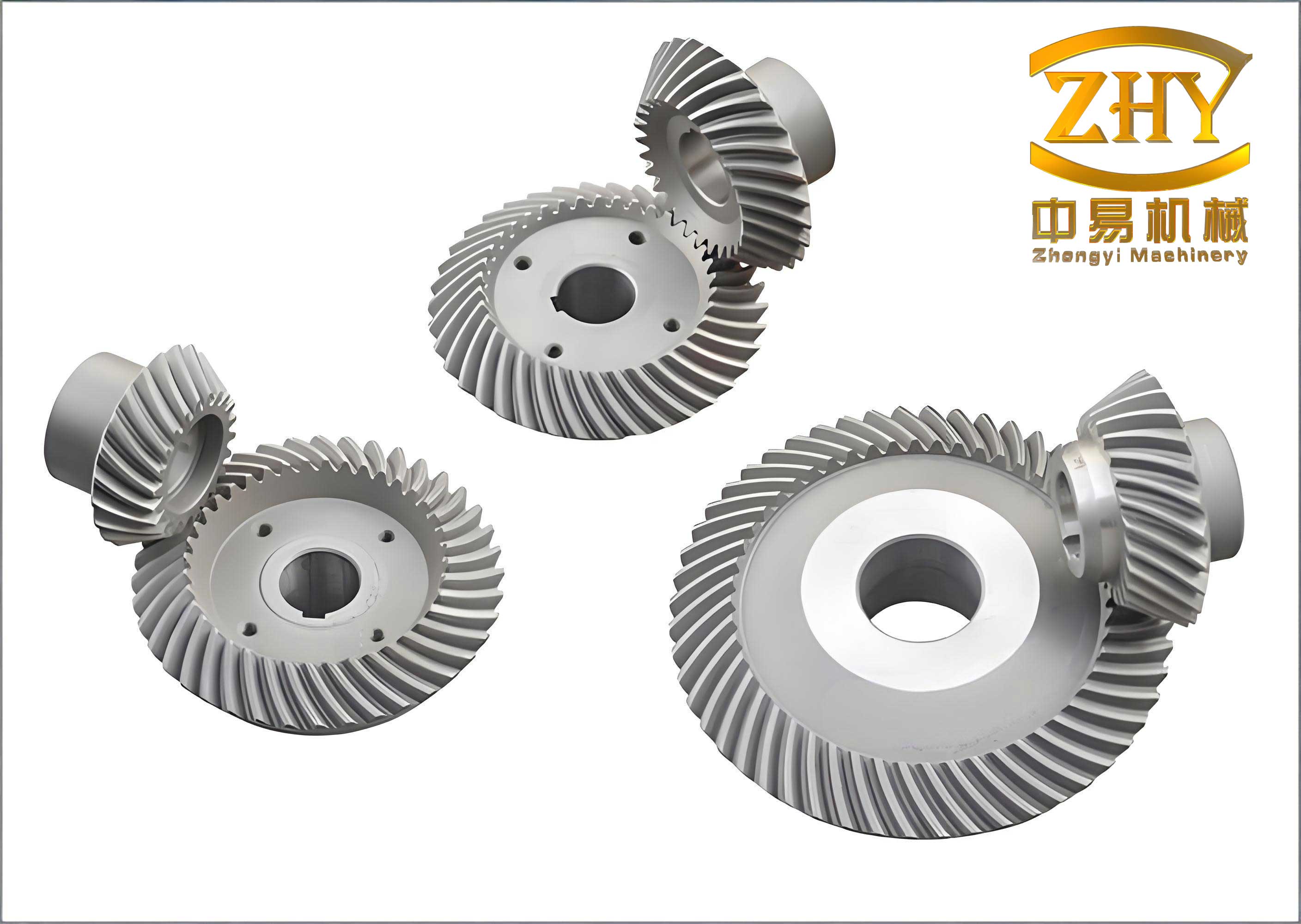
To establish a foundation, I first describe the mathematical model for gear mesh stiffness calculation based on finite element analysis. The model considers the gear pair as a coupled system where multiple contact points exist at any meshing instant, incorporating nonlinearities such as tooth flank间隙 and friction. As shown in Figure 1, the hyperbolic gear mesh involves complex interactions between the pinion and gear. A coordinate system is defined to capture geometric relationships during meshing: let \( S_1 \) and \( S_2 \) be coordinate systems fixed to the pinion and gear, respectively, with \( S_0 \) as the global坐标系 aligned with \( S_2 \). The \( X_1^{(1)} \)-axis coincides with the pinion axis, pointing from the small to large end, and the \( X_2^{(1)} \)-axis is parallel to the gear axis, similarly oriented. The \( X_3^{(1)} \)-axis is determined by the right-hand rule. For the gear, \( S_2 \) is defined analogously.
The contact region is discretized into finite elements, and the mesh stiffness \( k_{ij} \) is a function of gear geometry, meshing position, and applied torque. The total normal force \( F_t^{(l)} \) at time \( t \) can be expressed as:
$$ F_t^{(l)} = \sum_{i=1}^{N_{\text{tooth}}} \sum_{j=1}^{N_{\text{point}}} n_{ij}^{(l)} k_{ij} \delta_{ij} = n_t^{(l)} k_t \delta_t $$
where \( N_{\text{tooth}} \) is the number of simultaneously contacting teeth, \( N_{\text{point}} \) is the number of discretized points per tooth pair, \( n_{ij}^{(l)} \) is the normal vector for each contact element, \( n_t^{(l)} \) is the equivalent normal direction, \( k_t \) is the equivalent stiffness, \( \delta_t \) is the equivalent deformation, and \( F_t^{(l)} \) is the equivalent normal force. Defining \( W_t = k_t \delta_t \), we have:
$$ F_t^{(l)} = n_t^{(l)} W_t $$
With \( F_t^{(l)} = (F_{xt}, F_{yt}, F_{zt}) \), the magnitude is:
$$ W_t = \sqrt{F_{xt}^2 + F_{yt}^2 + F_{zt}^2} $$
The equivalent meshing point position \( r_t^{(l)} \) is calculated as:
$$ r_t^{(l)} = \frac{\sum_{i=1}^{N_{\text{tooth}}} \sum_{j=1}^{N_{\text{point}}} r_{ij}^{(l)} k_{ij} \delta_{ij}}{\sum_{i=1}^{N_{\text{tooth}}} \sum_{j=1}^{N_{\text{point}}} k_{ij} \delta_{ij}} $$
where \( r_{ij}^{(l)} \) is the position vector for each contact point. The moment at the equivalent meshing point is:
$$ M_t^{(l)} = \sum_{i=1}^{N_{\text{tooth}}} \sum_{j=1}^{N_{\text{point}}} r_{ij}^{(l)} \times W_{ij}^{(l)} = r_t^{(l)} \times n_t^{(l)} \cdot k_t \delta_t $$
Defining the directional moment arm \( \lambda_t^{(l)} = r_t^{(l)} \times n_t^{(l)} \), we get \( M_t^{(l)} = \lambda_t^{(l)} W_t \), so:
$$ \lambda_t^{(l)} = \frac{M_t^{(l)}}{W_t} $$
For an ideal rigid gear pair, the driven gear position \( \theta_2 \) relates to the driver gear position \( \theta_1 \) by the gear ratio \( N_1/N_2 \), where \( N_1 \) and \( N_2 \) are tooth counts. However, deformations cause a transmission error \( \Delta \theta_t \):
$$ \Delta \theta_t = \theta_{t2} – \frac{N_1}{N_2} \theta_{t1} $$
The unloaded transmission error is \( \Delta \theta_{0t} \), and the loaded error is \( \Delta \theta_{Lt} \). The mesh stiffness \( k_t \) is defined as the ratio of normal contact force to linear deformation:
$$ k_t = \frac{W_t}{\delta_t} $$
where \( \delta_t \) is the equivalent deformation due to meshing forces. For rotation around the x-axis, with other rotations negligible, this simplifies to:
$$ \delta_t = (\Delta \theta_{Lt} – \Delta \theta_{0t}) \lambda_{xt}^{(l)} $$
Thus, the time-varying mesh stiffness is:
$$ k_t = \frac{W_t}{(\Delta \theta_{Lt} – \Delta \theta_{0t}) \lambda_{xt}^{(l)}} $$
For spur gears, \( \lambda_{xt}^{(l)} \) is constant (equal to the pitch radius), but for hyperbolic gears, it varies with meshing position, adding complexity to the calculation.
To validate this model, I applied it to a spur gear pair, as their mesh stiffness has well-established empirical formulas. The gear parameters are listed in Table 1.
| Parameter | Gear | Pinion |
|---|---|---|
| Number of teeth, N | 34 | 34 |
| Pressure angle, α (°) | 20 | |
| Module, m (mm) | 2.5 | |
| Profile shift coefficient, x (mm) | 0 | 0 |
| Face width, b (mm) | 12 | 12 |
| Fillet radius, r (mm) | 0.44 | 0.44 |
| Elastic modulus, E (GPa) | 210 | |
| Poisson’s ratio, υ | 0.3 | |
| Input torque, T (N·m) | 60 | |
| Input speed, v (r/min) | 150 | |
A finite element model was built, and the mesh stiffness was computed using the described method. The results, shown in Figure 3, align closely with those from the Kuang model, confirming the validity of the approach. The FEM results exhibit slight fluctuations due to contact nonlinearities and friction, but the overall trend matches, including stiffness jumps during transitions from double to single tooth contact—a characteristic of spur gears that contributes to noise.
Moving to hyperbolic gears, the geometric modeling is crucial for accurate stiffness calculation. Hyperbolic gears are typically manufactured using methods like formate (HFT) or generate (HGT) processes, depending on the gear cone angle. The tooth surfaces are generated based on Litvin’s conjugate theory, which transforms tool motions into gear coordinates. The modeling flow involves: defining tool parameters to obtain tool coordinate vectors, applying coordinate transformations to derive the tool surface, transferring this surface to the gear coordinate system using machine settings, solving the meshing equation for discrete points on the tooth flank, and reconstructing the surface with Non-Uniform Rational B-Splines (NURBS). For this study, HFT hyperbolic gears are analyzed, with the pinion generated and the gear formed. The gear blank and machine parameters are summarized in Tables 2 and 3.
| Parameter | Pinion | Gear |
|---|---|---|
| Module | 6.861 | |
| Offset distance (mm) | -25.4 | |
| Hand of spiral | Left | Right |
| Number of teeth | 8 | 43 |
| Face width (mm) | 44.8 | 41 |
| Mean pressure angle | 22°30′ | 22°30′ |
| Outer cone distance (mm) | 150.69 | 151.26 |
| Midpoint cone distance (mm) | 128.32 | 130.75 |
| Addendum (mm) | 9 | 1.59 |
| Dedendum (mm) | 3.17 | 10.45 |
| Normal tooth top width (mm) | 2.74 | 3.63 |
| Distance from crossing point to pitch cone apex (mm) | 0.07 | 1.08 |
| Distance from crossing point to face cone apex (mm) | -0.44 | 1 |
| Distance from crossing point to root cone apex (mm) | -6.67 | 0.05 |
| Root angle | 11°56′ | 73°33′ |
| Face angle | 16°4′ | 77°51′ |
| Pitch angle | 12°33′ | 77°13′ |
| Midpoint spiral angle | 45°3′ | 33°49′ |
| Parameter | Pinion (Convex Side) | Pinion (Concave Side) | Gear (Both Sides) |
|---|---|---|---|
| Machine type | Gleason NO 116 Generator | Gleason NO 609 Machine | |
| Tool profile angle | 29°0′ | 16°0′ | 25°0′ (convex), 20°0′ (concave) |
| Tool diameter (mm) | 234.95 | 224.79 | 228.6 |
| Tool tip radius (mm) | 1 | 1 | 1.25 |
| Machine root angle | 356°40′ | 357°0′ | 75°0′ |
| Bedding position (mm) | MD + 2.22 | MD – 1.16 | MD – 3.59 |
| Horizontal wheel position (mm) | WITH 24.04 | WITH 20.20 | 79.06 |
| Vertical wheel position (mm) | DOWN 26.48 | DOWN 23.31 | 83.96 |
| Eccentric angle | 63°27′ | 60°28′ | – |
| Cradle angle | 126°16′ | 125°55′ | – |
| Tool rotation angle | 261°15′ | 256°22′ | – |
| Tool tilt angle | 54°25′ | 55°21′ | – |
| Ratio of roll | 5.3608 | 5.2441 | – |
The three-dimensional digital model of the hyperbolic gear pair was created in CATIA using point clouds generated from MATLAB scripts, as shown in Figure 5. This model preserves the complex curvature of hyperbolic gears, essential for accurate finite element analysis.
For the finite element model, the geometry was imported into Hypermesh for meshing. To minimize geometric simplification, the entire gear bodies were discretized using hexahedral elements (C3D8R in ABAQUS), totaling 276,722 elements and 237,804 nodes, as depicted in Figure 6. The material properties are listed in Table 4.
| Component | Hyperbolic Gears |
|---|---|
| Elastic modulus, E (MPa) | 2.06 × 10⁵ |
| Poisson’s ratio, υ | 0.27 |
| Density, ρ (t/mm3) | 7.90 × 10⁻⁹ |
In ABAQUS, a quasi-static analysis was performed using the Standard/Static, General solver to simulate meshing under operational conditions. The analysis accounted for geometric nonlinearities and contact interactions. Two steps were defined: load application and gear rotation. Contact pairs between pinion and gear teeth were established with a friction coefficient of 0.1 and “hard” normal behavior. Boundary conditions fixed the pinion input end and constrained the gear output end except for rotation about its axis, with a ramp-applied resistive torque. For a vehicle speed of 40 km/h, the pinion input speed was set to 9.6 rad/s, and the gear resistive torque was 9,500 N·m. Initial velocities were prescribed to stabilize the meshing process. The results, shown in Figure 7, reveal stress distributions: compressive stresses on contact surfaces and tensile stresses at tooth roots, with multiple teeth in contact simultaneously. The contact pattern shifts gradually across the tooth flank, avoiding abrupt changes typical of spur gears.
The calculation of time-varying mesh stiffness begins with determining the transmission error under light load, approximating the unloaded state. A small torque of 10 N·m was applied to the gear output to maintain contact without significant deformation. Figure 8 plots the normal force on individual tooth pairs during rotation, indicating single-tooth contact with minimal force. The transmission error under this light load, shown in Figure 9, exhibits a parabolic trend—consistent with design intentions to reduce meshing impact by optimizing tooth geometry. This aligns with experimental observations for hyperbolic gears under light loads. Table 5 compares the meshing midpoint coordinates and normal vectors from finite element analysis (FEM) and tooth contact analysis (TCA), showing good agreement and validating the FEM model’s accuracy.
| Method | Coordinates (mm) | Normal Vector |
|---|---|---|
| TCA | (-79.729, 18.360, 49.949) | (-0.221, 0.747, -0.627) |
| FEM | (-80.101, 18.411, 49.556) | (-0.220, 0.743, -0.632) |
Under full load (9,000 N·m resistive torque), the meshing behavior changes significantly. Figure 10 shows the normal forces on individual teeth, with up to three teeth in contact at certain positions. The force direction varies per tooth due to the hyperbolic gear geometry, so vector summation is required to obtain the equivalent meshing force \( W_t \), plotted in Figure 11. This force oscillates periodically with gear rotation. The transmission error under load, shown in Figure 12, remains parabolic but shifts downward with reduced fluctuation compared to light load, as increased deformation smoothens contact. The time-varying mesh stiffness \( k_t \) is then computed using the formula:
$$ k_t = \frac{W_t}{(\Delta \theta_{Lt} – \Delta \theta_{0t}) \lambda_{xt}^{(l)}} $$
where \( \lambda_{xt}^{(l)} \) is derived from moment and force data. The resulting stiffness, plotted in Figure 13, varies cyclically with a period equal to the gear meshing cycle. Starting at maximum stiffness, it decreases, stabilizes, then drops further before rising sharply into the next cycle. Unlike spur gears, hyperbolic gears show no abrupt stiffness jumps, promoting smoother meshing and lower noise.
To investigate load effects, stiffness was computed under different torques: 1,000, 3,000, 5,000, 7,000, and 9,000 N·m. As shown in Figure 14, the average mesh stiffness increases with load, while amplitude fluctuations decrease. This is attributed to higher contact conformity and greater gear body deformation under heavy loads, which enhance meshing stability. The relationship can be approximated by:
$$ \bar{k} \propto T^{0.2} \quad \text{and} \quad \Delta k \propto T^{-0.1} $$
where \( \bar{k} \) is the mean stiffness and \( \Delta k \) is the fluctuation range. These trends highlight the importance of considering operational conditions in dynamic models for hyperbolic gears.
In conclusion, this article presents a comprehensive finite element-based methodology for calculating the time-varying mesh stiffness of hyperbolic gears in automotive drive axles. The approach integrates geometric modeling, quasi-static analysis, and post-processing to capture stiffness variations under different loads. Key findings include: the mesh stiffness varies periodically with the gear meshing cycle, showing no abrupt jumps due to gradual contact transitions in hyperbolic gears; stiffness increases with load while fluctuations diminish, improving meshing stability; and the method validates well against established models for spur gears and matches theoretical expectations for hyperbolic gears. This work provides a practical tool for integrating accurate stiffness data into dynamic system models, enabling better prediction of noise and vibration in automotive applications. Future research could extend this to dynamic transient analyses or incorporate thermal effects for even more realistic simulations of hyperbolic gear performance.
The developed methodology offers several advantages: it uses widely available software (MATLAB, CATIA, ABAQUS), requires no simplifying assumptions about force direction or contact patterns, and directly outputs stiffness values for dynamic simulations. By repeatedly emphasizing hyperbolic gears throughout this discussion, I underscore their unique behavior compared to conventional gear types. This approach not only advances the understanding of hyperbolic gear dynamics but also supports engineering efforts to optimize drive axle designs for enhanced NVH performance. As automotive systems evolve toward electrification and higher efficiency, accurate modeling of components like hyperbolic gears becomes increasingly critical, and this work contributes a robust foundation for such endeavors.