
In modern mechanical manufacturing, the production of hyperbolic gears holds a pivotal role, particularly in industries such as automotive engineering, where these components are extensively utilized. The significance of hyperbolic gears stems from their superior performance compared to straight bevel gears in certain applications. While straight bevel gears are simpler to design and machine and do not generate axial forces during transmission, they fall short in terms of operational smoothness and load-bearing capacity. Hyperbolic gears, on the other hand, offer high strength, smoother operation, suitability for high reduction ratios, uniform wear distribution, improved contact patterns, enhanced surface finish, and reduced noise levels. Consequently, hyperbolic gears have become nearly ubiquitous in passenger vehicles. This underscores the necessity of深入研究 the machining theory, parameter optimization, and simulation of hyperbolic gears, especially in educational settings where practical understanding is crucial.
In this article, I delve into the theoretical foundations of hyperbolic gear design, machining methods, and forming principles, with a focus on computer numerical control (CNC) machining. Through detailed analysis and examples, I aim to demonstrate and validate the effectiveness of system pre-correction optimization. I explore key aspects such as machining parameters and simulation for hyperbolic gears, optimizing these parameters to construct a robust simulation machining system. This approach not only enhances manufacturing precision but also serves as a valuable tool for teaching and research in mechanical engineering education.
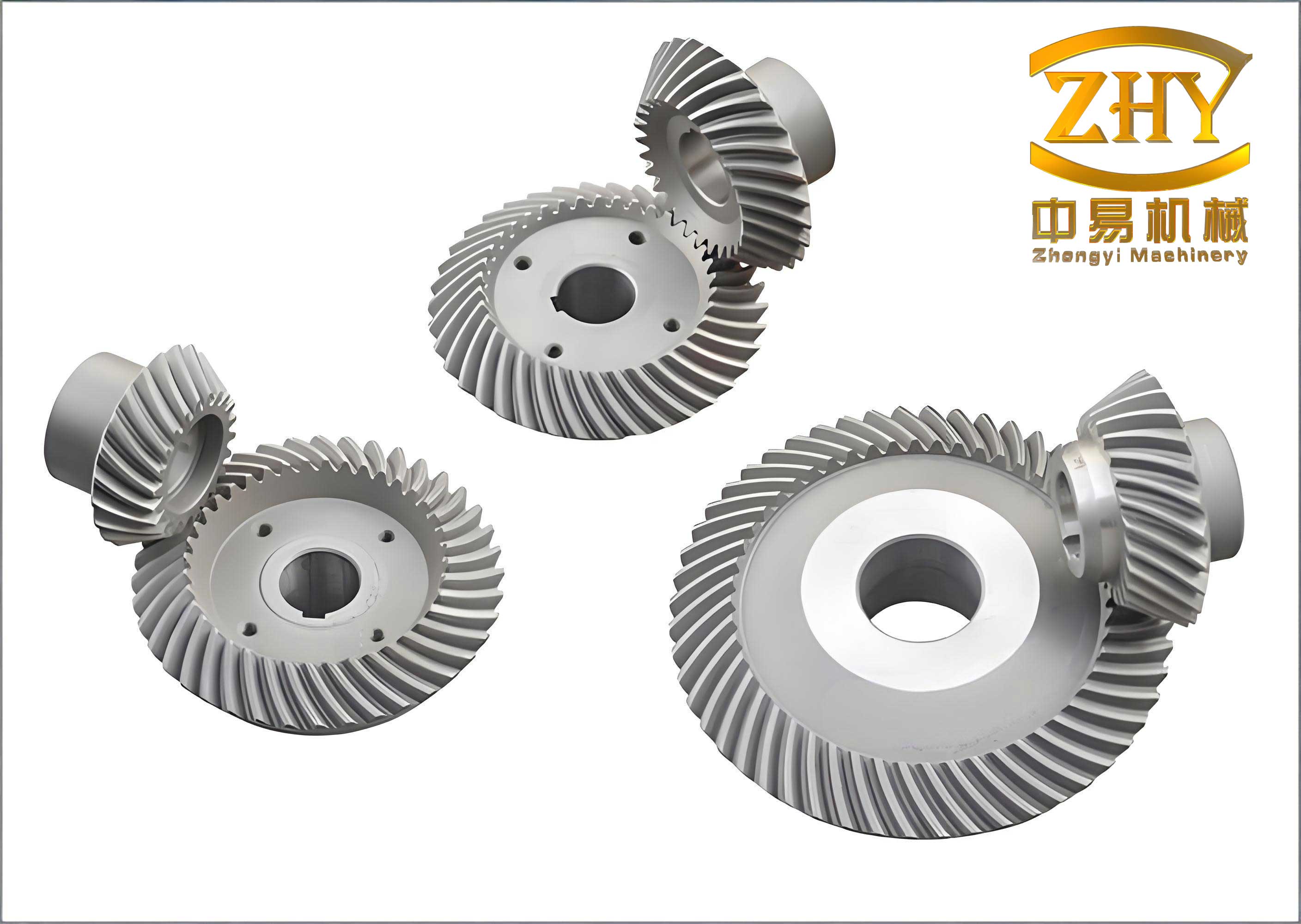
The geometric design of a hyperbolic gear pair is fundamental to its performance. The basic parameters involve the relative positions of the two axes and a reference point, which determine the transmission characteristics. Key elements include the offset distance, shaft angle, and pitch cone angles. The pitch plane is the common tangent plane of the two pitch cones, and the pitch cone surface approximates a hyperboloid. Understanding these geometries is essential for accurate machining.
To formalize this, consider the following geometric parameters: let \( \Sigma \) be the shaft angle, \( E \) the offset distance, \( r_1 \) and \( r_2 \) the pitch circle radii of the pinion and gear respectively, and \( \epsilon \) and \( \eta \) the offset angles in the gear and pinion axial sections. The relationship between these parameters can be expressed using trigonometric functions. For instance, the pitch cone angles \( \delta_1 \) and \( \delta_2 \) for the pinion and gear are derived from the shaft angle and offset. A simplified representation is:
$$ \tan \delta_1 = \frac{\sin \Sigma}{\cos \Sigma + (r_2 / r_1)} $$
and
$$ \tan \delta_2 = \frac{\sin \Sigma}{\cos \Sigma + (r_1 / r_2)} $$
These formulas highlight the interdependence of geometric factors in hyperbolic gear design. Additionally, the spiral angle at the mean point, denoted \( \beta_m \), influences the tooth curvature and contact pattern. It is calculated based on the offset and pitch radii:
$$ \sin \beta_m = \frac{E}{r_1 + r_2} $$
Accurate computation of these parameters is critical for ensuring proper meshing and performance of the hyperbolic gear pair. In educational contexts, students can use these equations to simulate different design scenarios and understand the impact of parameter variations.
Advancements in computer technology, particularly spreadsheet software and databases, have revolutionized the calculation and management of hyperbolic gear parameters. These tools facilitate the handling of complex and tedious data, enabling quick and efficient analysis. For example, customized electronic tables can be created to compute initial design parameters, as shown in the following table, which summarizes key values for a hypothetical hyperbolic gear pair.
| Parameter | Pinion | Gear | Units |
|---|---|---|---|
| Number of Teeth | 12 | 38 | – |
| Pitch Cone Angle | 20.5° | 78.85° | degrees |
| Pitch Diameter | 101.2 | 286.25 | mm |
| Spiral Direction | Left | Right | – |
| Face Module | 8.4388 | 8.4388 | mm |
| Pressure Angle | 20° | 20° | degrees |
| Normal Pressure Angle | 20.5° | 20.5° | degrees |
| Mean Spiral Angle | 36.9828° | 36.9828° | degrees |
| Mean Cone Distance | 168.619 | 168.619 | mm |
| Mean Addendum | 1.132 | 1.132 | mm |
| Mean Dedendum | 12.607 | 12.607 | mm |
| Radial Cutter Position | 99.6012 | 99.6012 | mm |
| Basic Cutter Rotation | 324.5255° | 324.5255° | degrees |
| Vertical Wheel Position | 24.4895 | 24.4895 | mm |
| Roll Ratio | 4.31167 | 4.31167 | – |
This table serves as a foundation for further machining parameter optimization. By adjusting these values, one can explore different design iterations to achieve optimal performance. The use of spreadsheets allows for automated recalculation, making it an excellent educational tool for students to learn about parameter sensitivity in hyperbolic gear design.
The machining of hyperbolic gears typically involves two primary methods: form cutting for the gear and刀倾法 (cutter tilt method) for the pinion. In CNC machining, these methods are implemented through precise control of tool paths and machine settings. The goal is to generate the complex tooth surfaces accurately. Simulation plays a crucial role in this process, as it allows for the verification of parameter settings, detection of potential issues such as tool or workpiece deformation, overload conditions, and analysis of geometric and mechanical properties before physical machining.
For the gear, form cutting can be simulated in software like CATIA or UG. The process begins by establishing coordinate systems for the machine, gear, and cutter based on adjusted parameters. The mathematical model for the cutter surface is defined, and through coordinate transformations, the gear tooth surface is generated. The cutter profile is represented parametrically. For example, the cutter surface coordinates \( (x_c, y_c, z_c) \) can be expressed as:
$$ x_c = r_c \cos \theta, \quad y_c = r_c \sin \theta, \quad z_c = f(\theta) $$
where \( r_c \) is the cutter radius, \( \theta \) is the angular parameter, and \( f(\theta) \) defines the profile curve. Using these, the gear tooth surface is derived via enveloping theory. The condition for enveloping is given by the equation of meshing:
$$ \mathbf{n} \cdot \mathbf{v} = 0 $$
where \( \mathbf{n} \) is the normal vector to the cutter surface and \( \mathbf{v} \) is the relative velocity between the cutter and gear. This equation ensures that the cutter generates the desired tooth geometry. In simulation, these calculations are performed numerically, allowing students to visualize the generation process and understand the underlying principles.
For the pinion, the刀倾法 involves a rolling motion between the pinion and the cradle, characterized by a roll ratio. In 3D CAD software, similar coordinate systems are established. The pinion tooth surface is generated by creating a series of envelope lines based on the roll ratio. These lines are then fitted into a surface, and a solid cutting body is formed. Through array and Boolean operations, the complete pinion model is constructed. The roll ratio \( R_r \) is defined as the ratio of the angular velocity of the cradle to that of the pinion:
$$ R_r = \frac{\omega_c}{\omega_p} $$
where \( \omega_c \) is the cradle angular velocity and \( \omega_p \) is the pinion angular velocity. This parameter is critical for achieving the correct tooth curvature. The envelope lines are generated by solving the meshing equation iteratively for different positions. The resulting surface points \( (x_p, y_p, z_p) \) are computed using transformation matrices:
$$ \begin{bmatrix} x_p \\ y_p \\ z_p \\ 1 \end{bmatrix} = \mathbf{T}_{mc} \cdot \mathbf{T}_{cg} \cdot \begin{bmatrix} x_c \\ y_c \\ z_c \\ 1 \end{bmatrix} $$
where \( \mathbf{T}_{mc} \) and \( \mathbf{T}_{cg} \) are transformation matrices from machine to cradle and cradle to gear, respectively. This mathematical framework enables accurate simulation of the pinion machining process.
Once the models are built, CNC machining simulation can be performed. This involves defining tool paths, cutting speeds, feed rates, and other machining parameters. The simulation helps in optimizing these parameters to minimize errors and improve surface quality. For instance, the cutting force \( F_c \) can be estimated using empirical formulas:
$$ F_c = K_c \cdot a_p \cdot f_z \cdot z $$
where \( K_c \) is the specific cutting force, \( a_p \) is the depth of cut, \( f_z \) is the feed per tooth, and \( z \) is the number of teeth engaged. By simulating different parameter sets, one can identify conditions that reduce forces and prevent tool wear. This is particularly useful in education, as students can experiment with virtual machining without the cost and risk of physical trials.
Parameter optimization is a key aspect of hyperbolic gear manufacturing. Through iterative simulation, optimal parameters for radial cutter position, cutter rotation, vertical wheel position, and roll ratio can be determined. The objective function for optimization might include minimizing tooth surface error, maximizing contact area, or reducing machining time. For example, the surface error \( \epsilon_s \) can be defined as the deviation between the simulated tooth surface and the theoretical design:
$$ \epsilon_s = \sqrt{\frac{1}{N} \sum_{i=1}^{N} (d_i – d_{i, \text{theory}})^2} $$
where \( d_i \) are measured distances at sample points and \( d_{i, \text{theory}} \) are the theoretical values. Optimization algorithms, such as gradient descent or genetic algorithms, can be applied to adjust parameters until \( \epsilon_s \) is minimized. This process not only improves gear quality but also teaches students about optimization techniques in engineering.
In educational settings, the simulation of hyperbolic gear machining offers numerous benefits. It provides a hands-on learning experience where students can explore design and manufacturing concepts in a virtual environment. They can modify parameters, observe the effects on gear geometry and performance, and develop problem-solving skills. Additionally, simulation tools can be integrated into coursework to complement theoretical lessons on gear theory, CNC machining, and computer-aided design.
To further illustrate, consider a case study where a hyperbolic gear pair is designed for an automotive differential. Initial parameters are set based on load requirements and space constraints. Using spreadsheet software, students calculate the geometric parameters as shown in the table above. Then, in CAD software, they build the gear and pinion models through simulation. They might encounter issues such as improper contact patterns or excessive stress concentrations. By adjusting parameters like the spiral angle or pressure angle, they can iteratively improve the design. For instance, increasing the spiral angle \( \beta_m \) can enhance smoothness but may require changes to the offset distance. The relationship can be explored through formulas:
$$ E = (r_1 + r_2) \sin \beta_m $$
Through simulation, students verify that the modified design meets performance criteria. They also analyze machining parameters, such as optimizing the cutter path to reduce cycle time. The simulation might reveal that a higher feed rate causes vibrations, prompting a reduction to ensure quality. This experiential learning deepens understanding of hyperbolic gear systems.
Moreover, the integration of simulation with CNC programming is crucial. Students can generate G-code directly from the simulated models, bridging the gap between design and manufacturing. They learn to account for machine kinematics, tool compensation, and other practical factors. For example, the tool center point (TCP) trajectory must be computed accurately to avoid collisions. The TCP coordinates \( (X_t, Y_t, Z_t) \) are derived from the gear surface coordinates and tool geometry:
$$ X_t = x_g + r_t \cdot n_x, \quad Y_t = y_g + r_t \cdot n_y, \quad Z_t = z_g + r_t \cdot n_z $$
where \( (x_g, y_g, z_g) \) are gear surface points, \( r_t \) is the tool radius, and \( (n_x, n_y, n_z) \) is the surface normal vector. Simulation helps validate these trajectories before actual machining.
In conclusion, the study of hyperbolic gear CNC machining parameter optimization and simulation is vital for advancing manufacturing precision and educational outcomes. I have explored the geometric design, parameter calculation, simulation methodologies, and optimization techniques for hyperbolic gears. By构建 a simulation machining system, educators can provide students with interactive tools to master complex concepts. The use of tables and formulas, as demonstrated, enhances clarity and facilitates learning. While this article covers key aspects, there remain many challenges in the field of hyperbolic gears, such as thermal effects during machining or advanced material considerations, which warrant further research. Nonetheless, the integration of simulation in education promises to cultivate a deeper understanding of hyperbolic gear technology among future engineers.
To support ongoing learning, below is an expanded table with additional parameters that are often considered in hyperbolic gear design and machining optimization.
| Category | Parameter | Symbol | Typical Value Range | Impact on Performance |
|---|---|---|---|---|
| Geometric | Shaft Angle | \( \Sigma \) | 90° (common) | Determines gear type and offset feasibility |
| Offset Distance | \( E \) | 10-50 mm | Affects spiral angle and strength | |
| Pitch Diameter Ratio | \( r_2 / r_1 \) | 1.5-4.0 | Influences speed reduction and size | |
| Tooth Width | \( b \) | 20-100 mm | Related to load capacity and machining complexity | |
| Machining | Cutter Radius | \( r_c \) | 50-200 mm | Affects tooth profile accuracy and tool life |
| Roll Ratio | \( R_r \) | 2.0-5.0 | Critical for pinion tooth generation | |
| Feed Rate | \( f \) | 0.1-0.5 mm/tooth | Impacts surface finish and machining time | |
| Cutting Speed | \( V_c \) | 100-300 m/min | Affects tool wear and material removal rate | |
| Optimization | Surface Error Tolerance | \( \epsilon_{\text{max}} \) | 0.01-0.05 mm | Target for quality control |
| Contact Pattern Area | \( A_c \) | 60-80% of tooth face | Indicator of load distribution | |
| Machining Time | \( T_m \) | Minimized | Economic factor in production |
This comprehensive approach to hyperbolic gear education, combining theory, computation, and simulation, prepares students for real-world challenges in gear design and manufacturing. As technology evolves, continued refinement of these methods will further enhance the efficacy of hyperbolic gear systems in various industrial applications.