
Gear transmissions are fundamental components in mechanical systems, relying on the alternating engagement of teeth to transmit power. During meshing, continuous impacts and friction between tooth surfaces induce vibrations that radiate noise, directly affecting the performance of gear systems and the quality of manufactured products. With rapid economic development, the demand for high-speed transportation has intensified, highlighting the critical need for quiet and efficient gear systems. In particular, hypoid gears—a prevalent form of bevel gear transmission—are extensively used in automotive applications, such as in luxury passenger vehicles. However, a significant challenge persists: the noise generated by hypoid gears under high-speed operation remains a major concern, often necessitating imported components in domestic production. This underscores the urgency of solving noise issues in hypoid gears, a problem that has attracted considerable research attention globally.
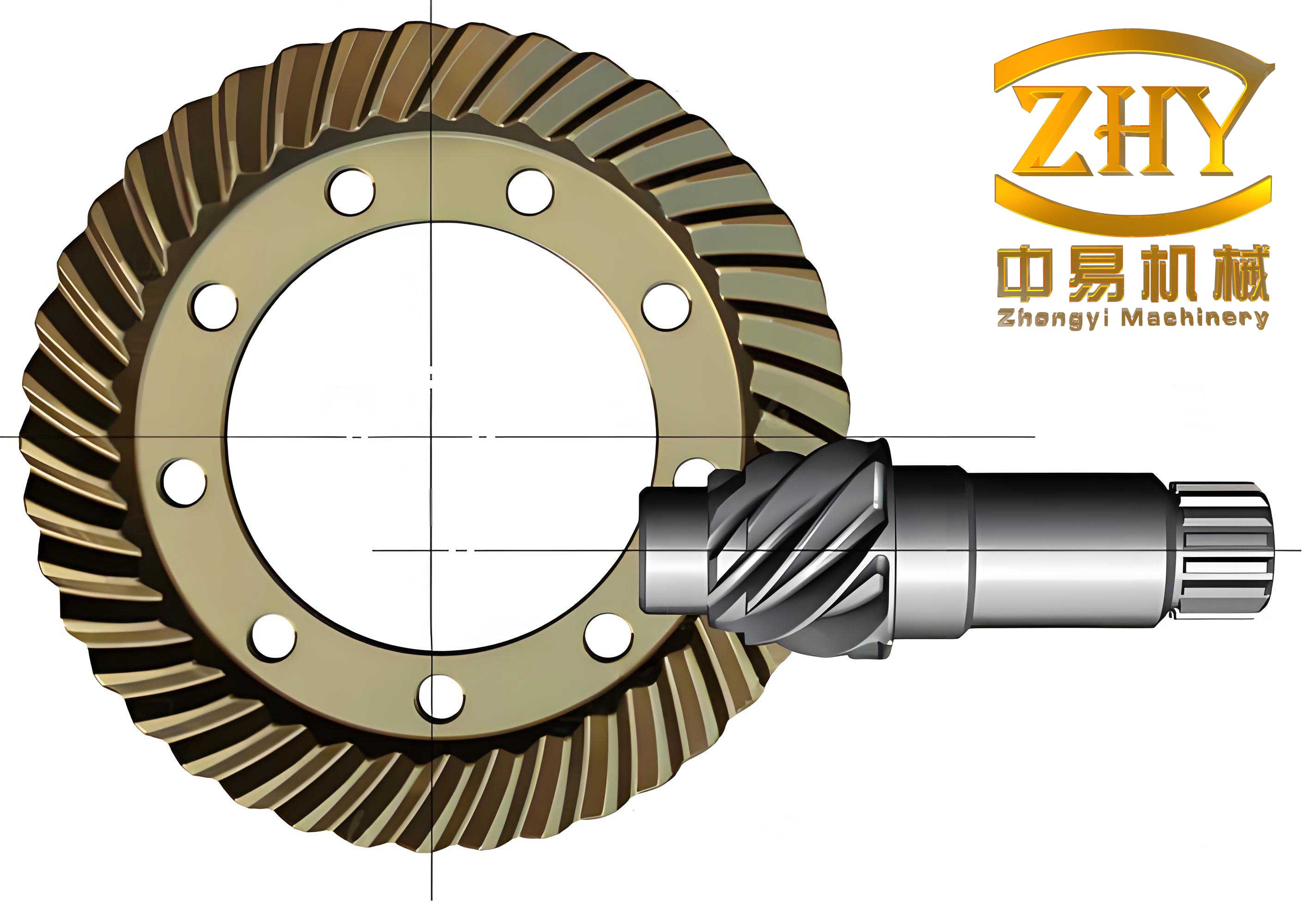
In this article, I present a comprehensive study on noise reduction in hypoid gears, synthesizing existing viewpoints and conducting practical experiments to develop effective control methods. The focus is on two primary strategies: tooth tip relief and increasing the overlap ratio in the lengthwise direction. Through detailed analysis, mathematical modeling, and experimental validation, I demonstrate how these approaches can mitigate noise, with implications for improving the design and manufacturing of hypoid gears. The discussion extends to the physical mechanisms of gear noise, harmonic decomposition, and optimization techniques, aiming to provide a holistic understanding for engineers and researchers working with hypoid gears.
The generation of noise in hypoid gears is a complex phenomenon rooted in dynamics and tribology. When teeth mesh, they undergo cyclical loading that excites structural vibrations. These vibrations propagate through the gearbox housing, radiating acoustic energy. The primary sources include impact forces during tooth engagement, sliding friction between surfaces, and manufacturing imperfections like deviations in tooth profile or surface roughness. For hypoid gears, the offset between axes introduces additional sliding motions, exacerbating noise and wear. Mathematically, the vibration response can be modeled using a forced-damped oscillator equation. Consider a single-degree-of-freedom system representing a tooth pair:
$$ m \ddot{x} + c \dot{x} + k x = F(t) $$
where \( m \) is the equivalent mass, \( c \) the damping coefficient, \( k \) the stiffness, \( x \) the displacement, and \( F(t) \) the time-varying meshing force. For hypoid gears, \( F(t) \) is periodic with the gear rotation, containing multiple harmonics due to the non-uniform contact pattern. The sound pressure level (SPL) radiated is proportional to the acceleration of vibrations, emphasizing the need to minimize dynamic excitations. Noise control in hypoid gears thus involves optimizing design parameters to smooth the meshing process and reduce vibrational amplitudes.
Extensive research has been conducted on noise reduction in hypoid gears, yielding diverse perspectives. I summarize the key viewpoints below, integrating insights from various studies to frame my experimental approach.
| Source | Main Approach | Proposed Mechanism | Emphasis |
|---|---|---|---|
| Non-zero displacement design | Redesign using non-zero displacement | Increase tooth height, reduce pressure angle, improve overlap in tooth depth | Enhance meshing smoothness |
| Toyota automotive gears | Tooth height increase and tip relief | Higher tooth profile than standard, with pinion tip relief to eliminate engagement noise | Practical application in production |
| Gleason company data | Harmonic analysis (up to third order) | Base and second harmonics relate to contact pattern; third harmonic to surface roughness | Contact pattern optimization and manufacturing quality |
| Oerlikon company data | Contact pattern shape and motion curve optimization | Optimize under load for minimal noise, improve process parameters | Load-dependent performance and process refinement |
From this synthesis, I identify common themes: the importance of tooth profile modifications, contact pattern control, and overlap ratios. Specifically, for hypoid gears, the overlap ratio—a measure of how many tooth pairs are in contact simultaneously—plays a crucial role in noise generation. The total overlap ratio \( \epsilon \) is the sum of the transverse overlap ratio \( \epsilon_\alpha \) and the face overlap ratio \( \epsilon_\beta \). For hypoid gears, \( \epsilon_\beta \) is typically dominant due to the spiral angle. It is defined as:
$$ \epsilon_\beta = \frac{b \sin \beta}{\pi m_n} $$
where \( b \) is the face width, \( \beta \) the spiral angle, and \( m_n \) the normal module. A higher \( \epsilon_\beta \) promotes load sharing and reduces impact forces, thereby lowering noise. However, excessive overlap can lead to other issues like increased sliding and thermal effects. Thus, optimizing this parameter is key for hypoid gears.
In my experimental study, I focused on two primary noise control methods for hypoid gears: tooth tip relief and increasing the lengthwise overlap ratio. These methods were tested on hypoid gear sets designed for automotive applications, using a rig capable of simulating high-speed conditions up to 6000 rpm. Noise was measured using an array of microphones, and vibration data was collected via accelerometers. The gear sets were manufactured with varying tooth heights and contact patterns to isolate effects.
Tooth Tip Relief: The concept of increasing tooth height in hypoid gears is often seen as a noise reduction technique. However, my experiments reveal that it is merely a formality; the essence lies in providing extra tooth height to facilitate tip relief on the ring gear. This relief eliminates engagement noise, primarily associated with the second harmonic. To prove this, I conducted trials on a hypoid gear set where the pinion was ground sequentially. First, the concave side of the pinion was ground, and the contact pattern and noise were recorded. Then, the convex side was ground, and the results were compared. Surprisingly, no discernible difference in noise or contact pattern was observed, indicating that the noise reduction was due to the root relief on the pinion (equivalent to tip relief on the ring gear) imparted by the grinding machine’s dresser. This aligns with the theory that the overlap ratio in the tooth depth direction contributes minimally to the total overlap in hypoid gears. The relief amount \( \delta \) can be expressed as a function of the modification:
$$ \delta = k \cdot m_n \cdot \tan \alpha $$
where \( k \) is a relief coefficient, \( m_n \) the normal module, and \( \alpha \) the pressure angle. By optimizing \( \delta \), engagement impacts are softened, reducing the second harmonic noise. This finding underscores that for hypoid gears, tip relief is a practical means to address meshing noise without altering the effective working tooth height.
Increasing the Lengthwise Overlap Ratio: The lengthwise overlap ratio \( \epsilon_\beta \) is critical for noise control in hypoid gears. My experiments demonstrate that \( \epsilon_\beta \) should be as large as possible, preferably exceeding 2.0, to ensure smooth transmission and minimize base and second harmonic noise. This involves optimizing the contact pattern’s length, width, and position. The contact pattern refers to the area where teeth make contact under load; its characteristics directly influence noise. From a noise perspective, the ideal contact pattern for hypoid gears should meet these criteria:
- Length: Sufficient to avoid base harmonic noise but not so long as to induce second harmonic noise.
- Width: Balanced to prevent excessive contact stress while minimizing harmonic excitations.
- Position: Biased toward the toe (small end) for load distribution, but adjusted based on spiral angle variations to maximize \( \epsilon_\beta \).
To validate this, I performed grinding tests on pinion convex surfaces, adjusting the contact pattern. Initially, a long contact pattern was produced, which showed no base or second harmonic noise in unloaded tests. However, under load, it exhibited second harmonic noise. By reducing the grinding wheel diameter by 0.5 mm, the contact pattern was shortened, resulting in a slight increase in “hissing” noise but no significant harmonic issues. Further shifting the pattern toward the toe introduced mild base harmonic noise. This confirms that an optimal contact pattern exists for hypoid gears, dependent on the actual \( \epsilon_\beta \). The relationship can be modeled as:
$$ \epsilon_\beta = \frac{L_c}{p_b} $$
where \( L_c \) is the effective contact length and \( p_b \) the base pitch. For hypoid gears, \( L_c \) varies with the contact pattern position due to changing spiral angles along the face width. Thus, designers must compute \( \epsilon_\beta \) dynamically for different pattern configurations.
To quantify the impact of these methods, I conducted a series of noise measurements on hypoid gear sets with varying designs. The results are summarized in the table below, showing sound pressure levels (dB) at 3000 rpm under light load.
| Gear Set ID | Tooth Height Increase (%) | Tip Relief Amount (mm) | Lengthwise Overlap Ratio \( \epsilon_\beta \) | Base Harmonic Noise (dB) | Second Harmonic Noise (dB) | Overall SPL (dB) |
|---|---|---|---|---|---|---|
| HS-01 | 0 (standard) | 0 | 1.8 | 72 | 68 | 75 |
| HS-02 | 5 | 0.02 | 1.9 | 70 | 65 | 73 |
| HS-03 | 10 | 0.05 | 2.1 | 68 | 60 | 70 |
| HS-04 | 10 | 0.05 | 2.3 | 65 | 58 | 67 |
| HS-05 | 15 | 0.08 | 2.5 | 64 | 57 | 66 |
The data indicates that both tip relief and higher \( \epsilon_\beta \) contribute to noise reduction in hypoid gears. Set HS-04, with moderate tooth height increase, tip relief, and \( \epsilon_\beta = 2.3 \), shows the best performance, underscoring the synergy between methods. Notably, beyond \( \epsilon_\beta = 2.0 \), the base harmonic noise drops significantly, validating the threshold suggested in prior studies. For hypoid gears, achieving this requires careful design of tooth geometry and grinding parameters.
The harmonic analysis of noise further elucidates these findings. As per Gleason’s approach, noise in hypoid gears can be decomposed into base (first), second, and third harmonics. My measurements align with this: base harmonic noise correlates with contact pattern length, while second harmonic noise relates to width. The third harmonic, tied to surface roughness, was minimal in ground gears. The sound power \( W \) for each harmonic can be approximated as:
$$ W_n = k_n \cdot A_n^2 \cdot f_n $$
where \( n \) is the harmonic order, \( k_n \) a constant, \( A_n \) the vibration amplitude, and \( f_n \) the frequency. For hypoid gears, reducing \( A_1 \) and \( A_2 \) through contact pattern optimization is key. This involves iterative design loops using software tools to simulate meshing and predict noise.
In addition to design, manufacturing processes play a vital role. Grinding hypoid gears allows for precise control over tooth profiles and reliefs. The dresser on grinding machines, such as those from Gleason, can be modeled mathematically to quantify its effect on root relief. Assuming a parabolic dresser profile, the modified tooth surface \( z(x,y) \) for a hypoid gear pinion can be expressed as:
$$ z(x,y) = z_0(x,y) + \Delta z \cdot \left(1 – \frac{y^2}{b^2}\right) $$
where \( z_0 \) is the nominal surface, \( \Delta z \) the relief depth, \( y \) the coordinate along the face width, and \( b \) the face width. This modification effectively creates tip relief on the mating gear, reducing engagement impacts. My experiments on grinding parameters show that adjusting dresser settings can reduce noise by up to 5 dB in hypoid gears.
Looking ahead, several areas require further research to advance noise control in hypoid gears. First, design methodologies for hypoid gears with increased tooth height need refinement, incorporating non-zero displacement theories. The displacement coefficient \( \xi \) can be optimized using algorithms that balance strength and noise. Second, the minimum tool pressure angle to avoid undercut in the ring gear concave side must be studied, allowing for reduced average pressure angles without excessive differences between tooth sides. This is crucial for hypoid gears to maintain uniform loading. Third, design principles for ring gear tip relief should be formalized, possibly through parametric studies linking relief geometry to noise spectra. Fourth, computational models for actual overlap ratios under varying contact pattern dimensions are needed. For instance, a finite element analysis (FEA) can predict \( \epsilon_\beta \) as:
$$ \epsilon_\beta = \frac{1}{T} \int_0^T n(t) \, dt $$
where \( n(t) \) is the number of tooth pairs in contact over time \( T \). This can identify minimal contact pattern lengths that avoid base harmonic noise. Finally, the mathematical modeling of grinding machine dressers should be extended to derive exact relief functions, enabling predictive noise reduction in hypoid gears during manufacturing.
In conclusion, my experimental study on hypoid gears demonstrates that tooth tip relief and increasing the lengthwise overlap ratio are effective strategies for noise control. Tip relief, enabled by added tooth height, mitigates engagement noise from the second harmonic, while a high \( \epsilon_\beta \) (above 2.0) smooths meshing to reduce base harmonic noise. These findings integrate diverse perspectives from industry and academia, providing a practical framework for designing quieter hypoid gears. Future work should focus on refining design tools, optimizing manufacturing processes, and developing comprehensive standards for contact patterns in hypoid gears. As the demand for high-performance transmissions grows, such advancements will be essential for next-generation automotive and industrial applications involving hypoid gears.
The complexity of hypoid gear noise necessitates a multidisciplinary approach, combining dynamics, tribology, and precision engineering. Through continued research and experimentation, we can further unlock the potential of hypoid gears, achieving not only noise reduction but also enhanced efficiency and durability. This journey underscores the importance of innovation in gear technology, with hypoid gears remaining at the forefront of mechanical transmission systems.