
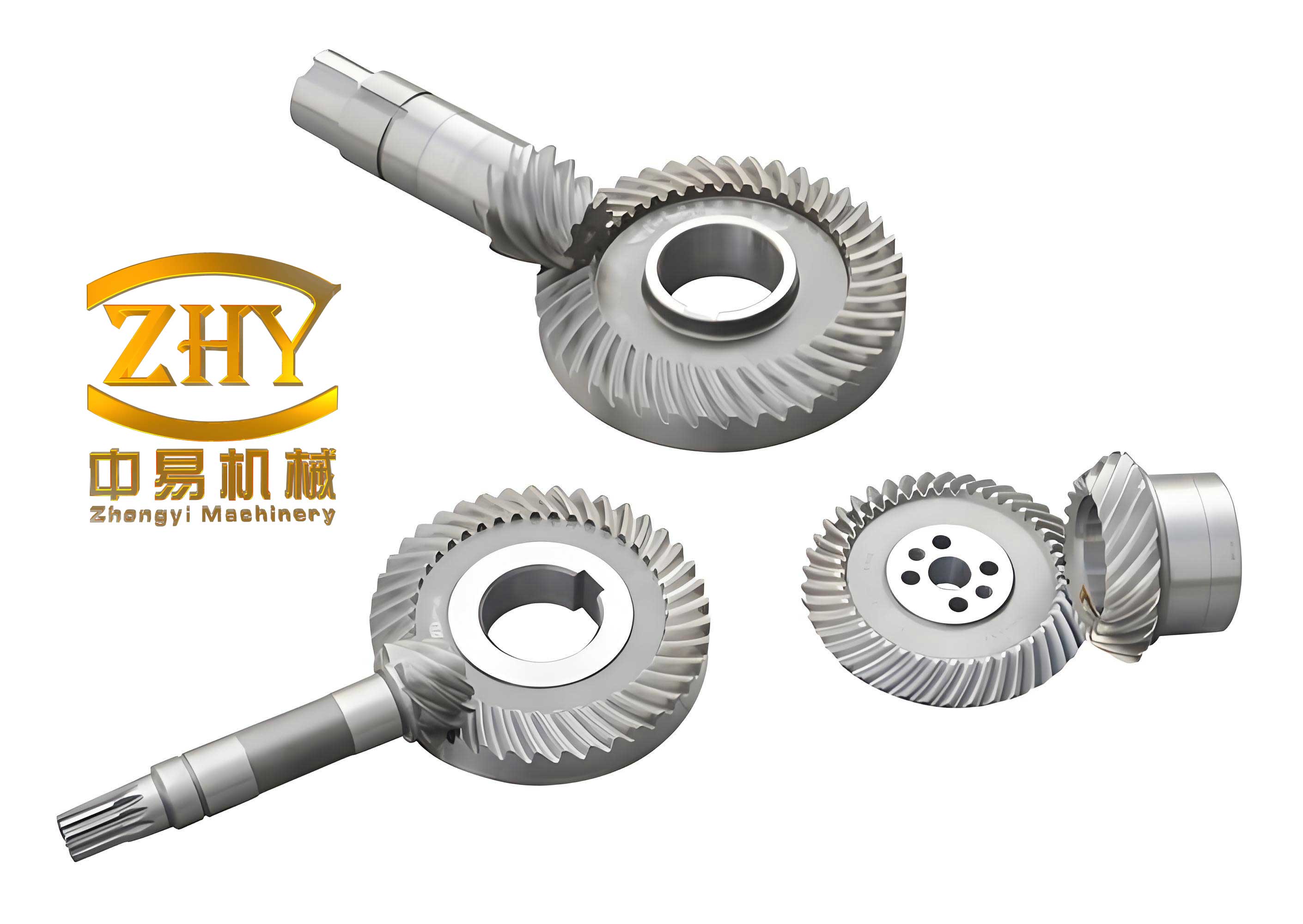
The manufacturing of hypoid gears is a cornerstone of modern power transmission systems, particularly in demanding applications such as automotive rear axles, heavy machinery, and aerospace. Their ability to transmit high torque between non-intersecting, crossed axes makes them indispensable. While traditional machining methods like hobbing or face milling have been the standard, there is a growing impetus towards near-net-shape forming technologies. These methods, including forging, rotary forging, and rolling, offer significant advantages in terms of material savings, improved mechanical properties through grain flow alignment, reduced production time, and enhanced sustainability—aligning with the principles of green manufacturing. Among these, the hot rolling process presents a particularly attractive route for forming hypoid gears pinions due to its potential for high productivity and excellent surface integrity.
However, the transition from theoretical potential to robust industrial application is fraught with challenges. The hot rolling of complex geometries like hypoid gears involves severe, localized, and continuous plastic deformation under non-isothermal conditions. This complexity often leads to specific forming defects that are not prevalent in conventional cutting processes. A predominant and critical defect observed in the hot rolling of hypoid gear pinions is the formation of “lugs” or “ears”—unwanted protrusions of material on the tooth flanks or tip. These defects compromise the geometric accuracy, contact pattern, and ultimately the fatigue life and noise performance of the gear pair. Therefore, a deep understanding of the genesis of these defects and the precise control of process parameters is paramount for the successful implementation of this technology. This article delves into a comprehensive analysis of the forming defects, specifically “lugs,” in the hot rolling process for hypoid gear pinions. It systematically investigates the influence of key process parameters through numerical simulation and validates the findings with experimental trials, culminating in a set of optimized process settings.
Theoretical Analysis of Forming Defects in Hypoid Gear Rolling
The rolling process for hypoid gears is a sophisticated incremental forming operation. A shaped rolling die (the tool gear) is pressed against a heated, cylindrical workpiece blank (the future pinion) while both rotate in a coordinated manner. The process can be conceptually divided into three stages: initial indentation, feed forming, and sizing.
During initial indentation, the tool teeth penetrate the workpiece surface. The localized stress must exceed the temperature-dependent yield strength of the workpiece material to initiate plastic flow. At this point, shallow, periodic impressions corresponding to the tool’s tooth spaces are created on the blank.
The feed forming stage is the core of the process. As the tool continues to feed radially into the workpiece while both rotate, the plastic deformation zone expands. Material from the future tooth dedendum (the “valley” being formed) is displaced upwards to fill the cavity of the rolling die, thereby forming the tooth addendum and flanks. The material flow is highly constrained and three-dimensional, influenced by the complex curvature of the hypoid gear tooth. The flow stress is a critical factor here, governed by the temperature and strain rate.
The final sizing or calibration stage involves a complete revolution of the tool with minimal or zero further feed. This stage ensures dimensional accuracy, homogenizes any minor irregularities, and imparts the final surface finish to the tooth flanks.
The defect of “lug” formation is intrinsically linked to this material flow dynamics. In the context of rolling hypoid gears, the tool engagement is not symmetric due to the offset and the curved tooth geometry. This can lead to an imbalance in the velocity field of the flowing material. If the process parameters are not judiciously chosen, material on one side of the developing tooth space may experience a higher velocity gradient or less restraint, causing it to flow upwards more rapidly than the material on the opposite side. This asymmetric flow results in an overfilling or extrusion of material beyond the intended tooth profile on one flank, manifesting as a “lug.”
Simulation studies vividly capture this phenomenon. In a process without corrective measures, a lug on one side (e.g., the left flank) can grow uncontrollably. It may eventually spill over the tooth tip and interfere with the formation of the opposite (right) flank, potentially causing severe folding or underfilling—a catastrophic defect for gear functionality. The mitigation strategy involves manipulating the flow direction. By periodically reversing the direction of rotation of the tool relative to the workpiece, the asymmetry in material flow is alternately applied to both flanks. This alternating action helps to balance the upward material movement, preventing a single lug from dominating. Eventually, controlled lugs from both sides may meet and coalesce at the tooth tip, resulting in a fully formed tooth without major flow defects.
The governing mechanics can be partially described by plasticity theory. The yield criterion under hot working conditions can be simplified. The effective stress $\bar{\sigma}$ is related to the flow stress, which is a function of strain, strain rate, and temperature:
$$
\bar{\sigma} = f(\bar{\epsilon}, \dot{\bar{\epsilon}}, T)
$$
where $\bar{\epsilon}$ is the effective strain, $\dot{\bar{\epsilon}}$ is the effective strain rate, and $T$ is the absolute temperature. The imbalance leading to lug formation can be seen as a divergence in the strain rate tensor $\dot{\epsilon}_{ij}$ on the two flanks of the nascent tooth. The material’s tendency to flow towards the path of least resistance is amplified by high friction or inappropriate feed-speed ratios.
Systematic Process Parameter Investigation for Hypoid Gear Rolling
The quality of a hot-rolled hypoid gear pinion is highly sensitive to the interplay of several key process parameters. To deconvolute their individual and combined effects, a controlled numerical simulation approach using the Finite Element Method (FEM) is employed. The following parameters are identified as the most influential:
- Tool Rotational Speed (n): This dictates the strain rate and the thermal interaction time between the tool and workpiece.
- Tool Feed per Revolution (f): This is the radial infeeding amount of the tool for each full rotation of the workpiece (or tool, depending on the machine kinematics). It is a primary determinant of the severity of deformation in each engagement.
- Friction Condition (μ): The interfacial friction between the hot workpiece and the cooler tool influences material flow, filling behavior, forming forces, and tool wear.
- Workpiece Initial Temperature (T0): This directly controls the flow stress of the material, its ductility, and the forming window.
A design of experiments based on the control variable method is established to isolate the effect of each parameter. The baseline material for simulation is a common gear steel like AISI 8620 or 20CrMnTi, with temperature-dependent properties. The process window is defined as follows:
| Investigated Parameter | Level 1 | Level 2 | Level 3 | Level 4 | Constant Parameters (When Variable) |
|---|---|---|---|---|---|
| Tool Speed, n (rpm) | 30 | 50 | 70 | 90 | f=0.7 mm/rev, μ=0.3, T0=950°C |
| Feed per Rev, f (mm/rev) | 0.7 | 0.8 | 0.9 | 1.0 | n=70 rpm, μ=0.3, T0=950°C |
| Friction Coeff., μ | 0.30 | 0.35 | 0.40 | 0.45 | n=70 rpm, f=0.7 mm/rev, T0=950°C |
| Initial Temp., T0 (°C) | 950 | 1000 | 1050 | 1100 | n=70 rpm, f=0.7 mm/rev, μ=0.3 |
The friction coefficients are selected based on typical lubricants used in hot forging/rolling processes. A lower μ (e.g., 0.30) may represent a graphite-based lubricant, while higher values (0.40-0.45) approach conditions of poor or no lubrication. The temperature range of 950-1100°C is within the stable austenitic region for low-alloy steels, providing good formability without excessive oxidation or grain growth.
Influence of Tool Rotational Speed
Increasing the tool speed directly increases the nominal strain rate $\dot{\epsilon}$ at the contact interface. The relationship can be approximated by:
$$
\dot{\bar{\epsilon}} \propto \frac{v}{h} \approx \frac{2\pi n R_{tool}}{h_{def}}
$$
where $v$ is the tangential velocity, $R_{tool}$ is the pitch radius of the tool, and $h_{def}$ is the characteristic deformation zone height. A higher strain rate typically increases the flow stress due to less time for dislocation motion and dynamic recovery, which is reflected in the simulation results.
The analysis of key target variables reveals clear trends:
- Forming Load: The total forming force increases with time as more material is engaged. The rate of load increase is more pronounced at higher tool speeds (e.g., 90 rpm) compared to lower speeds (30 rpm). This is attributed to the combined effect of higher strain rates and slightly reduced thermal softening due to shorter contact times.
- Effective Strain at a Tracked Node: A node on the workpiece tooth flank shows that the accumulation of effective strain $\bar{\epsilon}$ is faster at higher speeds. The final strain value is also generally higher, indicating more severe work hardening if the temperature cannot compensate.
- Nodal Displacement: The radial flow displacement of material to form the tooth is greater at higher speeds, suggesting a more aggressive forming action but also a higher risk of uncontrolled flow (lugging).
- Temperature Evolution: Due to the shorter process time and potentially increased heat generation from plastic work, the average workpiece temperature shows a smaller drop at higher speeds. However, localized temperature spikes at the surface may differ.
Conclusion: A very low speed (30 rpm) may lead to incomplete filling due to excessive heat loss. A very high speed (90 rpm) leads to excessive loads and unstable material flow, increasing lug risk. A moderate speed of 70 rpm appears to offer a good compromise between forming efficiency and controlled flow for hypoid gears.
Influence of Feed per Revolution
The feed per revolution, $f$, is perhaps the most critical parameter for defect control. It defines the incremental reduction per engagement. A simple geometric relationship links feed to the local effective strain per pass:
$$
\Delta\bar{\epsilon} \approx \ln\left(\frac{h_0}{h_0 – f \cdot \cos\alpha}\right)
$$
where $h_0$ is the initial tooth space height and $\alpha$ is the pressure angle. A larger $f$ leads to a larger $\Delta\bar{\epsilon}$ per engagement.
Simulation results show strong dependence on this parameter:
- Forming Load: The load increases dramatically with increasing feed. A feed of 1.0 mm/rev generates significantly higher forces than 0.7 mm/rev. This is a direct consequence of the larger volume of material being displaced in each tool rotation.
- Effective Strain: The tracked node experiences a rapid and high increase in effective strain with larger feeds. At $f=1.0$ mm/rev, the strain can exceed safe limits, drastically increasing the risk of internal cracking or surface tearing, especially in conjunction with lower temperatures.
- Nodal Displacement & Material Flow: Larger feeds cause larger, more abrupt displacements. This sudden material movement is a primary driver of asymmetric flow and lug formation. The material does not have sufficient time to flow uniformly into the die cavity.
- Temperature: The temperature curves show larger fluctuations with higher feed rates. The intense, localized deformation at high feed causes adiabatic heating, but the subsequent exposure to the cooler tool and environment leads to a sharper temperature drop.
Conclusion: A lower feed rate (0.7 mm/rev) promotes smoother, more controllable material flow, which is essential for preventing lugs in the complex geometry of hypoid gears. While it increases the total number of rotations needed, the gain in quality and reduced defect rate is substantial.
Influence of Friction Condition
Friction at the tool-workpiece interface governs the shear forces that either restrain or assist material flow. The shear stress $\tau_f$ is given by:
$$
\tau_f = \mu \cdot p
$$
where $p$ is the interfacial normal pressure. In metal forming, $\mu$ often follows a constant shear factor model ($\tau_f = m \cdot k$, where $k$ is the shear yield strength and $0 \le m \le 1$), but a Coulomb model is a common simplification for initial studies.
The simulation outcomes for different friction coefficients are summarized below:
| Friction Coeff. (μ) | Typical Lubricant | Forming Load | Material Flow Uniformity | Risk of Lug Formation | Tooth Fill Quality |
|---|---|---|---|---|---|
| 0.30 | Graphite-based | Lowest | Most uniform | Lowest | Complete, sharp corners |
| 0.35 | Soap-based | Moderate | Good | Low | Complete |
| 0.40 | Water (minimal lubrication) | High | Less uniform, some sticking | Moderate | Slight underfill possible |
| 0.45 | Poor/No Lubrication | Very High | Non-uniform, high shear | High | Underfill, potential tearing |
The analysis of target variables shows that low friction (μ=0.3) results in lower forming loads, more predictable nodal displacement curves, and a more gradual temperature change. High friction increases all forces and stresses, promotes uneven flow (a precursor to lugs), and can cause excessive temperature rise at the surface due to frictional heating.
Conclusion: Effective lubrication to achieve a low friction coefficient (≈0.3) is critical for the successful hot rolling of hypoid gears. It reduces loads, ensures smooth material flow into the die’s intricate geometry, minimizes tool wear, and is fundamental for defect prevention.
Influence of Initial Workpiece Temperature
Temperature is the master variable controlling flow stress. The relationship is often expressed by constitutive equations like the Arrhenius-type model:
$$
\dot{\bar{\epsilon}} = A [\sinh(\alpha \bar{\sigma})]^n \exp\left(-\frac{Q}{RT}\right)
$$
where $A$, $\alpha$, $n$ are material constants, $Q$ is the activation energy for deformation, and $R$ is the gas constant. A higher temperature $T$ exponentially reduces flow stress for a given strain rate.
The simulation results across the temperature range yield the following insights:
- Forming Load: Load decreases monotonically with increasing temperature. Rolling at 1100°C requires significantly lower force than at 950°C, as the material is much softer.
- Effective Strain: While the final fill geometry might be similar, the path to get there differs. At higher temperatures, the material yields more easily, leading to potentially higher total plastic strain due to less resistance to flow. However, the risk of rupture is lower due to enhanced ductility.
- Nodal Displacement: The rate of displacement is higher at elevated temperatures, indicating easier and faster material flow. This can be beneficial for filling but must be managed with feed and speed to avoid rushing material and causing lugs.
- Temperature Loss & Microstructure: The primary temperature curve is a decay from the initial setpoint. Starting at a lower temperature (950°C) risks the material cooling into a regime where flow stress increases sharply, potentially leading to incomplete filling or excessive load. Starting too high (1100°C) risks excessive oxidation, grain growth, and potential incipient melting for some steels.
Conclusion: A temperature of 950°C is at the lower end of the practical window but was found to be sufficient for forming when combined with optimal feed and speed. It offers a good balance: sufficient ductility and low flow stress, while minimizing oxidation and grain growth concerns that are more severe at 1100°C. This temperature is particularly suitable for the selected gear steel when forming hypoid gears with precise geometry requirements.
Synthesis of Optimal Process Settings and Experimental Validation
Based on the systematic numerical analysis of individual parameters for the hot rolling of hypoid gear pinions, an optimized parameter set can be synthesized. The goal is to combine parameters that collectively promote stable, controlled material flow, complete die filling, and minimal forming loads to prevent defects like lugs and ensure tool life.
The recommended process window derived from this study is:
| Process Parameter | Symbol | Recommended Value / Range | Rationale |
|---|---|---|---|
| Tool Rotational Speed | n | 70 rpm | Balances strain rate to avoid excessive load (high speed) and heat loss/incomplete fill (low speed). |
| Feed per Revolution | f | 0.7 mm/rev | Promotes smooth, incremental deformation critical for controlling asymmetric flow and preventing lug formation in complex hypoid geometry. |
| Friction Coefficient | μ | 0.30 (Graphite-based lubricant) | Minimizes interfacial shear, reducing forming load, ensuring uniform fill, and extending tool life. |
| Workpiece Initial Temperature | T0 | 950 °C | Provides adequate material softness (low flow stress) while minimizing oxidation and microstructural degradation. |
| Process Strategy | – | Multi-pass feed with periodic reversal of rotation | Essential for mitigating the inherent asymmetry in material flow, balancing lug formation on both flanks. |
To validate these simulation-based recommendations, experimental trials were conducted on a dedicated hot rolling test bench capable of the required rotational, feed, and reversal motions. The workpiece material was 20CrMnTi steel, blanked to the appropriate preform dimensions. The blanks were heated in an induction furnace to the target temperature of 950°C ± 15°C. A graphite-based suspension was applied as a lubricant and parting agent.
The rolling process was executed using the optimized parameters: a tool speed of 70 rpm, a feed of 0.7 mm/rev, and a periodic reversal schedule (e.g., 2 forward rotations, 1 reverse rotation) during the main feed forming stage, followed by a final sizing pass. The process was monitored for stability, and the final formed pinion was air-cooled.
Results: The experimentally produced hypoid gear pinion demonstrated a significant improvement over parts made with non-optimal parameters. Visual and tactile inspection revealed a smooth, continuous tooth surface without the pronounced “lug” defect. Sectioning of a sample tooth via wire EDM confirmed the internal soundness: the grain flow followed the tooth contour elegantly, and no internal folds or voids were observed in the critical root and flank regions. Dimensional inspection showed that the tooth profile accuracy and cumulative pitch error were within an acceptable range for a formed gear (e.g., achieving IT10 grade), validating the process’s capability for near-net-shape manufacturing. The successful experiment confirms that the parameter combination identified through systematic simulation—moderate speed, low feed, excellent lubrication, and controlled temperature with a reversal strategy—is effective in mitigating the key forming defects in the hot rolling of hypoid gears.
Conclusion
The hot rolling of hypoid gear pinions presents a promising alternative to traditional machining, but its success hinges on overcoming specific forming defects, primarily the “lug” defect. Through a combination of theoretical analysis, detailed finite element simulation using the control variable method, and experimental validation, this investigation establishes clear cause-effect relationships between process parameters and forming outcomes for hypoid gears.
The key findings are:
- The formation of “lugs” is a direct consequence of asymmetric material flow driven by the complex geometry of hypoid gears and inappropriate process parameters. Implementing a rolling strategy with periodic reversal of rotation is an effective corrective measure to balance this flow.
- Process parameters have predictable and significant impacts:
- Forming Load increases with higher tool speed, feed rate, friction, and lower temperature.
- Effective Strain and Material Flow Severity increase with higher speed and feed rate. High feed rates are particularly detrimental, promoting abrupt, unstable flow that directly leads to lugging.
- Friction is a critical control variable. Low friction (μ ≈ 0.3) is essential for uniform die filling and defect prevention.
- Temperature must be high enough to ensure adequate ductility (≥950°C) but controlled to avoid microstructural damage.
- An optimized parameter set for the studied hypoid gear pinion was determined: Tool Speed = 70 rpm, Feed per Revolution = 0.7 mm/rev, Friction Coefficient = 0.30 (using graphite lubricant), Initial Temperature = 950°C, coupled with a multi-pass feed and reversal strategy.
- Experimental trials using this optimized setup successfully produced hypoid gear pinions with smooth tooth surfaces, no observable lug defects, sound internal microstructure, and acceptable geometrical accuracy, thereby validating the simulation-based process design methodology.
This work provides a foundational framework for process design in the hot rolling of complex gears. It underscores that the precise matching and control of interdependent parameters—rather than focusing on a single variable—is the key to transforming the hot rolling of hypoid gears from a laboratory possibility into a reliable, high-quality manufacturing process. Future work may focus on advanced tooling designs for improved cooling/lubrication, real-time adaptive control based on process forces, and detailed studies on the resulting mechanical properties and fatigue performance of hot-rolled hypoid gears.