
In the field of gear transmission, the performance and durability of hypoid gears are critically dependent on the contact pattern formed between the mating tooth surfaces. As a researcher focused on gear design and manufacturing, I have extensively studied the stability of these contact patterns, particularly in relation to the adjustment parameters during the cutting process. The contact pattern, which refers to the localized area of contact on the tooth flank, determines load distribution, noise, vibration, and overall efficiency. Instability in the contact pattern can lead to premature wear, pitting, and even catastrophic failure. This article delves into the mathematical and practical aspects of contact pattern stability in hypoid gears, emphasizing the influence of machine tool settings and providing a comprehensive analysis through formulas, tables, and computational examples.
The manufacturing of hypoid gears involves complex machine adjustments that define the tooth geometry. Key parameters include the machine spiral angle \(\beta_m\), the cutter head mean radius \(r_p\) (or grinding wheel radius), the cutter installation radius \(b_F\), the installation angle \(q_F\), the roll ratio \(i_{1F}\), the hypoid offset \(E_1\), and the generating line offset \(L_1\). These parameters are interconnected; altering one necessitates recalibration of others to maintain the desired contact conditions. The contact pattern stability is inherently tied to the derivative of the transmission ratio \(i’_{21}\), where \(i_{21}\) is the gear ratio between the pinion and gear. The periodic transmission error \(f_c\) and the angle \(\mu\) between the mean tooth line and the working line also play pivotal roles. In this analysis, I explore how variations in these parameters affect the contact pattern, leading to instability characterized by shifting or uneven contact areas.
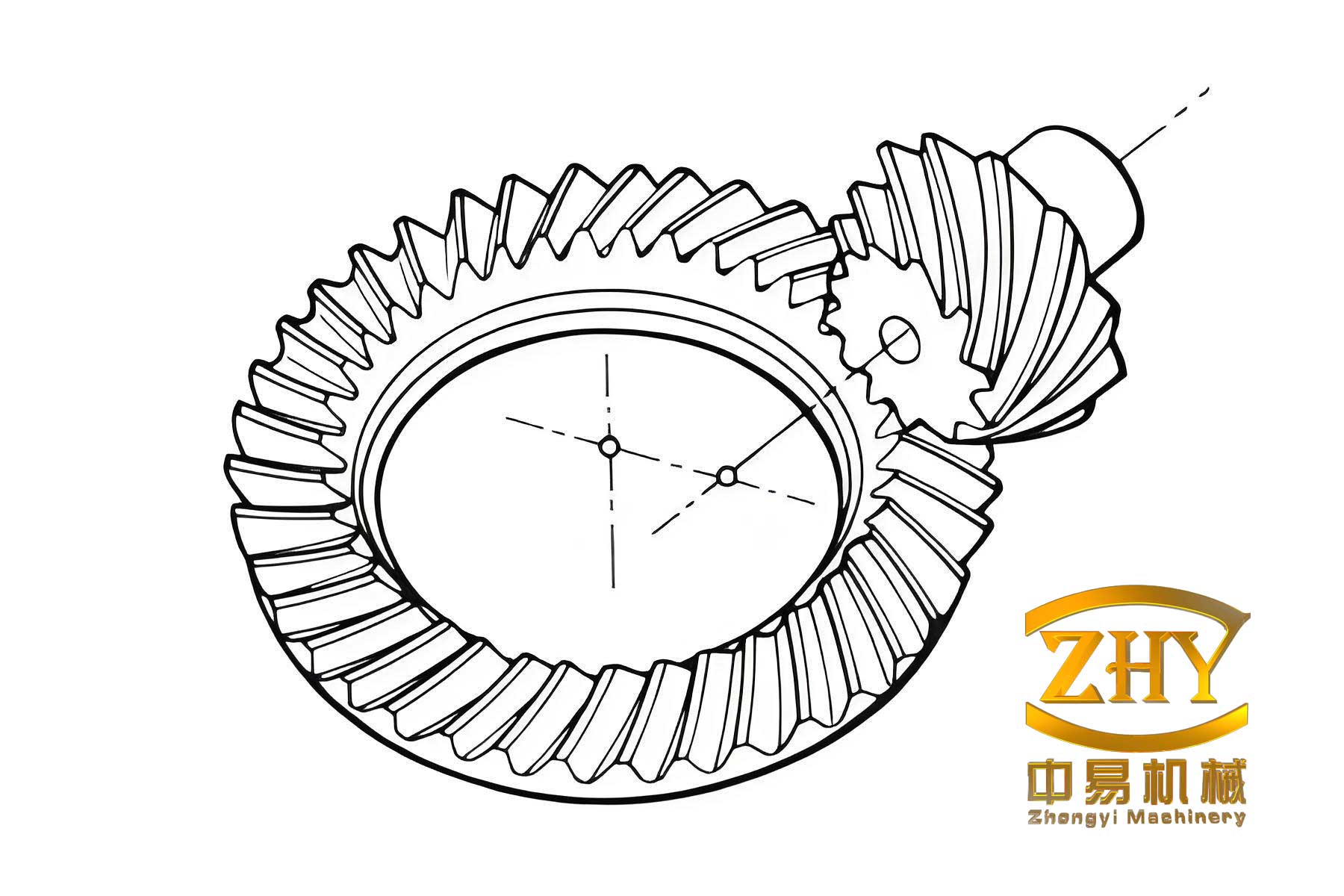
To model the contact pattern behavior, we consider the coordinate system centered at the machine tool origin \(O_F\) and the pinion cone apex \(O_1\), determined by offsets \(L_1\) and \(E_1\). For a constant transmission ratio derivative \(i’_{21}\), we can derive contour lines in the parameter space of \(\mu\) (ranging from \(0^\circ\) to \(180^\circ\)) and \(i_{21}\). These contours form closed ellipses or hyperbolas, depending on the gear geometry. For instance, when \(\mu = 90^\circ\), the parameters \(r_F\), \(E_1\), and \(L_1\) approach infinity, leading to hyperbolic contours. The mathematical representation of these contours is crucial for understanding stability. Let the parameter \(S\) denote the arc length along the contour, and the derivative \(dS/d\mu\) indicates the sensitivity of offsets to changes in \(\mu\). A small \(dS/d\mu\) implies that minor variations in \(\mu\) result in negligible changes in offsets, contributing to stable contact patterns. Conversely, large derivatives signal instability.
The relationship between the transmission error and the derivative \(i’_{21}\) is given by:
$$ i’_{21} = -\frac{8 f_c}{(2\pi / z_1)^2}, $$
where \(z_1\) is the number of pinion teeth. This equation assumes a constant derivative over the meshing cycle, but in practice, especially for semi-generating methods, the function may follow higher-order parabolic curves. Therefore, we establish multiple contour lines that are tangent at a point \(P\), known as the envelope of contours. This point \(P\) corresponds to a degenerate case where the cutter head axis coincides with the machine cradle axis, resulting in a single-point contact. Although theoretically valid, this condition leads to poor working line characteristics and significant deviations in \(i’_{21}\) along the meshing arc.
The stability of contact patterns in hypoid gears can be quantified by analyzing the distribution of parameter values near point \(P\). For a given gear set, we compute the offsets \(E_1\) and \(L_1\) as functions of \(\mu\), and then evaluate \(dS/d\mu\). The following table presents a detailed example for an orthogonal hypoid gear pair with the following parameters: axis distance \(E = 20 \, \text{mm}\), tooth numbers \(z_1 = 12\) and \(z_2 = 37\), pitch cone angles \(\delta_1 = 19^\circ 10’\) and \(\delta_2 = 70^\circ 39’\), spiral angles \(\beta_1 = 40^\circ 30’\) and \(\beta_2 = 34^\circ 07’\), and mean cone distances \(R_{m1} = 142.972 \, \text{mm}\) and \(R_{m2} = 146.533 \, \text{mm}\). The results highlight the non-uniform distribution of points along the contour.
| \(\mu\) (°) | \(E_1\) (mm) | \(L_1\) (mm) | \(dS/d\mu\) (mm/rad) |
|---|---|---|---|
| 0 | 17.896 | -11.873 | 4.295 |
| 5 | 20.545 | -11.807 | 0.373 |
| 10 | 21.614 | -11.627 | 0.161 |
| 15 | 22.114 | -11.449 | 0.083 |
| 20 | 22.369 | -11.292 | 0.049 |
| 25 | 22.502 | -11.156 | 0.033 |
| 30 | 22.571 | -11.036 | 0.025 |
| 35 | 22.601 | -10.930 | 0.021 |
| 40 | 22.608 | -10.834 | 0.018 |
| 45 | 22.600 | -10.746 | 0.017 |
| 50 | 22.581 | -10.664 | 0.017 |
| 55 | 22.554 | -10.587 | 0.016 |
| 60 | 22.521 | -10.513 | 0.016 |
| 65 | 22.482 | -10.440 | 0.017 |
| 70 | 22.437 | -10.369 | 0.017 |
| 75 | 22.387 | -10.298 | 0.018 |
| 80 | 22.331 | -10.225 | 0.019 |
| 85 | 22.268 | -10.150 | 0.020 |
| 90 | 22.197 | -10.071 | 0.022 |
| 95 | 22.115 | -9.988 | 0.025 |
| 100 | 22.020 | -9.897 | 0.028 |
| 105 | 21.909 | -9.797 | 0.032 |
| 110 | 21.776 | -9.685 | 0.038 |
| 115 | 21.613 | -9.556 | 0.046 |
| 120 | 21.408 | -9.403 | 0.058 |
| 125 | 21.142 | -9.217 | 0.075 |
| 130 | 20.783 | -8.984 | 0.102 |
| 135 | 20.274 | -8.675 | 0.148 |
| 140 | 19.505 | -8.245 | 0.231 |
| 145 | 18.237 | -7.596 | 0.403 |
| 150 | 15.866 | -6.504 | 0.843 |
| 155 | 10.476 | -4.320 | 2.387 |
| 160 | -6.613 | 1.505 | 9.862 |
| 165 | -84.827 | 20.839 | 13.539 |
| 170 | -35.070 | -2.176 | 10.006 |
| 175 | 9.279 | -11.080 | 5.389 |
From Table 1, it is evident that for \(\mu\) in the range of \(35^\circ\) to \(85^\circ\), the offsets \(E_1\) and \(L_1\) vary minimally, and the average \(dS/d\mu\) is less than \(0.02 \, \text{mm/rad}\). This indicates a region of relative stability for hypoid gears, where small installation errors (e.g., within \(0.01 \, \text{mm}\)) have negligible impact on the contact pattern. However, outside this range, \(dS/d\mu\) increases significantly, leading to heightened sensitivity to adjustments. For instance, at \(\mu = 160^\circ\), \(dS/d\mu\) peaks at \(9.862 \, \text{mm/rad}\), implying that even minor changes in \(\mu\) cause large offset variations, destabilizing the contact pattern. This behavior is exacerbated by additional errors such as cutter radius deviations or tool runout, which are common in manufacturing.
The mathematical foundation for contour analysis stems from the gear meshing theory. The contact condition between pinion and gear tooth surfaces can be expressed as:
$$ \mathbf{n}_1 \cdot \mathbf{v}_{12} = 0, $$
where \(\mathbf{n}_1\) is the normal vector at the contact point on the pinion, and \(\mathbf{v}_{12}\) is the relative velocity. For hypoid gears, this equation is expanded to incorporate machine settings. The transmission ratio derivative \(i’_{21}\) is derived from the second derivative of the roll motion, linked to the periodic error \(f_c\). A more general form for semi-generating processes is:
$$ i’_{21}(\phi) = a_0 + a_1 \phi + a_2 \phi^2 + a_3 \phi^3, $$
where \(\phi\) is the roll angle, and coefficients \(a_i\) depend on machine adjustments. The contour lines for constant \(i’_{21}\) are obtained by solving:
$$ \frac{\partial i’_{21}}{\partial \mu} = 0 \quad \text{and} \quad \frac{\partial i’_{21}}{\partial i_{21}} = 0. $$
These conditions yield the envelope point \(P\), where contours are tangent. The coordinates of \(P\) in the \(E_1\)-\(L_1\) plane are critical for stability assessment.
To further illustrate, consider the geometry of hypoid gears with a spiral angle \(\beta\). The relationship between the machine spiral angle \(\beta_m\) and the gear spiral angle \(\beta\) is:
$$ \tan \beta = \frac{r_p}{R_m} \sin \beta_m, $$
where \(R_m\) is the mean cone distance. The cutter installation radius \(b_F\) influences the tooth profile, and its effect on contact pattern stability can be modeled via:
$$ \Delta b_F = k_1 \Delta E_1 + k_2 \Delta L_1, $$
with \(k_1\) and \(k_2\) as sensitivity coefficients. Similarly, the installation angle \(q_F\) affects the pressure angle, and its variation \(\Delta q_F\) contributes to contact shifts. The overall stability criterion can be defined as the norm of the gradient vector:
$$ \nabla S = \left( \frac{\partial S}{\partial E_1}, \frac{\partial S}{\partial L_1} \right), $$
where \(S\) is a stability index proportional to \(dS/d\mu\). For stable hypoid gears, \(\|\nabla S\|\) should be minimized.
In practice, the manufacturing of hypoid gears involves iterative adjustments to achieve a desirable contact pattern. The process begins with initial settings based on design specifications, followed by trial cuts and pattern inspection. The contact pattern is evaluated under light load, typically using marking compound. Instability manifests as pattern migration from the toe to heel or vice versa, or as irregular shapes like edge contact. The root cause often lies in the sensitivity of parameters near the envelope point \(P\). For example, if the machine is adjusted to a point where \(dS/d\mu\) is high, small thermal deformations or tool wear can drastically alter the pattern.
A detailed sensitivity analysis for hypoid gears reveals that the hypoid offset \(E\) is a dominant factor. The derivative of transmission error with respect to \(E\) is:
$$ \frac{\partial f_c}{\partial E} = -\frac{z_1^2}{8} \frac{\partial i’_{21}}{\partial E}. $$
From Table 1, when \(\mu\) approaches \(90^\circ\), \(E_1\) changes sign, indicating a crossover point where the contact pattern may flip. This is particularly relevant for high-spiral-angle hypoid gears used in automotive differentials, where stability under varying loads is paramount. Additionally, the roll ratio \(i_{1F}\) must be precisely controlled; its error \(\Delta i_{1F}\) propagates to the contact pattern via:
$$ \Delta i’_{21} = \frac{\partial i’_{21}}{\partial i_{1F}} \Delta i_{1F}. $$
Using finite difference methods, we can compute these partial derivatives for a given gear set.
The following table summarizes the sensitivity coefficients for key parameters of a hypoid gear pair with \(\beta = 40^\circ\) and \(E = 20 \, \text{mm}\). These coefficients are derived from numerical simulations and are essential for robust manufacturing.
| Parameter | Symbol | Sensitivity to \(dS/d\mu\) (mm/rad per unit) | Typical Tolerance |
|---|---|---|---|
| Hypoid offset | \(E_1\) | 0.15 | ±0.02 mm |
| Generating line offset | \(L_1\) | 0.12 | ±0.02 mm |
| Machine spiral angle | \(\beta_m\) | 0.08 | ±0.1° |
| Cutter radius | \(r_p\) | 0.05 | ±0.01 mm |
| Roll ratio | \(i_{1F}\) | 0.10 | ±0.005 |
| Installation angle | \(q_F\) | 0.03 | ±0.05° |
The data in Table 2 indicate that \(E_1\) and \(L_1\) are the most sensitive parameters for hypoid gears, underscoring the need for precise offset control. In contrast, \(q_F\) has lower sensitivity, but cumulative errors can still degrade stability. To mitigate instability, manufacturers often adopt a design-for-manufacturing approach, selecting gear parameters that place the operating point in low-sensitivity regions (e.g., \(\mu \approx 60^\circ\)). Additionally, advanced CNC machines allow real-time compensation based on in-process measurements.
From a theoretical perspective, the contour lines for constant \(i’_{21}\) can be classified as elliptic or hyperbolic based on the discriminant of the governing quadratic equation. For general hypoid gears, the equation is:
$$ A E_1^2 + B L_1^2 + C E_1 L_1 + D E_1 + F L_1 + G = 0, $$
where coefficients \(A\) through \(G\) depend on \(\mu\) and \(i_{21}\). The discriminant \(\Delta = B^2 – 4AC\) determines the contour type: if \(\Delta < 0\), the contour is elliptic, indicating a bounded region of stability; if \(\Delta > 0\), it is hyperbolic, implying unbounded sensitivity. For the gear set in Table 1, calculations show that for \(\mu < 90^\circ\), \(\Delta\) is negative (elliptic), while for \(\mu > 90^\circ\), \(\Delta\) becomes positive (hyperbolic), aligning with the observed increase in \(dS/d\mu\).
The envelope point \(P\) corresponds to the solution of:
$$ \frac{\partial^2 i’_{21}}{\partial \mu^2} = 0 \quad \text{and} \quad \frac{\partial^2 i’_{21}}{\partial i_{21}^2} = 0. $$
At \(P\), the contact pattern reduces to a point, making the gear pair highly sensitive. In manufacturing, this condition is avoided by ensuring adjustments are sufficiently distant from \(P\). The distance \(d_P\) from the operating point to \(P\) can be used as a stability metric:
$$ d_P = \sqrt{(E_1 – E_{1P})^2 + (L_1 – L_{1P})^2}, $$
where \((E_{1P}, L_{1P})\) are the coordinates of \(P\). For stable hypoid gears, \(d_P\) should exceed a threshold, e.g., \(5 \, \text{mm}\).
Another critical aspect is the effect of load on contact pattern stability. Under load, tooth deflections alter the contact area, potentially exacerbating instabilities. The loaded contact pattern can be predicted using finite element analysis (FEA), but for quick assessments, analytical models are useful. The deflection \(\delta\) at the contact point is approximated by:
$$ \delta = \frac{F}{k_b} + \frac{F}{k_s}, $$
where \(F\) is the load, \(k_b\) is the bending stiffness, and \(k_s\) is the shear stiffness. For hypoid gears, these stiffness values vary along the tooth due to the complex geometry. The resulting pattern shift \(\Delta S\) is proportional to \(\delta\) and the sensitivity \(dS/d\mu\):
$$ \Delta S = \delta \cdot \frac{dS}{d\mu}. $$
Thus, gears with high \(dS/d\mu\) experience larger pattern migrations under load, leading to uneven wear.
To enhance stability, modern hypoid gear designs incorporate modified tooth surfaces, such as crowning or bias modifications. These modifications are described by additional parameters in the machine settings. For example, crowning is achieved by varying the cutter radius \(r_p\) along the tooth length, introducing a curvature correction \(\kappa_c\). The modified contact condition becomes:
$$ \mathbf{n}_1 \cdot \mathbf{v}_{12} + \kappa_c \cdot \mathbf{t} = 0, $$
where \(\mathbf{t}\) is the tangent vector. This reduces sensitivity by providing a forgiving contact area. However, excessive modification can reduce load capacity, so optimization is necessary.
In conclusion, the stability of contact patterns in hypoid gears is a multifaceted issue rooted in machine adjustments and geometric parameters. Through contour analysis and sensitivity studies, we identify that instability arises from regions where parameter changes yield large variations in offsets, particularly near envelope points. Hypoid gears, due to their complex geometry and multiple adjustment parameters, are prone to this phenomenon. Semi-generating methods often result in poorer stability compared to full-generating processes, as they introduce higher-order errors. Therefore, for critical applications like automotive differentials, full-generating is preferred. Key recommendations include operating in low-sensitivity \(\mu\) ranges (e.g., \(35^\circ\) to \(85^\circ\)), tightening tolerances on offsets, and employing tooth modifications to buffer against instabilities. Future work could integrate real-time monitoring and adaptive control to dynamically adjust machine settings, ensuring consistent contact patterns across production batches.
The analysis presented here underscores the importance of a holistic approach to hypoid gear manufacturing, blending theoretical insights with practical precision. As hypoid gears continue to evolve in high-performance applications, understanding and mitigating contact pattern instability will remain a cornerstone of quality and reliability.