
The construction of an accurate geometric model is fundamental for the mechanical system simulation of hypoid gears, significantly influencing their loaded tooth contact analysis (LTCA) and subsequent dynamic performance evaluation. Given the inherent complexity of hypoid gear tooth surfaces, a precise, computationally efficient, and structurally meaningful parametric representation is crucial. I propose a unified framework utilizing three distinct yet interconvertible parameterization schemes. This framework not only facilitates the construction of the tooth surface but also enables advanced operations such as surface refinement, construction of end curves and transition surfaces, and, most importantly, the visualization of realistic contact patterns directly on the manufactured tooth geometry.
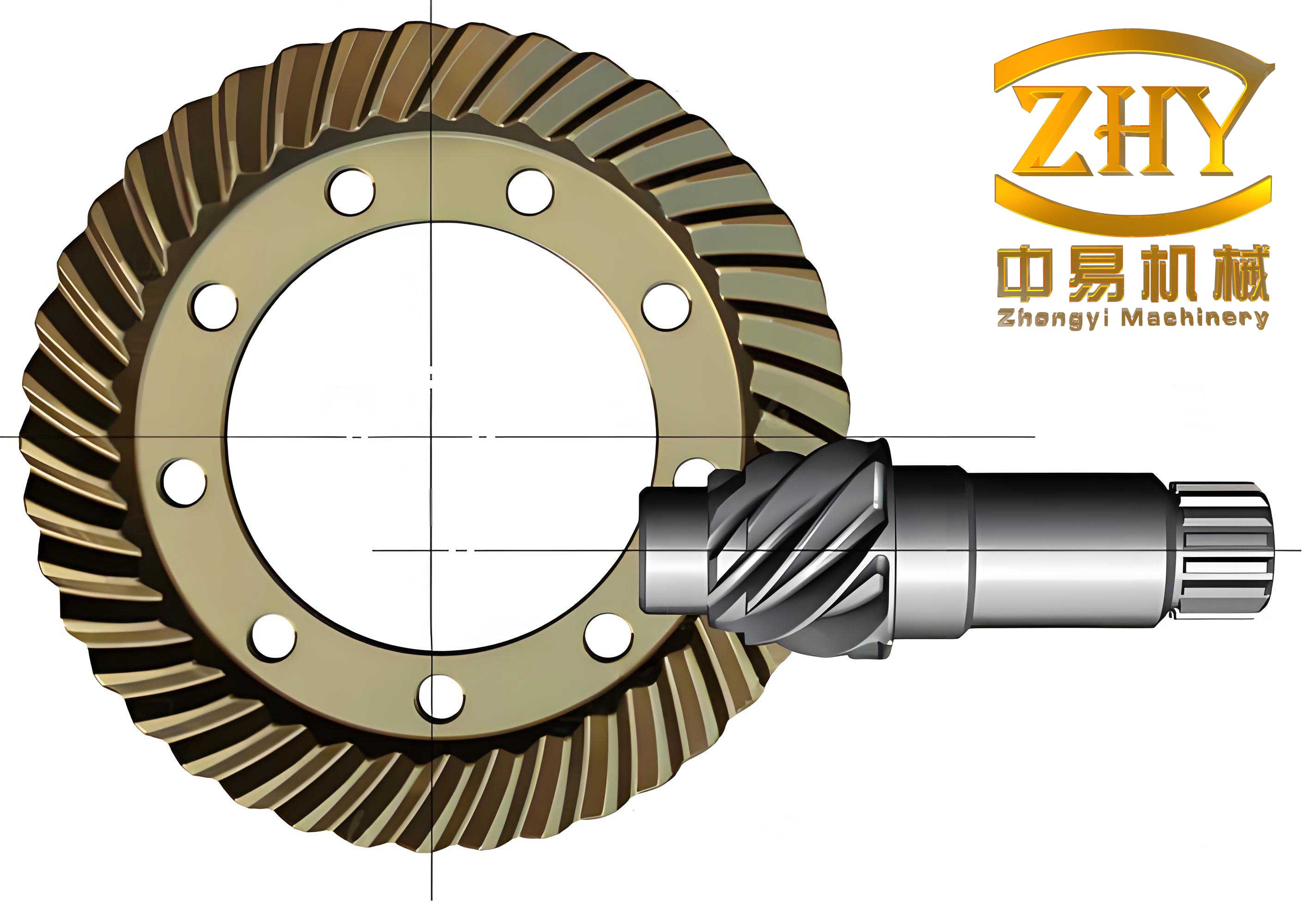
The geometry of hypoid gears is generated via a simulated meshing process between a imaginary generating gear (cutter) and the gear blank, known as the generating or hobbing method. The cutter surface is typically a conical surface, which can be naturally described by two parameters: the rotational angle $\theta$ of the blade and the relative distance $s$ along the cone generator. The conjugate motion adds another parameter, the rotation angle $\phi_1$ of the cutter. The meshing equation imposes a functional relationship $s = s(\theta, \phi_1)$. Through a series of coordinate transformations, the tooth surface of the hypoid gear can be expressed as a vector function of these two manufacturing parameters:
$$ \mathbf{r} = \mathbf{r}[\theta, \phi_1, s(\theta, \phi_1)] = \mathbf{r}(\theta, \phi_1). $$
This Machine Parameterization is direct and theoretically sound. The $\phi_1$-parameter lines represent instantaneous contact lines during the generation process. While essential for calculating differential geometric properties (normals, curvatures), this form lacks an intuitive connection to the final gear’s physical dimensions, making tasks like defining tooth boundaries or specifying a point at “mid-face width and mid-height” cumbersome.
Therefore, a Structural Parameterization is introduced. A point on a hypoid gear tooth is bounded by the root cone, face cone, and the inner and outer back cones. Its position can be uniquely defined by structural parameters: the cone distance $A$, the cone angle $\delta$, the offset angle $\varphi$, and the back-cone distance $C$. The relationships between cartesian coordinates $(x, y, z)$ and these structural parameters are:
$$
\begin{aligned}
A &= \sqrt{x^2 + y^2 + z^2}, \\
\tan \delta &= \frac{\sqrt{y^2 + z^2}}{x}, \\
\tan \varphi &= \frac{z}{y}, \\
C &= \sqrt{y^2 + z^2} \tan \delta_0 – x.
\end{aligned}
$$
For surface parameterization, we select $C$ (controlling the face width position) and $\delta$ (controlling the tooth height position) as the independent parameters. The dependent offset angle $\varphi$ is obtained as an interpolation function $\varphi = \varphi(C, \delta)$ from a grid of calculated points. The parametric surface is then:
$$
\begin{aligned}
x &= \frac{C \cos \delta \sin \delta_0}{\sin(\delta + \delta_0)}, \\
y &= \frac{C \sin \delta \sin \delta_0 \cos \varphi(C, \delta)}{\sin(\delta + \delta_0)}, \\
z &= \frac{C \sin \delta \sin \delta_0 \sin \varphi(C, \delta)}{\sin(\delta + \delta_0)}.
\end{aligned}
$$
Often, the radius $R = \sqrt{x^2 + y^2}$ is used instead of $\delta$ for visualization. This method ensures all generated points lie on the correct conical grid, preserving the essential geometric structure of hypoid gears.
The third approach employs Normalized Parameters $u$ and $v$, both ranging from 0 to 1, mapping the entire active tooth surface to a unit square. This is extremely useful for design specifications and contact pattern reporting (e.g., “contact centroid at u=0.5, v=0.6”). The mapping from structural parameters is linear:
$$
u = \frac{C – C_s}{C_b – C_s}, \quad v = \frac{\delta – \delta_f}{\delta_a – \delta_f},
$$
where subscripts $s$, $b$, $f$, $a$ denote small end, big end, root, and apex respectively. The surface becomes $\mathbf{r} = \mathbf{r}(u, v)$.
The power of this framework lies in establishing rigorous transformations between these parameter domains. Suppose a curve $\mathbf{r}(t)$ on the surface is known in machine coordinates with derivative $\mathbf{r}'(t) = [x’, y’, z’]$. Its derivatives in the structural parameter domain can be derived:
$$
\begin{aligned}
A’ &= \frac{yy’ + zz’}{A} + x’ \cos \delta, \\
\delta’ &= \frac{A’ \cos \delta – x’}{A \sin \delta}, \\
C’ &= A’ \sin(\delta + \delta_0) + A \delta’ \cos(\delta + \delta_0) – \sin \delta_0, \\
\varphi’ &= \frac{(z’ \cos \varphi – y’ \sin \varphi) \cos \varphi}{y}.
\end{aligned}
$$
Such transformations are vital for operations requiring first or second-order information (like tangents or curvatures) in a different parameter space. For instance, a curve on a constant $C$ surface (an end curve) must satisfy $C’=0$, leading to the condition:
$$ x’ \tan \delta_0 + y’ \cos \varphi + z’ \sin \varphi = 0. $$
This condition can be used to construct Hermite or spline curves directly within the structural parameter domain.
The following table summarizes the characteristics of the three parameterization methods for hypoid gears:
| Parameterization Type | Primary Parameters | Key Advantages | Primary Application |
|---|---|---|---|
| Machine (Generating) Parameters | $\theta$, $\phi_1$ | Direct from theory; essential for calculating differential geometry (normal vectors, curvatures). | Tooth surface generation theory, LTCA core calculations. |
| Structural Parameters | $C$, $\delta$ (or $R$), $\varphi(C, \delta)$ | Intuitive relation to gear geometry; preserves conical grid structure; easy boundary definition. | Surface refinement, end curve/transition surface construction, contact pattern visualization. |
| Normalized Parameters | $u$, $v$ (0 to 1) | Universal, scale-independent description; ideal for design specifications and reporting. | Contact ellipse location reporting, pre-positioning analysis points, standardized data exchange. |
Practical Applications in Hypoid Gear Modeling
1. Surface Refinement and Interpolation: Computational constraints often limit the initial tooth surface grid for hypoid gears to a sparse set (e.g., 5×9 points). For high-fidelity visualization or finite element analysis, dense interpolation is required. Simple linear interpolation of coordinates $(x, y, z)$ destroys the structural integrity. The correct approach within our framework is:
- For the sparse grid, compute the corresponding structural parameters $(C_i, \delta_i, \varphi_i)$.
- Perform 2D interpolation (e.g., using piecewise polynomial or B-spline functions) on the $\varphi(C, \delta)$ data over the refined $(C, \delta)$ grid.
- Use the parametric equations of the structural parameterization to calculate the refined $(x, y, z)$ coordinates.
This guarantees all interpolated points correctly reside on the intended conical surfaces, maintaining the geometric fidelity of the hypoid gear tooth.
2. Construction of End Curves and Transition Surfaces: The fillet or transition surface between the active tooth flank and the root surface is generated by the tip rounding of the cutter. Its exact calculation is non-trivial. A robust workaround using structural parameterization is:
- Separately calculate points for the active flank and the root surface (modeled as a simple cone).
- Combine their $\varphi$ parameter matrices into a single dataset spanning the full $\delta$ range from root to tip.
- Perform a smooth interpolation of $\varphi$ versus $\delta$ across the entire combined set.
- Reconstruct the complete surface using the structural parameterization formulas.
This yields a seamlessly blended surface that includes the active hypoid gear flank, the transition zone, and the root cone, all obeying the correct geometric constraints.
3. Visualization of Contact Ellipses: Contact analysis predicts an elliptical contact zone on the unloaded tooth surface. To visualize this as a realistic “contact pattern”:
- For a given contact point, the Hertzian theory provides the contact ellipse’s center, orientation of its major axis ($\mathbf{a}$), and its principal radii ($a$, $b$) in the tangent plane.
- Points $\mathbf{p}_{ellipse}$ on the 2D ellipse in the tangent plane are projected onto the 3D tooth surface along the surface normal direction $\mathbf{n}$: $\mathbf{p}_{surface} \approx \mathbf{p}_{center} + \mathbf{p}_{ellipse}$.
- To accurately plot $\mathbf{p}_{surface}$, its structural parameters $(C, \delta)$ are found. The ellipse is then sampled, and for each sample, the corresponding $\varphi$ is obtained via the $\varphi(C, \delta)$ interpolation function, finally yielding its 3D position.
- To simulate the graduated intensity of a real contact stain (dark red in the center, fading outwards), the ellipse is plotted as multiple concentric ellipses with varying color opacity.
This method allows for the direct, realistic overlay of theoretical contact ellipses onto the CAD model of the manufactured hypoid gear tooth, enabling immediate visual comparison with physical test results.
The mathematical conversions between parameter spaces are essential. Below is a summary of key transformation formulas:
| Transformation | Key Formulas |
|---|---|
| Cartesian to Structural | $$ A=\sqrt{x^2+y^2+z^2},\quad \tan\delta=\frac{\sqrt{y^2+z^2}}{x},\quad \tan\varphi=\frac{z}{y},\quad C=\sqrt{y^2+z^2}\tan\delta_0 – x $$ |
| Structural to Cartesian | $$ x=\frac{C\cos\delta\sin\delta_0}{\sin(\delta+\delta_0)},\quad y=\frac{C\sin\delta\sin\delta_0\cos\varphi}{\sin(\delta+\delta_0)},\quad z=\frac{C\sin\delta\sin\delta_0\sin\varphi}{\sin(\delta+\delta_0)} $$ |
| Structural to Normalized | $$ u = \frac{C – C_s}{C_b – C_s}, \quad v = \frac{\delta – \delta_f}{\delta_a – \delta_f} $$ |
| End Curve Condition ($C’=0$) | $$ x’ \tan \delta_0 + y’ \cos \varphi + z’ \sin \varphi = 0 $$ |
Conclusion
In the design and analysis of hypoid gears, moving beyond the theoretical machine-parameterized surface to a structured, application-oriented representation is vital. The unified framework presented here—encompassing machine, structural, and normalized parameters—provides the necessary flexibility and rigor. The structural parameterization, in particular, serves as a critical bridge, preserving the conical architecture of hypoid gears while enabling efficient and accurate geometric operations. The ability to visualize true contact ellipses on a realistic tooth model, leveraging these parameterization techniques, closes the loop between analytical prediction and physical inspection. This integrated approach forms a robust foundation for the advanced digital design, simulation, and validation of high-performance hypoid gear drives.